

An agent harness is the software layer built around an AI model: the loop that decides what happens next, the tools it can call, the memory between steps, and the guardrails that stop it before it does something wrong. Ask a vendor in Phnom Penh what model powers their "AI agent" and most answer instantly. Ask what happens when the agent is three steps into a task and the first approach fails, and the answers thin out fast. That second question matters more: the harness, not the model inside it, usually decides whether an agent recovers or quietly does the wrong thing.
What is an agent harness, exactly?
An agent harness is every piece of software wrapped around the model itself: the loop that breaks a goal into steps, the tools it can call, the memory of what happened earlier, and the checks that decide whether a task is finished. The field settled on a shorthand for this in 2026, the one we used to define what an AI agent is: agent equals model plus harness (Anthropic, November 2025).
Anthropic's own engineering team published that framing while documenting why Opus 4.5, left in a loop across multiple context windows with no harness, "will fall short of building a production-quality web app" alone (Anthropic, November 2025). The model supplies the reasoning; the harness turns it into finished, checkable work: an environment script, a list of what is untouched, a record of what was already tried, and a way to verify a task is done rather than just declared done.
Why does the harness matter more than the model?
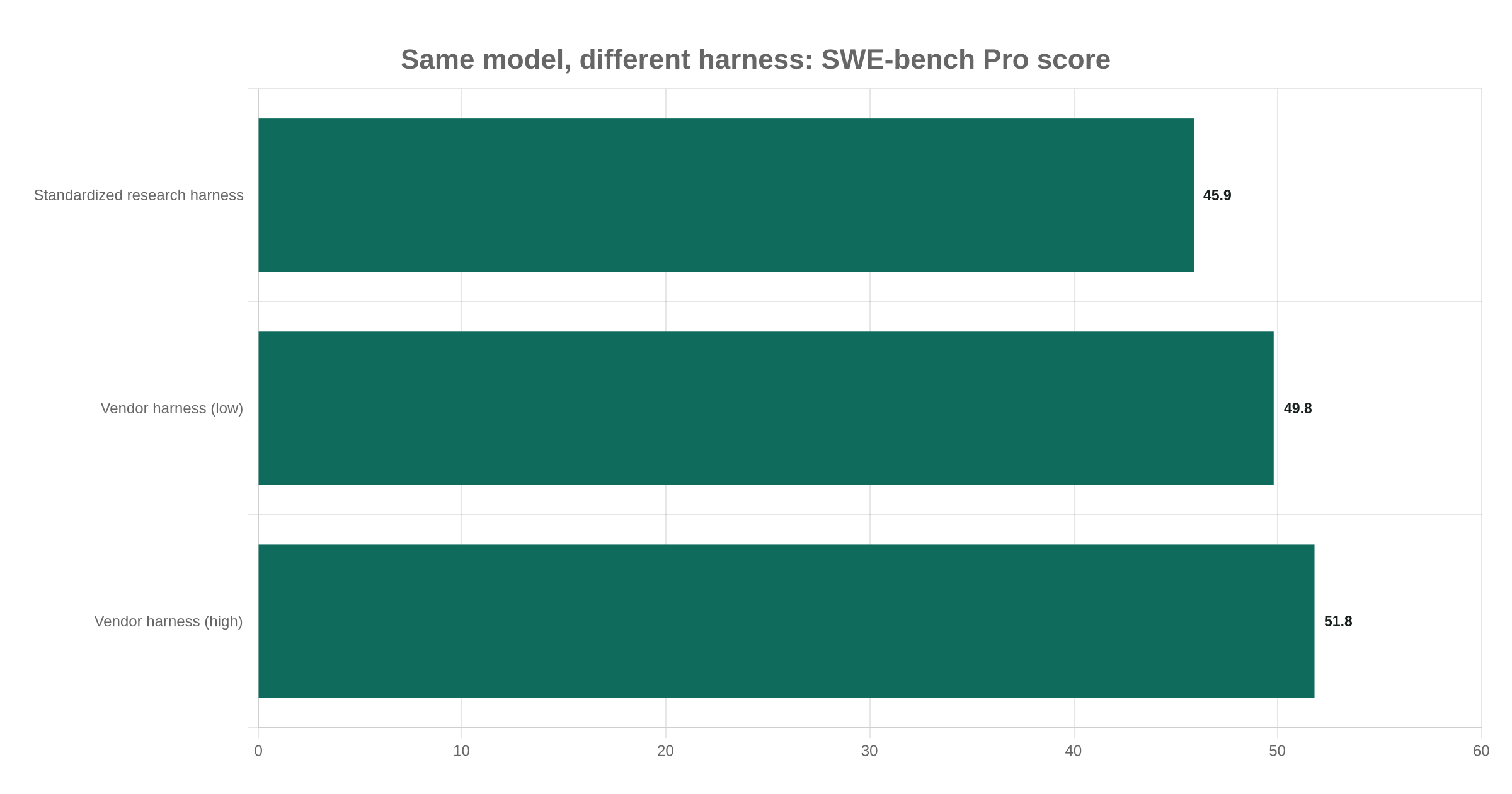
Because, holding the model constant, the harness alone can swing task success. A July 2026 benchmark comparison found Claude Opus 4.5 scoring about 45.9 percent on SWE-bench Pro under a standardized research harness, against 49.8 to 51.8 percent under vendor harnesses running the identical model, a swing of up to six points from scaffolding alone (Scale AI SEAL-lab standardized evaluation, reported by Future AGI, July 2026). A separate paper goes further, arguing the harness is often "a stronger determinant of agent performance than the model it wraps" and finding 10 to 20 point score differences between harnesses on the identical backbone model, a common result, not an exception (arXiv, "Stop Comparing LLM Agents Without Disclosing the Harness," May 2026).
The phrase itself is barely a year old. Mitchell Hashimoto, the well-known infrastructure engineer, floated it on February 5, 2026, writing that he did not know "if there is a broad industry-accepted term for this yet," but had grown to calling it harness engineering: fixing an agent's environment permanently every time it errs, rather than re-explaining the fix next prompt. Six days later, OpenAI gave the term its most extreme proof: a team of three to seven engineers used Codex agents to write over one million lines of code across more than 1,500 pull requests in five months, zero lines written by a human, zero human review (OpenAI, February 2026).
The model still matters, it is just not the whole story
Harness quality is not the only variable. Carnegie Mellon's TheAgentCompany benchmark ran several frontier models through the same office-work environment, the same harness, and still found a 28-point spread: Gemini 2.5 Pro completed 30.3 percent of tasks, Claude 3.7 Sonnet 26.3 percent, Claude 3.5 Sonnet 24 percent, GPT-4o 8.6 percent, Amazon Nova Pro 1.7 percent (Carnegie Mellon University, reported by The Register, June 2025).
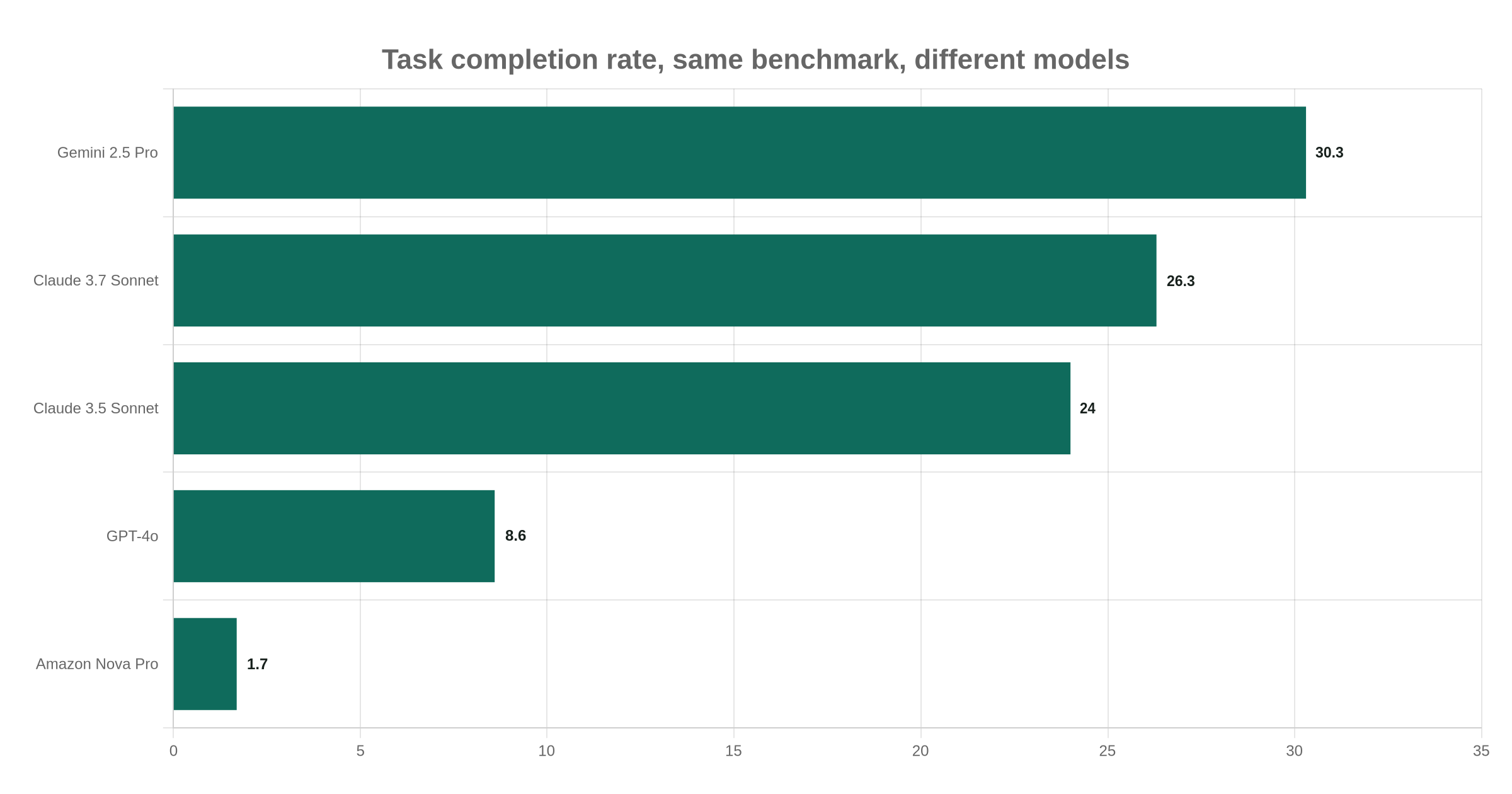
Put the two findings side by side and a buyer gets the actual decision framework, not a slogan. Ask about the harness first: a mediocre model in a well-designed harness usually beats a frontier model in a thin one. But a five-times gap between a frontier and a budget model on the same task is still a five-times gap, so harness quality does not let a buyer skip the model question. Both axes move the result; a pitch that only talks about one answers half the question.
One second-order consequence: once a harness does the noticing and recovering, a team's skill mix shifts from checking output line by line toward writing the verification logic that catches the next failure, a different hire than most SMEs budget for.
What does a good agent harness actually do?
A good agent harness does four things: it plans, it acts, it remembers, and it checks its own work before declaring a task finished. Anthropic's write-up on long-running agents names the failure mode behind each gap, with a concrete fix: a feature list marked "failing" by default against declaring victory too early, a starting git commit and progress file against an undocumented environment, a mandated end-to-end check (often browser automation) against work marked complete untested, and a reproducible init.sh script instead of a blank prompt for an agent unsure how to proceed (Anthropic, November 2025).
Picture a 15-room guesthouse in Siem Reap running a Telegram booking agent, a common setup given how much small tourism business here runs through Telegram rather than a booking engine. Without a check-its-own-work step, the agent can confirm a room to a second guest while a first confirmation is still pending in another chat, because "reply politely and confirm" is its only instruction. A harness built the way Anthropic describes adds the missing step: it re-reads the live calendar before replying "confirmed," and if two threads claim the same room and night, it holds both and flags the conflict for a person.
The tool-access piece increasingly runs on a shared standard, the Model Context Protocol (MCP), letting an agent discover and call a tool without custom code for each one. It is the same layer we rely on when we orchestrate a client's harness with n8n and route reasoning through OpenRouter across Claude, GPT, Mistral and Llama, so a build is not locked to one model's pricing or Khmer performance.
How far has harness engineering already gone?
It has already gone as far as a small team shipping a million-line codebase without a human reviewing the code: OpenAI's "Symphony" system managed Codex agents writing, reviewing and merging code on their own, at 3.5 pull requests per engineer per day, with the only human involvement being environment design and intent, not review (OpenAI, February 2026). For a narrower, person-still-in-the-loop version, see guardrails for Claude Code, sized for a business team, not that zero-review extreme.
We would not bring OpenAI's zero-human-review boundary into a client build in Cambodia, not yet. A harness that lets an agent touch a refund or a reconciliation report unsupervised is a different risk than one that only touches its own codebase, and that boundary belongs in the contract before the first real run, not as a lesson learned after something breaks.
What should a business in Cambodia actually ask an AI agent vendor?
Ask for proof the harness recovers from a failed first attempt, not just the model's name. A vendor who can describe what their agent logs when a tool call fails, what a human sees before anything is marked done, and what happens when the first plan fails is describing a harness. A vendor who only answers with a model name is probably describing a chatbot with a new label. That is why Gartner estimates only around 130 of the thousands of vendors claiming an agentic label actually meet the bar of observing, reasoning and revising their own plan (Gartner, June 2025).
Three questions separate the two in a single conversation: what does the agent do after its first approach fails, what is logged when it is wrong, and what still requires a person to approve before it ships, pays or sends.
The same test applies outside tourism. A small retail shop in Phnom Penh running a KHQR payment-reconciliation agent hits a version of the same failure: a scan times out and reads as unpaid, though the $20 KHQR transfer cleared on the bank's side seconds later. Without a check-its-own-work step, the agent flags the order unpaid and a staffer spends 10 minutes chasing a customer who already paid, or worse, issues a refund that was never owed. A harness that re-checks the bank feed first turns that into a silent match: no call, no wrong refund, for any payment or ledger-touching agent, not just a booking one.
How TechFlow builds the harness, not just the agent
An AI agent build at TechFlow starts with a free process-mapping audit, a costed action plan within five days, deployment in one to four weeks, and a monthly report once running. The pitfall we check first is what happens when the first plan fails: design that path up front, or it gets bolted on after the first mistake, the expensive order to learn it in. We orchestrate with n8n and OpenRouter rather than one model; sovereign hosting adds four to eight weeks when data must stay in-country. Cambodia's National AI Strategy 2025-2030, led by the Ministry of Post and Telecommunications, names data infrastructure and sectoral adoption among its six priorities, the same direction this work points toward (OECD.AI, policy registry, accessed 2026).
The open question nobody in this market has a clean answer to yet is whether a non-technical buyer can tell a well-built harness from a good demo before signing anything. The loop, the recovery behavior and the guardrails mostly show after the first failure, not during the pitch. Our recommendation: buy the audit before the agent. Book a call with our AI agents team to map one process first, or browse recent project work to see how we scope a build.
Prefer to chat? Message our founder directly on Telegram (@maxgrolier), or book a call with the team.
Frequently asked questions
Is an agent harness the same as a framework like LangGraph or CrewAI?
No. A framework like LangGraph or CrewAI is a toolkit for building a harness: pre-written components for the loop, memory and tool-calling. The harness is the specific system a product actually runs, whether built from a framework, MCP directly, or custom code.
Is harness engineering just a new name for prompt engineering?
Not quite. Prompt engineering shapes what you ask the model in a single turn. Harness engineering shapes the system around the model across many turns: what tools it reaches, what it remembers, and what gets fixed in the environment after a mistake instead of re-explained next prompt.
Can a small business in Cambodia build its own agent harness?
For a single, well-bounded task, yes, with the right help; this is exactly what a Claude Code seat or a small n8n workflow can cover. For a harness running unattended against a CRM, a payment record or a customer channel, most SMEs here get there faster, and more safely, through a scoped build.
Does a better model mean a business can get away with a simpler harness?
Partly, but not entirely. A stronger model needs fewer guardrails for straightforward reasoning, but CMU's TheAgentCompany results show even the best model tested completed fewer than a third of multi-step office tasks alone (30.3 percent, June 2025), which is why checking and recovery stay necessary no matter the model.
How long does it take TechFlow to build a working agent harness?
A narrow AI skill, one automated step wired into an existing tool, can ship in 24 to 48 hours. A fuller autonomous agent with its own harness, decision logic and guardrails typically takes one to four weeks, starting from the free process-mapping audit that scopes the build.