

Picture a freight-forwarding business on Phnom Penh's Chbar Ampov riverfront, drowning in Telegram messages about shipment status and customs paperwork. The owner asked three vendors to quote an AI agent for the job. The lowest AI agent cost estimate came in at 1,800 dollars. The highest, for what the vendor called the same scope, was 85,000 dollars. Neither quote separated what it would cost to build the agent from what it would cost to run it every month.
That fifty-fold gap is not a fluke. A same-day Google Cambodia search for "ai agent cost" returns ten different 2026 pricing guides whose upfront estimates run from about 1,000 to more than 500,000 dollars, and monthly bills quoted from 20 to 8,000 dollars (DataForSEO SERP pull, October 2026). None of them price a Cambodia-based build or a Khmer-speaking channel. Below, we separate the two numbers that actually make up an AI agent's cost, build and run, and price both against what a Phnom Penh business can book.
What does "AI agent cost" actually include?
An AI agent's cost is two separate line items, a one-time build and a recurring run, and most quotes that look wildly different are really just pricing different mixes of the two. Before pricing it, the vendor and the buyer should agree on what an AI agent actually does: a single-intent chatbot and a multi-step workflow agent should never share the same cost line. Biz4Group's 2026 AI agent pricing guide breaks a build into five lines: discovery and scoping (1,500 to 10,000 dollars), build and integration (20,000 dollars and up), then, once the agent is live, model and API usage, infrastructure and hosting, and maintenance, which the guide prices at 15 to 25 percent of the build cost every year.
A quote that only states one number is usually hiding which of those five lines it covers. A 1,800-dollar quote almost certainly covers build only, on a template with light testing. An 85,000-dollar quote may well include a year or more of hosting and review folded in. Neither tells the buyer what they are actually comparing.
How much does it cost to build a custom AI agent?
Building a custom AI agent costs 20,000 to 60,000 dollars for a single-workflow business agent on the international 2026 market, rising past 150,000 dollars once the build has to work across several systems, according to Biz4Group's complexity-tiered guide.
| Complexity | What it does | Build cost (2026 international guide) |
|---|---|---|
| Simple | Single-intent agent: FAQ, one channel, no write access to internal systems | $20,000 to $30,000 |
| Standard | Reads and writes to 2 to 3 tools: CRM, calendar, ticketing | $30,000 to $45,000 |
| Advanced | Multi-step workflow across several systems, conditional logic, human hand-offs | $45,000 to $60,000+ |
These bands assume a team billing at European or North American rates. A freight-forwarder's Telegram agent, reading a shipment number and writing a status reply, sits at the simple end of this table at those rates. A 40-room Siem Reap hotel asking for a booking agent that checks its calendar and writes back into its CRM sits a tier up, at standard: two systems, not one, and a hand-off to a human when a date is unavailable.
Agency quotes for the same agent can differ by ten times, and here is why
Quotes vary this much because vendors price different amounts of invisible work: how much of the agent's output gets checked and rewritten before it reaches the customer. Gartner calls this the Inference Paradox: token prices keep falling, yet the cost of running an actual agentic workflow keeps rising, because each new generation of agent spends more tokens per task, often on a pricier model tier, faster than the per-token price drops.
"The harsh economics of the Inference Paradox are exemplified by the differences between a simple chatbot and an AI agent," said Will Sommer, a senior director analyst at Gartner, in the firm's August 2026 analysis of agentic workflow costs.
Gartner expects inference cost per agentic workflow to rise more than fivefold through 2028. McKinsey's "Is that AI agent worth it?" research points at the same mechanism from the buyer's side: about 60 percent of the cost of an agentic task goes to checking, correcting and regenerating the first answer, not to the initial reply. A vendor who scopes for heavy review quotes high; a vendor who scopes for a single clean pass quotes low, and the buyer rarely sees the difference until the agent is live. Much of that review load comes down to the agent harness, not which model sits behind it: a tighter harness around the model needs fewer corrections per task, which is the line item most quotes never separate out.
What does it cost to run an AI agent every month in Cambodia?
Running an AI agent costs well under 300 dollars a month for most Cambodia SMEs, model usage included, once it is self-hosted on a small server. Take the freight-forwarder: 2,200 Telegram conversations a month, 45 percent in English and 55 percent in Khmer, on Claude Haiku 4.5 (Anthropic: 1 dollar per million input tokens, 5 per million output).
- Model usage: 990 English conversations at 0.036 dollars and 1,210 Khmer conversations at 0.082 dollars (Khmer is an Abugida script, and published tokenizer research puts the Abugida penalty at roughly 2.2 to 3.4 times more tokens than English depending on the tokenizer: Lee et al., "Equity with Efficiency: An Empirical Study of Tokenizers for Multilingual Large Language Models," June 2026. We have not yet run this specific comparison on Claude's own tokenizer.) comes to 135 dollars without caching, or about 108 dollars once the fixed instruction tokens are cached. The same per-token pricing logic applies if the business also runs Claude Code for other tasks: it is billed the same way, by the token, not by the seat.
- Routing fee: OpenRouter's 5.5 percent platform fee adds 6 to 7 dollars.
- Orchestration and hosting: n8n automation setup's free, self-hosted Community Edition on a 2 GB DigitalOcean droplet, 12 dollars flat, with no execution ceiling to budget around.
- Channel: the Telegram Bot API, free by default.
- Human review: about 28 hours a month, from 31 dollars at Cambodia's 2026 garment-sector minimum wage of 210 dollars a month to 102 dollars at our office-wage assumption of 700 dollars a month.
Add the lines and the freight-forwarder's agent runs 157 to 256 dollars a month, or roughly 1,880 to 3,070 dollars across a first year.
Which cost breaks a Cambodia budget first, the build or the run?
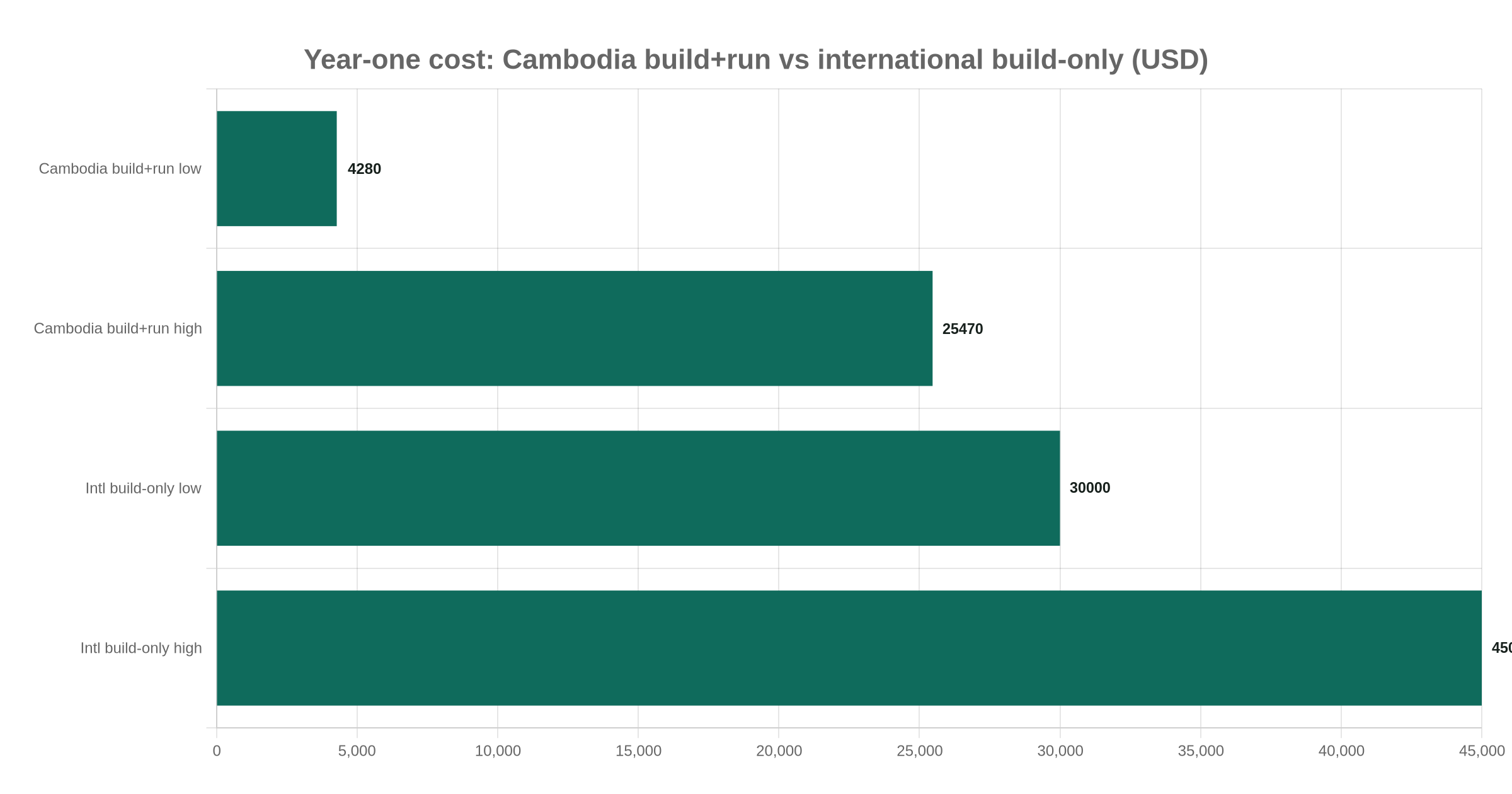
The build breaks a Cambodia budget first, almost every time, because even a lean local team is a bigger one-time number than a full year of running the agent. TechFlow's own published delivery window for an autonomous agent is 1 to 4 weeks. At the Cambodia AI company rate band TechBehemoths lists, 30 to 70 dollars an hour, a two-person team (a developer and a project manager, 80 hours in a 1-week sprint, up to 320 hours over 4 weeks) prices the freight-forwarder's simple-tier build at 2,400 to 22,400 dollars. The Siem Reap hotel's standard-tier booking agent, roughly double the scope at 160 to 640 hours for the same two-person team, would run 4,800 to 44,800 dollars built and billed locally, still a fraction of Biz4Group's 30,000-to-45,000-dollar standard-tier estimate for the build alone at international rates.
Add that to the 1,880 to 3,070 dollars of year-one running cost from the section above, and the full first-year cost of ownership lands at 4,280 to 25,470 dollars, build and run together. Compare that with Biz4Group's "standard" tier alone, 30,000 to 45,000 dollars, for a build with no running cost included at all: even the high end of a Cambodia-built, Cambodia-run year one still comes in under a single international build-only quote for the same scope.
What should you ask before you sign an AI agent quote?
Ask a vendor to separate their number into the same five lines Biz4Group uses: scoping, build, model usage, hosting, and review, before you sign anything. A single bundled figure, in either direction, hides which risk you are actually paying for. We would not sign a single-line AI agent quote ourselves, for the same reason: it tells us nothing about which of the five lines we would actually be paying for.
Specific questions worth asking:
- How many hours of build time, and at what rate, make up the quote?
- Which model runs the agent, and was it tested on real Khmer messages, not just English ones?
- Where does the orchestration run, on a metered cloud plan or a flat-fee server, and what happens past the plan's execution cap?
- How many hours of human review are priced in per month, and for how many months?
- What happens to the quote if conversation volume doubles?
In our own scoping calls, we price model usage and hosting before we price build hours, not after: a vendor who backs into a monthly running number once the build is already signed is guessing at your real conversation volume, not pricing it. The pitfall we check first is whether the quoted hours were tested on Khmer messages or only on English ones, since an agent tested only in English usually needs more review hours once Khmer traffic arrives, not fewer.
McKinsey found that 93 percent of enterprise AI teams already exceed their budget, mostly on that same review and correction cycle, not on the headline build price. Asking these five questions before signing catches most of that gap on paper, before it shows up on an invoice.
Our recommendation: cost the whole year, not just the build
Cost the whole year, build plus twelve months of running, before you compare two vendors, not just the number on the first line of their quote. The open question neither quote answers well is volume: conversation counts tend to climb once customers learn the agent replies instantly, and the running line scales with that, while the build line does not.
We run our own agent projects from Phnom Penh (ICT, UTC+7) starting with a free 1 to 2 hour process-mapping audit, then a costed action plan within 5 days that prices scoping, build, model usage, hosting and review as five separate lines for your actual volumes, not a single bundled figure. We price that work roughly 35 percent below European agencies. Ready to see your own numbers? Book a call with our Phnom Penh team for a 30-minute walk-through of your own conversation volumes, or browse our project work to see what a Phnom Penh build looks like end to end. Prefer a written number first? Request a scoped estimate once you have real volumes in hand.
Prefer to chat? Message our founder directly on Telegram (@maxgrolier), or book a call with the team.