
DataForSEO's own keyword tool puts "CRM Cambodia" at about ten searches a month, the kind of number that looks like nobody is asking the question. Meanwhile 12.0 million people in Cambodia were online as of October 2025, 67.3 percent of the population, up 5.4 percent in a year (DataReportal, Digital 2026: Cambodia). The mismatch is the point: the market is not short of connectivity, it is short of a CRM comparison written for it. We ran the actual Google search for "best crm cambodia" in November 2026 and the current top 10 is mostly directory spam, "Top Firms in Cambodia" pages with no comparison inside them, and one Facebook post for a local tool. Nobody has actually laid out the real options side by side.
So we did it ourselves, with ten tools, real pricing pulled from each vendor's own page in November 2026, and the one question most comparisons skip: does any of this work in Khmer. The short version: if you are two to five people with a simple pipeline, start free on HubSpot or Freshsales and expect to pay within the year; if you already sell through Facebook, Instagram or Telegram livestreams, CRM Cambodia is worth a look precisely because it is not built like the other nine; and if you are weighing Salesforce because it is the name everyone knows, read the pricing section before you sign anything.

Key points
- None of the ten tools we tested ships a Khmer-language interface except CRM Cambodia, a local live-selling and chat-commerce platform; everyone else runs their CRM in English (or Chinese, for Bitrix24) and keeps the Khmer conversation on Telegram or Messenger.
- Entry prices run from $9 a seat a month (Twenty CRM, Freshsales) to $25 a seat a month (Salesforce Starter Suite); over three years, that gap is worth more than $500 per seat even before anyone upgrades a tier.
- We migrated a real client off HubSpot and onto Brevo in 2025 and rebuilt its automation on n8n; the lesson that generalised best, covered below, is that the CRM you pick second usually matters more than the one you pick first.
What actually matters when you pick a CRM in Cambodia?
Four things decide whether a CRM survives its first year here, and none of them is the logo on the homepage.
Price per seat at the size you actually are, not the size the sales page assumes. Most of the tools below quote their cheapest number on a 10-seat annual contract; a four-person team pays a different story, and we checked that number specifically for each one.
What happens in Khmer. Every tool's own interface runs in English, French, Chinese or another set of global languages; none of the nine international options we tested lists Khmer among them. That does not make them unusable here, but it changes how a Cambodian team actually works inside one, which the section below covers directly.
Whether it talks to the channels your customers already use. Facebook, Messenger and Telegram carry the bulk of commercial conversation in Cambodia: Facebook alone counted 14.0 million user identities and Messenger 8.90 million as of October 2025 (DataReportal, Digital 2026: Cambodia). A CRM that cannot receive or log a Telegram message is working against the market, not with it.
What it costs to leave. A CRM holds a company's entire sales history. We weighted the data-export story and the lock-in risk of each tool as part of "who it fits," because the true cost of a CRM is not the subscription, it is the day you want to stop paying it.
The ten options, side by side
| Tool | Entry paid price | Free tier | Who it actually fits |
|---|---|---|---|
| HubSpot | $20/seat/month | 2 users, 1,000 contacts | A small team that wants one familiar tool and will pay once it outgrows the free limits |
| Zoho CRM | $20/seat/month (Standard) | 3 users, forever | A team that wants a gentle ramp into AI features and automation without jumping straight to Salesforce money |
| Salesforce Starter Suite | $25/seat/month | None | A team that already needs forecasting, lead routing and an AI coworker, and can carry the price |
| Odoo | $16.90/user/month (Standard, all apps) | One app, unlimited users (not CRM) | A team that wants CRM, invoicing, inventory and e-commerce in one subscription, not ten separate tools |
| Twenty CRM | $9/seat/month (Pro) | Full product, self-hosted, if someone owns the server | A technical team that wants to own its data and does not mind running infrastructure |
| Brevo Sales Platform | $12/seat/month (Standard) | Yes, limited pipeline | A team that already uses Brevo (or wants to) for email and does not need a dedicated sales tool yet |
| Freshsales | $9/user/month (Growth) | 21-day trial, no permanent free tier | A small sales team that wants Zoho-level features at Twenty-level price |
| Bitrix24 | $49/month flat, up to 5 users (Basic) | 1 to 2 users, 5 GB | A team of five to ten where per-seat pricing from the others would cost more |
| monday CRM | $12/seat/month (Basic, 3-seat minimum) | None | A team that already runs its project work in monday and wants the sales pipeline in the same place |
| CRM Cambodia | $10/month (entry paid tier) | Yes | A business selling through Facebook, Instagram or Telegram livestreams, or running a small retail counter, that wants Khmer and English from day one |
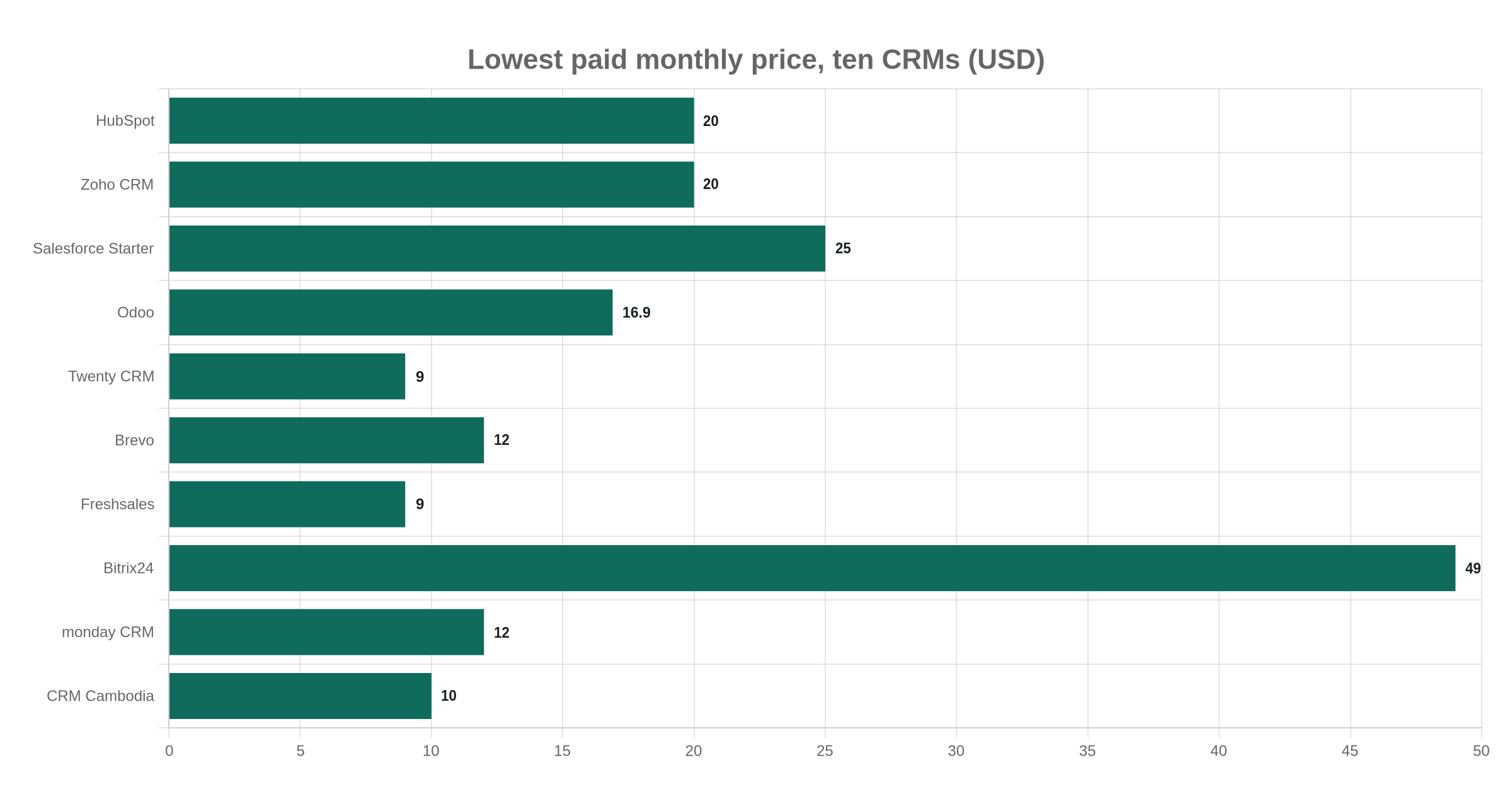
Two numbers in that table deserve a flag before anyone screenshots them into a budget. Bitrix24 and CRM Cambodia price per organization, not per seat, so their number gets better as a team grows and worse as it shrinks below the included seat count. Everyone else prices per seat, so their number gets worse as a team grows. That single difference, more than any feature list, is what should decide the shortlist for a team of five or more.
What does each of the ten actually deliver?
HubSpot
HubSpot's free tier covers 2 users and 1,000 contacts with no time limit and no card required; the Starter plan lists at $20 per seat per month and removes HubSpot branding, raises the contact ceiling, and adds up to 50 sales automations and 15 pipelines (hubspot.com/pricing/crm, November 2026). HubSpot also runs a new-customer promotional rate as low as $7 to $10 a seat, limited-time and new-accounts-only; we quote the standing $20 price because a promotion that disappears after a renewal is not the number to budget against. HubSpot's own page lists interface support for English, French, German, Japanese and Portuguese; Khmer is not among them.
Who should skip it: a team past 1,000 contacts that is trying to delay the Starter upgrade. The free tier's ceiling arrives faster than most founders plan for, usually around the first trade fair or ad campaign that brings in real leads.
Zoho CRM
Zoho's free tier runs for up to 3 users, forever, with contact management, workflow automation and mobile apps included. The paid ladder, Standard, Professional, Enterprise and Ultimate, is billed per user per month with an annual discount; compiled publicly in November 2026, the going rate runs $20, $35, $50 and $65. Zoho's own pricing page states support across 28 languages including Arabic, Chinese and Japanese; again, no Khmer.
Zoho earns its place here as the tool that adds automation and AI features gradually rather than all at once, which suits a team that is not ready for Salesforce money but wants a credible upgrade path if it grows.
Salesforce Starter Suite
Salesforce's entry point, Starter Suite, lists at $25 per user per month and includes an AI coworker (Agentforce), email campaigns and built-in lead routing (salesforce.com/crm/pricing, November 2026). The next tier up, Pro Suite, runs $100 per user per month on an annual commitment, four times the entry price, for real-time chat, quoting and forecasting.
This is the tool we would push back on hardest for most Cambodian SMEs: the four-times jump to Pro Suite arrives the moment a team needs forecasting, which most growing SMEs eventually do. Salesforce earns its reputation in markets with enterprise budgets; it is priced for that market, not this one.
Odoo
Odoo's free plan gives one app, unlimited users, at no cost, but CRM is not included in it. The Standard plan, which bundles every app including CRM, e-commerce, invoicing and inventory, lists at $16.90 per user per month at regular pricing (discounted to $13.50 on a longer commitment); Custom runs $32.00 (odoo.com/pricing, November 2026). Odoo publishes support for 30-plus languages including Chinese, Japanese and Arabic.
Odoo's case is not "cheapest CRM," it is "one subscription instead of ten tools." A business already paying separately for invoicing software, an inventory spreadsheet and a CRM trial can often net out cheaper on Odoo Standard once every other subscription gets cancelled, which is the comparison worth running before dismissing it as expensive.
Twenty CRM
Twenty is open-source and self-hostable at no licence cost; the hosted Pro plan runs $9 per seat per month with email and calendar sync and limited AI usage, and Organization runs $39 per seat per month with SSO and custom roles (twenty.com/pricing, November 2026). Self-hosting removes the subscription entirely but replaces it with a server someone has to patch, back up and monitor.
Twenty is the right answer for a technical team, or one working with a partner like ours who already runs infrastructure for a client. It is the wrong answer for a team without anyone who would notice if the server went down on a Friday night.
Brevo Sales Platform
Brevo offers a free sales tier with a limited pipeline, a Standard plan at $12 per seat per month, and a Professional plan priced per five-seat pack at $156.60 a month, close to $31.32 per seat (Brevo's own help documentation, help.brevo.com, November 2026). Brevo's core strength is not the CRM itself, it is that the same account already runs transactional email and marketing campaigns, so a small team avoids syncing contact data between two tools.
We know Brevo's migration path directly: we moved the Kretz Club account from HubSpot to Brevo in 2025, covered in detail further down. That migration was not about the CRM screen, it was about what Brevo's automation layer could do once the data landed there.
Freshsales
Freshsales (Freshworks' CRM) starts at $9 per user per month on the Growth plan, rising to $39 for Pro and $59 for Enterprise, all billed annually (freshworks.com/crm/pricing, November 2026). Growth already includes a Kanban pipeline view, lifecycle stages and basic workflows, which covers most of what a five-person sales team needs on day one.
Freshsales is the closest match to "Zoho's feature set at Twenty's price," and the plan we would point a bootstrapped team toward if HubSpot's free tier already feels too small.
Bitrix24
Bitrix24's free plan covers 1 to 2 users and 5 GB of storage with a working CRM, task boards and shared calendars. Paid tiers price per organization rather than per seat: Basic runs $49 a month billed annually (5 users included), Standard $99 a month (50 users), Professional $199 a month (100 users); month-to-month billing runs noticeably higher, at $69, $144 and $289 (bitrix24.com/prices, November 2026). Bitrix24 also lists regional interface support including Simplified Chinese and Japanese.
This is the one tool on this list that gets cheaper, not more expensive, the more people use it, right up to its included seat count. A nine-person team on Bitrix24 Basic pays the same $49 a month as a five-person one; the same nine people on a per-seat tool would be paying for nine licences.
monday CRM
monday's sales CRM starts at $12 per seat per month for Basic, $17 for Standard and $28 for Pro, each with a 3-seat minimum, billed annually (monday.com/pricing, November 2026). Basic covers 1,000 active contacts and deals; Standard raises that to 10,000 and adds a communications hub and mobile apps.
monday's real argument is not the CRM, it is that a team already running its project and operations boards in monday gets the sales pipeline in the same screen, with no second login and no second bill for anyone who is not actually in sales.
CRM Cambodia
CRM Cambodia is a different kind of product than the other nine: a unified commerce platform combining live selling on Facebook, Instagram and Telegram, centralised chat, inventory tracking, point-of-sale and basic e-commerce, built in Khmer and English from the start. It offers a free tier, then paid plans at $10, $30 and $49 a month, flat per account rather than per seat (crmcambodia.com, November 2026).
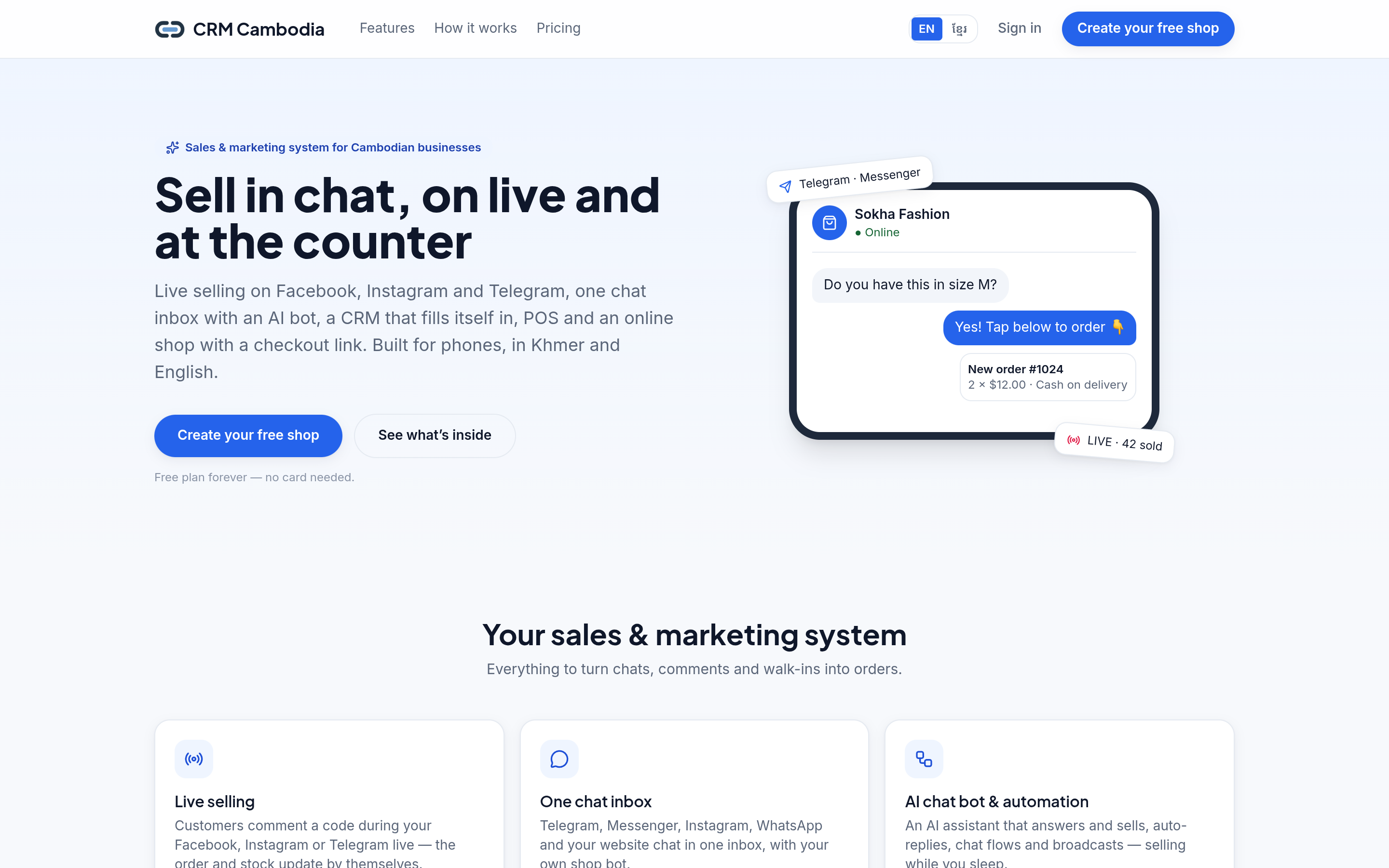
CRM Cambodia will not replace a B2B sales pipeline with multi-stage deals and forecasting; that is not what it is built for. It is the right tool for a business whose sales process already happens as a livestream or a chat thread, which describes a meaningful share of Cambodian retail and F&B commerce.
Why doesn't any of the nine international tools ship a Khmer interface?
None of HubSpot, Zoho, Salesforce, Odoo, Twenty, Brevo, Freshsales, Bitrix24 or monday lists Khmer among its supported interface languages on its own pricing or help pages, checked directly in November 2026. That is not an oversight anyone is likely to fix soon: Khmer's Unicode complexity (combining vowels, subscript consonants, a script most global SaaS localisation teams have never budgeted for) puts it well behind Chinese, Japanese or Arabic on every vendor's translation queue, and Cambodia's market is small enough that the business case rarely clears the bar.
In practice, this matters less than it sounds. We built the same pattern ourselves at Kretz Club, for a French-speaking membership business rather than a Khmer-speaking one. The working pattern is to run the CRM's backend in whichever language it supports and keep the actual customer conversation on the channel the customer already uses: Telegram, Messenger, or a livestream comment thread. The CRM holds the record; Telegram or Messenger carries the Khmer. CRM Cambodia collapses that into one interface, which is its real pitch, not that it has more features than HubSpot.
The practical takeaway for a Cambodian SME: do not rule out an English-only CRM because your team speaks Khmer at work. Rule it out if it cannot receive and log a message from the channel your customers actually write to you on.
The ten options, and the claims that don't survive a Phnom Penh sales floor
Myth: the free tier is basically a free CRM, indefinitely. Reality: HubSpot's 1,000-contact ceiling and Zoho's 3-user cap both get hit within one good trade fair or ad campaign for most of the SMEs we talk to. Budget for the $9 to $20 seat within the first year rather than plan around staying free.
Myth: Salesforce is simply the safe, grown-up choice. Reality: its entry price is built for markets where $25 a seat is a rounding error, and the jump to Pro Suite at $100 a seat arrives the moment a team needs forecasting. For most Cambodian SMEs, "safe" and "priced for a different market" turn out to be the same sentence.
Myth: a Khmer-language CRM interface is the main local-adoption problem to solve. Reality: CRM Cambodia is Khmer-native, but it solves chat commerce, not B2B pipeline management. Most of the adoption friction we actually see is process friction (nobody logs the call, not the language the button is written in).
Myth: open source means free. Reality: Twenty and Odoo only stay free if somebody owns the server, the backups and the updates. That is a real cost, it just shows up as a person's time instead of a software line item, which makes it easy to under-budget.
What does a CRM actually cost a Cambodian SME over three years?
Take a realistic profile: a five-person sales and support team in Phnom Penh, running a CRM for three years (36 months). The sticker price per seat hides how much that gap compounds.
| Tool (tier) | Monthly | x 5 seats | x 36 months |
|---|---|---|---|
| Twenty CRM (Pro) | $9/seat | $45 | $1,620 |
| Freshsales (Growth) | $9/seat | $45 | $1,620 |
| CRM Cambodia (Growth tier) | $30 flat | $30 | $1,080 |
| Bitrix24 (Basic, flat for 5) | $49 flat | $49 | $1,764 |
| Odoo (Standard) | $16.90/seat | $84.50 | $3,042 |
| HubSpot (Starter) | $20/seat | $100 | $3,600 |
| Zoho CRM (Standard) | $20/seat | $100 | $3,600 |
| Salesforce (Starter Suite) | $25/seat | $125 | $4,500 |
The spread between the cheapest and most expensive line on that table is $3,420 over three years, for a team of five, before anyone adds a single paid add-on. The decision is not trivial money, even at SME scale.
What did we actually do at Kretz Club, and why isn't it a universal answer?
We took over the marketing, sales and operations infrastructure for Kretz Club, a French prestige real estate investment club, in 2025, after a Parisian agency had run it on an expensive, rigid HubSpot setup with scattered Zapier automations. We migrated the entire database from HubSpot to Brevo with no data loss, rebuilt the data model (membership status, assigned account manager, acquisition source, renewal count) and replaced the Zapier automations with more than 170 workflows on n8n, connecting Brevo to Stripe, Calendly, Typeform, WhatsApp and the club's own member app (Kretz Club migration).
One result from that work speaks directly to a CRM decision, not just an automation one: steering meeting setting through five self-maintained lists in Brevo cut the no-show rate to 12.3 percent on in-house setting, against 35.3 percent for direct inbound bookings. That gap did not come from switching CRMs. It came from what we built on top of the CRM once the migration was done.
We are not claiming Brevo is the right CRM for a Cambodian SME because it worked for a French real estate club; the two situations share almost nothing except that both needed a CRM that could carry heavy automation without falling over. What generalises is the lesson, not the tool: the CRM you pick is less important than the automation, the list hygiene and the follow-up discipline you build around it in the first ninety days. A perfect CRM with nobody logging calls into it loses to a mediocre CRM that the team actually uses.
When is none of these ten the right call?
Three signals tell us a client has outgrown this list and needs something built rather than bought. The first is running two CRMs at once because of how a business is structured, the way AMA Campus's training catalogue needed every web form routed into two separate systems through Make, one flow per CRM, because the group split its data between two brands. The second is sales intelligence beyond what any of these ten ship out of the box, call recordings transcribed and scored, lead data fed back into targeting, the kind of layer we built on top of Brevo at Kretz Club with AI automation. The third is a payment and reconciliation workflow tight enough that a CRM's native integrations cannot cover it, which is where CRM and ERP work gets built from scratch.
None of those three situations is common at the five-to-twenty-person stage most of this article is written for. If none of the three signals above describes your business, buy one of the ten tools above before you build anything.
Our pick, and the one question we can't answer for you
If we had to put one name on a shortlist for most Cambodian SMEs reading this, it would be Freshsales for a lean sales team that wants real features without Salesforce money, or Bitrix24 once that team passes five people and per-seat pricing starts working against growth instead of for it. If your sales process already lives inside Facebook, Instagram or Telegram livestreams, CRM Cambodia solves a problem none of the other nine were built for, and solving a real problem beats a longer feature list every time.
The question we genuinely cannot answer from a blog post is how disciplined your team already is about logging a call, a quote or a follow-up. Every number in this article assumes the CRM gets used. We have watched a well-chosen tool fail for exactly that reason, and a mediocre one succeed because the team committed to it. That part of the decision is not a pricing table; it is a conversation about your actual sales process, and that is the one we would have before recommending a tool at all.
Prefer to chat? Message our founder directly on Telegram (@maxgrolier), or book a call with the team.
Frequently asked questions
Is there a truly free CRM that works for a small team in Cambodia?
Yes, for a genuinely small team: HubSpot's free tier covers 2 users and 1,000 contacts with no time limit, Zoho's covers 3 users forever, and CRM Cambodia offers a free tier for live-selling businesses. None of the three stays free once a team or contact list grows past those limits, so treat "free" as a starting point rather than a long-term plan.
Does any of these ten CRMs support Khmer language or local payment rails?
None of the nine international tools ships a Khmer interface as of November 2026; CRM Cambodia does, built in Khmer and English from the start. None of the ten publishes a native integration with Cambodia's KHQR payment standard; businesses that need that reconciliation typically wire it in through an automation layer like n8n rather than a built-in CRM feature.
How long does it take to migrate from spreadsheets to a CRM?
For a straightforward contact and deal list, most of the tools above can import a spreadsheet and have a usable pipeline running within a day or two. The real timeline is rebuilding the habits around it, logging every call, every quote, every follow-up, which took weeks rather than days even on the well-resourced Kretz Club migration we ran ourselves.
Is Salesforce worth it for a Cambodian SME?
Rarely, at the size most Cambodian SMEs operate at. Salesforce's $25-a-seat entry price and the four-times jump to $100 a seat for forecasting features are priced for markets with far higher average revenue per employee. A team that genuinely needs enterprise-grade forecasting and lead routing should still consider it; a five-person team should look at Freshsales or Zoho first.
What happens when we outgrow the free tier?
Expect it earlier than planned, usually around the first trade fair, ad campaign or sales hire that brings in a wave of new contacts. Budget for the $9 to $20 paid seat from the start of year one rather than building a plan that assumes the free tier lasts.
Keep reading
- the sales-process check: why a CRM doesn't fix a sales process, it exposes whether you have one.
- Cambodia's invoicing rules: what changed on the compliance side of running business software here in 2026.
- AI automation we build: what we actually layer on top of a CRM once the migration is done.
Need this built? We set up, migrate and wire a CRM into Telegram, Messenger and payment tools as part of a structured CRM pipeline, under our sales funnel system, and we would rather talk through a scoped estimate against your actual sales process than sell you a tool you will not use.