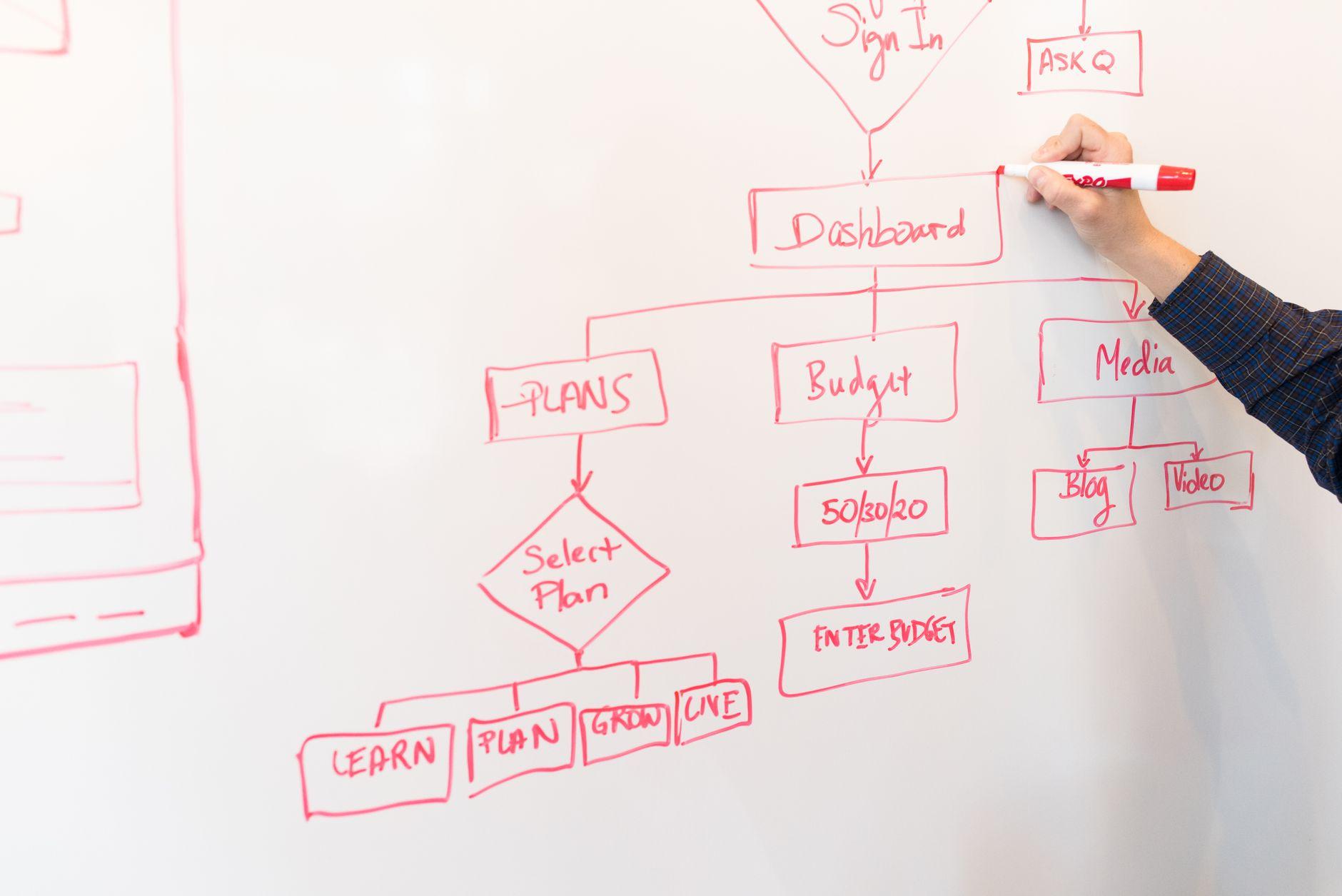

We keep seeing a version of this across Phnom Penh SMEs. A small team, a recruitment agency is a common shape of it, wants one thing: stop a recruiter from retyping every CV into a shortlist spreadsheet by hand. The freelance developer they hire does not start there. He opens a LangGraph tutorial, spends weeks wiring a multi-node graph with its own memory store, then asks for more time to bolt on a CrewAI "review crew" on top, on the theory that a crew of agents catches bias a single agent misses. The business never gets its shortlist tool. It gets a GitHub repository nobody on staff can run without the developer on a call: a textbook case of an AI agent framework picked before the job was ever scoped.
A same-day Google Cambodia search for "ai agent framework" returns an AI Overview and a page of developer-written comparisons of LangGraph, CrewAI, AutoGen and similar libraries, all aimed at someone who has already decided to write code (DataForSEO SERP pull, October 2026). None of them ask the question a Phnom Penh business actually needs answered first: does this team have anyone who can run what gets built, and what does each path cost before the agent does a single useful thing. That gap matters more here than in a market with a deep bench of LangGraph engineers to hire from, because the cost of guessing wrong falls on a three or four-person team, not on a budget line a larger company can absorb without noticing. Below, we price four real paths, n8n, LangGraph, CrewAI and the Claude Agent SDK, against local numbers instead of developer taste.
What makes an AI agent framework different from n8n's no-code canvas?
An AI agent framework is a code library that a developer imports into a Python or TypeScript project to build an agent's planning, memory and tool-calling logic by hand, while n8n is a visual canvas that gives a non-developer most of that same logic as drag-and-drop nodes. The distinction matters more than it sounds, because the two are not as far apart as the "code versus no-code" framing suggests: n8n's own Agent node is documented as running on LangChain's JavaScript framework under the hood, with Memory sub-nodes, Tool sub-nodes, and the same plan-call-evaluate loop that a hand-coded LangGraph agent runs, just wrapped in a canvas that does not require anyone to read a stack trace.
That means the real choice is rarely "n8n or a framework." It is "a managed wrapper around agent primitives, or the raw primitives themselves." n8n prices that wrapper on a monthly plan: Starter at 20 EUR for 2,500 workflow executions, Pro at 50 EUR for 10,000, Business at 667 EUR self-hosted only for 40,000, or the Community Edition free and self-hosted with no execution cap at all (n8n, pricing page, 2026). A code framework charges nothing for the library itself. It charges in the developer-hours it takes to write, test and maintain what n8n ships pre-built. What an AI agent actually does for a business does not change between the two paths. What changes is who is accountable when it breaks at 11pm on a Friday. For a deeper look at the no-code side specifically, see how we build agents in n8n for Cambodian clients today.
Take a three-person e-commerce seller on Khmer24 or a Telegram storefront, the kind of business this comparison actually serves. They cannot afford five weeks of a mid-level developer's time no matter which framework gets picked, so the Community Edition, free and self-hosted on a small cloud server for a few dollars a month, puts a working order-status agent live without a licence fee at all. The same seller, told to "pick a framework" by a generic guide, would spend that budget on hosting a graph they do not yet need. The framework question only gets interesting once that seller's volume outgrows what a single n8n workflow can carry, and even then, Business tier at 667 EUR a month buys a lot of runway before a custom LangGraph deployment starts making financial sense.
LangGraph vs CrewAI: which agent framework fits the problem, not the demo?
LangGraph and CrewAI solve the same underlying problem, getting an LLM to plan, act and self-correct across multiple steps, with two different mental models, and picking between them by feature list instead of by the shape of the actual task is how projects like the recruitment agency's end up stuck. LangGraph, built and maintained by LangChain Inc, models an agent as a graph: you define nodes (a step, often an LLM call or a piece of deterministic code) and edges (the paths between them), and the framework adds checkpointing so a long-running agent can persist through a failure and resume where it left off, plus hooks for a human to inspect or edit the state mid-run (LangChain, LangGraph documentation, 2026). It is open-source under the MIT licence, with a separate paid layer, LangSmith Deployment, for teams that want LangChain to host and scale it rather than running the graph themselves.
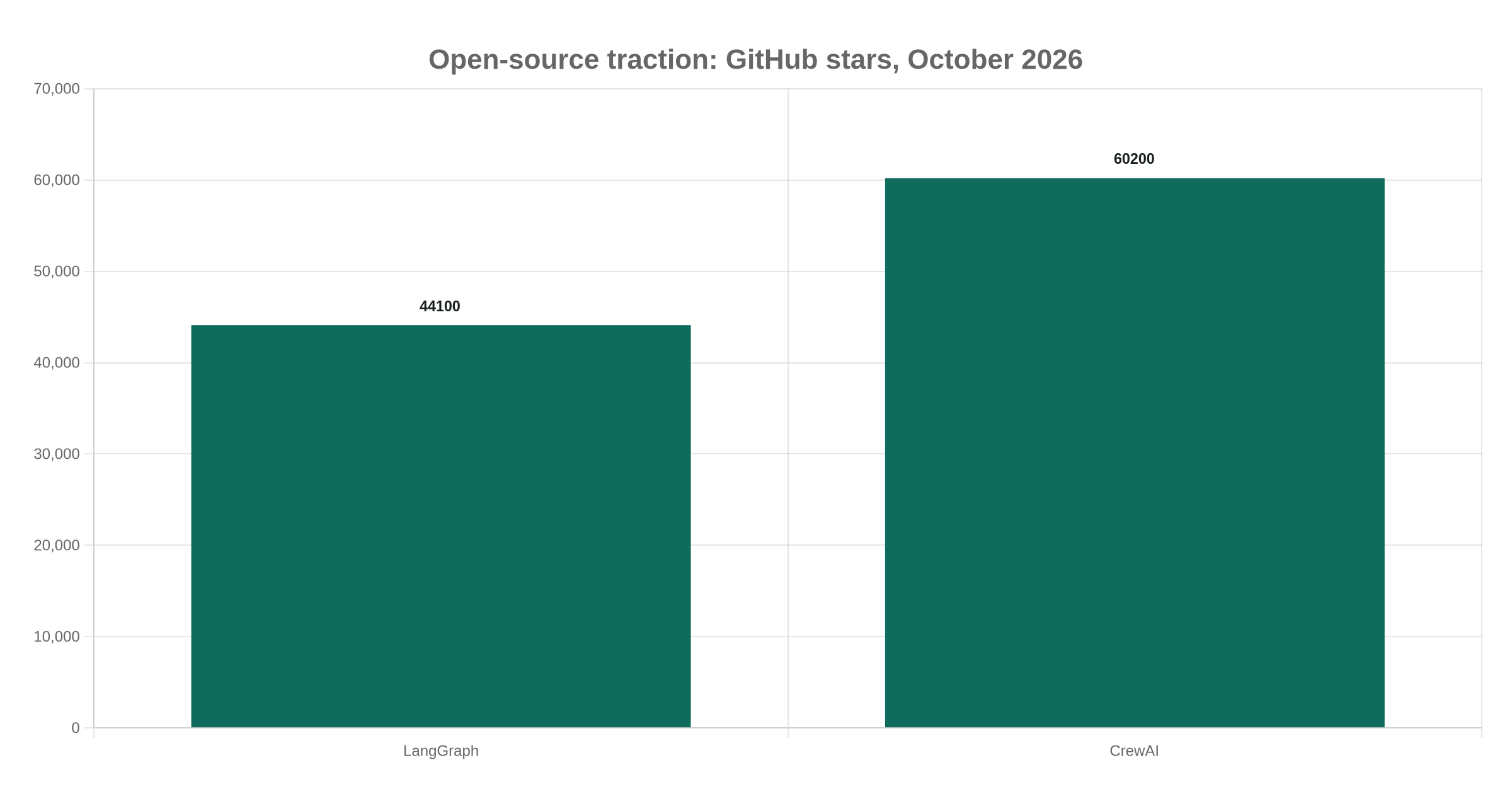
CrewAI takes the opposite starting point: instead of a graph of arbitrary steps, it gives you Crews, teams of role-based agents (a researcher, a writer, a reviewer) that cooperate autonomously on a shared goal, and Flows, a more deterministic layer for the parts of the process that should not be left to agent judgment (CrewAI documentation, 2026). It is also MIT-licensed and, unlike LangGraph, built as a standalone framework with no LangChain dependency, a detail worth knowing if a team wants to avoid taking on LangChain's own release cycle as a side effect of picking an agent library. On GitHub, CrewAI (60.2k stars) has pulled ahead of LangGraph (44.1k stars, 7.6k forks) as of October 2026, and CrewAI's own docs claim more than 100,000 developers certified through its community courses, a popularity signal worth noting even though it says nothing about which framework fits a given task better.
Pick the shape that matches the task, not the demo
Pick LangGraph when the task is one well-defined process with branches you can draw, an invoice that gets approved, escalated or rejected depending on three conditions, where you want full control over exactly what happens at each step and a paper trail of why. Pick CrewAI when the task genuinely benefits from several distinct roles checking each other's work, a research brief that one agent drafts and a second, prompted differently, critiques before it reaches a human.
Our own read, covered in more depth in our piece on multi-agent systems, is that most business tasks are closer to the LangGraph shape than the CrewAI shape: a single well-scoped job, not a committee. A Crew only earns its extra complexity once a task genuinely needs independent checking, a loan-screening agent whose recommendation a second, differently-prompted agent audits before a human sees it, for instance. Outside that kind of check-and-balance requirement, a Crew tends to add agents without adding accuracy, and the token bill grows with every extra role added to the conversation.
Is the Claude Agent SDK an agent framework at all?
The Claude Agent SDK is not a graph-orchestration framework in the LangGraph or CrewAI sense. It is a library that runs the same Claude Code binary and agent loop that powers Anthropic's own coding tool, exposing built-in tools (file read, write, edit, run commands), hooks, subagents, Model Context Protocol connections, permissions and sessions directly to a Python or TypeScript program, under Anthropic's Commercial Terms of Service (Anthropic, Agent SDK documentation, 2026). Where LangGraph asks a developer to assemble an agent's capabilities node by node, the Agent SDK hands over a capability set that already exists and lets the developer decide which pieces of it to expose.
That makes it a different kind of decision than LangGraph versus CrewAI. The real comparison for the Agent SDK is not "which framework," it is "do we want to run this ourselves at all." Anthropic's own answer for teams that do not is Claude Managed Agents, launched April 8, 2026 at 0.08 USD per session-hour, a hosted agent harness with no framework to install, already running production agents for Notion, Rakuten and Asana (Anthropic, Claude Managed Agents launch, April 2026). At that rate, an agent handling eight hours of active sessions a day runs about 19 USD a month in session-hours alone (0.08 USD multiplied by roughly 240 hours), before any integration work connecting it to a business's own systems: cheap enough that the harness itself is rarely the budget question, the integration work is. A Cambodian team weighing the Agent SDK against LangGraph or CrewAI should ask first whether it actually wants the Claude Code harness specifically, since that is what the SDK buys, before comparing it feature by feature with a general-purpose orchestration library built for any model.
The Agent SDK's Model Context Protocol support is the detail worth knowing before ruling it out as "Claude-only": MCP lets the same agent reach a business's own databases, CRM or internal APIs as named tools, the same connection pattern TechFlow wires through OpenRouter when a client's build needs to call Claude for one task and a cheaper model for another. A business locked into Anthropic's models specifically, with staff who already read Python, gets a shorter path to a working agent through the SDK than through LangGraph, because the harness, memory and tool permissions ship built in rather than assembled node by node. A business that wants to swap models freely, or that has no in-house Python developer at all, gets less value from that specific shortcut.
The real cost of each path, in Phnom Penh numbers
Three paths, three different cost shapes, and the gap between them is bigger than most quotes let on. Path one, n8n: a Pro plan runs 50 EUR a month for 10,000 executions, more than enough for a single agent's traffic, and an existing operations person with no coding background can typically have a first working Agent node live within a week using n8n's own documented examples, since the framework's job is to remove exactly that learning curve.
Path two, a code framework built from scratch with LangGraph or CrewAI, carries no licence fee, but someone has to write it. In Cambodia that someone costs 900 to 1,800 USD a month for a mid-level developer, or 1,800 to 3,000 USD a month for a senior one, on a salaried basis (Second Talent, Cambodia developer rate card, 2026). A scoped, single-process agent, the shape LangGraph suits best, realistically takes six to eight weeks to build with a developer who already knows the framework: somewhere between 1,350 USD (six weeks at the mid-level low rate) and 6,000 USD (eight weeks at the senior high rate) in salary alone, before the agent handles a single real request. Add ramp-up time to that estimate, not just build time, and the real cost of path two usually lands near the top of that range, not the bottom, because most developers will not already know the framework. CDRI's own 2021 study of digital skills supply in Cambodia found that subjects covering machine learning, AI, fintech and data science were "limited and almost non-existent" in local ICT higher-education curricula, even as firms projected ICT skills demand growing 30 percent a year (CDRI, Demand for and Supply of Digital Skills in Cambodia, 2021).
Path three, buy it running: Claude Managed Agents at 0.08 USD per session-hour has no framework to learn and no developer-hours to budget for the harness itself, only for the integration work connecting it to a business's actual tools, the same category of work TechFlow wires through n8n and OpenRouter into a client's CRM, ERP, email and databases regardless of which model sits behind the agent.
Two worked examples: a recruitment agency and a hotel
Rerun that recruitment-agency pattern with these three numbers in hand. The n8n path would have cost one week of an existing staff member's time and 50 EUR a month. The LangGraph and CrewAI path it took instead ran roughly five weeks of developer salary, 1,125 to 2,250 USD at the mid-level rate quoted above (more again if the freelancer billed senior rates), and produced nothing anyone on staff could operate. Short of that specific case, the order we follow whenever a stalled agent project like this lands on our desk does not start with the code. It starts with asking the client to state, in one sentence, what decision the agent is supposed to make, not which steps it runs. If nobody on the client's side can answer that, the fix is not a better framework. It is scoping the process properly before any code gets touched again, the same free process-mapping audit TechFlow runs before a new build.
A second example makes the same math harder to ignore. A 20-room boutique hotel in Siem Reap wants an agent that answers booking questions on WhatsApp and checks real-time room availability before promising a date. Quoted the LangGraph route, the realistic build is six to eight weeks at a mid-level Cambodian developer's 900 to 1,800 USD monthly rate, call it 1,350 to 3,600 USD, plus the time that same developer needs to learn the hotel's property-management system API, a cost no framework comparison prices in. Quoted the n8n route, the same hotel wires WhatsApp Business, its booking system and an Agent node together inside the Pro plan's 50 EUR a month, with a setup window closer to two to three weeks since nobody has to learn a new library first, only the hotel's own systems. The framework did not make the second path faster. Removing the framework did.
We would not recommend a Cambodian SME's first AI agent project start with LangGraph or CrewAI. n8n gets a working agent in front of real users inside a week, and most teams do not yet know their own process well enough to justify a hand-built graph of nodes.
Who should skip the framework entirely and hire it done?
A business with no engineer on staff and no near-term plan to hire one should treat "pick a framework" as the wrong first question, because the data says most teams struggle to ship an agent even where the engineering talent is not scarce. LangChain's own State of Agent Engineering survey of 1,340 practitioners, run November 18 to December 2, 2025, found 57.3 percent of respondents had an agent running in production, up from 51 percent a year earlier, with quality cited by about a third as the top blocker, security by 24.9 percent at firms above 2,000 employees, and latency by 20 percent (LangChain, State of Agent Engineering, 2025). Those are teams with ready access to LangGraph and CrewAI expertise. A Cambodian SME building its first agent solo, without that bench of experience, should expect the odds to run worse, not better.
MIT's NANDA initiative found the same pattern from a different angle: across more than 300 real deployments tracked in its GenAI Divide study, projects built with an external partner reached production 67 percent of the time, against 33 percent for projects built in-house, while 95 percent of generative AI pilots overall produced no measurable profit-and-loss result (MIT NANDA, The GenAI Divide: State of AI in Business, 2025, reported by Fortune). Cambodia's own skills picture points the same direction from the supply side: a market this short on specialised AI talent, per CDRI's findings above, is exactly the market where the external-partner number should be taken seriously, not dismissed as a problem other countries have. A CrewAI demo built over a weekend is not evidence a team is ready to run an agent framework in production. The real test is whether anyone on staff can read a failed node's stack trace six months from now, after the person who built it has moved on. For a business that has outgrown n8n but has no engineer who can own a LangGraph or CrewAI deployment, we would point them at a hosted option like Claude Managed Agents, or at a build partner, before we would point them at a framework's GitHub README.
"Hire it done" does not have to mean losing visibility into how the agent works. TechFlow's own AI agent engagements run a documented four steps regardless of which framework ends up underneath: a free one to two hour process-mapping audit, a costed action plan delivered within five days, deployment in one to four weeks, then continuous improvement with monthly reports once the agent is live. A business that goes this route still gets to see exactly which path, n8n, a code framework or a managed option, got chosen and why, the scoping work just happens before the invoice instead of after a framework has already been picked for them.
What we would do in a Phnom Penh team's place
Three moves, in order. First, build the first agent in n8n, not a code framework, even if the team eventually expects to outgrow it. A week and 50 EUR a month beats five weeks of developer salary for a process nobody has validated yet, and n8n's LangChain-based Agent node means the underlying logic is not wasted if a migration to LangGraph ever makes sense later.
Second, reach for LangGraph or CrewAI only once n8n has hit a named limitation it genuinely cannot solve, not a feature a tutorial made look impressive, and only once someone, on staff or on contract long-term, is accountable for running what gets built. Short of that specific case, the signal we look for is structural, not anecdotal: a process that needs to branch into more distinct states than a canvas stays readable with, or an agent that has to hold context across more steps than a single workflow execution comfortably carries. A crowded canvas is a worse signal than people assume. Forty nodes on a canvas, like a messy repository, usually means nobody scoped the process first, not that the process genuinely outgrew the tool. A framework chosen because n8n hit a real wall is a framework that earns its cost. A framework chosen because a developer wanted to use it is a bill with no return.
Third, if neither a no-code platform nor an in-house build makes sense, buy the outcome instead of the tooling. A hosted option like Claude Managed Agents, or a build partner, gets a working agent running without betting the project on a framework nobody in the business can maintain. That third move is exactly where TechFlow's own AI agent engagements start, with a free one to two hour process-mapping audit before any framework, model or vendor gets named, because recommending n8n, LangGraph, CrewAI or a managed option without first seeing the actual process is just guessing with extra steps. The framework name on the invoice matters far less than whether the agent still runs, unsupervised, a year after the contract ends.
Book a scoped estimate and we will tell you honestly which of the three paths fits what you are actually trying to automate, before any framework gets picked.
Prefer to chat? Message our founder directly on Telegram (@maxgrolier), or book a call with the team.