

Type "n8n AI agent" into YouTube and most of what comes back is the same workflow wearing different clothes: a Telegram trigger, one prompt node, one reply. That is a chatbot with a better name, not an agent. The AI Agent node that n8n actually ships, the one that can call a tool, remember a conversation and decide what to do next, shows up in a fraction of those tutorials, usually buried past the first ten minutes. For a Cambodian business deciding whether an agent is worth building, that difference is the whole decision.
We build this kind of automation for clients from Phnom Penh, on ICT (UTC+7), scoping and delivering the work in English and French, as part of our AI agents work; the Telegram-chatbot version is usually the thing a client already tried and outgrew before calling us. This piece sets out what actually separates an n8n AI agent from a chatbot, how to wire a Telegram front end to the real thing, which tools are worth connecting first, and what it costs to build and run from Cambodia.
What Makes an n8n Workflow an AI Agent, Not a Chatbot?
An n8n workflow earns the name AI agent when it can call a tool, hold memory across turns, and choose its own next step, not when it simply forwards a message to a language model and returns the reply. n8n's AI nodes run on LangChain's JavaScript framework (n8n, 2026), and the framework draws a sharp line between the two: a chain, including n8n's Basic LLM Chain node, follows one fixed path, input in, one model call, output out. None of n8n's chain nodes support memory at all (n8n, 2026).
The Agent node is built differently. Memory sub-nodes only attach to the Agent root node, and when a workflow runs, the agent can run multiple times within that single execution: an initial pass to plan, a second to call a tool, a third to evaluate what the tool returned, before it ever answers the user (n8n, 2026). That is what an AI agent actually means, the same ground we cover for agentic AI more broadly: a system that decides, not one that only replies.
We think most "n8n AI agent" tutorials online are chatbot tutorials wearing a better name, and that gap matters commercially. An agent that cannot check a real booking or a real order is not worth n8n's engineering overhead. A plain auto-reply does the same job for free.
Four Building Blocks Every Working Agent Needs
A working n8n agent needs four pieces connected to the same canvas, not stacked as separate tools. Each one does a specific job, and skipping one is usually what turns an "agent" back into a chatbot:
- A trigger, most often the Telegram Trigger node, listening for new messages.
- A chat model connector, pointed at Claude, GPT or another model, directly or through a router.
- A Memory sub-node, usually Window Buffer Memory keyed to the conversation (the Telegram chat ID works well), so the agent does not forget what the customer said two messages ago.
- One or more Tool sub-nodes, the part a chatbot never has, that let the agent check or change something real.
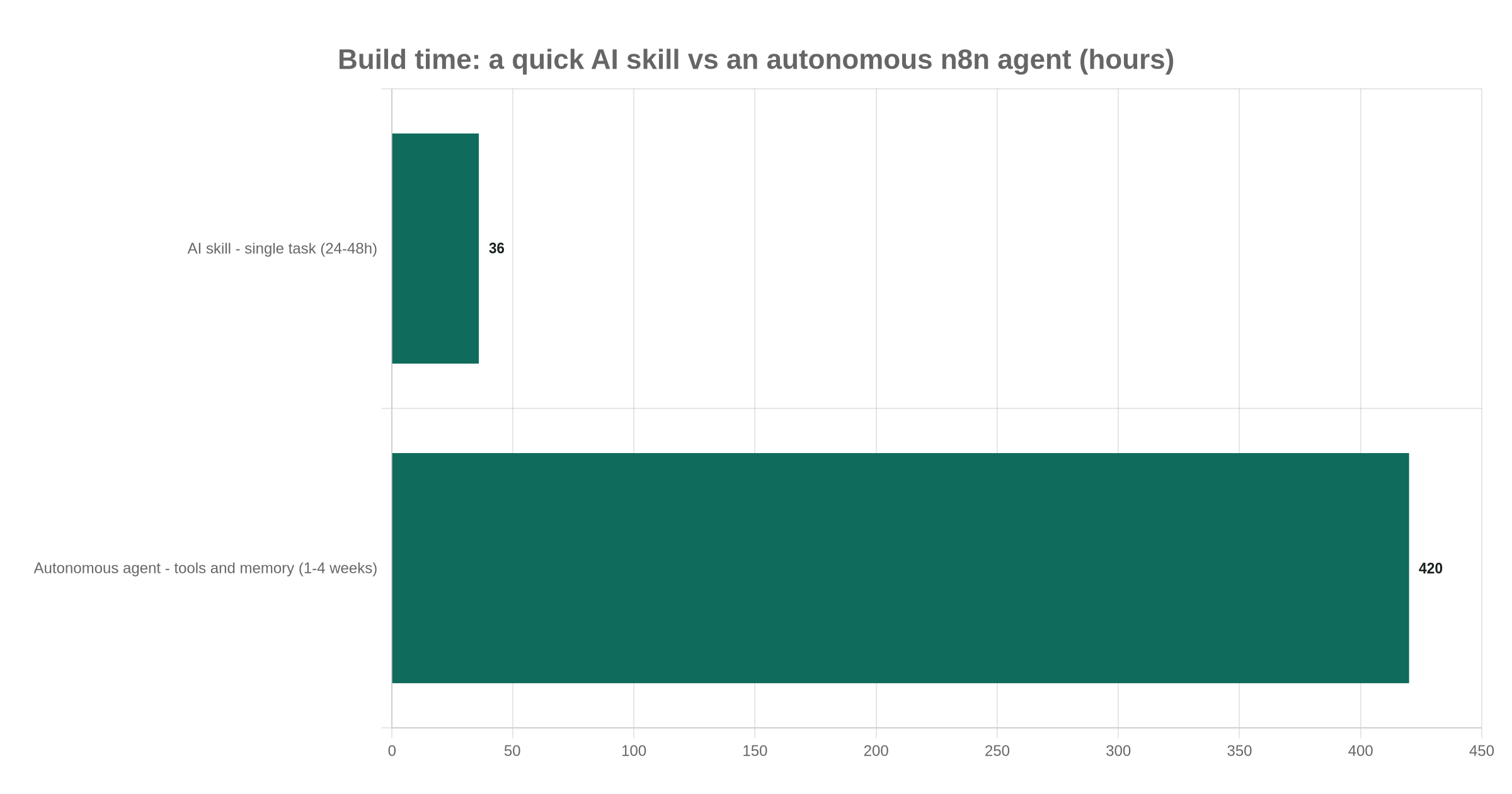
Building the full version takes longer than wiring a single prompt node, which is exactly why most tutorials skip straight to the chatbot. In our own scoping work, a single-task AI skill, one model call with no tools, typically ships in 24 to 48 hours. A real autonomous agent, memory and tools included, runs one to four weeks depending on how many systems it needs to reach (TechFlow Agency service timelines, 2026), a gap wide enough that it changes which one a business should actually commission.
How Do You Wire a Telegram Front End to the Agent?
You wire a Telegram front end to the agent with three connected nodes: a Telegram Trigger that listens for new messages, an AI Agent node that reads the message and decides what to do, and a Telegram node that sends the reply back to the same chat. The trigger itself can listen for far more than plain messages, including edited messages, button clicks and channel posts, though the sane default is "all updates except Chat Member, Message Reaction and Message Reaction Count," since those fire too often to be useful (n8n, 2026).
Getting a bot running starts outside n8n entirely. Message @BotFather on Telegram, run /newbot, pick a name and a username ending in "bot", and BotFather hands back an API token that authorizes everything the bot does (Telegram, 2026). That token goes into n8n's Telegram credential. From there, set the Trigger to "On Message," connect its message text into the Agent node's input, add a Memory sub-node keyed on the chat ID so the conversation has continuity, and finish with a Telegram "Send Message" node mapping the chat ID and the agent's output back to the user.
One limit worth planning around: a single Telegram bot supports only one active trigger at a time, so a business running two distinct agents needs two separate bots, not two workflows on one bot (the n8n Community forum, 2026).
Which Tools Should an AI Agent Be Allowed to Call?
An AI agent should be allowed to call only the tools that touch a real, specific job, not every integration the business owns. n8n's Tool sub-nodes cover a wide range, from an HTTP Request Tool that queries your own API or booking system, to a Workflow Tool that lets the agent reuse an existing n8n workflow as a callable step, to a Vector Store Tool for simple retrieval over a policy document or FAQ, alongside narrower options like Wikipedia or a custom Code Tool (n8n, 2026).
For most Cambodian SMEs, the useful short list is one or two of those, not all of them. A 20-room guesthouse automating its Telegram front desk, as an illustration rather than a client case, would connect one HTTP Request Tool to its own booking sheet so the agent can answer "is Saturday free" with a real figure, and stop there until that single tool is proven.
A small Phnom Penh real estate agency, a different illustration, needs a different first tool. A buyer's question about a listing rarely reduces to a yes-or-no the way room availability does, so the better fit is a Vector Store Tool indexed over the agency's own listings sheet (unit, price, status, neighbourhood), letting the agent answer "do you have a two-bedroom unit under $800 near BKK1" with a real match instead of a canned reply. That retrieval pattern matters at scale: Facebook Messenger alone already reaches 8.90 million people in Cambodia (DataReportal, 2026), and an agency fielding that volume of enquiries by hand hits the same overflow problem the guesthouse has, just on a different channel and with a lookup instead of a single API call. Reaching further than one tool, into the kind of sequencing and prioritization work we cover in automations worth building first, only pays off once that first tool is already trusted.
What an Agent Costs to Build and Run From Phnom Penh
An n8n agent's cost splits into a build price and a running bill, and the running bill is the one most first-time buyers underestimate. On the build side, our own process runs a free one to two hour process-mapping audit, a costed action plan within five days, then one to four weeks of deployment depending on how many tools the agent needs (TechFlow Agency, 2026). We break that down in full, with worked monthly numbers, in agent's real cost.
The running bill comes from execution volume, not the model bill most people expect to dominate. n8n's cloud Starter plan caps out at 2,500 workflow executions a month for 20 euros; Pro raises that to 10,000 executions for 50 euros, and the 667-euro Business tier is self-hosted only (n8n, 2026). A guesthouse Telegram agent answering 800 messages a month, at roughly two to three executions per exchange (the trigger, the tool call, the reply), lands near 2,000 executions before counting a second tool. That is close enough to the Starter ceiling that self-hosting the free Community Edition, which carries no execution cap, is usually the more sensible default from day one rather than a later migration.
Is n8n Enough, or Do You Need a Custom-Built Agent?
n8n is enough for most Cambodian SMEs' first AI agent, right up until that agent needs to coordinate more than two or three tools at once or hand work off to a sub-agent of its own; past that point, a custom-built agent, not another n8n workflow, is usually the better investment. n8n itself frames this as a feature, not a gap: its own positioning leans on explicit logic, human approval steps and full execution visibility rather than a fully autonomous black box (n8n, 2026), which matches how we would ship a first agent anyway.
We would not give a first agent more than two tools, and we would add a human-approval step on anything irreversible, a refund, a cancellation, a message sent to a customer list, rather than ship every tool the business owns on day one. That is the honest verdict: build the narrow version in n8n first, watch it for two to three weeks, and only reach for a custom build once the agent's job has outgrown what two or three well-chosen tools can do.
If an n8n AI agent is the right next step for your business, our AI agent build process starts with the same free audit described above. Book a call with our AI agents team, or look at recent project work first.
Prefer to chat? Message our founder directly on Telegram (@maxgrolier), or book a call with the team.
Frequently Asked Questions
Does n8n's AI Agent node work with Claude, or only OpenAI models?
It works with any chat model n8n can connect to, including Claude and GPT, either through a direct API key or through a router like OpenRouter that lets one credential reach several providers. The model choice does not change the underlying architecture: the Agent node still needs its own memory and tool sub-nodes regardless of which model answers.
Can the same agent answer on WhatsApp or a website chat, not just Telegram?
Yes. Swapping the trigger and the reply node for a different channel's equivalents leaves the Agent node, its memory and its tools unchanged. Telegram is usually the fastest channel to prototype on in Cambodia, and TheirStack's own technology directory already lists 111 Cambodia-based companies running a public Telegram presence (TheirStack, 2026), a reasonable sign of where customers already expect to message a business first.
How long does it realistically take to get a working agent live?
Our own process runs a free one to two hour process-mapping audit, a costed action plan within five days, then one to four weeks of deployment depending on how many tools the agent connects to (TechFlow Agency, 2026). A single-tool Telegram agent sits at the short end of that range; an agent reaching three or four systems sits at the long end.
What stops the agent from doing something wrong on its own?
Scope and a human checkpoint. We limit a first agent to tools that cannot cause damage on their own, log every execution so a wrong answer is traceable to the exact tool call that caused it, and route anything irreversible, like a refund, through a human approval step rather than letting the agent act alone.
Do we need to self-host n8n to run this reliably?
Not on day one, but often soon after. Once a single agent's executions approach the 2,500-a-month Starter ceiling, which an active Telegram bot reaches faster than most businesses expect, the free self-hosted Community Edition usually works out cheaper and removes the cap entirely (n8n, 2026).