Picture a driving school in Phnom Penh that built its website two years ago through a web builder whose starter template came in English. The owner never changed the language. Today the site ranks on page one for a handful of English queries that almost nobody around Tuol Kork actually types, while every real inquiry still arrives through a Khmer-language Facebook post. That gap, a site that reads perfectly to Google and invisibly to its own customers, is what Khmer SEO exists to close.
Khmer SEO is the work of making a Cambodian website rank for how people in Cambodia actually search: in Khmer script, in romanized Khmer typed with a Latin keyboard, and in English, often mixed inside the same sentence. It is not a translation task bolted onto an existing English strategy. Get the Unicode and the URL structure wrong, and no amount of keyword research fixes it.
What does Khmer SEO actually involve?
Khmer SEO covers three jobs that usually get treated as one: making sure the site's Khmer text is real, indexable Unicode rather than an image or a broken legacy font; giving each language its own URL path so Google can rank them independently; and researching keywords across three ways of typing the same idea, not just translating an English list word for word.
Most businesses that ask us about this already went through the broader question of whether to hire a marketing agency in Cambodia at all. Khmer SEO is usually the second conversation, not the first, because it only matters once a site already has traffic worth optimizing.
The order matters. A site with broken Khmer Unicode will not benefit from better keywords, because Google cannot read the text it is being asked to rank. Fix the encoding first, then the architecture, then the keyword list.
Why do keyword tools show almost no Khmer search volume?
Keyword tools show almost no Khmer search volume because the panel data they sample from under-counts Cambodia by construction, not because nobody searches in Khmer. Our own DataForSEO data for "khmer seo" and its close variants returns volumes of 10 searches a month or less, a number small enough that a cautious team could read it as proof the query does not exist.
Three things explain the gap. First, Android holds 63.45% of Cambodia's mobile operating system share against iOS at 36.48% as of October 2026 (StatCounter Global Stats), and the Khmer keyboard experience on budget Android phones has historically been slow enough that many users default to typing in Latin letters or switching to voice input rather than hunting for Khmer characters. That friction pushes real demand into romanized spellings keyword tools weight differently, or suppress for low match confidence.
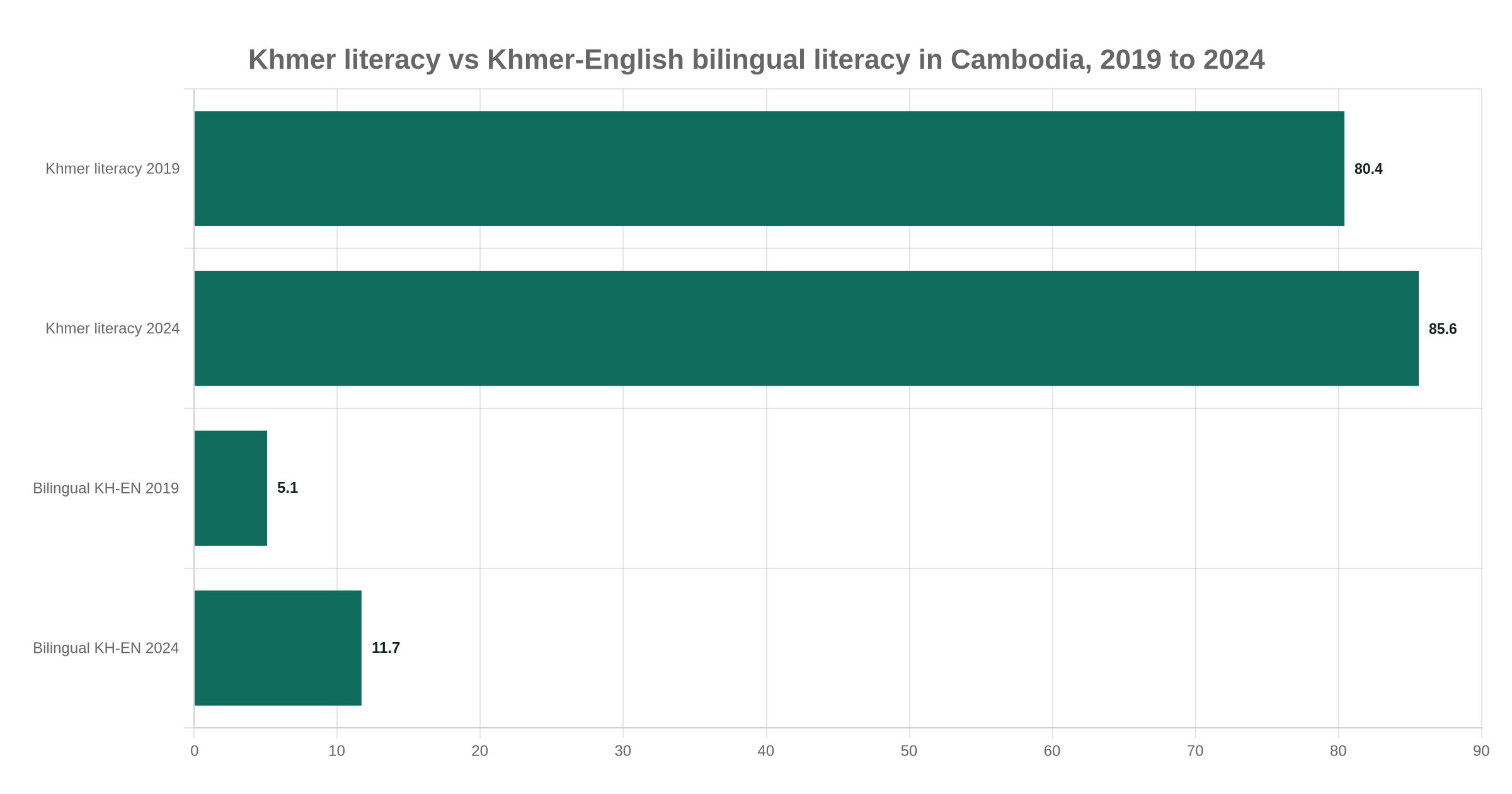
Second, Cambodia's 2024 Inter-Censal Population Survey put national Khmer literacy at 85.6%, up from 80.4% in 2019, but bilingual Khmer-English literacy at only 11.7% nationally (16.8% in urban areas), up from 5.1% in 2019 (National Institute of Statistics, Cambodia Inter-Censal Population Survey 2024, reported by Khmer Times). Most of the population reads Khmer fluently and English barely at all, which means the actual query intent behind a Khmer business search rarely gets typed in the English words a keyword tool was built to sample.
Third, a large share of Cambodian commercial research never touches Google at all. Buyers ask in Telegram groups, scroll Facebook Marketplace, or message a page directly, channels no keyword planner indexes. A Phnom Penh tutoring center might see twenty messages a month arrive through a Telegram group share and zero through organic search, and conclude correctly that Telegram is where its real demand lives, while a keyword tool looking only at Google would score the same service at near-zero volume and call the opportunity dead.
We think most businesses chasing "Khmer SEO" are optimizing for the wrong signal: they read a near-zero Keyword Planner number and conclude Khmer demand does not exist, when the tool is simply blind to where that demand lives. The fix is not to abandon Google entirely, Google still carries 95.16% of Cambodia's search traffic against Bing's 3.17% as of October 2026 (StatCounter Global Stats), but to treat a low keyword-tool number as a measurement limit, not a verdict on the market.
Should a bilingual site use one URL path or two?
A bilingual site should use two separate URL paths, one per language, connected with hreflang tags, rather than a single page that swaps text with a toggle or an auto-translate widget.
Option A, the dual-path structure, publishes /km/ and /en/ as distinct, fully written pages and tells Google which one to serve to which audience through hreflang annotations. Each path can rank on its own, gets its own title tag and meta description, and can be improved independently once Google Search Console shows which one is actually drawing clicks. The cost is upfront: someone has to write two real pages, not one page and a plugin.
Here is the arithmetic worth running before deciding whether that upfront cost is worth it. Take a hypothetical Phnom Penh clinic whose English-only showcase site pulls 800 monthly impressions in Search Console, almost all on English queries, and zero impressions on anything typed in Khmer script, because no Khmer-script page exists for Google to show in the first place. Splitting the site into two real paths does not touch the English side; it adds a second property that starts from zero and grows on its own. If the Khmer path reaches even a modest 300 monthly impressions within two quarters of being indexed, roughly a third of the English side's volume, the clinic has not traded one language for the other. It has added a channel on top of the one it already had. That comparison, a new number next to the old one rather than a smaller number instead of it, is the one that justifies the extra setup week.
Option B, the single-page toggle, feels cheaper at launch. A script swaps the visible text when a visitor clicks "KM" or "EN", but the URL never changes, so Google indexes one page with one language signal, usually whichever loaded first. The Khmer content frequently never gets crawled as Khmer at all, and an auto-translate overlay, widely used by smaller Cambodian sites, routinely renders transliterated nonsense for brand names and local terms that a human translator would leave untouched.
We would never ship a bilingual site as a single toggled page. Two URL paths cost more setup time, typically one to two extra weeks on top of a standard three to six week showcase build, but they let each language rank on its own merits instead of competing for one set of signals.
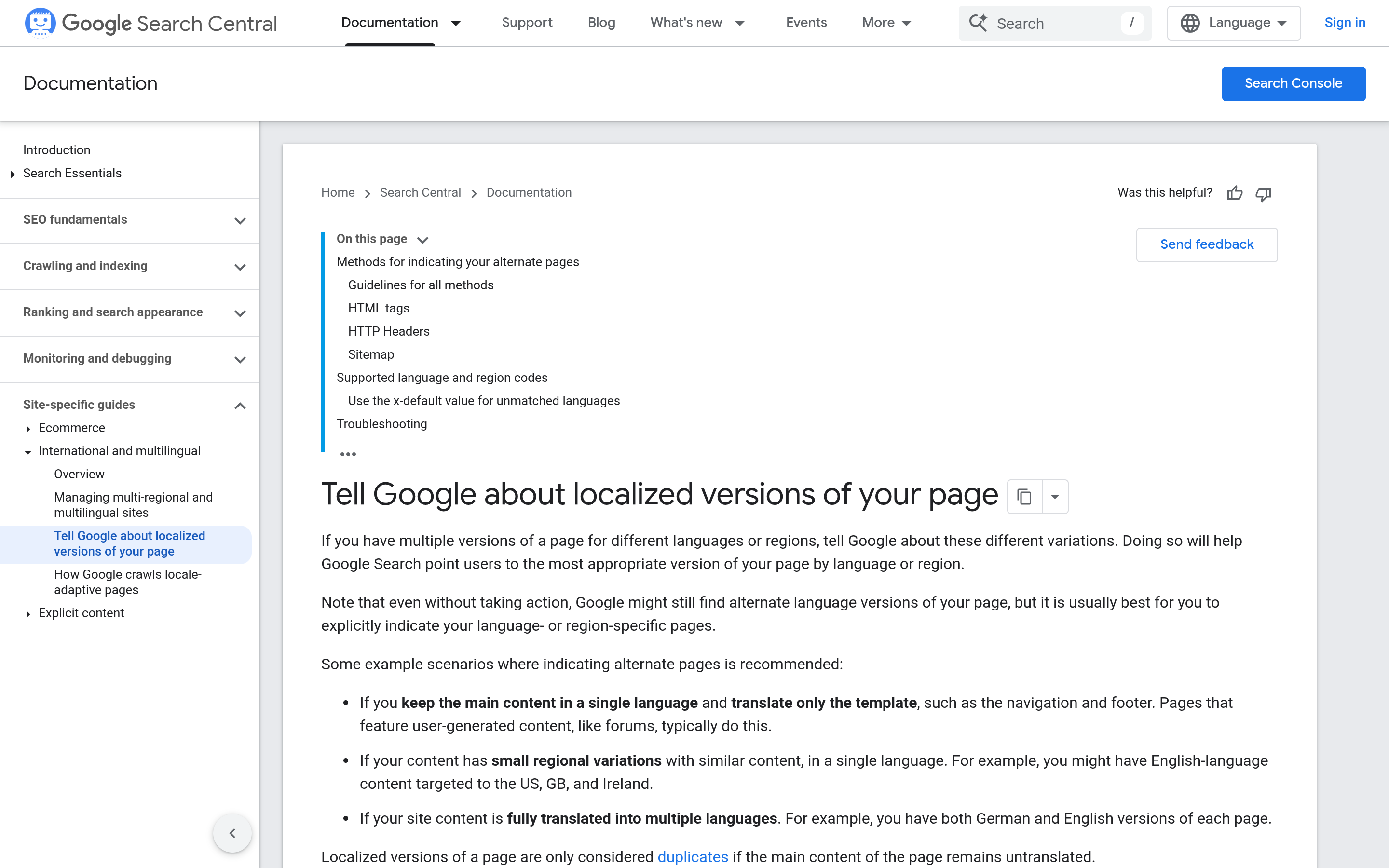
Google's own documentation on hreflang (Google Search Central, "Tell Google about localized versions of your page") spells out the mechanics: each language path needs an annotation pointing to every other language version, including itself, or Google treats the hreflang cluster as incomplete and may ignore it. A single Khmer path linking to an English path that does not link back is a common setup mistake, and it quietly breaks the entire signal. We check this with a crawl before declaring a bilingual build finished, not after a client reports a ranking problem.
Does Google index Khmer script pages differently from English ones?
No, not when the Khmer text is genuine Unicode: Google indexes a correctly encoded Khmer page exactly as reliably as an English one, and only stumbles when the page gives it an image of text or a legacy pre-Unicode font that maps Khmer glyphs onto Latin character codes instead of real, selectable characters.
Three technical details decide whether that happens. The page needs a correct lang="km" attribute so Google treats the text as Khmer rather than guessing from surrounding markup. The font stack needs a genuine Unicode Khmer typeface, Noto Sans Khmer is the common, freely licensed default, rather than one of the older proprietary Khmer fonts still found on sites built before Cambodia's government mandated a move to Unicode input systems for official documents in 2009 (The Cambodia Daily, January 2010). And the Khmer page's own title tag and meta description need to be written in actual Khmer words, not a romanized transliteration of the English title, because that is the text Google actually indexes and ranks.
A site's Google Business Profile should follow the same logic: the business name, category and description fields support a Khmer-language entry, and leaving them in English only means the profile never surfaces for the Khmer-script version of a local search, even when the website itself is bilingual.
A site straddling both language versions also benefits from treating bilingual web development as one project rather than an English build with a Khmer add-on, since the font stack, URL structure and metadata all need deciding before either language version ships.
What keyword research method works for Khmer queries?
Khmer keyword research works by combining four sources that each see a different slice of real demand, instead of relying on one keyword tool's volume column.
Start with Google's own autocomplete, typed directly in Khmer script on google.com.kh, not transliterated. Add the "People also ask" box on the same search, which surfaces genuine follow-up questions in whichever language the original query used. Cross-check against what is actually ranking: our own DataForSEO pull for "khmer seo" in November 2026 returned a results page dominated by Facebook business pages and generic "best agency" directory listings, with an AI Overview occupying the top slot and not one page offering a real technical explanation, a gap worth writing into rather than around.
Then look at Facebook and Telegram directly. Group names, page categories and pinned posts in Khmer reveal the exact phrasing Cambodian buyers use for a service, phrasing that rarely matches the formal English keyword a foreign-run keyword tool suggests. A guesthouse in Siem Reap, for instance, might find its real demand for airport pickup split three ways: the plain English phrase, a romanized Khmer phrase typed phonetically on a phone keyboard, and the equivalent Khmer-script phrase, three variants a single keyword list in English would never surface.
Build the keyword set as a table of variant against intent, not a flat list. The English phrasing of a query often reads as informational ("what is SEO"), while the Khmer-script or romanized version of the same underlying need reads as commercial, a reader already comparing providers rather than defining a term. An automated classifier that scores all three spellings the same way misreads half the list.
One failure mode worth naming directly: Search Console's "international targeting" and "duplicate, Google chose different canonical than user" reports routinely flag auto-translated Khmer pages as near-duplicates of their English source, which caps how much of the Khmer path Google will even crawl. Checking that report before writing a single word of Khmer content catches the problem months earlier than waiting for a traffic plateau to notice it.
For the broader picture of what moves rankings in this market beyond the Khmer-specific pieces, see our analysis of SEO in Cambodia.
What should the Khmer title tag and meta description actually say?
The Khmer title tag should state the service and the city in plain Khmer words a reader would actually type, not a direct translation of the English title's marketing phrasing.
English titles often lead with an adjective, "professional", "trusted", "affordable", because that is what ranks in competitive English-language markets. Khmer searchers typing on a phone tend to type the service and the place, nothing more, so a title translated word for word from an English draft usually buries the two words that matter under three that do not. The same discipline applies to the meta description: write it as the direct answer a Khmer reader would want, in Khmer, rather than running the English version through a translation tool and shipping the output unread.
Word order in "khmer seo" and "seo khmer" barely changes what ranks
Google's matching is token-based, not phrase-based, so a page built to answer "khmer seo" ranks almost identically for "seo khmer". Our live pull for both spellings in November 2026 returned the same set of results in a near-identical order, with only minor shuffling among the lower-ranked directory listings: the same Facebook pages, the same two or three agency-directory posts, and the same AI Overview near the top of the page.
That near-identical result set tells us something useful: Google has already decided which handful of pages it considers authoritative for this topic in Cambodia, regardless of word order, and none of them is a genuine technical explanation. A page that earns that authority does not need to hedge its title with every possible word order; one clear phrasing, backed by real depth, is enough.
That matters less for the content itself than for how a business decides to buy help with it. If a Cambodian SME is comparing providers, the exact word order it searches rarely changes who shows up, which means the deciding factor is what those SEO services actually include, not which spelling variant a provider optimized for. A provider that leads with keyword density across both spellings, rather than the underlying site architecture, is optimizing for a distinction Google has already stopped caring about.
Our take: fix the Khmer homepage before you build a Khmer blog
Our recommendation, in order: fix the Unicode and the font stack first, split the site into two real URL paths with hreflang second, and only then start writing Khmer-specific content. Businesses that skip straight to a content calendar end up publishing Khmer articles that Google still associates with the wrong language because the underlying page structure was never fixed.
On the builds we scope, adding a fully separate Khmer URL branch to an existing English showcase site typically adds one to two weeks to a three to six week build, not a second project with a second budget. That is a smaller lift than most owners assume, and it is the one piece of this that a web development team needs to own directly, since it touches templates and routing, not just copy.
Once the structure is sound, Khmer SEO stops being a separate discipline and becomes one more input into the same sales funnel system that is already supposed to turn search traffic into a booked call. A Khmer landing page that ranks but has no clear path to a contact form or a Telegram link is a half-finished job, regardless of how clean its Unicode is.
The open question we cannot answer yet is how Google's AI Overviews will treat Khmer-script queries as they mature. Our own SERP pull for "khmer seo" showed an AI Overview already occupying the top slot in English, but we have not yet seen a stable pattern for how often that summary box appears, or draws from, pages written primarily in Khmer script. That is a genuinely open question, not a rhetorical one: the data to answer it with confidence does not exist yet for this market. Our recommendation does not wait for that answer. A site with correct Unicode, a real bilingual URL structure, and keyword research built from where Cambodians actually type is better positioned for whatever ranking signal comes next, AI-generated or not, than one still arguing over which transliteration to use in a single English-only title tag.
Prefer to chat? Message our founder directly on Telegram (@maxgrolier), or book a call with the team.
Frequently asked questions
Does Google rank Khmer-script pages the same way as English pages?
Yes, once the Khmer text is genuine Unicode with a correct language attribute and a proper font stack. Google's crawling and ranking systems do not treat Khmer as a second-class script; most ranking problems blamed on "Google not understanding Khmer" trace back to broken encoding or an auto-translate overlay, not a language limitation. The same ranking factors apply, backlinks, content depth, page experience, once the basic encoding is correct.
Do we need a separate Khmer SEO strategy if we already rank well in English?
Usually yes, because ranking in English tells you nothing about whether your Khmer-script pages are indexed at all. Many Cambodian businesses only discover their Khmer page was never properly crawled when they check Google Search Console and find zero impressions for Khmer queries, despite strong English traffic. The two language versions should be tracked as separate properties in Search Console, not one combined view, or the gap stays invisible.
How long does it take to add a proper Khmer URL structure to an existing site?
On a standard showcase site, expect one to two added weeks on top of the normal three to six week build, mostly for routing, hreflang tags, and writing (not translating) the Khmer pages. A platform-scale rebuild takes longer, closer to the same proportion of its own two to four month timeline. The writing time for genuinely original Khmer copy, rather than a translated pass, is usually the part owners underestimate most.
Can a Google Translate widget replace a real Khmer version of a site?
No. A translate widget changes what a visitor sees without changing what Google indexes, so the page still ranks as whatever language it was originally written in. It also mistranslates brand names, service names and local terms often enough that a real Khmer reader notices immediately, which does more damage to trust than simply staying English-only until a real Khmer version is ready.
Does a Cambodian business need a Google Business Profile written in Khmer?
If local search matters at all to that business, yes. A profile with only an English name and category misses the Khmer-script searches most of Cambodia's internet users (12.0 million people, 67.3% of the population, per DataReportal's Digital 2026 Cambodia report) actually type. Our guide to local SEO covers the Google Business Profile setup in more depth.