

A founder weighing whether to outsource web development to Cambodia is really asking three separate questions at once: what will it cost compared to the outsourcing destinations everyone already compares against each other, will the work be any good, and will a Phnom Penh team's working day ever actually line up with ours. The honest answer is that Cambodia wins clearly on the first question, is workable but unproven on the second, and depends entirely on which country you are calling from for the third. This article takes the three apart, with the rate data, the market data and the time zone math that a buyer needs before signing anything.
What Outsourcing Web Development to Cambodia Actually Means
Outsourcing web development to Cambodia means contracting an external company, an agency or a studio, to deliver a defined piece of software or a website, rather than hiring a person directly onto your own payroll. That distinction matters more than it sounds: an outsourced vendor carries its own project management, its own bench of developers if one person leaves, and its own liability for the deliverable, while a direct hire is an employee you manage yourself under Cambodian labour law. Our web development in Cambodia guide covers the build itself, the stack choice between Webflow, Shopify, WordPress and custom code; this one stays one layer up, on the decision to route the work through a vendor at all rather than hiring a developer directly.
Cambodia's own market has grown fast enough to make that vendor option real rather than theoretical. Mordor Intelligence sizes Cambodia's ICT market at 2.51 billion US dollars in 2026, forecast to reach 3.61 billion US dollars by 2031 at a 7.55 percent compound annual growth rate. Against that growth, 9cv9's 2026 recruitment statistics project a shortfall of 600,000 IT professionals in Cambodia by 2025, one of the starkest skills-gap figures in the region. That is still a small, strained market next to Vietnam or the Philippines, which is exactly why outsourcing here rewards a buyer who vets a specific vendor rather than assuming market depth the way they might in a bigger outsourcing hub.
The vendors themselves split into three tiers on Clutch's own Cambodia listings, and conflating them is the most common first mistake. Boutique studios of 2 to 9 people price lowest and carry the least bench depth: lose the one developer who understands your codebase and there is no second person to hand it to. Mid-sized shops of 10 to 49 people, the bulk of Cambodia's Clutch-listed agencies, carry a project manager and a small team behind the one person you talk to, so a single departure slows a project instead of stopping it. A handful of larger, higher-rate firms serve enterprise clients, carry formal account management, and price accordingly. Deciding which tier fits your project before you request quotes saves the awkward conversation of comparing a 1,000-dollar minimum against a 50,000-dollar one for what you assumed was the same service, and it also tells you how much project-management overhead is already built into the rate you are being quoted. A short list of questions to ask before signing, regardless of tier, catches most of this before the contract does: our guide on vetting a web development company in Phnom Penh walks through the specific ones worth asking a vendor directly.
A fourth option sits outside all three tiers: a Cambodia-based freelancer found through a platform rather than a registered company. That path can undercut even the lowest Clutch band, but it carries none of the bench depth, account management or corporate liability the agency tiers above provide, which matters more for outsourcing specifically because the buyer is, by definition, not managing the work day to day the way a direct hire's employer would. A freelancer's lowest rate is also the least stable one: there is no agency behind it to absorb a missed deadline or a sudden unavailability, so the discount is a bet on one person's schedule holding, not a like-for-like comparison against the agency tiers above.
How Much Does Outsourcing Web Development to Cambodia Cost?
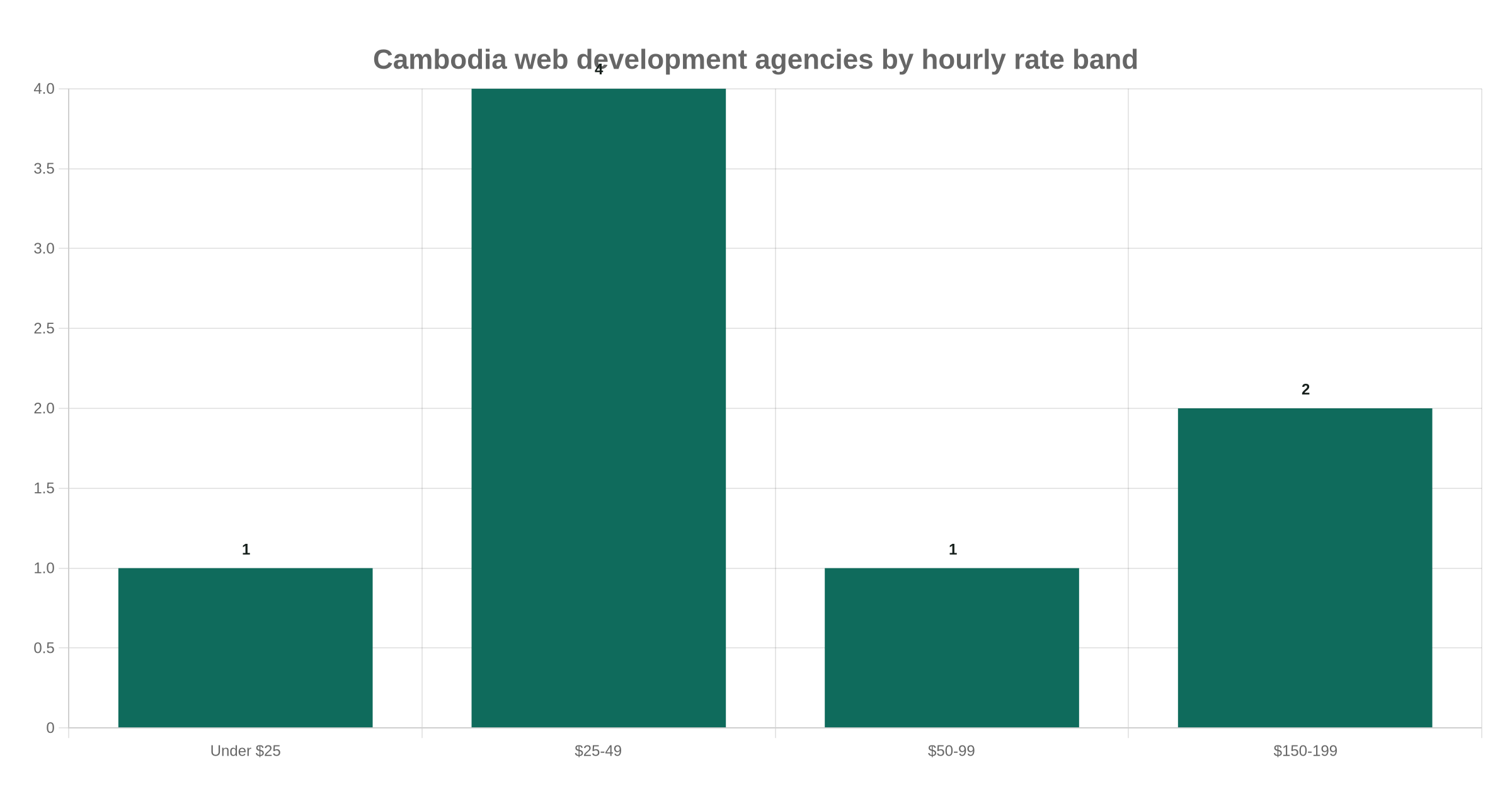
Outsourcing web development to Cambodia costs between 25 and 199 US dollars an hour depending on the vendor tier, with most agencies clustered at the low end of that range. Clutch's Cambodia directory lists nine web development companies as of 2026: one prices under 25 US dollars an hour (Mango Byte), four sit in the 25 to 49 US dollar band (ZINation, Alderson Labs, DKMads, and Khmer Gaming Software Solution), one sits at 50 to 99 US dollars an hour (SYNQFORM), and two premium, larger firms price at 150 to 199 US dollars an hour (Dotfusion Digital, a B Corp-certified studio, and NuForm). Project minimums run from 1,000 US dollars at the low end to 50,000 US dollars and up at the top.
That spread is wide enough that the average is close to useless. A 15,000-dollar e-commerce rebuild, 400 hours at a blended 37 dollars an hour, the midpoint of the 25 to 49 US dollar band, is a mid-tier Cambodia quote; the same scope at a 150-dollar-an-hour premium firm runs past 60,000 dollars for no difference in what Webflow or Shopify can actually render on the front end. A smaller landing-page project, say 60 hours, swings from under 1,500 dollars at Mango Byte's sub-25 rate to close to 9,000 dollars at Dotfusion Digital's premium tier, which is less a quality gap than a question of whether a buyer needs a B Corp-certified firm's account management for a six-page site.
The number that actually decides which quote is cheaper rarely sits on either invoice: it is the rework. A 400-hour build quoted at Mango Byte's under-25-dollar rate starts around 10,000 dollars; one mid-project pivot, 60 hours of rebuilding a page because a spec was read differently than it was written, pushes the same project past 11,500 dollars, close enough to a 37-dollar-an-hour mid-tier quote that needed no rework at all to erase most of the gap this section opened with. The cheapest hourly rate and the cheapest finished project are two different numbers, and a buyer who compares only the first one is the one who ends up paying for the second.
We would treat the rate band itself as the first filter: decide which tier your project's risk tolerance can afford before a single call, not after three quotes that turn out to describe three different services. A project under 10,000 dollars rarely needs the premium tier's account management overhead; a project that touches customer data, payments, or a multi-month roadmap often does, and paying the lower rate there is how buyers end up re-quoting the same project with a different vendor six months in.
Is Cambodia Cheaper Than Vietnam, the Philippines or Eastern Europe?
Cambodia is cheaper than Vietnam, the Philippines and Eastern Europe at the low end of each market, but the gap narrows sharply once a project needs a larger or more senior team. Qubit Labs' December 2025 offshore rate guide puts Cambodia's blended band at 25 to 49 US dollars an hour, the narrowest and lowest ceiling of any Southeast Asian market it tracks, against Vietnam and the Philippines both running under 25 up to 99 US dollars an hour, and Eastern Europe split between a 25 to 99 US dollar band for most countries and a 25 to 149 US dollar band for Poland and Romania specifically.
| Destination | Blended hourly rate (Qubit Labs, 2026) | What that buys |
|---|---|---|
| Cambodia | 25-49 USD | The narrowest band; no local agency prices above roughly 50 USD on Clutch's own listings bar two firms |
| Vietnam | Under 25-99 USD | A much larger talent pool than Cambodia's, room to hire up market without a rate penalty |
| Philippines | Under 25-99 USD | Same band as Vietnam, plus a workforce historically built around US-aligned business process outsourcing |
| Poland, Romania | 25-149 USD | Highest ceiling of the group, priced for senior and specialised roles (fintech, mobile, cloud) |
We would not pick Cambodia on the low end of that table alone. Vietnam and the Philippines carry roughly the same floor, a much deeper talent pool to hire up from when a project gets more technical, and in the Philippines' case a workforce built around decades of English-language business process work. Cambodia's real argument is narrower: for a standard business website or a Webflow-scale build, where the ceiling on complexity is low, its market simply does not have the higher-rate tiers that pull the other countries' averages up, so a buyer who sticks to that scope pays the Southeast Asian floor with less chance of accidentally landing in a higher band.
Where Cambodia loses the comparison outright is on anything that needs a specialised or senior role filled fast. Vietnam's much larger IT workforce and the Philippines' decades of business process outsourcing experience both mean a buyer can hire up to a senior architect or a security specialist inside the same market; Cambodia's sector, which 9cv9's 2026 analysis puts on track for a 600,000-professional shortfall by 2025, is simply thinner at the top of the skill ladder, so a complex project often means importing a senior contractor from outside Cambodia anyway, which erases the rate advantage this section opened with.
Does Cambodia's Time Zone Actually Work for Outsourced Work?
Cambodia's time zone works well for outsourcing from Australia and the rest of mainland Southeast Asia, and poorly for outsourcing from the United States or Western Europe. Cambodia runs on Indochina Time, UTC+7, year round, with no daylight saving to complicate the math. That fixed offset is 3 to 4 hours behind Sydney and Melbourne depending on the Australian season, which puts a Phnom Penh team's morning (roughly 6am to 3pm ICT) inside an Australian afternoon (9am to 6pm AEST or AEDT): enough real overlap for daily stand-ups and same-day reviews. Against Singapore, Hong Kong and mainland China, Cambodia sits only one hour behind, which is close enough that a Phnom Penh dev day and a regional client's day run almost in parallel. Run that one-hour gap through an actual day and it barely registers: a Phnom Penh team working 8am to 5pm ICT overlaps a Singapore or Hong Kong team's 9am to 6pm SGT or HKT day for eight of nine working hours, and against mainland China's Beijing time the same single-hour offset leaves the two sides sharing essentially the whole working day.
The picture flips for the two markets most outsourcing buyers actually come from. Against US Eastern time, Cambodia runs 12 hours ahead (11 during US daylight saving), which leaves essentially no shared working hours: a Phnom Penh morning is a US nighttime, and the two sides trade asynchronous updates by default rather than meeting live. Against Central European time, the gap is 6 hours (5 in European summer), so a Cambodia morning catches the European team only in its last hour or two of the day, enough for a short handoff call but not for sustained pairing.
None of this makes outsourcing to Cambodia a bad idea from the US or Europe; it makes it a different operating model. A team that plans for asynchronous handoffs, with written specs and recorded demos doing the work a live call would do elsewhere, gets the cost advantage without fighting the clock. A team that assumes it can run daily live stand-ups across a 12-hour gap will burn the savings on someone's 11pm meeting within a month.
Work the Australia case through concretely, since it is the one Western market where the overlap is real. A Sydney or Melbourne team on a standard 9am to 6pm AEST day shares roughly 9am to 12pm of its own afternoon with a Phnom Penh team's 6am to 9am ICT morning, a genuine three-hour live window for a daily stand-up and same-day review, widening to four hours during the Australian summer when AEDT adds an extra hour of separation rather than closing it. A US or European buyer gets no equivalent window at all: the honest plan is a written handoff at the end of each side's day, not a daily call either side has to stay up for.
Quality and Communication Carry the Real Risk of Outsourcing to Cambodia
Quality and communication, not the hourly rate, are where an outsourcing decision in Cambodia actually goes wrong, and the market's own data says so more clearly than any rate card does. EF Education First's 2025 English Proficiency Index ranks Cambodia 123rd out of 123 countries assessed worldwide, in the "very low proficiency" band alongside Thailand, Myanmar and Afghanistan, with Cambodia's weakest sub-score in reading, at 368. That is not a verdict on any individual developer, plenty of whom work fluently in English day to day, but it is a market-wide signal that a buyer should verify written and spoken English during vetting rather than assume it, the way they might with a Philippines-based vendor.
The second risk the SERP for this topic never surfaces is depth. 9cv9's 2026 recruitment statistics project Cambodia heading toward a shortfall of 600,000 IT professionals by 2025, a gap of a scale that outpaces the market's own growth. DataReportal's Digital 2026 report counts 12.0 million internet users in Cambodia, a 67.3 percent penetration rate, confirming the domestic market itself is still building the infrastructure its own developers will eventually be asked to build on. A small, fast-growing talent pool means a vendor's best people rotate across clients and sometimes across companies; a reference check that asks specifically who will be on your project, not just who is in the agency's portfolio, catches more problems than a portfolio review alone.
We think the cost argument for outsourcing to Cambodia is real but gets compared on the wrong number. The rate gap to Vietnam or the Philippines, a few dollars an hour at the low end, is small once a single miscommunicated requirement costs a sprint of rework. Decide on communication fit and time zone overlap first, and let the rate be the tiebreaker between vendors that already cleared that bar, not the first filter.
In practice, vetting communication fit is a short, concrete checklist rather than a judgment call: ask for a written project update from a past engagement, not a sales call, since a vendor's sales team is reliably more fluent than the developers who will actually staff your project. Ask who specifically will be assigned, by name, and whether that person has shipped a project in your exact stack before. And run the first paid week as a trial on a small, reversible task before committing the full scope, which turns an English-proficiency or skills-depth problem into a one-week loss instead of a signed contract's worth of one.
How Do You Protect Your IP When You Outsource to a Cambodia-Based Team?
You protect your IP when you outsource to a Cambodia-based team with a written contract clause, not with trust in the vendor's reputation. Tilleke & Gibbins' 2024 guide to intellectual property in Cambodia states plainly that, absent a written assignment, copyright and other IP created by an individual author vests in that author by default, not automatically in the company that paid for the work. Cambodia's IP enforcement mechanisms also lag regional peers like Thailand and Singapore, with under-resourced judicial processes producing low prosecution and conviction rates for infringement. That is a market-wide signal about enforcement culture, not a claim about any specific vendor's practice, but it is the reason the contract clause below matters more here than it would in a market with a stronger enforcement track record.

The practical fix is unglamorous: a contract that contains a present assignment of all IP rights in the deliverables to your company on creation and payment, a waiver of moral rights, and an explicit list of what gets delivered (source code, design files, credentials, documentation), signed before work starts, not negotiated after a dispute. That clause should also reach any subcontractor the vendor itself brings in: Cambodia's smaller studios routinely pull in extra developers for overflow work, and a present assignment that names only the agency as a party can leave a subcontracted developer's own rights unaddressed. A software development company that balks at adding that clause, or treats it as unusual, is telling a buyer something worth hearing before the contract, not after. None of this is specific to Cambodia; it is standard practice anywhere IP enforcement is uneven. It matters more here because the default, absent a clause, favours the individual developer over the paying company.
A second, cheaper safeguard is sequencing: start with a small, fully scoped pilot, a single page or a narrow feature, before committing a full project's budget. A pilot surfaces communication gaps and code quality at the cost of a few hundred dollars instead of the cost of a signed 15,000-dollar contract with a vendor you have not actually seen build anything.
Picture a SaaS founder who outsources an MVP's front end to a Cambodia-based studio on a one-page agreement that names the deliverable and the price but says nothing about ownership. Under the default rule Tilleke & Gibbins describes, the code the studio's developers wrote could remain theirs in the absence of a written assignment, leaving the founder with a working product and an unclear right to modify, resell or relicense it without going back to the studio. The fix costs nothing beyond a paragraph in the contract: it is a drafting decision, not a reason to avoid Cambodia, but it is the one clause worth checking before anything else in the agreement.
What We Would Do If We Were Outsourcing to Cambodia
We would make three moves, in this order, before signing anything. First, ask plainly which rate card a quote reflects, local, freelance or international-client, the same question that matters when hiring a developer directly: SecondTalent's 2026 rate data for Cambodia shows international clients typically paying 40 to 60 percent more than local companies for the same seniority of Node.js developer, and a 30 percent gap between two quotes is often just two different rate cards for the same skill level, not two different vendors.
Second, we would commit to asynchronous-first communication by default rather than fight the time zone. Written specs, recorded loom-style walkthroughs, and a shared task board do most of the work a live call would do from the US or Europe; live calls get reserved for the handful of weekly hours that actually overlap, which the Australia and regional-Asia math above makes workable even when the US and Europe math does not.
Third, we would insist on the IP assignment clause and a paid pilot before the full engagement, treating both as the cost of doing business in a market where enforcement will not protect us if the contract does not. This is not theoretical for us: our own web development work for France-based clients includes the Tandem Partners rebuild, a full digital identity redesign for a France-Asia investment group across five portfolio entities, built in Webflow and converting at 6 percent on the entity pages since launch, and the Groupe Revive redesign for a French takeover-and-turnaround firm, built on a modular CMS that let the client's own team start publishing cases and news themselves, with traffic up 42 percent in the first six months. Both are France-based clients served through TechFlow's own cross-border delivery, the same distance a buyer weighing Cambodia from Europe is sizing up in this article. If you are weighing the same decision, we would rather scope that first project with you than have you learn the IP clause lesson on your own contract: get a quote and we will tell you plainly whether Cambodia fits what you are building.
Prefer to chat? Message our founder directly on Telegram (@maxgrolier), or book a call with the team.