Most coverage of internet usage in Cambodia still frames the country as a market that is catching up, somewhere behind, still getting its population online. The 2026 numbers do not support that framing. Cambodia already has more mobile connections than it has residents, its fixed broadband network is close to irrelevant to how people actually get online, and the one figure every buyer wants, the country's average internet speed, does not have a single agreed answer: three credible sources quote three different numbers for it, and most articles never say which one they picked or why.
This article works through what Cambodia's internet usage data actually says in 2026: how many people are online, how they connect, why the speed question is more complicated than any single chart admits, which platforms carry real commercial reach, and what a business building a website or a marketing plan for this market should assume instead of guessing.
Cambodia's internet usage count passed 12 million in 2025, and growth has already slowed
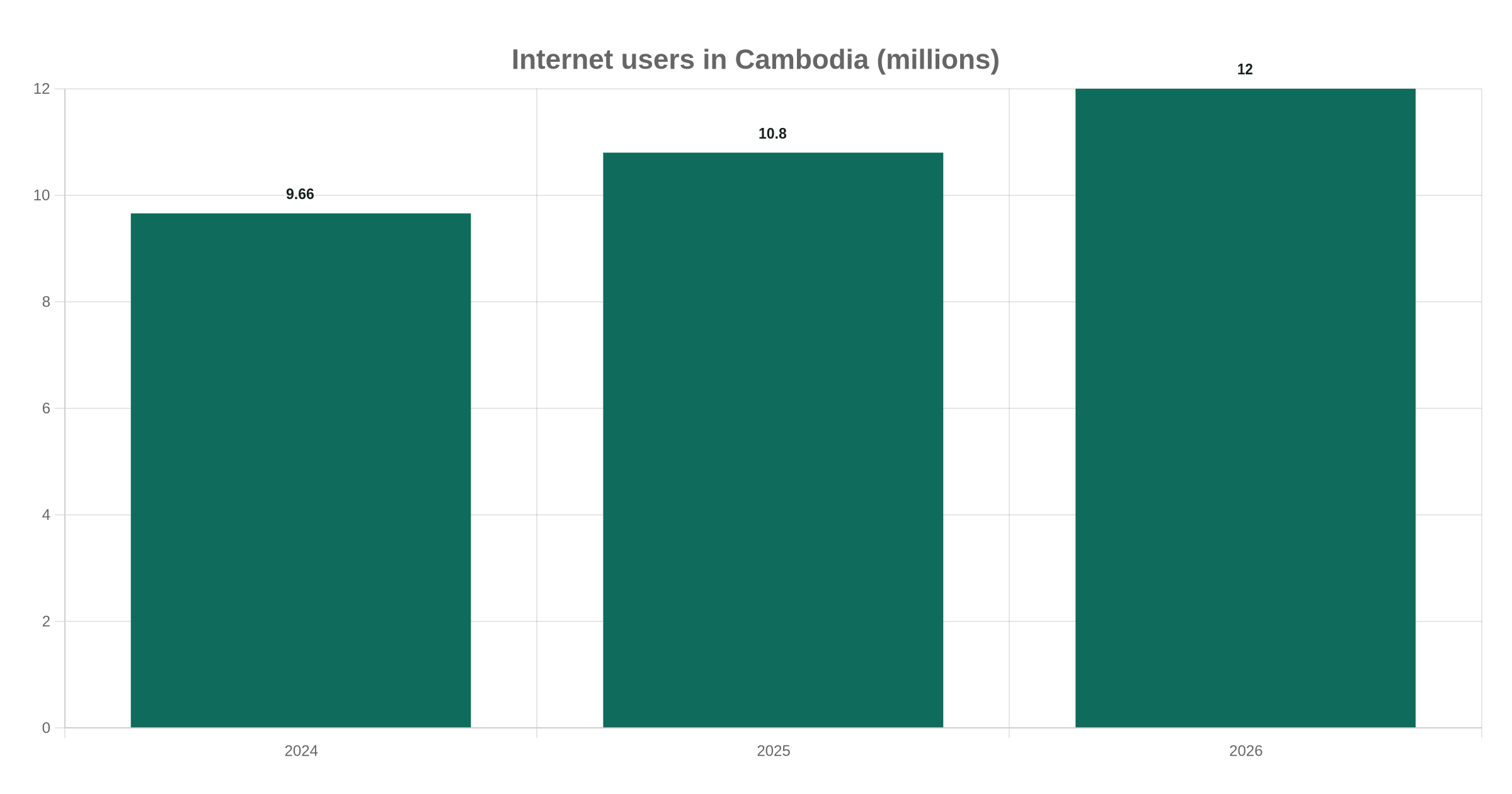
Cambodia had 12.0 million people online at the end of 2025, equal to 67.3 percent of the population, according to DataReportal's Digital 2026: Cambodia report. That is up 612,000 people, or 5.4 percent, on the year before. The same report puts Cambodia's total population at 17.9 million, which leaves roughly 5.86 million people, 32.7 percent of the country, still offline.
Growth has actually slowed in relative terms even as the absolute number keeps climbing. DataReportal's prior editions show 10.8 million users (60.7 percent) in January 2025 and 9.66 million (56.7 percent) a year before that. Each step added fewer new users than the one before it, which is the normal shape of a market approaching saturation among the population that is easiest to reach: urban, younger, already holding a smartphone. A separate, longer-running series, a Trading Economics aggregation of the World Bank's own internet-user indicator, put Cambodia at 60.72 percent in 2023, a reading broadly consistent with DataReportal's figures for a similar period, which is a useful cross-check given how often single-source statistics get repeated without any second opinion.
None of this lines up neatly with the number Cambodian officials quote in public. Chea Vandeth, Minister of Post and Telecommunications, told reporters in February 2025 that the country had 18.98 million internet subscribers in total: 18.28 million mobile internet subscribers plus 708,234 fixed internet subscribers. That number is not wrong, it is just answering a different question. A subscriber count tallies SIM cards and accounts, and a single Cambodian commonly holds more than one SIM, so the figure sits well above DataReportal's "unique people online" estimate. The Telecommunication Regulator of Cambodia's own telecom-statistics page adds a third angle again: total phone penetration of 118.12 percent in 2024, up from 115.24 percent in 2022 and down from a 2023 peak of 122.88 percent. Three official or semi-official sources, three different slices of the same market: people online, subscriptions sold, and phones in circulation. Treating any one of them as "the" internet usage number for Cambodia is where most generic content on this topic goes wrong.
This is also the backdrop behind the broader shift in digital marketing Cambodia spend: budgets are moving online faster than the remaining offline third of the population is, and that mismatch is its own kind of risk for anyone assuming the whole country behaves like Phnom Penh.
Is Cambodia a mobile-only internet market?
Cambodia is, for practical purposes, a mobile-only internet market: mobile connections already outnumber residents, and fixed broadband barely registers next to that.
DataReportal counted 21.7 million mobile connections in Cambodia in October 2025, equal to 121 percent of the population, and 94.0 percent of those connections were already broadband-capable rather than basic voice-and-text lines. Set that against the Minister's own figure of 708,234 fixed internet subscribers nationally, compared with 18.28 million mobile internet subscribers: fixed broadband is roughly 4 percent the size of mobile internet by subscriber count. A household or office fixed line is the exception in Cambodia, not the default.
"4G mobile network coverage has reached 82 percent of the kingdom's land area and 93.2 percent of the population." Chea Vandeth, Minister of Post and Telecommunications, speaking to Cambodianess, February 2025
That quote is the practical heart of the matter. For a business asking whether its site needs to work on a slow office fixed line, the honest answer in Cambodia is that the question is close to the wrong one. The question that matters is whether the site works on a mid-range Android phone over a 4G connection, because that is how the overwhelming majority of the country's internet usage actually happens.
Why do Cambodia's internet speed numbers contradict each other by three times?
Cambodia's internet speed numbers contradict each other because different publishers, all citing the same Ookla Speedtest Global Index, are measuring different time windows and different slices of that index, and almost nobody names which one they used.
DataReportal's Digital 2026: Cambodia report, drawing on Ookla data from around August 2025, gives a median mobile download speed of 53.58 Mbps (up 86.7 percent year on year) and a median fixed download speed of 49.32 Mbps (up 8.3 percent). A separate ASEAN regional ranking published by Seasia.co in April 2026, citing the same Ookla Speedtest Global Index, puts Cambodia's mobile median at 158.69 Mbps, fourth of nine ASEAN markets, and its fixed broadband median at 51.86 Mbps, eighth of nine. Internet Society's Pulse country report for Cambodia gives a third pair again: 123.88 Mbps mobile, 54.94 Mbps fixed.
| Source | Mobile median | Fixed median | Period cited |
|---|---|---|---|
| DataReportal (Ookla-sourced) | 53.58 Mbps | 49.32 Mbps | August 2025 |
| Seasia.co, ASEAN index (Ookla-sourced) | 158.69 Mbps | 51.86 Mbps | February 2026 |
| Internet Society Pulse | 123.88 Mbps | 54.94 Mbps | 2026 |
None of these three publishers is necessarily wrong. They are plausibly pulling the same underlying Ookla data at different months, with different weighting across device types and test volumes, which is a known hazard of how raw speed-test data gets re-published by secondary sites rather than quoted directly from Ookla's own index. What is notable is the pattern: the three fixed-broadband figures sit in a tight 49 to 55 Mbps band, while the three mobile figures spread across a much wider 53 to 159 Mbps range. We would treat that as the useful signal here. The fixed number is the one place these sources actually agree with each other, so it is the safer figure to plan around; any single mobile number should be read as an upper bound reachable under good conditions, not the typical case a visitor experiences.
Put a number on that choice and it changes a real project brief. A 40-room boutique hotel in Siem Reap building a direct-booking site, instead of relying only on an OTA listing, is a useful test case: at roughly 50 Mbps, a 2 to 3 MB homepage with compressed, modern-format images loads comfortably inside the 2 to 3 second window search engines and guests both tolerate. The same homepage built to a 150 Mbps assumption, with uncompressed hero video and five tracking scripts, is the kind of build that tests perfectly on an agency's own fibre connection in Phnom Penh and then disappoints a guest checking availability on a 4G phone from a provincial bus stop. Designing to the conservative, cross-confirmed figure rather than the headline one is the difference between those two outcomes.
Which platforms actually reach Cambodia's online population?
Facebook and TikTok reach the overwhelming majority of Cambodia's online population, but the audience under each platform is not the same age group.
DataReportal counted 14.0 million social media user identities in Cambodia as of October 2025, equal to 77.9 percent of the total population, almost entirely on Facebook. That figure is 115.9 percent of DataReportal's own "internet users" count for the same date, a reminder that these are platform-reported ad-audience numbers (counting multiple accounts and under-18 users), not a count of unique adults. TikTok reaches 11.3 million users aged 18 and over, equal to 97.5 percent of Cambodia's online adult population, which is about as close to universal as a single platform gets. Messenger reaches 8.90 million people (49.7 percent) and Instagram 1.85 million (10.3 percent). According to the same DataReportal breakdown, the gender split across these platforms runs 53.6 percent male to 46.4 percent female.
Telegram does not appear in DataReportal's ranked list of Cambodia's top platforms by audience size, because that list only covers platforms with public ad-reach tools, but it remains a default channel for direct business-to-customer messaging in this market, alongside Facebook Messenger, which matches Telegram's broader reputation in Southeast Asia as a direct-messaging channel businesses use alongside, not instead of, Messenger. A generic social strategy built around Instagram or X, the default in a lot of regional playbooks, misreads this market: TikTok's near-universal adult reach and Facebook's broad base matter far more here than either of those platforms does. It is exactly the kind of gap a lot of Cambodia startups misjudge when they copy a regional go-to-market plan wholesale instead of checking which platform Cambodian customers are actually on.
Run the arithmetic on a modest 1,000 US dollar monthly ad budget and the reach gap becomes concrete. Weighted by the population shares above, roughly 780 US dollars allocated to Facebook buys exposure across 77.9 percent of the population, while the same 220 US dollars on Instagram reaches a pool barely an eighth that size, 10.3 percent, for a similar cost per placement. A TikTok-first budget split aimed at Cambodia's 97.5 percent adult reach on that platform, with Facebook as the secondary line for the broader population figure it does not cover, routinely outperforms an Instagram-heavy plan copied from a European or Vietnamese media plan, simply because it is chasing the audience that is actually there.
5G went nationwide in January 2026, but the coverage math still favors 4G
Cambodia's first nationwide 5G service launched on January 1, 2026, led by Smart Axiata in coordination with the Ministry of Post and Telecommunications, with Cellcard (CamGSM) and Metfone (Viettel Cambodia) also building out their own 5G sites. Set against 4G's already near-universal reach, 93.2 percent of the population and 82 percent of the country's land area, 2026's 5G rollout reads less like a national access upgrade and more like added capacity in the densest parts of Phnom Penh and a handful of other cities. For a business shipping a website or an app this year, designing for the typical connection still means designing for 4G-grade conditions, not assuming 5G speeds will be the norm.
The infrastructure behind that coverage keeps expanding further upstream. Cambodia completed its first state-owned international submarine cable, the Sihanoukville-Hong Kong system, a 2,938-kilometre, 80 Tbps-capacity link built with China Unicom Global at a cost of roughly 165 million US dollars, with completion reported in Telecom Review Asia and SCMP's July 2026 coverage. A second route, the Malaysia-Cambodia-Thailand cable, began an upgrade with Nokia according to submarinenetworks.com's June 2026 report. Behind both projects sits the Ministry of Post and Telecommunications' Digital Economy and Society Policy Framework 2021-2035, which sets a formal target of 95 percent population coverage by the national internet backbone network, delivered across three phases running through 2035.
The investment case behind these numbers is also why an IT company in Cambodia today looks structurally different from the handful of small outfits that dominated the market a decade ago: the infrastructure a project can rely on has moved considerably, even where the headline "average speed" has not moved as cleanly as the cable announcements suggest.
Is rural Cambodia still offline?
Rural Cambodia is offline at a meaningfully higher rate than the cities, even though a clean, current number to prove exactly how much higher does not yet exist.
DataReportal's October 2025 figures put Cambodia's population at 26.6 percent urban and 73.4 percent rural, which is a population split, not an internet-access split, and the two should not be confused. The only directly comparable urban-versus-rural internet-use figure we could verify is now a decade old: a 2016 Asia Foundation study found 48 percent of urban Cambodians online against 31 percent of rural Cambodians. We looked for a current, methodologically equivalent replacement for that comparison and did not find one, which is itself worth flagging, since a lot of "Cambodia digital divide" content quotes decade-old numbers as if they were still current.
The Ministry's own 95 percent backbone-coverage target for 2035 is explicitly aimed at closing that same gap, which at least confirms the government reads the divide as real and unresolved rather than closed. Until a current rural-urban split gets published, we treat Cambodia's 67.3 percent national penetration figure as hiding a wide internal range: somewhere close to saturation in Phnom Penh, and well below the national average in several provinces. Any business targeting a nationwide Cambodian audience should assume its real traffic skews more urban than the national number implies, not less.
What Cambodia's internet usage data means for your website
Put together, these numbers point to a short, specific brief rather than a vague "go mobile" instruction. Build mobile-first by default, not mobile-friendly as an afterthought to a desktop design, since fixed internet subscribers are a rounding error next to mobile ones. Design and test against the roughly 50 Mbps fixed-line figure, the one place the competing speed sources actually agree, rather than the flashier mobile numbers that swing by three times depending on which source quoted them. And build for a bilingual audience from the start, because a large share of Cambodia's online population reads and searches in Khmer as readily as in English.
That last point is not theoretical for us. On our LeapMotor project, a bilingual English and Khmer website for the electric vehicle brand's Cambodian distributor, every screen was produced in both languages from the mockup stage specifically because Khmer typography, line height, spacing, alignment, breaks when it is bolted on after an English-first design instead of built in from the start. The result: 54 percent of the site's pages are viewed in Khmer, at an average load time of 1.2 seconds. That is the kind of detail a national internet-usage statistic cannot show you, and it is why we treat bilingual, mobile-first design as the default assumption for a Cambodian build, not an optional upgrade.
The open question Cambodia's internet statistics cannot answer cleanly yet is which of these competing figures becomes the country's standard reference once the Policy Framework's medium-term phase reports start landing closer to 2030. Our recommendation until then: build and budget for the conservative numbers in this article, the roughly 50 Mbps fixed-line median and a 4G-grade mobile experience, rather than the headline figures that get repeated without their source attached. It is the same discipline TechFlow Agency applies to every Phnom Penh build we ship, including the ones that start as a conversation about outsourcing to Cambodia rather than a direct local hire. If your team wants a second opinion on what your Cambodian audience can actually load, contact our team.
Prefer to chat? Message our founder directly on Telegram (@maxgrolier), or book a call with the team.
Frequently asked questions
How many people in Cambodia use the internet in 2026?
12.0 million people, 67.3 percent of the population, were online in Cambodia at the end of 2025, according to DataReportal's Digital 2026: Cambodia report. That is up from 10.8 million a year earlier, though growth has slowed in percentage terms as the easiest-to-reach, urban population approaches saturation.
Is Cambodia's internet fast enough to run a modern business website?
Yes, for most ordinary business use. The most consistent figures put Cambodia's fixed broadband median around 49 to 55 Mbps, a range three independent sources roughly agree on, which is enough for a well-built site, video, and most e-commerce checkouts. What it is not reliably fast enough for is an unoptimised, image-heavy homepage built to a European fixed-fibre assumption.
Do Cambodians use smartphones instead of computers to get online?
Overwhelmingly, yes. Cambodia had 21.7 million mobile connections in October 2025, equal to 121 percent of the population, against only 708,234 fixed internet subscribers nationally. Any site that treats a desktop visit as the primary experience is designing for a small minority of Cambodian visitors.
Which social media platforms matter most in Cambodia?
Facebook and TikTok. Facebook reaches 77.9 percent of Cambodia's population and TikTok reaches 97.5 percent of the online adult population, according to DataReportal's Digital 2026: Cambodia report. Messenger and Telegram matter specifically for direct customer messaging, more than they do for broadcast reach.
Is 5G available across the whole country yet?
No, not yet. Nationwide 5G service launched on January 1, 2026, led by Smart Axiata, but 4G already covers 93.2 percent of the population and 82 percent of the country's land area. In 2026, 5G adds capacity in dense areas rather than replacing 4G as the baseline experience most people get.
What should a business assume about internet access when building for the Cambodian market?
Assume a mobile-first, 4G-grade connection by default rather than a best-case fixed broadband line, and assume the visitor may be reading Khmer, English, or switching between both. Testing against those two assumptions catches most of the real-world problems a generic, one-size-fits-all brief misses.