

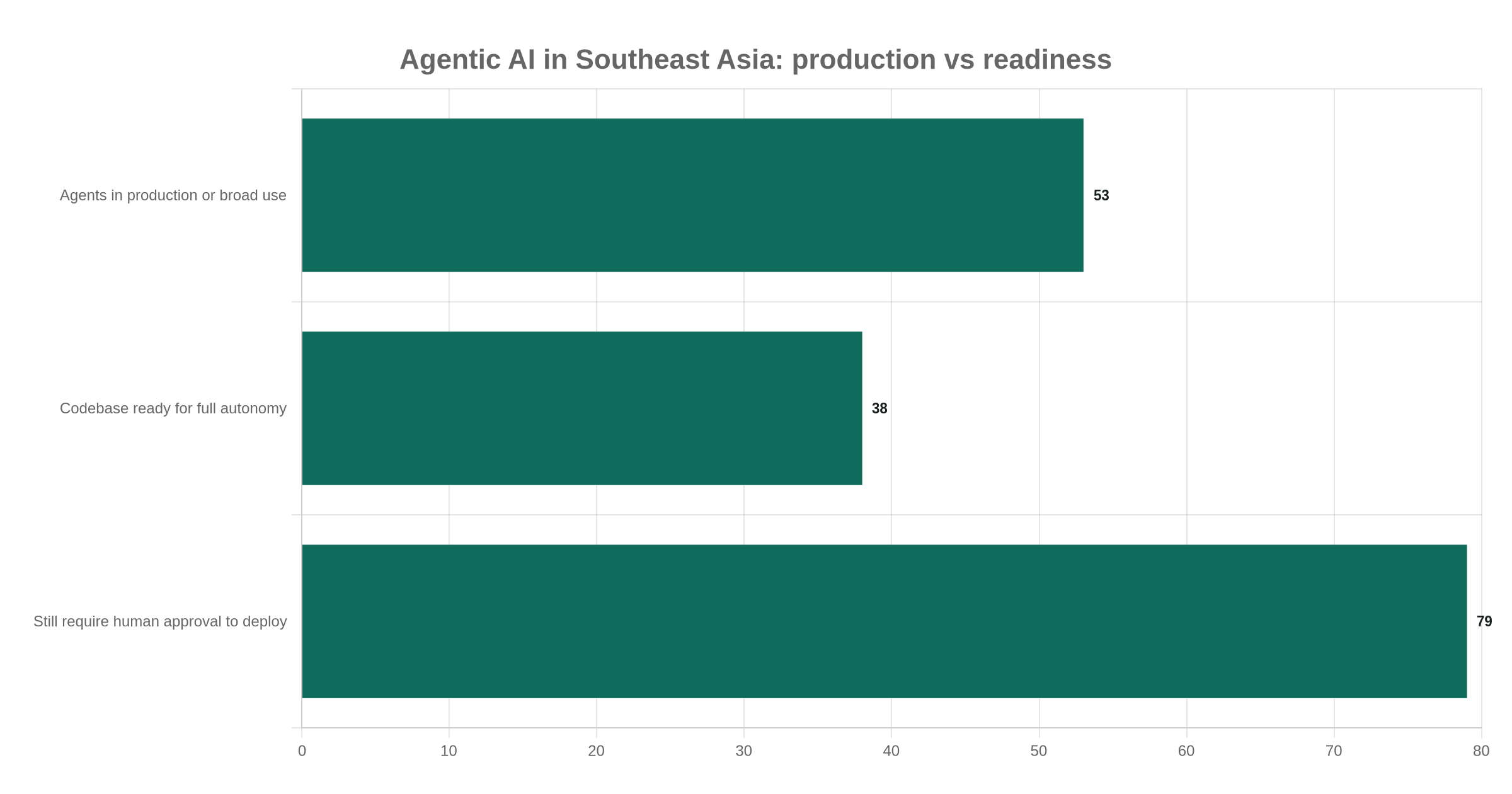
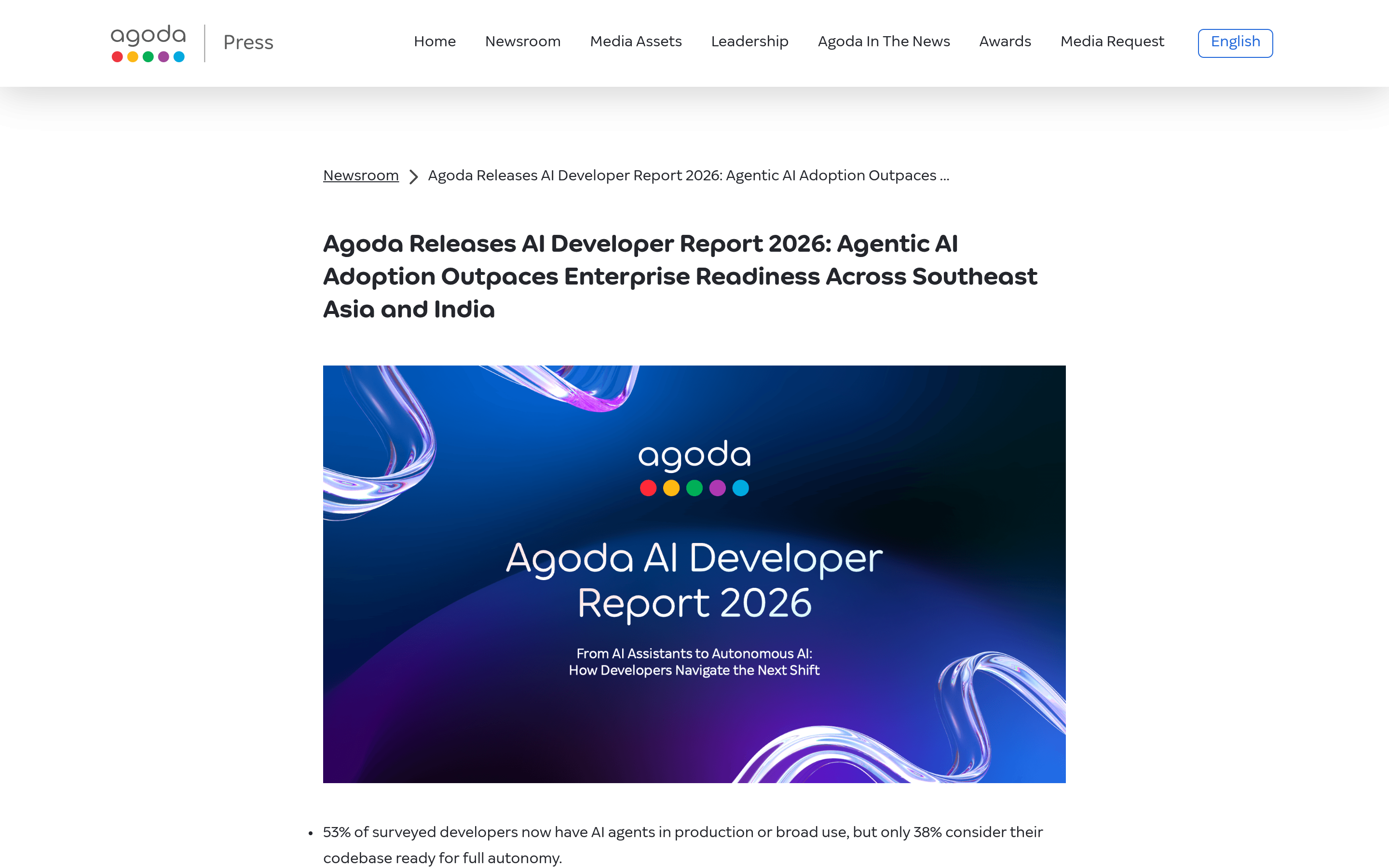
A 2026 developer survey across Southeast Asia and India found that 53 percent of teams already run an AI agent in production or broad use, yet 79 percent still require a person to approve every production deployment (Agoda AI Developer Report, 2026). Agentic AI is the software category behind that split: a system that plans a multi-step task, chooses which tool to use at each step, and adjusts the plan when something goes wrong, instead of answering one prompt at a time like a chatbot. For a business in Phnom Penh weighing whether to build one, that gap, not the industry hype around the term, is what actually matters.
This piece defines agentic AI in plain terms, works through three examples sized for a Cambodian SME, and argues that a fair amount of what gets marketed locally as "agentic" is really a well-built workflow wearing a newer label. We build agentic systems and workflow automation for clients from Phnom Penh as part of our AI agents work, so the distinction below is the one we actually use when scoping a project, not a theoretical one.
What Makes an AI System "Agentic" Instead of Just Automated?
An AI system is agentic when it can plan a multi-step task on its own, decide which tool or data source to use at each step, and revise that plan mid-task without a human approving every move, a step beyond both a scripted workflow and a chatbot. IBM defines it as an AI system that accomplishes a specific goal with limited supervision (IBM, 2026), and Google Cloud frames the contrast directly: generative AI responds to a prompt, while agentic AI "orchestrates complex tasks across digital and physical systems" using a model as its reasoning engine (Google Cloud, 2026).
MIT's John Horton sharpens that further: agentic AI is autonomous software that "perceive, reason, and act in digital environments to achieve goals on behalf of human principals" (MIT Sloan, 2026). His colleague Sinan Aral draws the line that matters most for a buying decision: true agentic AI usually means multiple agents "orchestrating a task together," not one chatbot with a slightly longer memory (MIT Sloan, 2026). That matters because a single AI agent doing one bounded job is already useful and far cheaper to build than a multi-agent system planning across several. Most Cambodian SMEs need the first kind long before they need the second.
The Adoption Numbers Hide a Wide Gap Between Piloting and Production
Agentic AI adoption looks much larger in headline surveys than it does once you ask how much of it is actually unattended in production. Gartner expects task-specific agents inside 40 percent of enterprise applications by the end of 2026, up from under 5 percent in 2025 (Gartner, 2025), and NVIDIA's 2026 State of AI Report puts 44 percent of surveyed companies already deploying or assessing AI agents (NVIDIA, 2026). Southeast Asia tracks that same curve: a February 2026 McKinsey, Singapore EDB and Tech in Asia survey found adoption still concentrated in technical functions like software engineering rather than customer-facing roles (McKinsey/EDB, 2026).
The Agoda developer survey above is the most granular read on that gap, because it asks the same companies about both ends of the funnel. Over half already run agents somewhere in production, but fewer than four in ten trust their own codebase to run one fully unattended, and fewer than one in five have built the governance to let an agent act without sign-off on every change. "The real cost is not simply the model call," said Idan Zalzberg, Agoda's CTO. "It is the work required to make AI trustworthy in production" (Agoda, 2026). That work, not the model itself, is what separates a demo from a deployed agentic system.
Three Agentic AI Examples That Fit a Cambodian SME Today
Three kinds of agentic AI fit a Cambodian SME right now, none needing a multi-agent system on day one: picture a 15-room guesthouse in Siem Reap, a retail shop in Phnom Penh, and an online seller on Telegram, as illustrations rather than client stories.
- A booking agent, not a booking chatbot. A chatbot answers "do you have a room on Friday?" An agentic version checks live availability, applies the guesthouse's own discount rules, holds the room, and only escalates a group booking or a price objection to a human. The difference is the second and third step: deciding, not just answering. At 70 percent occupancy, that is roughly 315 room-nights a month, and even at one inquiry per booked night, the agent is already triaging 200 to 300 messages before anything unusual shows up.
- A payment-reconciliation agent that knows when to stop. Matching KHQR payments against orders, against a national Bakong total of 608 million transactions worth 104.81 billion US dollars in 2024 (CoinGeek, reporting National Bank of Cambodia data, 2025), is usually a fixed sequence: read the notification, find the order, mark it paid: a n8n automation worth building first. It becomes agentic the moment it has to decide what to do with a partial payment, a duplicate, or an unscripted refund request, and chooses the next step itself.
- A Telegram support agent with limited authority. Most Cambodian customer support already happens on Telegram. A shop fielding even 50 refund and exchange requests a month spends 5 to 10 minutes per case checking the order and the policy before replying, 4 to 8 staff-hours. An agentic version reads the message, pulls the order record, resolves a routine refund within a pre-set limit, and hands off only what it is not authorized to decide, freeing most of that time for cases that need a person. Give it that authority gradually, not on day one.
How Does an Agentic Workflow Actually Run, Step by Step?
An agentic workflow runs as a loop, not a straight line: perceive the current state, plan the next step toward the goal, act through a tool or API, then check the result before deciding what to do next. Take the Telegram refund agent from above. It perceives an incoming message and the order history, reasons about whether the request fits a pre-approved refund rule, acts by issuing the refund or drafting an escalation if it does not, then reflects: did the refund post correctly, does the customer need a follow-up, should the case be logged for a human to review later.
That reflection step is what a scripted workflow typically skips, and it is also where most of the cost sits. A fixed n8n workflow runs the same four moves every time and is comparatively cheap to build and audit. An agentic loop has to reason about which move to make, which means it calls a language model more often, needs a clear boundary on what it is allowed to decide, and needs a reliable agent harness wrapped around it so a bad reasoning step gets caught before it reaches a customer or a bank account. Gartner predicts inference cost per agentic workflow will rise more than fivefold through 2028 (Gartner, 2026), a direct consequence of that extra reasoning step, not a pricing quirk.
What Does the Agentic AI Hype Get Wrong for a Business Here?
The agentic AI hype gets the risk backward for a Cambodian business: it sells autonomy as the goal, when a narrow, supervised scope is what actually keeps a first project alive. We think most Cambodian SMEs that bought an "AI agent" this year actually bought a well-built workflow, and that is fine on its own terms. The problem is calling a fixed sequence agentic, because it sets the wrong expectation for the second project, the one that is supposed to handle the exception the first one could not.
Gartner predicts over 40 percent of agentic AI projects will be canceled by the end of 2027, citing unclear business value and runaway cost (Gartner, 2025); McKinsey separately found only 23 percent of organizations scaling agentic AI in even one function, globally (McKinsey, 2026). Neither figure argues against agentic AI. Both read, to us, as teams handing an agent too much authority before the governance existed to contain a mistake, and that gap is wider here: Cambodia's draft data protection law is still unenacted (MPTC, 2026) and its draft National AI Strategy 2025-2030 is still unfinished (OECD.AI, 2026). Take the Telegram agent from earlier: in week one it should resolve only refunds under a small fixed amount and log the rest for a person; only once four weeks of decisions hold up should that limit move, or the agent near a payment reversal. Staged authority, not a blanket yes or no on day one, keeps a first agentic project inside the regulatory gap instead of outside it.
The ILO's often-cited, decade-old estimate that 57 percent of Cambodian employment sits at high automation risk (ILO, 2016) is usually read as a threat. Read the other way, it argues for starting now, narrowly, on one bounded task with a human signing off, rather than waiting for a fully autonomous system that is still years out everywhere, not just here. If your business is weighing a first agentic build this quarter, our free process-mapping audit scores the candidate task against exactly this framework before any code gets written. Book a call with our AI agents team, or browse recent project work first.
Prefer to chat? Message our founder directly on Telegram (@maxgrolier), or book a call with the team.
Frequently asked questions
Is ChatGPT an agentic AI?
Not by itself. ChatGPT answers prompts and can call a limited set of tools, but a standard chat session does not plan a multi-step task or act across systems without you driving each step. Products built on top of it with tool access, memory and a planning loop, including some of OpenAI's own agent features, move closer to agentic.
Is agentic AI the same thing as an AI agent?
No. An AI agent is usually one bounded system doing one job, answering a question or filing a record. Agentic AI is the broader capability, and MIT's Sinan Aral specifically ties the term to multiple agents orchestrating a task together, not a single agent working alone (MIT Sloan, 2026).
How much does an agentic AI project cost to build in Cambodia?
It depends heavily on scope, since an agentic loop with tool access and reasoning steps costs more to build and run than a fixed workflow doing the same visible job. See what an AI agent costs for a worked build and running-cost range.
Is an n8n workflow with an AI step the same as agentic AI?
Usually not. If the sequence of steps is fixed and the AI only fills in content inside one of them, it is a workflow with an AI step, not an agentic system. It becomes agentic once the system itself decides which step to take next based on what it just observed.
Does Cambodia's data protection law allow an agentic AI to handle customer payment data?
The law is still a draft. The Ministry of Post and Telecommunications ran its validation workshop on the draft Law on Personal Data Protection in August 2026, and it had not been enacted as of this writing (MPTC, 2026). Until it is, we treat any agent touching payment or personal data as if the stricter version of that law already applied.
Should a Cambodian SME build agentic AI now or wait?
Start now, but narrow. Pick one task with real volume, keep a human approving the first weeks of decisions, and expand the agent's authority only once it has a track record, rather than waiting for a fully autonomous system that global data shows most organizations have not reached either.