
Why would a Cambodia business building AI agents pay OpenRouter on top of what Claude or GPT already costs, and when does that actually pay off? Because the moment a build has to survive a provider outage, a model deprecation, or three separate billing dashboards at once, routing every model through one key stops being a convenience and starts being infrastructure.
OpenRouter is the orchestration layer we reach for on agent builds that cannot afford to go dark because one provider had a bad night, the same stack named in our own services pages next to n8n. Below, we cover what it actually does, what it costs model by model, and the one question the global guides skip: how a business in Cambodia pays the bill and who ends up seeing the prompts.
What does OpenRouter actually do for an AI agent build?
OpenRouter is a single API key and a single prepaid balance that sits in front of hundreds of models from dozens of providers, Anthropic, OpenAI, Meta, Mistral and smaller labs included, so an agent can call Claude today and fall back to Llama next week without rewriting the integration. OpenRouter's own documentation describes the service as a unified API that passes through each provider's list price with no markup on the inference itself (OpenRouter, 2026).
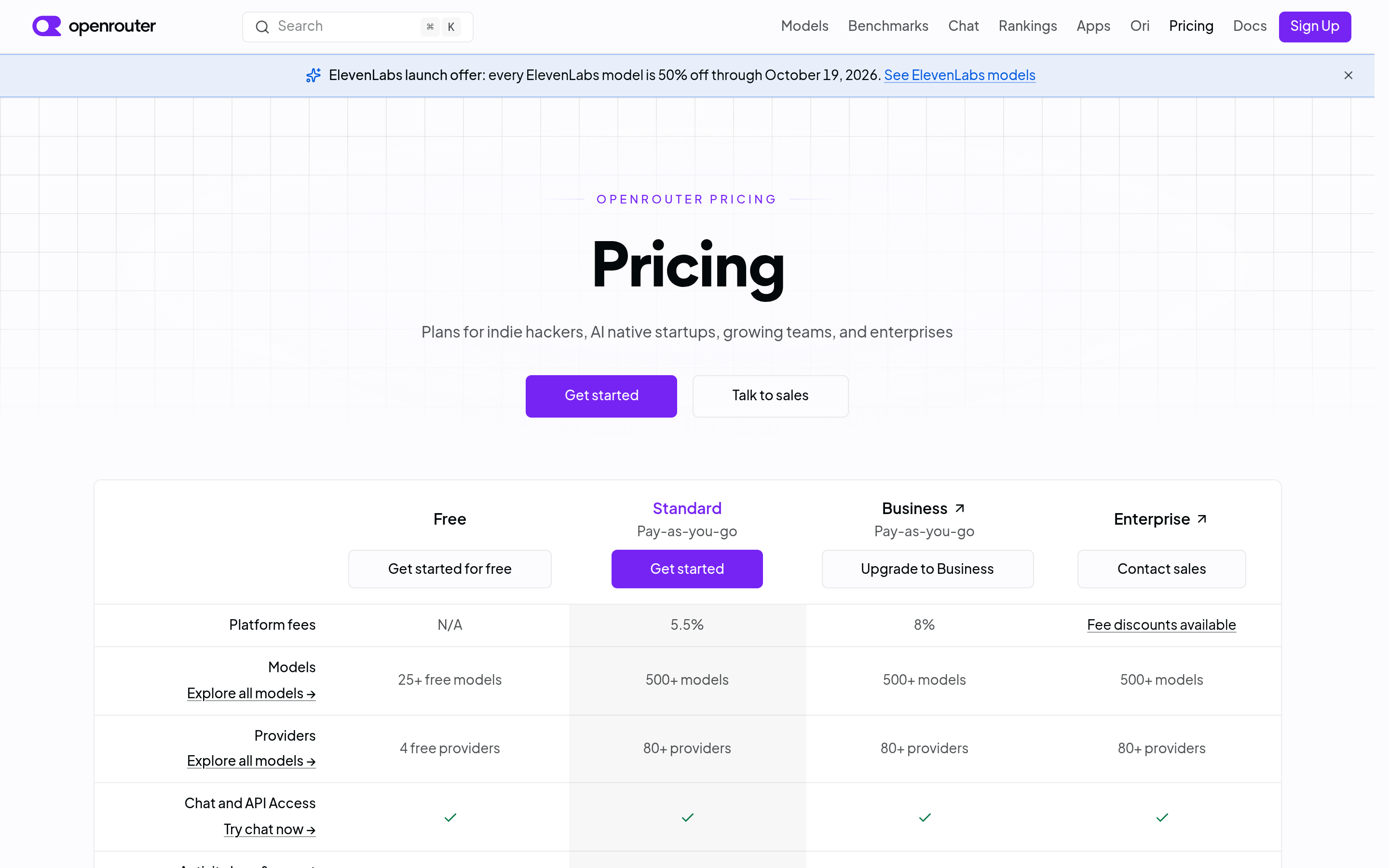
The fee sits somewhere else: a 5.5 percent charge on Standard accounts (8 percent on Business) when credits are purchased, not per request, with an $0.80 minimum. Routing itself carries three useful variants: :nitro optimizes for speed, :floor for the cheapest available provider, and :exacto for tool-calling reliability, a detail that matters once an agent is calling functions, not just chatting.
For a build already running on the automations worth building first, connecting OpenRouter is a credentials swap, not a rebuild. A community-built OpenRouter node covers n8n (recent versions also ship a native one), and the older route still works too: point the standard OpenAI Chat Model node at OpenRouter's own API base URL and drop in an OpenRouter key. Either way, what an AI agent is does not change. What changes is which model answers, and that choice can now move without touching the workflow.
Direct API calls are simpler than OpenRouter, until a provider has a bad day
A direct Anthropic or OpenAI key is the simpler choice on paper: no 5.5 percent credit fee, full access to provider-specific features like extended prompt caching, and one less hop between the agent and the model. For a single-model prototype with no uptime promise to a client, that simplicity is reason enough to skip OpenRouter entirely.
The trade-off shows up the first time that one provider has an outage during business hours, or quietly deprecates the exact model version a workflow was built on. A direct integration has no fallback: the agent is down until a human notices and redeploys against a different provider. OpenRouter's routing automatically retries the next available provider when a request returns a server error or hits a rate limit, a behaviour the platform documents as transparent failover rather than something the workflow has to handle itself.
We default new agent builds to OpenRouter rather than a bare provider key, because the cost of a Claude or GPT outage landing mid-shift on a client's customer-facing agent is higher than what the credit fee adds to a modest monthly bill. On a 50-dollar-a-month inference spend, 5.5 percent is less than three dollars, cheap insurance against an afternoon of silent failures. A reliable outcome still depends on a reliable agent harness around the model, OpenRouter solves the provider problem, not the prompt-and-review problem underneath it.
What does OpenRouter cost to run, model by model?
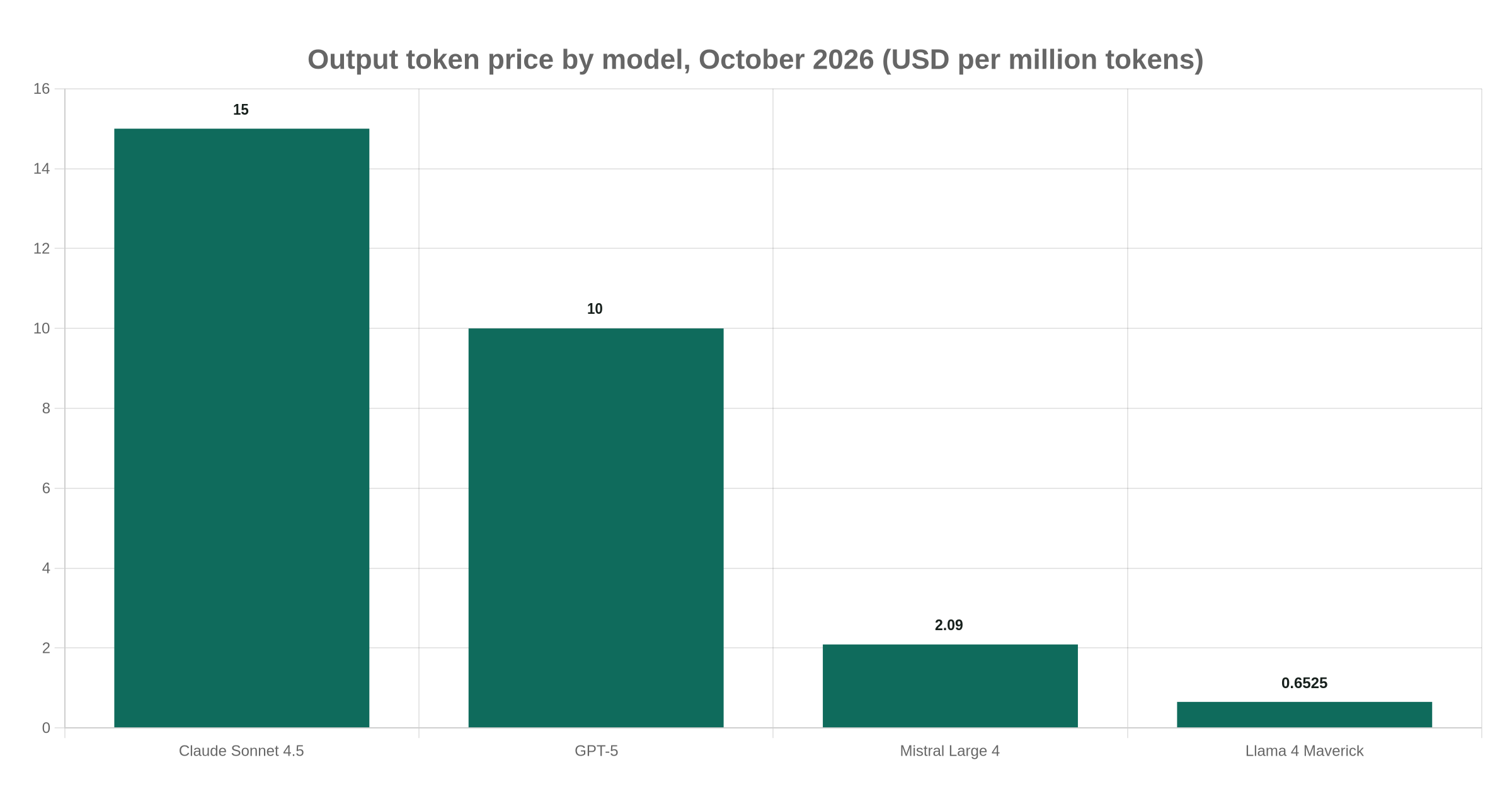
OpenRouter charges each model's own list price per token, so the real cost swings far more by model choice than by the platform itself. As of October 2026, the spread between the cheapest and priciest model we checked runs more than twenty times wider on output tokens alone.
| Model | Input $/M tokens | Output $/M tokens | Notes |
|---|---|---|---|
| Claude Sonnet 4.5 (Anthropic) | $3.00 | $15.00 | $6 / $22.50 past 200K context |
| GPT-5 (OpenAI) | $1.25 | $10.00 | Standard tier pricing |
| Mistral Large 4 (Mistral AI) | $0.68 | $2.09 | Released October 2026 |
| Llama 4 Maverick (Meta) | $0.1875 | $0.6525 | Also free, rate-limited to 50 requests/day |
Put numbers behind it: picture a 12-person Phnom Penh logistics startup running a WhatsApp support agent that answers 500 conversations a month on Claude Sonnet 4.5, roughly 2 million output tokens. That lands near 30 dollars in model cost before fees, and OpenRouter's 5.5 percent credit fee adds roughly $1.65 on top. The same 500 conversations on Llama 4 Maverick cost closer to $1.30 in model cost: at that volume, 5.5 percent of the bill is only a few cents, so OpenRouter's $0.80 minimum fee applies instead and adds roughly two-thirds on top of an already cheap bill, the real line item to watch for a low-volume build on a cheap model, not the model price itself.
We would not point a client's production agent at OpenRouter's free tier. It is the right tool for a weekend prototype in n8n and the wrong one for anything a customer touches, since the daily request cap trips before the day does: 50 requests a day baseline, rising to 1,000 only after the account has bought at least 10 dollars of credits. What an AI agent costs always includes this line, model usage is rarely the figure that breaks a 12-person team's budget, but it is the one vendors most often leave out of a quote entirely.
How do you pay for OpenRouter from Cambodia, and who sees the prompts?
Paying OpenRouter from Cambodia means a card, not a local rail: OpenRouter accepts credit and debit cards, AliPay, and USDC crypto through Coinbase, with no KHQR or ABA PayWay option, since the platform bills in USD through international card networks rather than a Cambodian payment gateway (OpenRouter, 2026). A Visa or Mastercard issued by ABA Bank, Wing or a similar local bank with overseas USD billing enabled works without friction, the same card a team would use for any US-based SaaS subscription.
For that same 12-person logistics startup, we would default to paying OpenRouter by card over crypto. A disputed card charge is a phone call to the bank; a failed crypto top-up is a support ticket and a wait, and most teams here do not keep a USDC balance sitting idle for exactly this purpose.
The privacy side matters just as much once an agent routes a client's customer or ledger data through a third party. OpenRouter performs zero logging of prompts and completions by default, and will only route to a provider that has agreed not to log or train on the traffic, unless the account opts into logging itself for a 1 percent fee discount (OpenRouter, 2026). For most Cambodia builds we would leave that opt-in off: the discount is small, and the question of where a client's data sits should stay a deliberate choice, not a default swapped for a fraction of a percent.
Prefer to chat? Message our founder directly on Telegram (@maxgrolier), or book a call with the team.
Frequently asked questions
Does OpenRouter support Mistral and open-weight models like Llama?
Yes. OpenRouter lists models from Mistral AI, Meta's Llama family, and dozens of other providers alongside Claude and GPT, each billed at that provider's own list price. Mistral Large 4 and Llama 4 Maverick both sit in the same catalogue as Claude Sonnet 4.5 and GPT-5, switchable through the same API key.
Can n8n call OpenRouter directly inside a workflow?
Yes, two ways. A community-built OpenRouter node exists for n8n, recent versions also ship a native one, and the generic OpenAI Chat Model node also works by pointing its base URL at OpenRouter's API endpoint, with an OpenRouter key in the credential field.
What happens when a model provider goes down mid-request?
OpenRouter automatically retries the request against the next available provider for that model when it receives a server error or hits a rate limit. The failover is transparent to the calling application, no retry logic has to be written into the agent itself.
Is OpenRouter's free tier usable for a production agent?
Not for anything a customer touches. The free tier caps requests at 50 a day, rising to 1,000 a day only after the account has purchased at least 10 dollars of credits, a ceiling a live customer-facing agent clears quickly.
Does OpenRouter log or train on the prompts it routes?
No, by default. OpenRouter logs zero prompt or completion data unless the account explicitly opts in for a 1 percent fee discount, and it only routes to providers that have agreed not to train on the traffic passing through.
What to check this week
Before wiring OpenRouter into a build, or deciding it is not needed yet, run through this short list:
- Count your daily request volume. If it is under 50 a day, the free tier may cover a prototype; anything customer-facing needs a funded account from day one.
- Pick a payment method now. A USD-enabled card from a local bank is the simplest route from Cambodia; keep a small USDC balance only if the team already holds crypto for other reasons.
- Decide on logging before the first live request, not after. Leaving the default off keeps client data out of OpenRouter's logs entirely.
- Price your heaviest model against your cheapest acceptable one. The gap between Claude Sonnet 4.5 and Llama 4 Maverick on the same workload can be twenty times wider than it looks on a single model's pricing page.
- Confirm your harness, not just your routing. OpenRouter solves provider failover; it does not review an agent's output before a customer sees it.
Weighing OpenRouter against a direct provider key for your own build, or unsure which model tier actually fits your conversation volume? Request a scoped estimate once you know your expected volume, so we can size the model mix and the fee against your real conversation count. Want to talk it through first? Book a call with our Phnom Penh team, or browse our project work to see how we have wired this into past builds.