Good web design in Siem Reap has one job for a hotel, tour operator or restaurant: turn a phone search into a direct booking or a WhatsApp inquiry, without losing the visitor to a slow page, a broken photo gallery or a booking form that only works on desktop. That job has gotten harder, not easier. Angkor Archaeological Park welcomed 387,772 international visitors in the first half of 2026, down 31.7 percent year-on-year, with ticket revenue down 29.8 percent over the same period (Xinhua, July 2026), so every property is competing for a smaller pool of international arrivals than it was fighting for in 2025.
The properties holding onto that shrinking pool are, in our view, the ones no longer renting their whole booking relationship from Booking.com and Agoda at a 15 to 28 percent commission per room. A direct-booking website takes some of that relationship back: the same traffic, converted without paying a platform for the introduction.
What does a website need to do for a hotel, tour operator or restaurant in Siem Reap?
A Siem Reap hospitality website needs to load fast on a phone, show a bookable calendar or a one-tap inquiry, and connect to the channels guests already use, WhatsApp, Telegram and a KHQR payment link, not just an email form nobody checks between shifts. Mobile devices made up over 70 percent of global online travel traffic in 2024 (Navan, 2025), so a site built and tested on a desktop screen is optimising for the visit that almost nobody makes.
The same site also has to survive a slow hotel wifi connection and a tourist's roaming data plan, which rules out heavy image galleries as the default homepage. This sits alongside our broader look at web development in Cambodia: the same mobile-first discipline applies everywhere in the country, Siem Reap just adds a harder connectivity floor because so much of the traffic arrives mid-trip, on a phone, between temple visits.
How many hotels and guesthouses in Siem Reap actually need this?
Siem Reap's registered accommodation supply is shrinking, which raises the stakes for each remaining property rather than lowering them. The Ministry of Tourism counted 179 hotels in Siem Reap in 2024, down from 190 the year before, and 243 guesthouses in 2025, down from 293 in 2024 (Cambodia Ministry of Tourism, via CEIC).
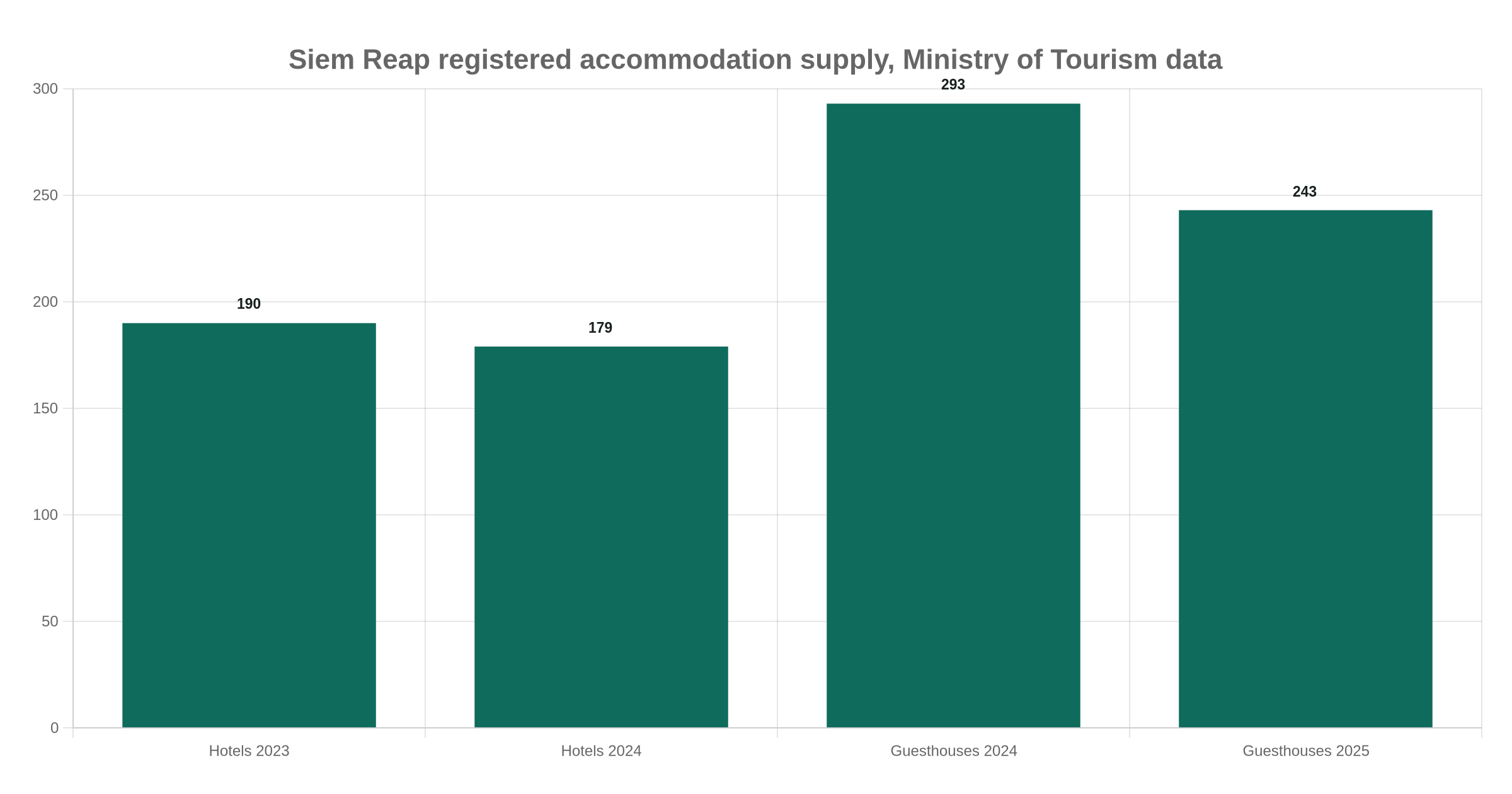
Read next to the arrivals numbers, that combination (fewer registered properties, fewer international visitors) means a weaker online presence now costs a Siem Reap property more of its addressable market. Tourism still contributes 9.4 percent of Cambodia's GDP as of 2024 (Open Development Cambodia, citing the Ministry of Tourism), so the sector is not shrinking away, but the properties that hold their bookings through this stretch will be the ones a guest can actually find, evaluate and book without friction.
The templated site most Siem Reap properties start with fails on three points
A generic templated site usually fails on three points at once: it is not genuinely mobile-first, it has no real booking or inquiry flow, and it uses stock photography instead of the property's own rooms, food or tours. A search for a web designer in Siem Reap turns up a long list of small local studios and freelancers, most offering a fast, low-cost templated build, which is a reasonable option for a business that just needs a digital business card.
It stops being reasonable once the site is the main channel converting a search into a booking. One failure mode is a templated gallery slideshow that takes six seconds to load on hotel wifi, with no clear way to check a date or send a WhatsApp message. Another is a booking or contact form built for a desktop screen only: a date field that needs pinching and zooming loses the guest before the enquiry reaches an inbox.
What does relying on OTAs instead of a direct-booking website actually cost a Siem Reap property?
Relying only on Booking.com, Agoda and a Facebook page costs a Siem Reap property a fixed percentage of every booking, with no way to reduce that cost as volume grows. Booking.com's headline commission for a Southeast Asian property is typically 15 percent, and the true all-in cost regularly exceeds 28 percent with other platform fees added (Hospitality Net, 2026). Agoda's commission runs 15 to 25 percent by industry estimates (SmartOrder, 2026).
Take a 20-room boutique hotel in Siem Reap at a $40 average nightly rate, selling 200 room-nights a month through OTAs at a 15 percent commission: that is $1,200 a month, $14,400 a year, paid to the platforms before any other cost. If a direct-booking website captures even 40 of those room-nights a month instead, the hotel keeps roughly $240 a month, around $2,880 a year, close to what a properly built showcase site costs to commission in the first place. This is illustrative, not an audited figure for any property, but the direction holds: a direct channel does not need to replace OTA listings, it just needs to take back a slice of them.
We think a Siem Reap hotel or tour operator that only appears on Booking.com, Agoda and a Facebook page is renting its entire customer relationship from three platforms it does not control, and paying a commission on every booking for the privilege.
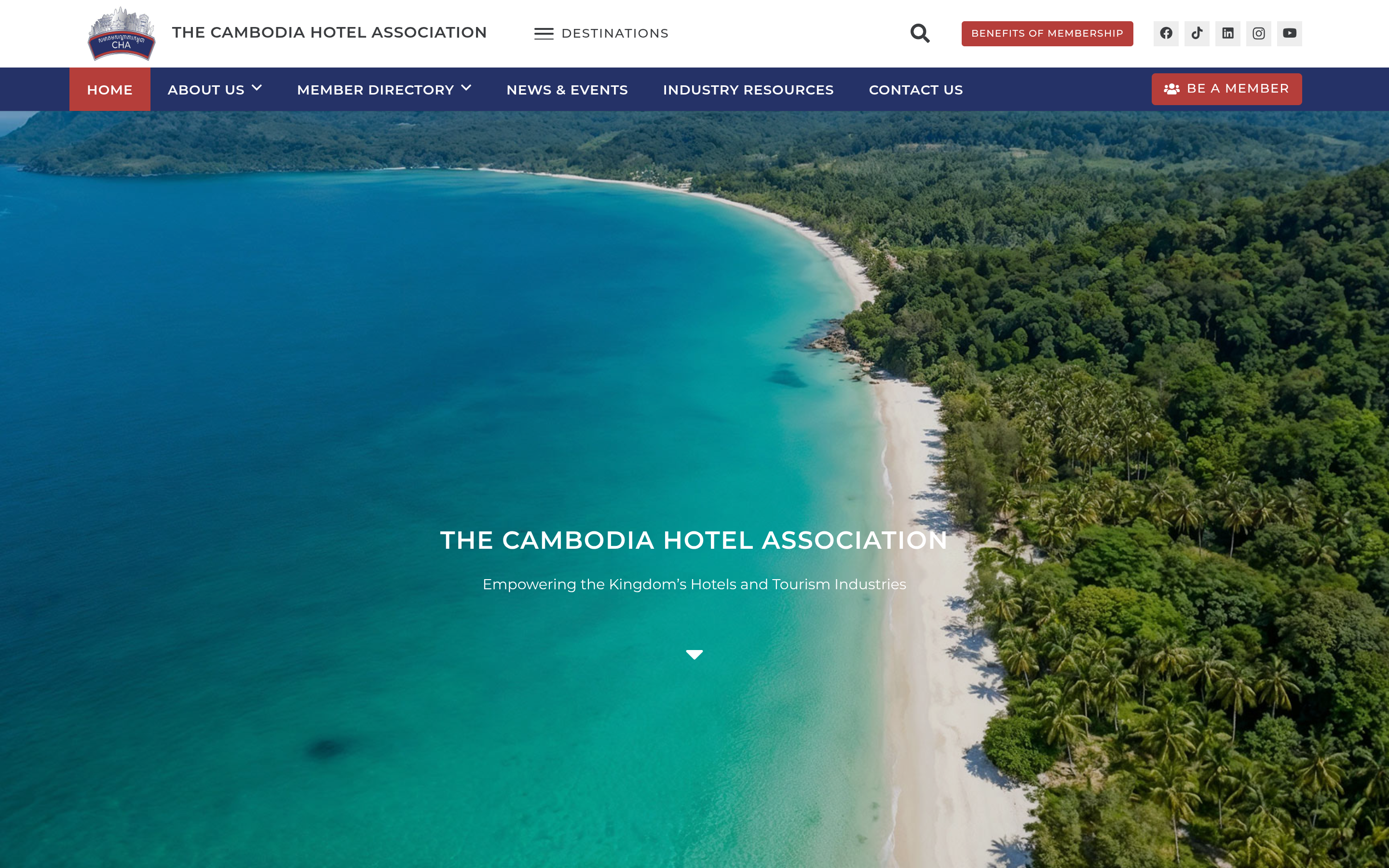
A property's own site is also judged against a more institutional bar than a Facebook page. The Cambodia Hotel Association, the sector's trade body, runs a plain, credible member site, the baseline a guest compares a small hotel's website against before booking directly.
Website, OTA listing or Facebook page: what should a Siem Reap hospitality business actually run?
A Siem Reap hospitality business should run all three, but only a website gives it control over the booking flow and the brand. Each channel does a different job, and none of them substitutes for the other two.
| Website | OTA listing (Booking.com, Agoda) | Facebook page | |
|---|---|---|---|
| Booking control | Full, direct to the property | None, platform sets terms | Manual, via Messenger |
| Cost per booking | Fixed build cost, then near-zero | 15 to 28 percent commission | Free, but slow to convert |
| Findable on Google | Yes, if built for it | Only via the OTA's own listing | Rarely ranks |
| Brand and story | Full control | Templated, same layout as competitors | Partial |
| Best for | Direct bookings, credibility, SEO | Volume and international discovery | Daily updates, quick replies |
The practical answer: keep OTA listings for discovery, a Facebook or Telegram channel for quick replies, and a website as the piece that converts a guest who already found the property into a direct, commission-free booking.
TechFlow's web design process for a Siem Reap project
Our process for a Siem Reap hospitality project runs the same six steps as every web project: scoping and audit, technical recommendations, design and prototype, sprint-based development, testing and go-live, then post-launch follow-up, delivered from Phnom Penh, ICT (UTC+7), over video calls and Telegram rather than in-person meetings. A showcase site typically takes 3 to 6 weeks from kickoff to launch, depending on how ready the photography, room inventory and copy are at the start.
Working from Phnom Penh rather than opening a Siem Reap office is a deliberate cost structure, not a compromise: it is part of why we position at roughly 35 percent below what a European agency would charge, a general positioning claim, not a measured saving on any specific project. The same team also builds web design and Webflow projects for SME clients elsewhere in Cambodia, so a Siem Reap brief runs through the same process as everything else we ship.
We would not build a full custom website for every guesthouse or tuk-tuk operator in Siem Reap. Below a certain size, a clean Google Business Profile, a fast WhatsApp or Telegram reply and a KHQR payment link solve more of the actual problem than a five-page site nobody updates.
What local details does a Siem Reap hospitality website need that a generic template skips?
A Siem Reap hospitality website needs local payment and messaging details baked in from the start, not bolted on after launch. KHQR, the National Bank of Cambodia's QR payment standard, is now accepted at more than 4.5 million merchants nationwide (National Bank of Cambodia data, 2026), so a booking deposit or a restaurant bill that supports a KHQR scan removes a real friction point for both Cambodian and international guests using the Bakong Tourist App.
Cambodia counted 12.0 million internet users as of October 2025, 67.3 percent of the population (DataReportal, Digital 2026 Cambodia), most of them on a phone rather than a desktop, so a WhatsApp or Telegram widget that opens a real conversation beats a contact form every time. Angkor Enterprise, which manages ticketing for Angkor Archaeological Park, already sells passes online and through its own mobile app, so guests arrive already expecting a digital-first experience before they ever reach a hotel's own site. Khmer and English text need to sit side by side without either script breaking on mobile, and a site should never assume every guest pays in US dollars only: riel pricing still matters for domestic visitors, whose visits rose 47.6 percent year-on-year even as international arrivals fell (The Star, September 2026).
Ready to fix your Siem Reap hospitality website
If your current site is a template nobody has touched since it launched, or you are still running the business entirely through Booking.com, Agoda and a Facebook page, book a call with our web development team and we will walk through what a properly built site would change. We scope every project on a call first, not a generic package, and can go through your booking flow, room inventory or menu before quoting anything. Our design and branding team covers visual identity when that is the bigger gap, you can see examples of what we have shipped on our projects page, or get in touch if you would rather message first.
Prefer to chat? Message our founder directly on Telegram (@maxgrolier), or book a call with the team.
Frequently asked questions
How long does it take to build a hotel or tour website in Siem Reap?
A showcase site for a hotel, restaurant or tour operator typically takes 3 to 6 weeks from kickoff to launch, depending on how ready the photography, room or tour inventory, and copy are when the project starts.
Do we need a website if we already have a Facebook page and a Booking.com listing?
Yes, because neither channel gives the property control over the booking flow or the commission it pays. A website adds a direct, largely commission-free booking or inquiry path on top of the discovery those platforms already provide.
Can a Siem Reap hotel or restaurant website accept KHQR payments?
Yes. KHQR, the National Bank of Cambodia's QR payment standard, can be integrated into a booking deposit or bill payment flow, and the Bakong Tourist App extends the same standard to visitors without a Cambodian bank account.
Does the website need to work in Khmer as well as English?
For most Siem Reap hospitality businesses, yes, at least for key pages like booking terms and contact details, since staff, suppliers and a share of domestic guests read Khmer, and the site should never assume every visitor reads English.
Should a small guesthouse or tuk-tuk operator get a full website at all?
Not always. Below a certain size, a well-maintained Google Business Profile, a fast reply on WhatsApp or Telegram, and a KHQR payment link cover most of what a small operator needs, and a full website makes more sense once booking volume or brand positioning justifies it.
What happens after the website launches?
Launch includes testing and go-live as one of our six process steps, and we stay involved for post-launch follow-up to fix issues, adjust content and confirm the booking or inquiry flow is converting the way it was designed to.