For a Cambodian SME, the n8n vs Zapier vs Make choice comes down to three questions most comparison blogs never ask: where does your workflow data sit, does the tool reach Telegram and KHQR instead of just Gmail and Slack, and does your billing model survive the month your busiest workflow triples. Zapier wins on the fastest setup and the widest connector library. Make wins on value for a three- or four-step workflow. n8n wins once you touch custom APIs, AI logic, or data that should not leave Cambodia.
None of that shows up in a feature table, so the rest of this article covers cost, data residency, local integrations, and the skills each tool demands.
n8n vs Zapier vs Make: three different bets on how automation should work
n8n, Zapier, and Make are workflow automation platforms: each lets you connect two or more apps so an event in one (a new Telegram message, a form submission, a paid invoice) triggers an action in another, without writing a full application. Where they differ is who builds the workflow and where it runs. Still deciding whether to build this in-house or bring in help? Our AI development in Cambodia guide covers that first.
Zapier bets on breadth and speed: the largest library of pre-built app connections, aimed at a non-technical user wanting a result in ten minutes. Make (formerly Integromat) bets on visual power: a canvas where branches and routers are drawn rather than stacked. n8n bets on control: an open-source core that can run on your own server, a workflow editor mixing visual nodes with real code, and pricing built around executions, not individual steps.

A widely upvoted thread in r/zapier (2026) put the practical pattern well: Zapier suits a first automation, Make fits once it grows branches, and n8n makes sense once APIs, custom logic, or AI workflows enter the picture.
How much do n8n, Zapier, and Make cost for a small team in Cambodia?
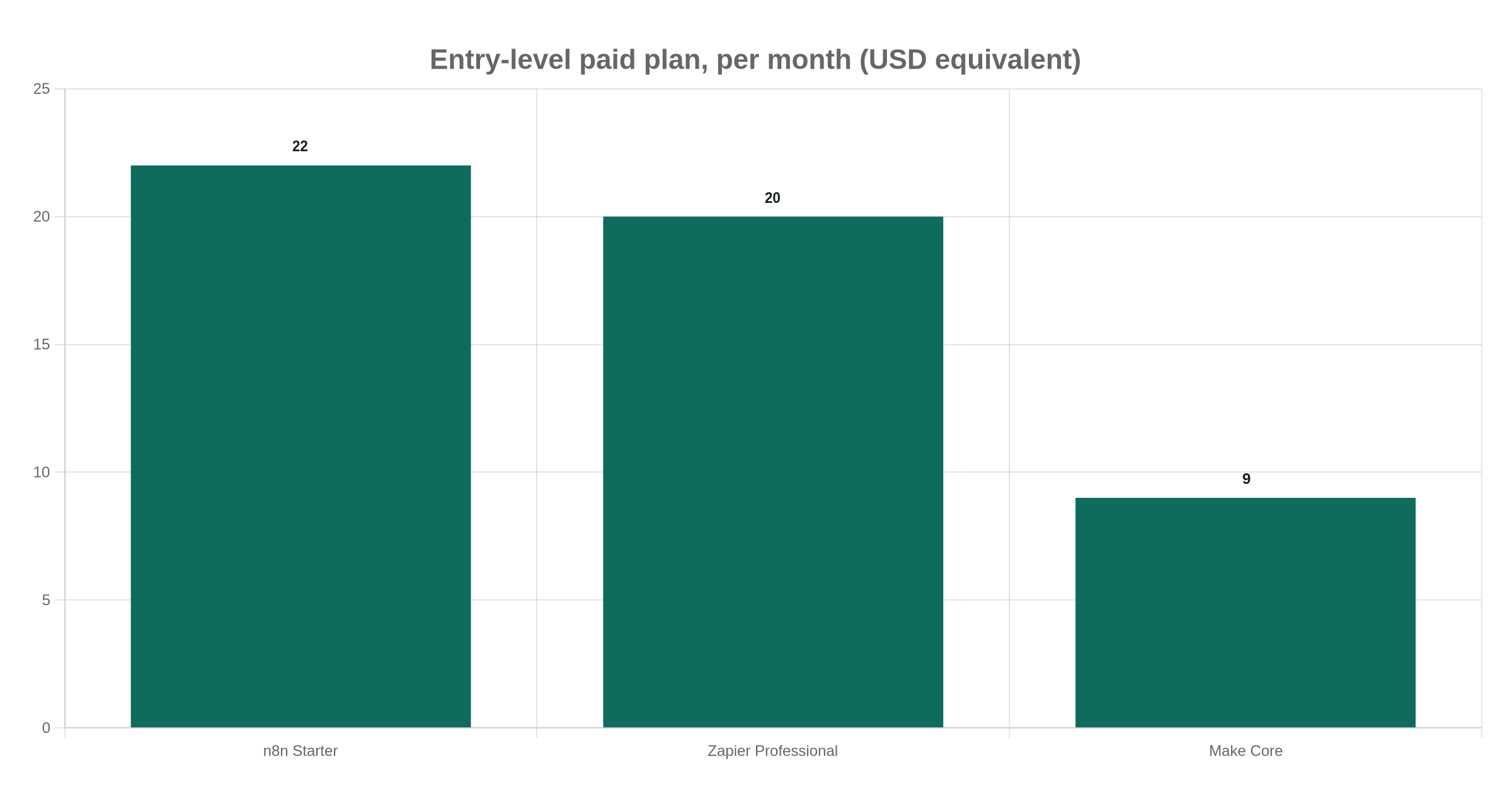
n8n, Zapier, and Make bill on three different units, and the unit matters more than the sticker price. Zapier charges per task, one per completed action step. Make charges per credit, roughly one per module run. n8n charges per workflow execution, where a ten-step workflow triggered once still counts as one.
| Tool | Free tier | Entry paid plan | What one unit costs you |
|---|---|---|---|
| Zapier | 100 tasks/month, 2-step Zaps only | Professional, from $19.99/mo (750 tasks, billed annually) | 1 task per completed action step |
| Make | 1,000 credits/month, 2 active scenarios | Core, $9/mo (10,000 credits) | About 1 credit per module run (non-AI) |
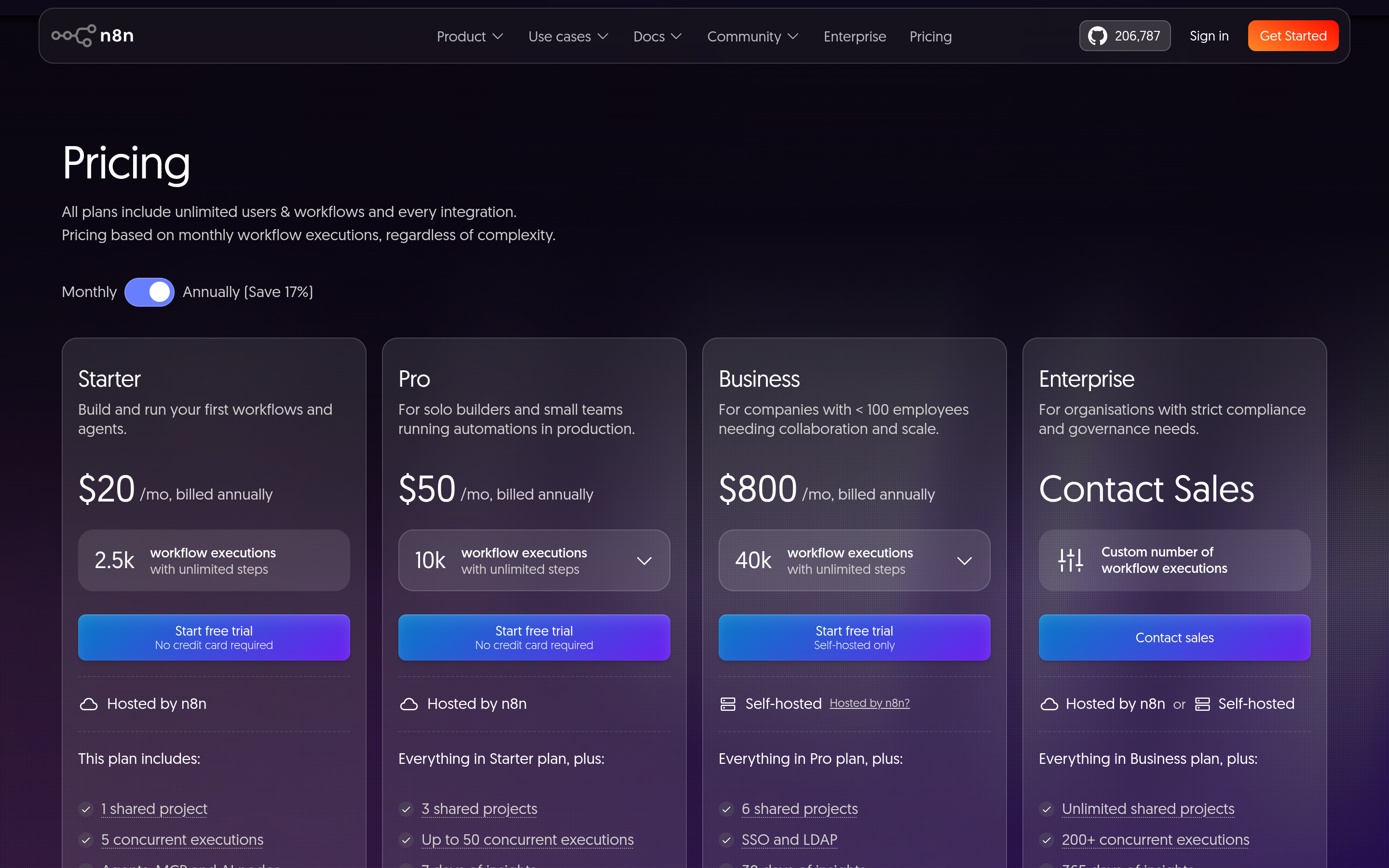
| n8n | Unlimited, self-hosted Community Edition (free) | Cloud Starter, 20 euros/mo (2,500 executions) | 1 execution per workflow run, regardless of step count |
Take a 12-room guesthouse in Siem Reap that wants every Telegram booking request to create a row in a CRM and send a confirmation email: one trigger, three action steps. At 40 bookings a month, Zapier counts 120 tasks (3 actions times 40), already past the 100-task free plan. Make counts roughly 160 credits, comfortably inside its 1,000-credit free plan. n8n counts 40 executions, whatever the step count, barely denting a 2,500-execution Cloud Starter plan.
That gap in billing units has a direct dollar cost. The guesthouse has to jump to Zapier's $19.99-a-month Professional plan just to clear 120 tasks, while the identical workflow stays free on Make (160 of 1,000 credits) and free on n8n's self-hosted Community Edition, hosting aside.
We think most Cambodian SMEs under about 20 staff should start on Make, not Zapier. Credit-based billing survives a three- or four-step KHQR-to-CRM workflow without the per-task math turning against you as it grows.
Which tool keeps customer data inside Cambodia?
n8n is the only one of the three you can self-host, which matters once the workflow touches customer financial data. Zapier and Make are cloud-only: your data flows through their US and EU servers. n8n's Community Edition is free, open-source software you run yourself, with no execution limit and no data leaving your infrastructure unless a node sends it somewhere on purpose.
This is not theoretical. Cambodia's Ministry of Post and Telecommunications held a validation workshop on the draft Law on Personal Data Protection on 5 August 2026 (MPTC, 2026). The draft, modelled partly on the EU's GDPR, would require breach notification within 72 hours and make transfers of personal data abroad subject to ministry permission or listed exceptions. It remained unenacted as of September 2026 (DLA Piper Data Protection Laws of the World, 2026).
Wait for the draft law to force the question, and the migration happens on a regulator's deadline, not yours. We think any business already touching KHQR payment data, ID numbers, loan or insurance applications should move to n8n self-hosted now, while it is still a choice. A compliance requirement you cannot yet estimate beats a monthly SaaS bill you can. Self-hosting is not free: it swaps a subscription for a small cloud server, typically $5 to $20 a month at DigitalOcean or Vultr. A lending or micro-insurance shop processing 300 KHQR loan-repayment confirmations a month, each needing a trigger plus four action steps (verify against the ledger, update the record, send a Telegram confirmation, log it), counts 1,200 Zapier tasks, pushing past the 750-task tier into the $39-a-month, 1,500-task tier, almost double the guesthouse's plan. Make counts roughly 1,500 credits, still inside its $9-a-month, 10,000-credit Core plan, so a cost-driven Zapier alternative search lands on Make too. n8n counts 300 executions, so the server earns its keep twice: on cost, and by keeping loan and ID data off infrastructure the draft law would flag.
Which tool connects to what a Cambodian SME actually uses?
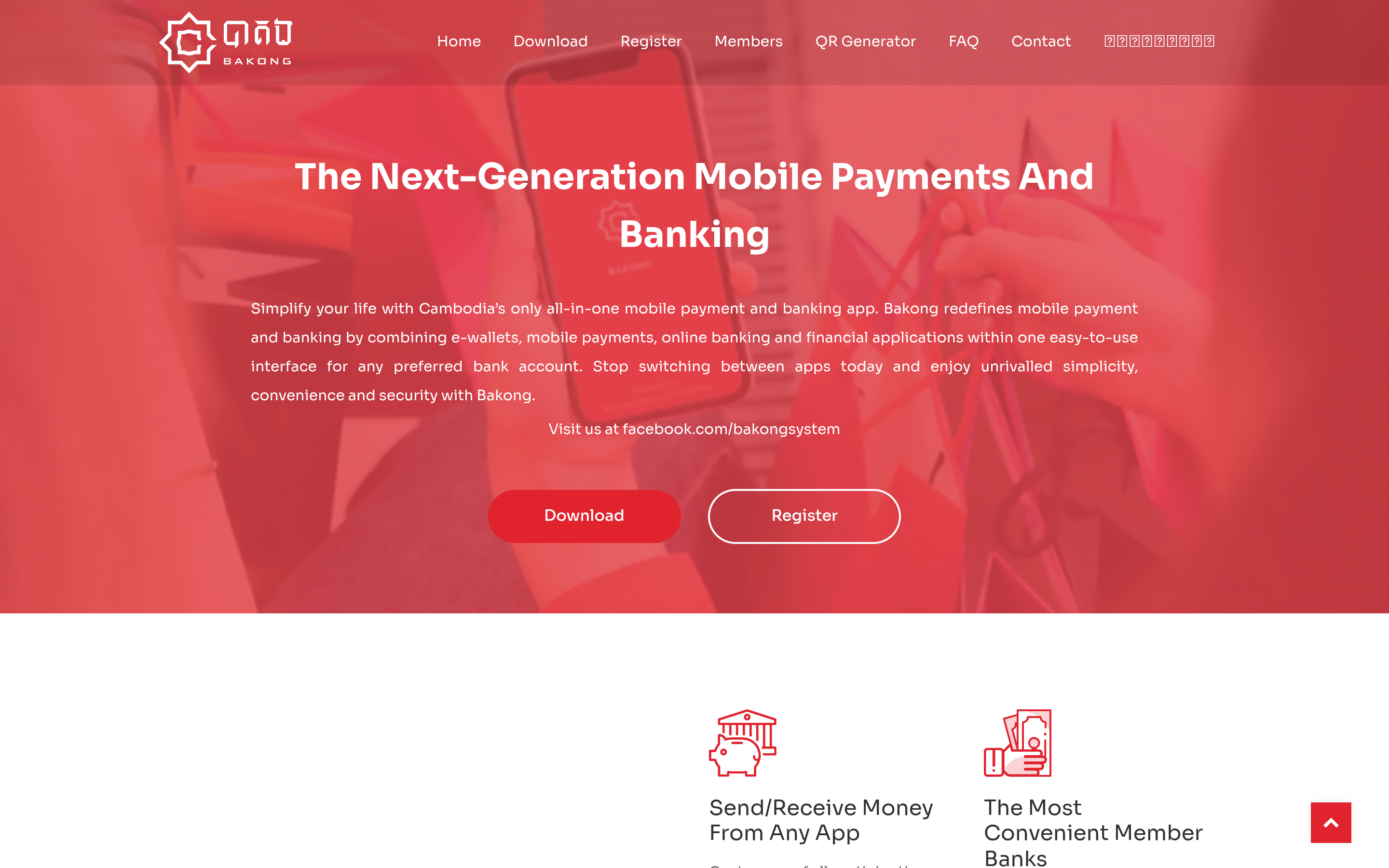
Zapier and Make both have official Telegram integrations and can reach a KHQR gateway such as ABA PayWay through a webhook; neither has a native ABA PayWay or Bakong connector. Make's HTTP and webhook modules add more visual control for routing a payment by amount or reference number.
n8n has the deepest reach here because its HTTP Request and Webhook nodes are first-class citizens of the platform, feeding straight into a CRM node for HubSpot or a self-hosted Twenty CRM instance. An n8n automation that reads a KHQR webhook, checks it against an open invoice, and updates that record is native here; Zapier or Make would lean on a generic HTTP module for the same job. That code-friendly editor is why one long-time Zapier user, on the n8n forum, called n8n cheaper, more extensible, and open-source, with none of Zapier's per-task ceiling (n8n Community, 2026).
Do you need a developer to run n8n, or can anyone use Zapier and Make?
You do not need a developer for a first workflow in Zapier or Make; both are built for a non-technical founder to drag, drop, and publish inside an hour. n8n's canvas is approachable too for a simple two-step automation, but a custom API or real error handling benefits from someone comfortable reading JSON and writing a short script.
That gap matters more here than in a market with deep software talent. CDRI's research on digital skills documents a persistent gap between the ICT competencies Cambodian employers need and what local graduates supply (CDRI, 2026). A Cambodian SME choosing n8n should budget for a technical hire or an agency partner; a Zapier or Make workflow is more realistically founder-owned. A short AI consulting audit usually settles which side of that line your team falls on.
n8n vs Zapier vs Make: which one should a Cambodian SME pick?
n8n vs Zapier vs Make is not one answer but three, depending on what the workflow touches and who maintains it.
| Your situation | Pick |
|---|---|
| First automation, no technical staff, need it running today | Zapier |
| Multi-step workflow (3 or more actions), still no developer on the team | Make |
| Workflow touches financial, ID, or health data, or needs a custom API | n8n, self-hosted |
| Fast-growing volume where per-task pricing is starting to bite | Make, or n8n if you have technical capacity |
Cambodia's own numbers explain why. The country had 12.0 million internet users at 67.3% penetration and 21.7 million mobile connections by late 2025 (DataReportal, Digital 2026: Cambodia), and mobile data is now the most affordable in Southeast Asia (Cable.co.uk 2026 survey, via Khmer Times). The bottleneck is not connectivity: it is a billing and hosting model that matches how a Cambodian business actually operates, on Telegram, on KHQR, and increasingly under a data law still being drafted.
Already paying for Zapier: do not migrate on cost alone while you stay under the 750-task tier. Migrate when a plan breach hits, the next tier jump, or a workflow that starts touching the data this article flags for n8n, and land on Make or n8n then, not the next Zapier tier out of habit. Once this back-office plumbing is running, many Cambodian SMEs add a customer-facing layer next; see what AI agents for small business cost before you do.
Where TechFlow fits once you outgrow spreadsheets
We build automation as part of our AI automation service, pairing n8n with OpenRouter to wire Claude, GPT, Mistral, or Llama models into a client's CRM, ERP, email, and payment webhooks. It keeps a client's data in Cambodia when the workflow needs that, and scales without a per-task ceiling. Our process runs in four steps: a free 1 to 2 hour process-mapping audit, a costed action plan within 5 days, deployment over 1 to 4 weeks, then continuous improvement with monthly reports.
If your workflow is too specific for an off-the-shelf tool, see what an AI agency in Phnom Penh should actually hand you before you sign anything. Ready to scope your own workflow? Request a quote from our team in Phnom Penh.
Prefer to chat? Message our founder directly on Telegram (@maxgrolier), or book a call with the team.
Frequently asked questions
Is n8n really free?
Yes, the self-hosted Community Edition is free and open-source, with unlimited workflows and executions. You pay only for the server it runs on, a few dollars a month, unless you need the paid Cloud or Business tiers for managed hosting.
What counts as one "task," "credit," or "execution"?
A Zapier task is one completed action step, a Make credit is roughly one module run, and an n8n execution is one full workflow run regardless of step count.
Does the draft Cambodian data law stop us from using Zapier or Make?
No, but it should factor into the decision. The draft law remained unenacted as of September 2026. Both Zapier and Make process your data on servers outside Cambodia; self-hosted n8n avoids the question entirely.
Can we switch from Zapier to n8n later without starting over?
You will rebuild the workflow logic, but the underlying idea (trigger, steps, destination) carries over, and n8n can reach most existing integrations through its HTTP and webhook nodes.