

.svg)

Kretz Club


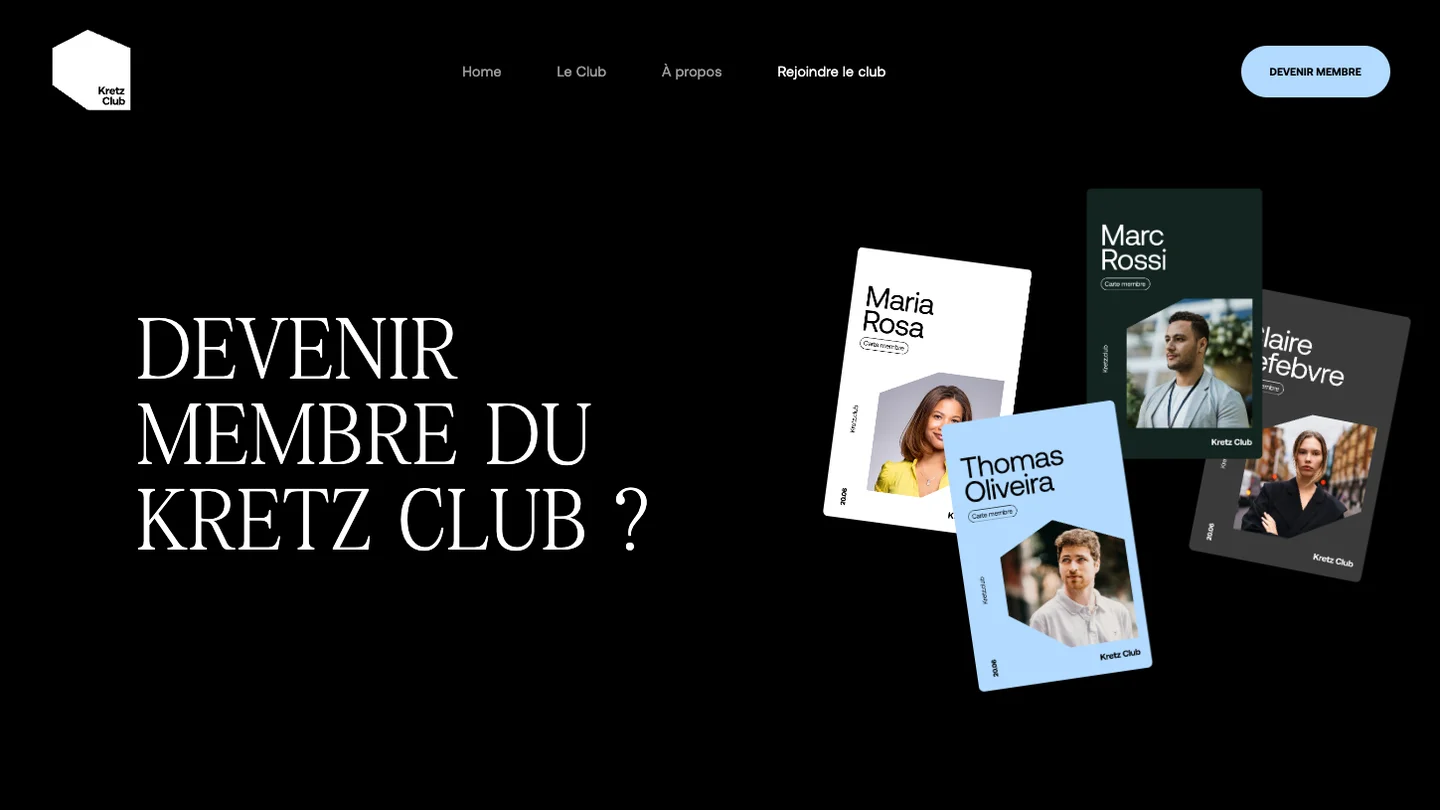

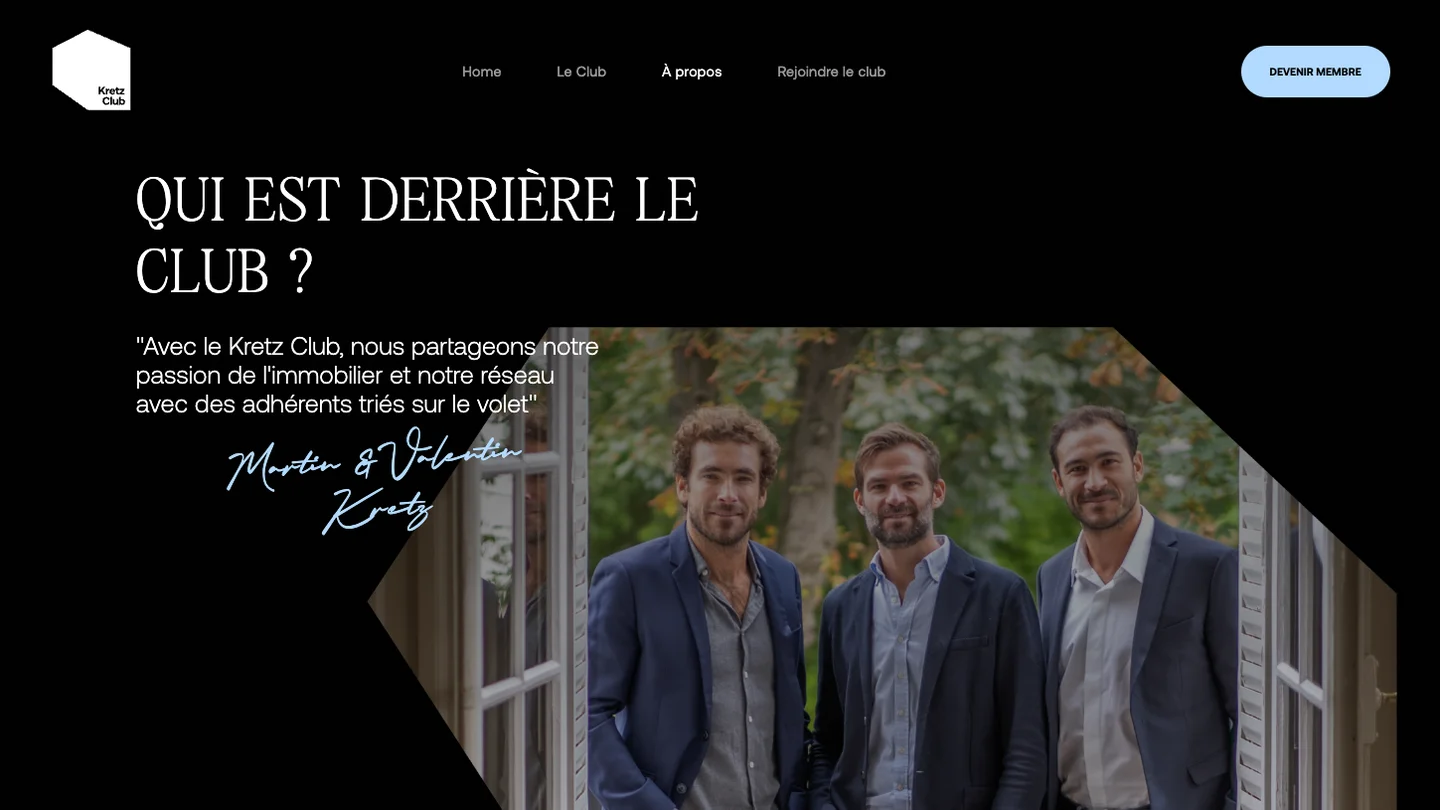











Kretz Club is the first investment club dedicated to prestige real estate. Launched in October 2024 by Martin and Valentin Kretz, co-founders of the Kretz agency, and Alexandre Bruneau, CEO of the Kretz Real Estate group, it builds on the profile of L'Agence, the series streamed on Netflix and broadcast on TMC that follows the family's day-to-day life in luxury real estate.
The model: an annual membership, members selected through an interview, and in return access to a deal flow of property operations (buy-to-sell, renovation, office real estate) in which members invest alongside the Kretz family, through a licensed crowdfunding platform. On top of that come a network of entrepreneurs and investors, events (evenings, padel tournaments, meetups at the agency) and perks shared between members.
In 2026 the club celebrates its third year and has doubled its revenue every year.
Context and challenges
When we took over the project in 2025, the club was working with a Parisian agency. The stack was a launch stack: an expensive and rigid HubSpot CRM, scattered Zapier automations, a welcome email sequence with no call to action before day eight, and a sales team (Sales & Customer Success Managers) running its activity by hand. Yet Kretz Club's business model is demanding:
- Acquisition is paid and high-volume. Meta Ads and Google Ads feed a waiting list qualified through Typeform every day. Every lead is expensive, and so is every missed meeting.
- The sales cycle is human and short. A prospect goes through a selection meeting with a closer, and the decision is made on a video call. The quality of the sales processes directly drives revenue.
- Communication has to be flawless. Members are business leaders and investors who pay a significant fee and are ready to invest in operations: every email, every text message, every follow-up carries the Kretz brand.
- The real proof of value is renewal. A subscription club wins when its members stay year after year. That means knowing, member by member, who has invested, who came to an event, who was contacted by their CSM, and when their membership expires.
- Financial operations have to be reliable. Stripe payments, bank transfers, discounts, invoices, accounting: a membership that fails because of a mistyped company registration number is a lost sale.
Our mandate was therefore not to deliver a website, but to build and run the club's marketing, sales and operations infrastructure, with a simple goal: send the right message to the right person at the right time, and give every team (marketing, setting, closing, CSM, finance) the tools to sell more and retain better. Three people from our team have been working on it full time for almost two years, in charge of the Tech & Product scope.
Our approach
1. CRM migration: from HubSpot to Brevo
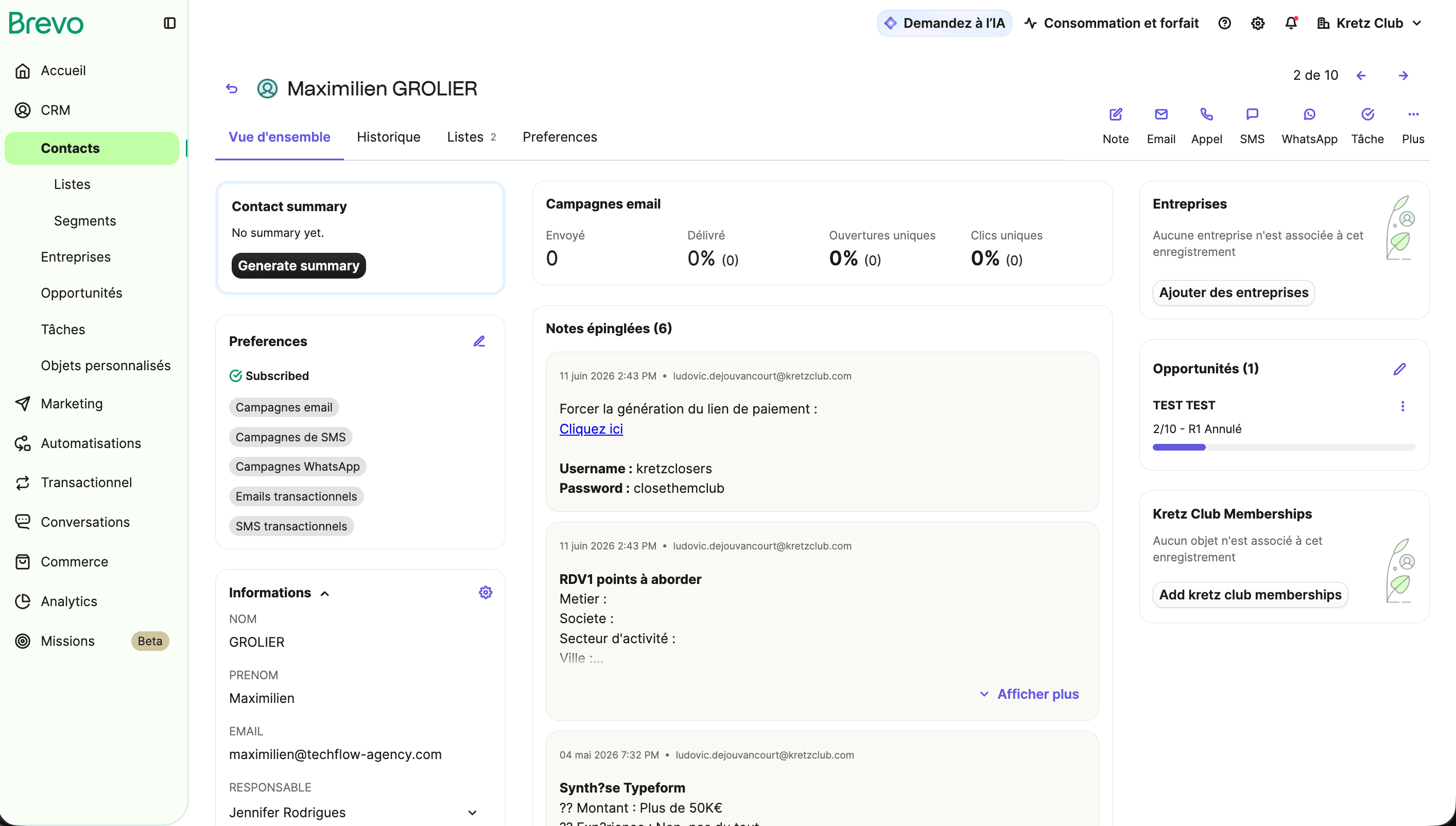
The first structural decision: move off HubSpot to Brevo, to cut licence costs and regain the flexibility that advanced automation requires. We migrated the entire database (contacts, attributes, lists, history, deals) while rebuilding a clean data model: normalised contact attributes (membership status, assigned CSM, setting owner, acquisition source, declared wealth, single-use Calendly links), membership objects holding the expiry date and the number of renewals, deals for the sales pipeline and self-maintained lists for steering. Brevo became the single source of truth for the whole system: it is what the workflows, dashboards, internal tools and AI agents read from and write to.
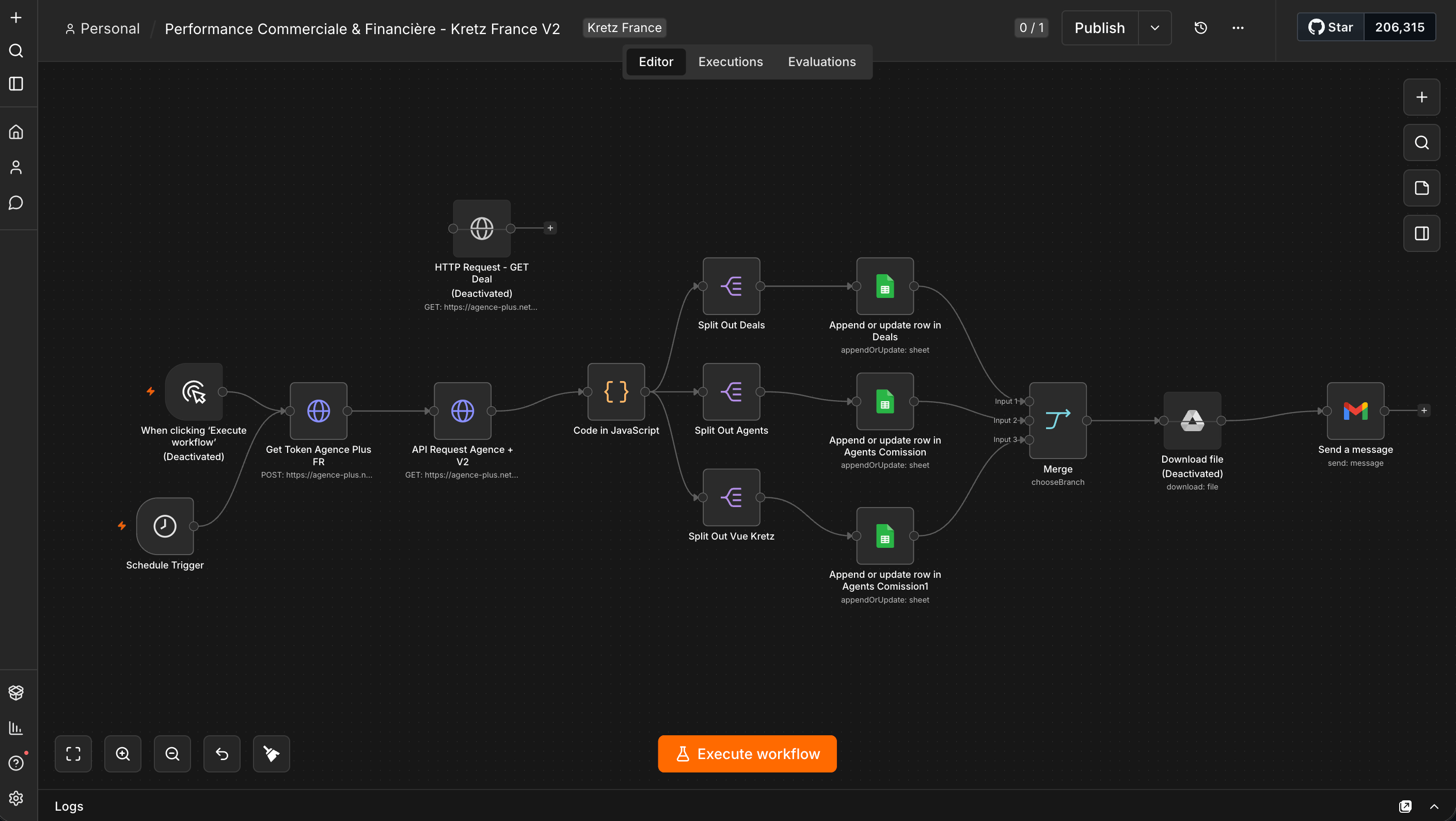
2. The backbone of operations: 170+ n8n workflows
We migrated the Zapier automations to n8n (a dedicated, backed-up instance with staging and CI/CD), then built more than 170 workflows over the months, connecting Brevo, Stripe, Calendly, Typeform, Allo, WhatsApp, Google Sheets, Notion, Pennylane, Qonto and the member app. A few representative examples:
- Meeting management: on every Calendly booking, the deal is created, the CSM assigned, D-1 reminder emails are sent from the closer's own address, rescheduling is handled automatically, and more.
- Event registration gateway: a unique link per member that recognises the person, prevents double registration, requires the identity record if it is missing, enforces seat limits and sends the confirmation email.
- Allo → Brevo sync: calls and text messages from the Setters' five lines are pushed automatically to the contact records, with no manual entry.
- Real-time WhatsApp alerts: payment received, payment failed, refund, checkout blocked, new meeting booked, payment link expiring today.
- E-invoicing: on every payment, the invoice is created in Pennylane, sent to the customer, archived in Drive, with alerts when data is non-compliant.
- Accounting: Qonto bank transactions synced to cash-flow tracking, supplier invoices collected automatically.
Every workflow follows our definition of "done": tested, documented, monitored. Fragile nodes are set to continue on fail, errors alert a named person by email and WhatsApp, and an end-to-end test of the payment funnel runs every four hours.
3. Marketing automation & lead nurturing
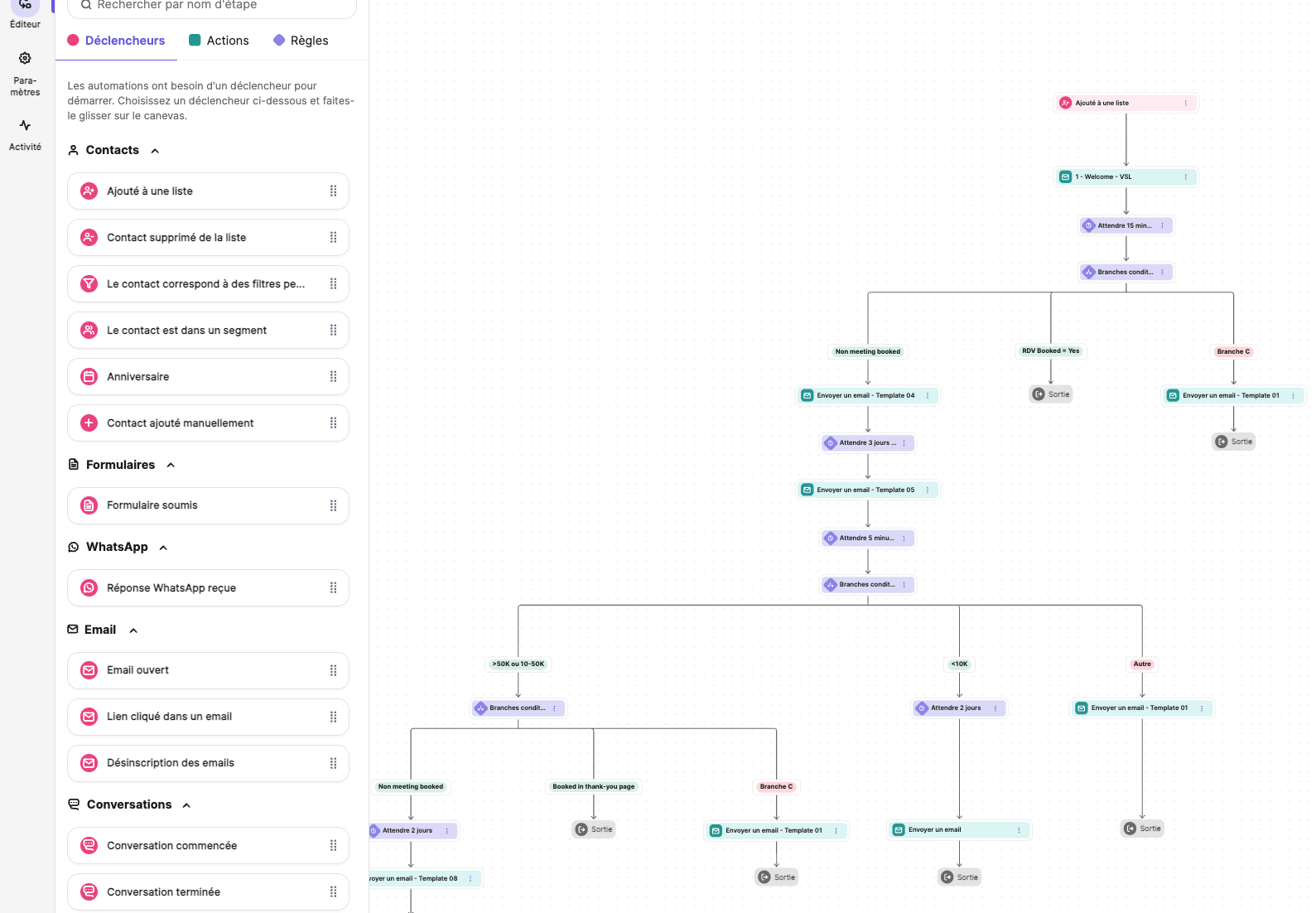
We audited and then completely rebuilt the acquisition email sequence: better copy, a call to book from the very first message, one distinctive angle per email, an A/B split, and an ending that archives and then follows up. Around that sequence, we built:
- reactivation sequences for dormant sign-ups without a meeting, identified during the first audit.
- automated SMS campaigns to prospects and members.
- WhatsApp messages to the sales team to steer activity: a setting recap every evening at 8 pm, daily and weekly closer reports, an instant alert for every meeting booked.
- member onboarding: a dedicated Calendly meeting per CSM, a Brevo attribute, thousands of contacts caught up in a single operation.
- ongoing work on deliverability: domains and senders, reputation, list cleaning, SMTP event tracking.
4. Lead scoring & qualification
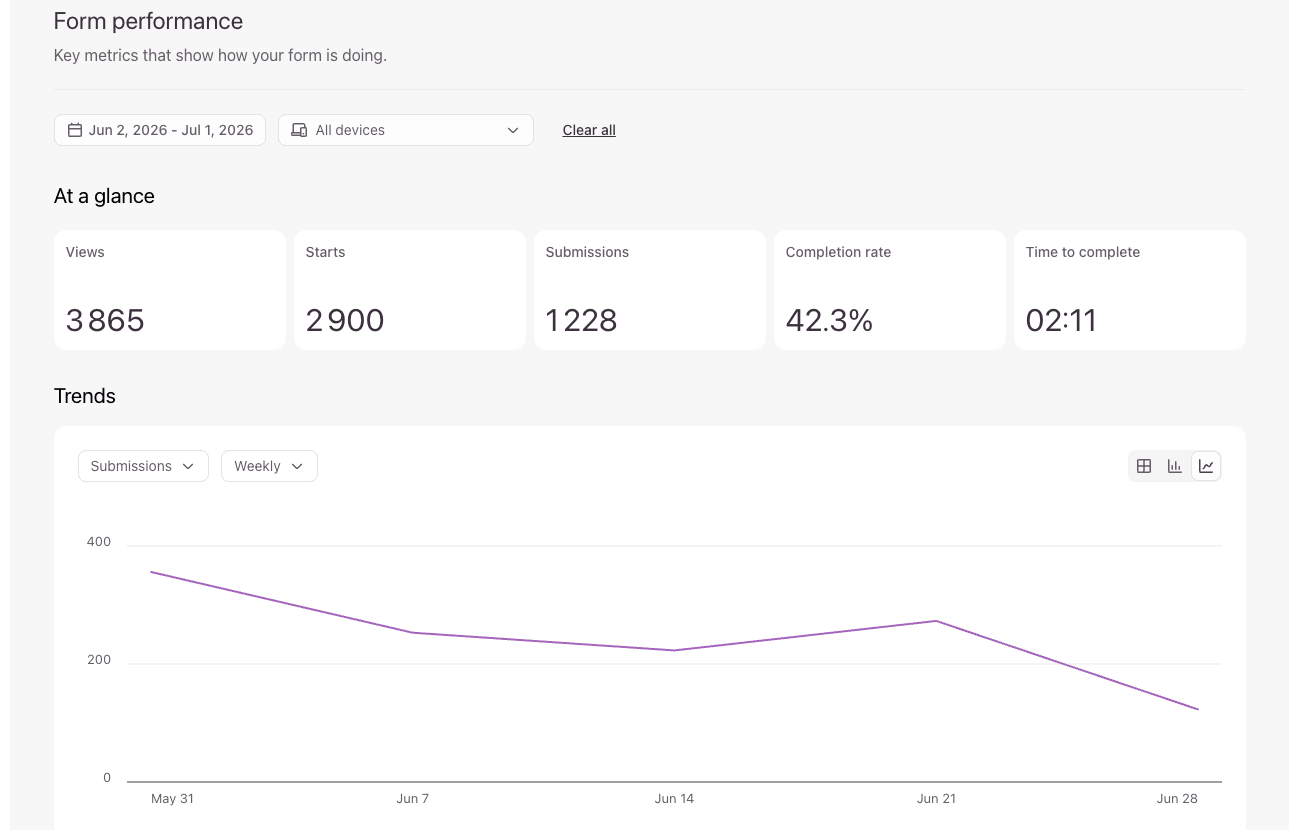
The waiting-list Typeform is the first filter of the funnel. We evolved it through five versions, with qualification rules and a scoring model that drives the high / low potential split in Brevo. Above all, we measured what actually predicts a sale. Across hundreds of meetings booked by leads from the v5 form:
- declared wealth ≥ €XM gives 75.6% attendance and 17.1% membership per meeting, versus 40.7% and 1.9% below €XM.
- a completed LinkedIn profile lifts membership from 2.6% to 12.5%.
- combined, these two criteria give 22.6% membership per meeting versus 5.1% for everyone else.
- the self-declared motivation score predicts nothing.
These results directly drove product decisions: a blocking exception for high-wealth leads, priority follow-up for leads who do not book, allocation of closer slots, and stopping a "no filter" setup that bought 61% more meetings but destroyed a third of memberships.
5. Sales Ops: equipping setters and closers
Setting is steered directly in Brevo: five self-maintained lists give the setter, in real time, the prospects to handle by priority. An n8n workflow moves contacts in and out according to precise rules. Measured result: a real conversation before the first meeting cuts no-shows by around 10 points.
On the closer side, the closer report measures no-show follow-up every day and showed that saving a no-show happens within the first 45 minutes.
.jpeg)
6. Sales intelligence: calls analysed by AI
We connected the sales team's phone lines to Allo, a call recording and transcription tool, then plugged Claude into it. Every closing call is transcribed, summarised and scored out of 10 against a grid. Strengths, areas for improvement and warning signs are logged in a Notion database the sales director can consult.
Upstream, the analysis of hundreds of calls (around 75 hours of audio) produced:
- a sales playbook: scripts for the 5 phases of the call, 8 arguments ranked by measured impact, a 6-step closing mechanism, verbatim handling of 12 objections.
- quantified buyer personas: occupation, location, age bracket, and more.
- a lost-deal analysis: the pitch is the same in both cases, the difference lies in the prospect's profile and how the end of the call is executed.
- the hierarchy of the arguments that close.
These insights continuously feed the Meta Ads scripts, the email sequence, the AI agents' knowledge base and the training of new closers.
7. Payments, invoicing and financial steering
The payment funnel is the last mile of the sale. We instrumented it end to end:
- Stripe monitoring: an instant WhatsApp alert to closers for every failed payment (name, amount, reason), to managers for every refund, and to the team for every membership paid.
- Checkout block detection: an alert naming the prospect and the exact cause as soon as an abandonment happens, plus a 9 am recap of payment links expiring that day.
- E-invoicing: one billing line per payment in the app, automatic invoice creation in Pennylane, sending to the customer, archiving, with dozens of event invoices caught up and filed along the way.
- Financial dashboards: sales, revenue incl. / excl. VAT by closer and by source, ROAS by channel, cash position synced from Qonto, tracking of fundraising on investment operations.
8. Internal tools: the member app and the team space
Beyond the workflows, we develop and maintain the club's internal web tools:
- Kretz Connect: a directory of continuously enriched profiles, a matching engine for introductions between members, a full events module, and the member identity record as the core data.
- Membership and payments back office: editing billing lines, managing discounts and promo codes, payment reminders, a per-CSM view.
- Unified reporting in an internal space: acquisition, setting, closing, memberships, events, fundraising.
- A daily consistency alert between the community's eleven WhatsApp groups and the active members database.
9. Autonomous AI agents and harness
The last building block, and the one that sets the system apart: AI agents working alongside the team.
- Continuous analysis: call transcripts, replies to the main inbox (thousands of emails classified into around forty typical situations, each with a response doctrine), the team's WhatsApp feedback summarised every evening.
- Harness agents: agents that improve the website on autopilot, rewriting FAQ copy and content pages, A/B testing the funnel by reading Search Console, GA4, Contentsquare / Hotjar, Webflow and the logs, proposing variants and measuring results, with human validation before anything goes live.
- Shared team memory: a private Git repository where each team member (and their Claude Code agent) reads and writes knowledge notes, decisions, logs and meeting summaries, a "big picture" index, confidentiality rules, and an automatic sync from the Notion backlog to the roadmap.
Results
Since the start of our collaboration, Kretz Club has doubled its revenue every year and is entering its third year on that trajectory. Our team of three full-time people now runs its entire growth, sales and operations stack.
- CRM: HubSpot → Brevo migration with no data loss, lower licence costs, a unified data model that has become the single source of truth for the whole system.
- Automation: 170+ n8n workflows in production, monitored and documented, with staging and backups; Zapier → n8n migration completed.
- Nurturing: acquisition sequence rebuilt (30+ emails), booking CTA from day 0, reactivation sequences, automated SMS and WhatsApp.
- Qualification: a priority segment identified at >20% membership per meeting (versus 1.9%), i.e. ×10.
- Setting: no-show rate brought down to 12.3% on in-house setting (versus 35.3% for direct inbound); a conversation before the meeting is worth -10 points of no-show.
- Sales intelligence: a sales bible, automatic scoring of every call, arguments with measured impact (+24%, +13%, +10%).
- Finance: 100% of payments tracked and alerted, e-invoicing in production, invoices caught up, revenue / ROAS / cash dashboards.
- Retention: renewal levers quantified, renewal pipeline triggered automatically, daily CSM steering.
- Tools: member app (directory of 930 profiles, matching, events), payments back office, unified reporting.
- AI: conversational agents on autopilot with guardrails, harness agents improving the website, a shared team memory of 147 notes.
What's next
The 2026 roadmap, shared with the club's four departments (sales, business, tech, marketing), focuses on commercial growth, customer satisfaction, partnerships and growing the network, the very essence of the club. It also covers testing new marketing channels and new ad formats, and extending the harness agents to the entire website and funnel.
Want the same results for your website?
Book a 30 minuts call to see what we can offer you.
Project Showcase

Have a project in mind?
TechFlow transforms ideas into results. Our clients see 40% faster launches and measurable growth within the first quarter.
Free · No commitment · 30 minutes


.svg)

.svg)