

MIT's 2025 GenAI Divide research tracked more than 300 real AI deployments and found that projects built with an external vendor partner reached production 67 percent of the time, against just 33 percent for projects built in-house: a two-to-one gap. The same research found that 95 percent of generative AI pilots overall never produced a measurable profit-and-loss result (MIT NANDA, The GenAI Divide: State of AI in Business, 2025, reported by Fortune). Who builds the agent changes whether it ever ships, and that is exactly the test an AI agent development company rarely gets asked to pass before a buyer signs.
A same-day Google Cambodia search for "ai agent development company" returns ten results, and every one of them is a generic international enterprise-AI agency: nobody addresses a Phnom Penh SME, a Khmer-language channel, or Cambodia's still-draft data protection law (DataForSEO SERP pull, October 2026). This article fills that gap: nine concrete questions to ask an AI agent development company in Cambodia before you sign, built from what actually separates a shipped agent from an expensive demo.

Most AI agent development company portfolios hide the same gap
Most AI agent development company pitches lead with the same three things: a slick deck, a handful of client logos, and a demo video. None of that tells a buyer whether the agent will still be working once real customers start using it. Gartner predicts that more than 40 percent of agentic AI projects will be canceled by the end of 2027, mostly over cost, unclear business value, or inadequate risk controls, and estimates that only around 130 vendors worldwide run genuinely agentic systems against thousands now marketing themselves with the word "agent" (Gartner, June 2025), a pattern it calls agent-washing.
Cambodia is not exempt from that gap. The ten organic results for "ai agent development company" in a Cambodia search are the same enterprise-AI shops that rank for the query anywhere in the world, and not one publishes a production reference a Cambodian buyer could actually call. Generic vendor checklists do exist (iTWire, September 2026), but they are written for a global enterprise buyer and never touch Cambodia's regulatory gap or language testing, the two things that actually trip up a local deployment. We would treat a reel of demo videos as a resume claim, not a credential, until a vendor can show a production account live for at least a month, doing what an AI agent actually does: reading and writing into real systems, not answering scripted questions in a sandbox.
Most of the gap between a working agent and an expensive demo comes down to the agent harness wrapped around the model, not the raw capability of the model itself, which is exactly the detail a glossy case study never shows.
Ask for a live account, not a recording, and ask who else is using it today. A vendor who hesitates on either question is quietly asking you to fund their next case study.
Is this AI agent development company selling a custom AI agent, or a templated chatbot?
A templated chatbot answers one kind of question, on one channel, from a fixed script; a custom AI agent reads and writes across the tools a business already runs, a CRM, a calendar, a Telegram inbox, and decides what to do next on its own. TechFlow builds the second kind: agents orchestrated with n8n and OpenRouter, running Claude, GPT, Mistral or Llama depending on the task, wired into CRM, ERP, email, APIs and databases rather than sitting in front of them.
Take a recruitment agency in Phnom Penh that wants to stop manually screening CVs sent over Telegram. A templated chatbot can reply "thanks, we received your CV." A custom AI agent reads the CV, checks it against the open role's requirements, writes a structured candidate record into the CRM, and only pings a recruiter when a match clears a threshold the agency set. The two quotes for "an AI agent" might look similar on paper; the systems behind them are not.
Ask a vendor to name the systems their agent will actually touch, by name: which CRM, which calendar, which messaging channel. If the answer stays abstract ("it integrates with your tools"), the agent probably has not been built yet, only the pitch has.
Who owns the model and the data once your agent is live?
The model and the data belong to whoever's infrastructure the agent runs on, not to the business that paid for it, unless the contract says otherwise. TechFlow deploys agents on private cloud or sovereign servers so a client's conversation data never leaves infrastructure they control; plenty of vendors instead route every message through a shared, vendor-owned account on a third-party platform, so the vendor, not the client, can see and export the full conversation history. Some vendor contracts now include a written commitment that a client's data will never be used to train the vendor's own models, covering prompts, files, outputs and metadata, not just the chat transcript (Glean, 2026); ask for that same clause before you sign anything.
That distinction matters more in Cambodia than most pitch decks suggest. As of 2026, Cambodia still has no enacted comprehensive data protection law: the Ministry of Posts and Telecommunications, alongside the Ministry of Commerce and the Ministry of Interior, continues to work from a draft, while existing obligations sit scattered across the E-Commerce Law's general requirement to take reasonable security measures against data loss or leakage, and the National Bank of Cambodia's Technology Risk Management Guidelines, which apply only to licensed banks (DLA Piper, Data Protection Laws of the World, Cambodia, checked 2026). Cambodia's National AI Strategy 2025-2030, led by the same ministry, sets a policy direction but is not itself a binding data law yet (MPTC, via the OECD AI Policy Observatory).
We think data custody is the single most underpriced question in an AI agent pitch in Cambodia right now: a conversation log says more about a business than its bank statement, and with the law still in draft, a written contract clause, naming where the data lives and who can access it, is the only real protection a buyer has until the law catches up.
Ask who owns the conversation logs, the prompts, and the code once the engagement ends, and get the answer in the contract, not the sales call.
Does the quote separate what it costs to build from what it costs to run?
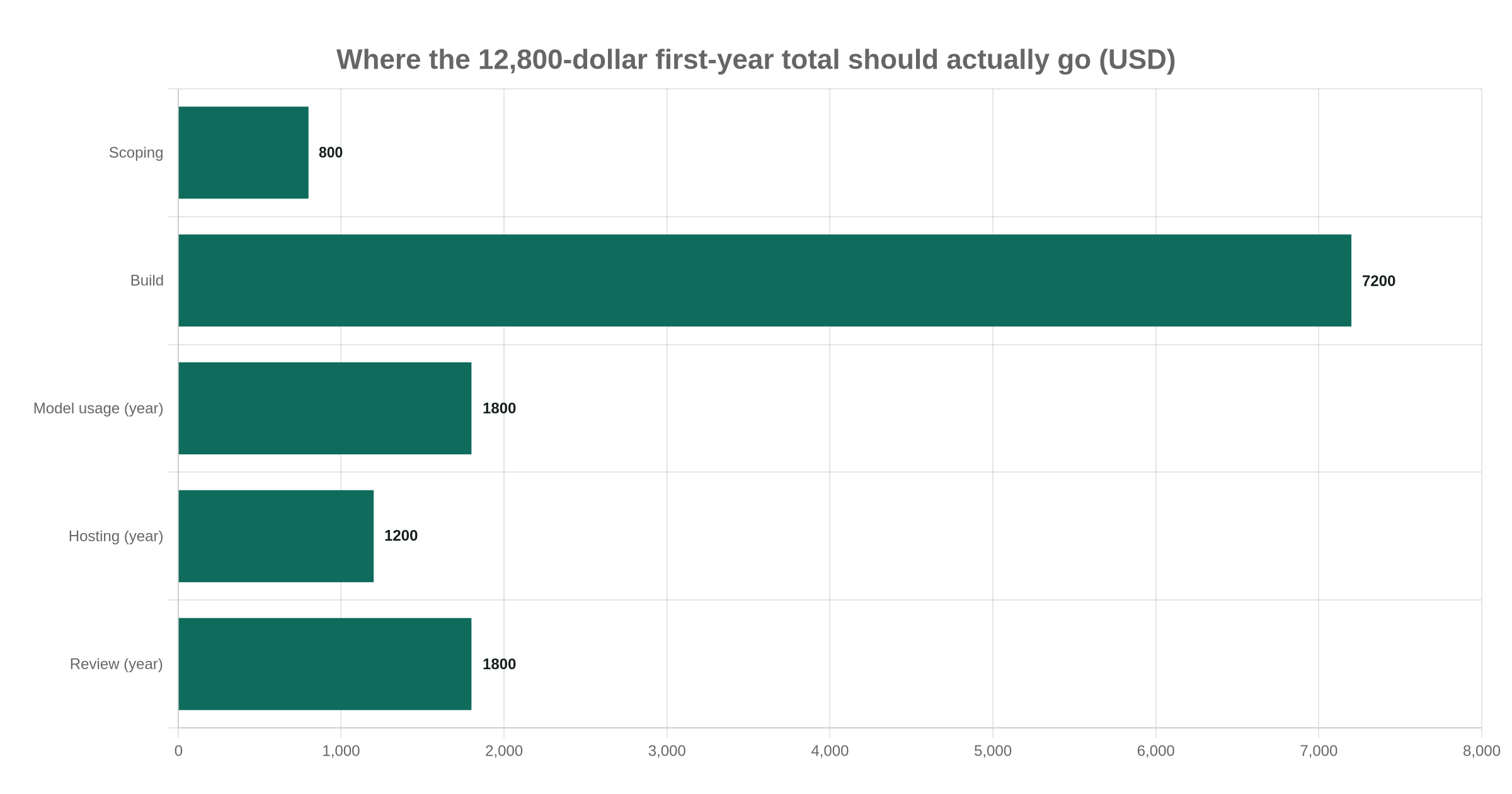
A trustworthy AI agent quote separates five line items: scoping, build, model usage, hosting and review, the same breakdown we price a build with and the one we walk through in detail in our AI agent cost guide. A quote that only states one number, whether it is 2,000 dollars or 80,000 dollars, is hiding which of those five lines it actually covers, and a buyer who does not ask finds out the hard way, usually the month after launch, when the "free" running cost turns out not to be free.
Take a two-line quote: "8,000 dollars to build, 400 dollars a month to run." On its own that reads as reasonable. Push it to separate scoping from build, though, and it often turns out scoping was never done, the 8,000 dollars is a guess at a generic build, and the 400 dollars a month includes no review hours, so nobody checks the agent's output after launch unless a customer complains loudly enough. Add the build cost to twelve months of that running fee and the real first-year commitment is 12,800 dollars, a number the two-line quote never shows.
We price our own AI agent work around 35 percent below typical European agency rates, stated plainly rather than bundled, so a client can compare line by line, not just on the total.
Ask the vendor to itemize all five lines before you compare two quotes on price alone.
Khmer support is where most vendor demos quietly fail
Most AI agent demos run entirely in English, which hides the one failure mode that shows up first in Cambodia: Khmer-language handling. Khmer is written in an Abugida script, and published tokenizer research puts its token cost at roughly 2.2 to 3.4 times higher than English for the same sentence, depending on the tokenizer (Lee et al., "Equity with Efficiency: An Empirical Study of Tokenizers for Multilingual Large Language Models," 2026). That is not just a cost line, it is a reliability line: a model only tested on English prompts tends to need more correction, not less, once real Khmer messages start arriving on a Telegram channel or a KHQR payment confirmation flow.
A directory of Cambodia-based AI companies lists only a handful of local vendors who disclose their rates at all, and most of the listed work reads as general software development rather than agent-specific delivery (TechBehemoths, Cambodia AI company directory, checked 2026). That thin local track record is exactly why asking to see a real Khmer conversation, not an English one, matters more here than in a market with a deeper bench of specialist vendors to choose from.
Picture a guesthouse on the Siem Reap riverside whose front desk fields most questions in Khmer over Telegram and expects payment confirmations through KHQR. An agent built and tested only in English will mishandle the accented Khmer messages first, quietly, in ways that never show up in a polished English-language demo. Orchestration tools like n8n automation workflows can wire that Telegram and KHQR flow together cleanly; the model sitting behind it still has to be tested in the language your customers actually use.
Ask to see a live run on a real Khmer message, not a translated English script.
What should you ask before you sign the contract?
Ask who reviews, retrains and fixes the agent after it launches, because a contract that ends at deployment is the most common gap we see in vendor proposals. TechFlow's own AI agent process runs four steps: a free one-to-two-hour process-mapping audit, a costed action plan delivered within five days, deployment in one to four weeks depending on complexity, and continuous improvement with monthly reports once the agent is live. We build that monthly reporting into every engagement by default, not as a paid add-on, because an agent nobody reviews for a quarter tends to degrade quietly, not loudly, and the business usually notices only once a customer complains.
Before you sign with any AI agent development company, ask these nine questions and expect a specific answer to each one, not a reassurance:
- Can you show a production deployment running today, not a demo?
- Who are three customers using it right now, and can we talk to one?
- Is this a custom AI agent built around our workflow, or a templated chatbot?
- Which model runs it, and where is the data actually processed?
- Who owns the conversation logs, the prompts and the code once the contract ends?
- Does the quote separate scoping, build, model usage, hosting and review into five lines?
- Has it been tested on real Khmer-language messages, not only English ones?
- Can it read and write into the CRM, Telegram or KHQR flow we already use?
- Who reviews and retrains the agent after launch, and what triggers a retrain?
We run this process from Phnom Penh (ICT, UTC+7), starting every engagement with the free process-mapping audit above. If you want a second opinion on a quote you already have, or a scoped answer to these nine questions for your own workflow, book a call with our team, browse our project work to see what a Phnom Penh build looks like end to end, or get a scoped estimate once you have a shortlist.
Prefer to chat? Message our founder directly on Telegram (@maxgrolier), or book a call with the team.