
A CRM in Cambodia is customer relationship software, tools like HubSpot, Odoo or Twenty, that logs every contact, deal and follow-up in one shared place instead of scattered Telegram threads and a notebook. Most Cambodian SMEs we talk to do not actually need one on day one. They need the habit a CRM forces: writing down who you spoke to, what they asked for, and when to follow up, every time.
A CRM sold as a fix for a sales process that does not exist yet becomes expensive admin nobody updates past week three. Below, how HubSpot, Odoo and Twenty compare on cost and fit.
A CRM Doesn't Fix a Sales Process, It Exposes Whether You Have One
Most CRM rollouts fail in Cambodia for the same reason they fail everywhere: the team adopts the software without first agreeing on what a "deal stage" means or who owns the next step. The Cambodia Business Environment Barometer 2025, a nationally representative survey of 2,741 formal and informal businesses, tracks exactly this question: how far Cambodian MSEs have actually digitized their operations (The Asia Foundation, 2025). A narrower Asia Foundation survey of 1,000 tourism MSMEs across seven provinces measured the same root cause directly: 58 percent cited a lack of digital skills as their main barrier to adopting new tools, ahead of a lack of budget at 28 percent (The Asia Foundation, Digital Technology Adoption in Tourism MSMEs in Cambodia, 2024).

We think that gap is a process gap before it is a tools gap. A five-person sales team that cannot say, without opening three different chat apps, how many live conversations are currently in progress does not need a CRM licence first. It needs someone who owns the follow-up habit, which a free CRM tier is cheap enough to enforce once that owner exists.
What does CRM software actually mean for a small team in Cambodia?
CRM software for a small team in Cambodia means a shared record of every customer and every open conversation, built around three parts: a contact list, a pipeline of deal stages (new lead, quoted, negotiating, won or lost), and a reminder system that will not let a lead go quiet without someone noticing. Most Cambodian firms we work with already run some basic digital presence, a website, a social media page or a point-of-sale system, so the gap is rarely "no digital tools." It is that none of those tools hold a pipeline or talk to each other.
In practice this starts small: a 3-restaurant group in BKK1 logging reservation calls across its branches so nobody double-books a table, or a 6-person import business tracking which Phnom Penh retailers near Orussey Market still owe a follow-up after a trade-show lead. HubSpot, Odoo and Twenty all solve this core job. Where they differ is bundling, cost and who is expected to run the setup.
HubSpot or Odoo: which CRM suits a Cambodian SME?
HubSpot suits a team that wants the CRM to stand alone and grow into marketing and service tools later. Its free CRM tier covers up to 2 users and 1,000 contacts, with no expiration date, including contact and deal records, email tracking and meeting scheduling (HubSpot, 2026). Past that, Sales Hub Starter adds automation at 20 US dollars per seat a month billed monthly, or 7 US dollars per seat a month on an annual plan; Professional reaches 100 US dollars per seat a month monthly, or 90 US dollars annual, once a team wants custom reporting (HubSpot, 2026 pricing).
Odoo suits a team that already runs, or plans to run, other business software on the same platform: accounting, inventory or HR. The CRM app ships inside Odoo's Standard plan at 16.90 US dollars per user a month billed monthly, or 13.50 US dollars annual, alongside every other Odoo app at no extra charge (Odoo, 2026 pricing). A company already on Odoo for invoicing gains a CRM for close to nothing extra; a company with no other Odoo footprint is paying full platform price for one app alone.
Neither is the wrong choice: HubSpot wins when sales is the whole project, Odoo wins when it is one piece of a bigger back office the team is building anyway.
Why doesn't Twenty CRM show up in most Cambodia CRM comparisons?
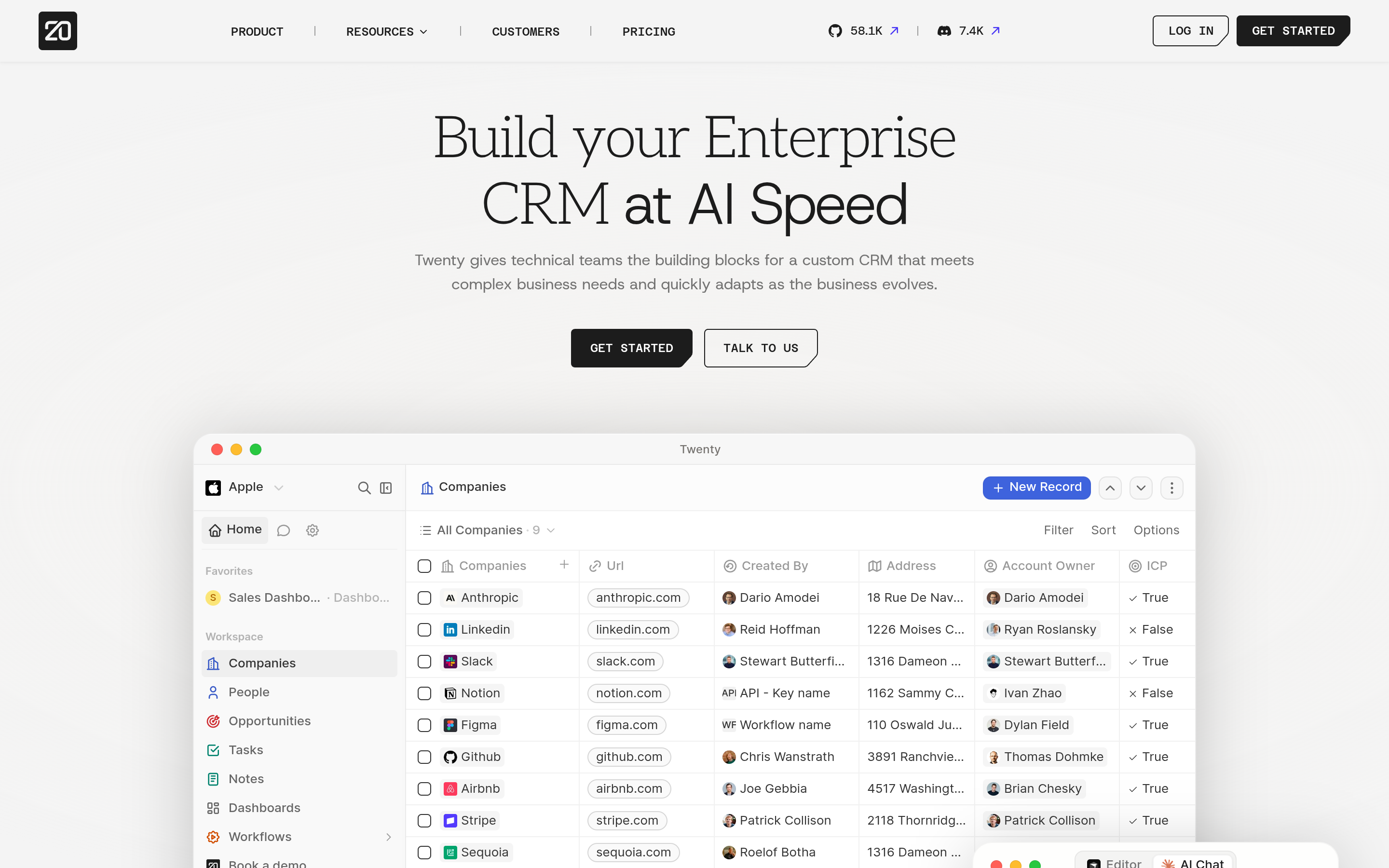
Twenty CRM is missing from most Cambodia CRM comparisons because it has no local reseller or agency affiliate programme pushing it, not because it lacks what HubSpot or Odoo sell. It publishes its core as open source on GitHub: the full product, contacts, pipeline and API included, can run on a self-hosted server for the cost of the server alone, with no per-seat fee and no record cap. Its hosted Cloud plan starts at 9 US dollars per seat a month (Pro), rising to 19 US dollars for Organization-tier single sign-on and priority support (Twenty, 2026 pricing).
For a Cambodian SME, self-hosting is not just a cost play. We already deploy client automations through n8n on sovereign infrastructure, so adding a self-hosted Twenty instance to that same server is a smaller lift for us than for a team evaluating it alone. The order we follow is always the same: wire n8n to Telegram or KHQR first, point Twenty at the server only once that layer works.
The tradeoff is real: self-hosting means someone owns updates, backups and the database, which is exactly the kind of maintenance a two-person founding team should not take on without a partner. That is a fit question, not a reason to default to the biggest logo.
What does a CRM actually cost a 5-person Cambodian sales team in a year?
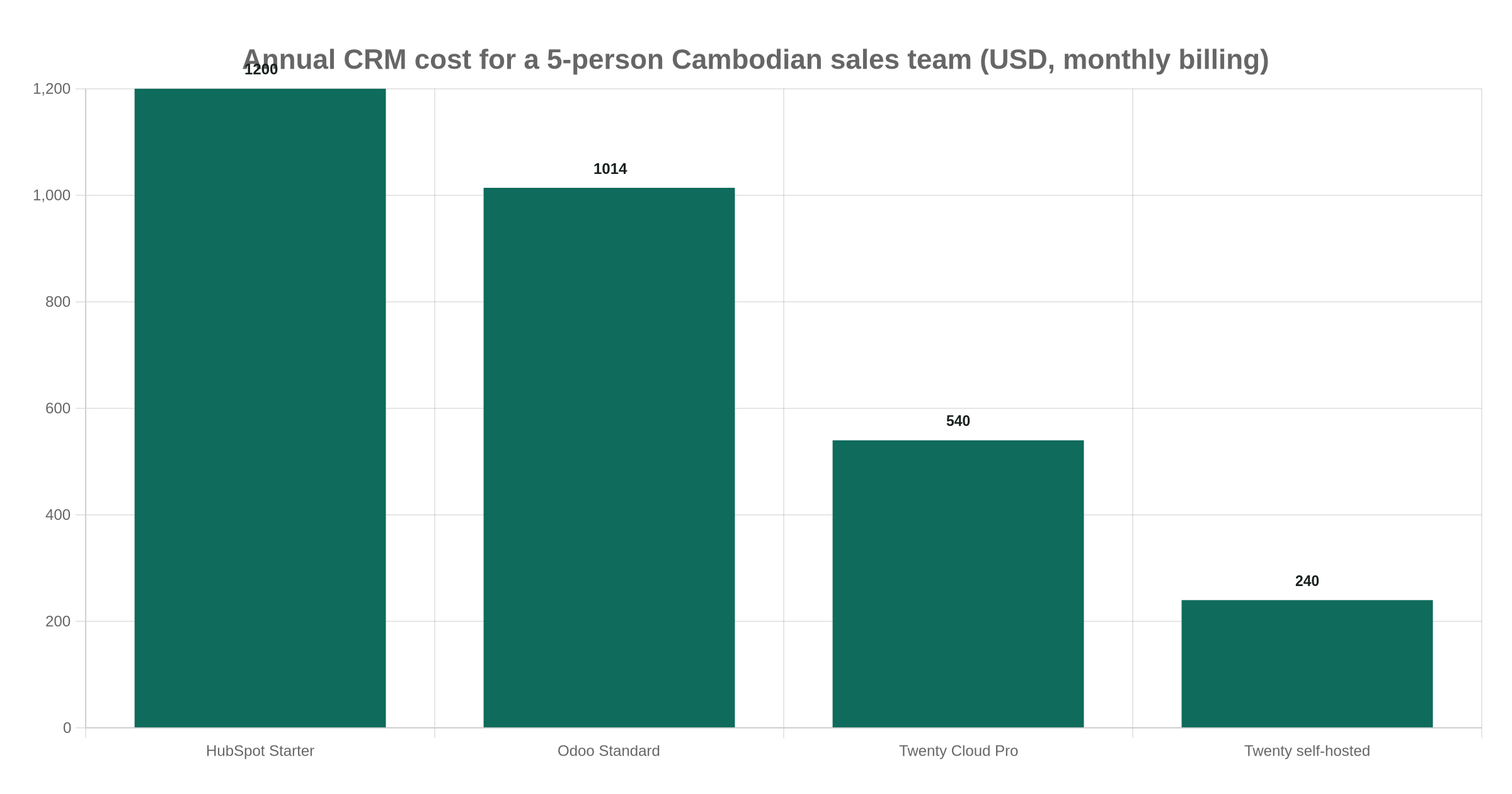
A 5-person sales team pays roughly 1,200 US dollars a year on HubSpot's Starter tier, billed monthly at 20 dollars per seat. Odoo's Standard plan runs close to 1,014 US dollars a year at its monthly rate of 16.90 dollars per seat, CRM included alongside every other app. Twenty's hosted Cloud Pro plan costs about 540 US dollars a year at 9 dollars per seat. Self-hosting Twenty instead costs as little as 240 US dollars a year, based on a small VPS at roughly 20 US dollars a month, all of it server infrastructure, with no per-seat licence at all.
The spread between the cheapest and most expensive option here is five times over. Take a hypothetical 5-person architecture firm in Tuol Kork quoting client retainers: on Twenty self-hosted, its annual bill stays at 240 dollars even after a sixth or seventh seat, while HubSpot or Odoo add a full seat's cost each time. For a founder weighing a CRM licence against a junior hire's monthly salary, the self-hosted option is the one that does not scale with headcount.
Does a CRM need to talk to Telegram and KHQR to be useful here?
Yes, or it is solving only half the sales process in Cambodia. Telegram has an estimated 3 to 5 million users in the country, functioning simultaneously as a messaging app, a content channel and a customer-service line for local businesses (Hashmeta, Social Media Landscape Cambodia, 2026). On the payments side, Bakong, the National Bank of Cambodia's instant payment system, processed more than 1.3 billion transactions worth roughly 224 billion US dollars in 2025, up 118.7 percent year on year, with KHQR now accepted at more than 4.5 million merchant touchpoints nationwide (National Bank of Cambodia 2025 figures, reported by Khmer Times).
We think a CRM that cannot log a Telegram conversation or confirm a KHQR payment is solving a sales process built for a different market, not the one most Cambodian SMEs actually run. None of HubSpot, Odoo or Twenty connects to Telegram or a payment webhook natively out of the box. All three reach them through an automation layer like n8n instead, and that integration work is usually where a generic CRM setup in Cambodia quietly runs over budget. The pitfall we check first is retry logic: a Telegram or Bakong callback that fails silently, with no retry, stales a CRM record more often than the integration itself breaking.
Our own sales funnel work treats this as one system: a structured CRM pipeline alongside lead generation and AI lead qualification, not bought separately.
The verdict: pick the habit before the licence
If your sales process is two people or fewer and a shared spreadsheet is still working, start on HubSpot's free tier before paying for anything: it covers exactly that. A third person breaks the free tier's cap, so that hire is also the moment to take the first paid seat. The cost of switching later is lower than the cost of a tool nobody opens. If you already run Odoo for accounting or inventory, add its CRM app rather than bolting on a second platform. If you want full control, low per-seat cost at scale, and a team willing to own the server, Twenty self-hosted is the option most Cambodia CRM guides skip, and the one we reach for first on client builds.
What we would not do is buy an enterprise-tier CRM before the team has run one full sales cycle inside any tracking system, free or paid. TechFlow Agency ships custom CRM builds when an off-the-shelf tool cannot fit a client's process, as part of our digital agency practice in Phnom Penh, and our sales funnel line wires whichever CRM a client picks into lead generation, qualification and KPI dashboards as one system. If your pipeline includes public-sector clients, Cambodia's shift to digital invoicing is worth tracking too, since it changes what your CRM needs to log on the payment side. Browse recent projects for examples, or get a scoped estimate against your actual sales process.
Prefer to chat? Message our founder directly on Telegram (@maxgrolier), or book a call with the team.
Frequently asked questions
What is the cheapest CRM for a small business in Cambodia?
HubSpot's free tier is the cheapest option with no time limit, covering up to 2 users and 1,000 contacts. Twenty CRM self-hosted is cheaper still past that size, since it carries no per-seat fee once the server is running.
Can a CRM connect to KHQR or Bakong payments directly?
Not natively, in any of HubSpot, Odoo or Twenty. The usual route is an automation layer like n8n that calls the Bakong Open API and updates the CRM record once a payment confirms.
Is Odoo's CRM worth it if we already use Odoo for accounting?
Usually yes. The CRM app sits inside the same Standard plan subscription, so adding it costs little beyond the per-user licence you are already paying for accounting or inventory.
How long does it actually take to set up a CRM for a 5-person team?
A basic pipeline, contacts, stages and reminders, can run within a day on any of the three tools. The real time cost is agreeing on what each deal stage means and migrating existing contacts, which usually takes longer than the software setup itself.
Do we need a developer to self-host Twenty CRM?
You need someone comfortable with Docker and a PostgreSQL database, or a partner who runs that infrastructure for you. It is not a point-and-click install the way the hosted Cloud plan is.