
Cambodia now runs two separate pushes toward digital invoicing at the same time, and most coverage treats them as a single story. The Council for the Development of Cambodia (CDC) is digitizing the fee payments investors make for public services, while the Ministry of Economy and Finance (MEF) is rolling out mandatory electronic invoicing for transactions with government ministries. A Khmer Times report on 28 September 2026 covered the CDC side: digital invoices meant to speed up public services for investors and the general public.
For an SME or a foreign-owned company operating in Cambodia, the two systems trigger at different moments, for different reasons, and under different institutions. This article separates them, dates each rollout, and sets out what a business actually has to do about each one before the end of 2026.
What CDC's digital invoices for public services actually are
CDC's push started in November 2024 with the Cambodia Investment Project Management system (cdcIPM), the online portal investors use to file Qualified Investment Project (QIP) applications and related paperwork. Sitting alongside it is the One Stop Payment System (cdcOSP), which lets applicants settle CDC fees digitally instead of paying in person at CDC's Phnom Penh office (Kampuchea Thmey Daily, 18 August 2026).
cdcOSP already connects to the Foreign Trade Bank of Cambodia (FTB), Wing Bank and ACLEDA Bank, and accepts QR codes, mobile banking apps, Visa and MasterCard for fee settlement. On 15 December 2025, CDC Deputy Secretary General Heang Sotheayuth chaired a meeting with six additional banks to connect their systems to cdcOSP, explicitly to cut the waiting time applicants face and to let transactions happen, in CDC's own framing, "anytime and anywhere" (cdc.gov.kh, 15 December 2025).
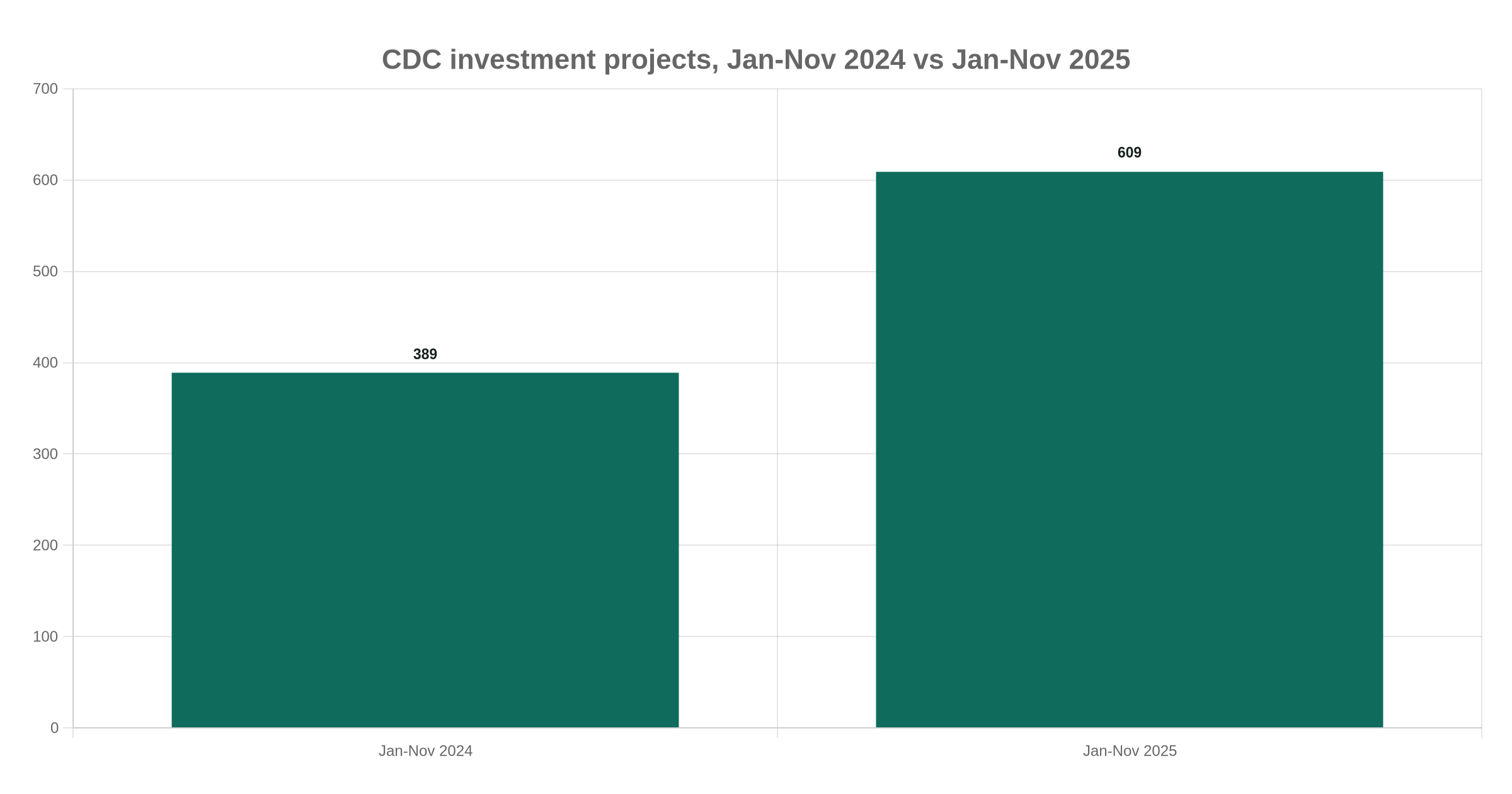
The numbers show why the pressure is on: CDC approved 389 investment projects in the first eleven months of 2024, against 609 in the same eleven-month window of 2025, a jump of 56 percent (Khmer Times, December 2025). CDC has not published a turnaround-time target for the bank integration work; what it has said is the goal itself, that a fee payment should clear "anytime and anywhere" rather than only during counter hours at a bank branch (cdc.gov.kh, 15 December 2025).
Is digital invoicing mandatory for businesses in Cambodia yet?
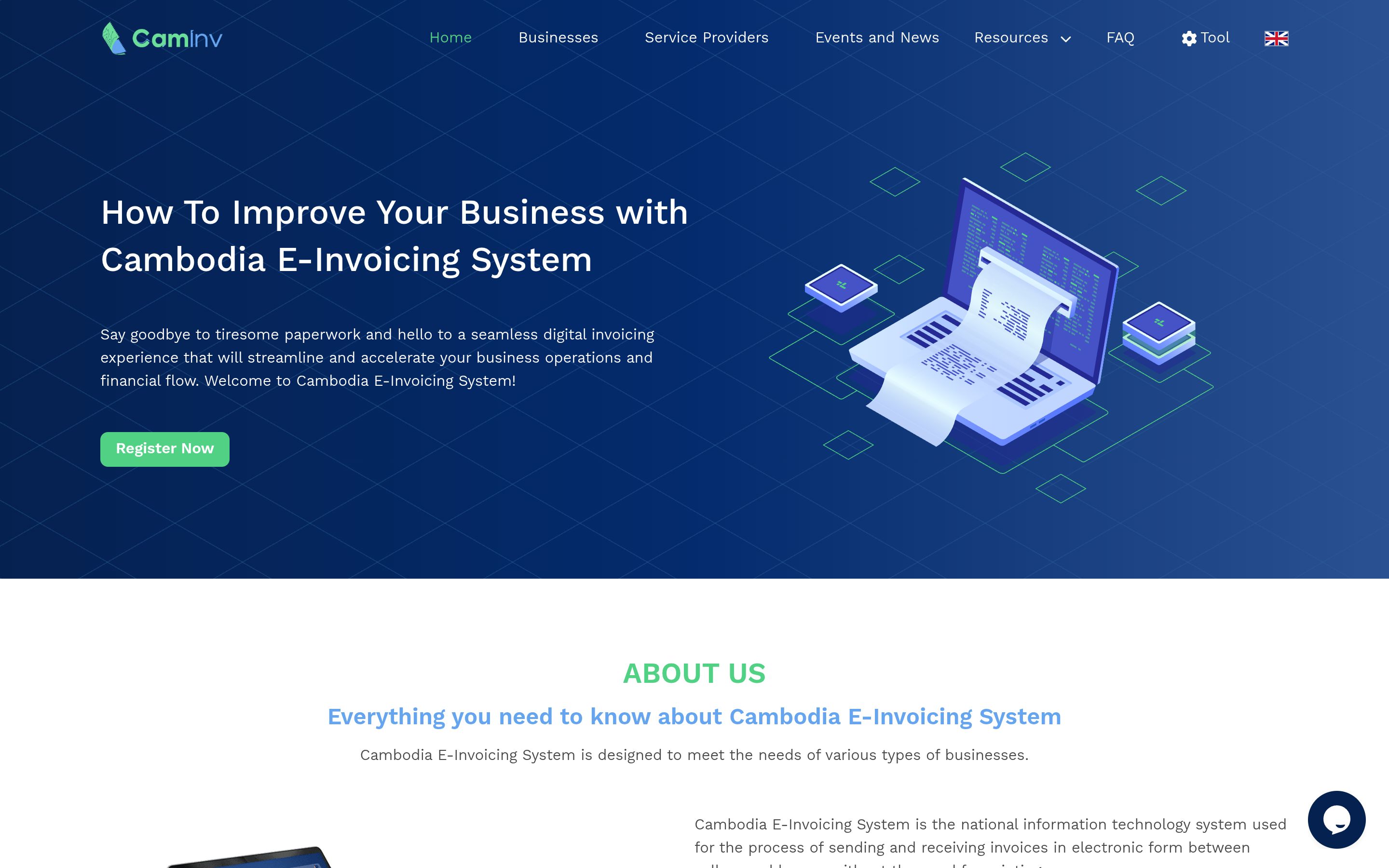
Digital invoicing is mandatory today only for business-to-government transactions with a growing list of ministries, not for business-to-business trade. MEF launched the national Cambodia E-Invoicing System, abbreviated CamInv, in December 2024, formalized by Prakas No. 075, signed 22 January 2025 (Open Development Cambodia, uploaded 24 January 2025). The General Department of Digital Economy (GDDE), the MEF department that runs the platform, soft-launched the B2G side of CamInvoice on 12 May 2025 (vatcalc.com, May 2025).
Phase 1, under Circular No. 003 of January 2025, made e-invoicing mandatory for B2G transactions with the two ministries holding central state budget access, while B2B adoption stayed voluntary. Phase 2, under Circular No. 012 of July 2025, extended the mandatory B2G requirement to six additional ministries (KPMG, November 2025). MEF frames the goal as speeding up administrative processes while improving transparency and accountability (Khmer Times, 18 November 2025).
Why does Cambodia have two different digital invoicing systems, not one?
CDC's cdcOSP and MEF's CamInv solve two different problems for two different institutions, and treating them as the same rollout is the most common mistake we see in how this news gets covered. One moves money for investment services; the other moves structured tax invoices between businesses and ministries.
| CDC's cdcOSP | MEF / GDDE's CamInv | |
|---|---|---|
| Runs under | Council for the Development of Cambodia | Ministry of Economy and Finance, General Department of Digital Economy |
| What it moves | Investor fee payments (QIP applications and related CDC services) | Structured B2G tax invoices |
| Who must use it | Investors and companies dealing directly with CDC | Ministries with central budget access, six more added in Phase 2 |
| Legal basis | CDC administrative rollout, no dedicated Prakas identified | Prakas No. 075 (Jan 2025), Circular 003 (Jan 2025), Circular 012 (Jul 2025) |
| Status, September 2026 | Expanding bank integrations after the December 2025 six-bank meeting | Phase 2 live for six extra ministries, B2B still voluntary |
Both belong to the same wider habit shift. Cambodians already moved 601.3 million KHQR transactions worth 75.8 billion USD in 2023 (National Bank of Cambodia Annual Report 2023, via fintechnews.sg), and internet penetration reached 67.3 percent of the population, 12.0 million users, by October 2025 (DataReportal, Digital 2026 Cambodia). CDC and MEF are extending that habit into public administration.
What does this change mean for an SME or foreign-owned company in Cambodia?
A foreign-owned company applying for Qualified Investment Project status deals with CDC's digital fee payments, while any company invoicing a covered ministry deals with MEF's CamInv system, and a growing number of businesses will eventually touch both. Picture a Singapore-backed manufacturer setting up in a Special Economic Zone near Phnom Penh: its QIP application fees now clear through cdcOSP by QR code or mobile banking, cutting out a trip to CDC's office for every payment milestone.
Picture separately a Phnom Penh-based garment trading SME that supplies uniforms to a state hospital, one of the ministries added under Phase 2. From July 2025, that SME has had to issue its invoices through CamInv in a structured format the ministry's system can validate automatically, not as a PDF attached to an email. Missing that format does not just look outdated, it can stall payment, because the receiving ministry's own compliance process now expects the CamInv record to exist.
How does a business get set up to issue or receive a compliant digital invoice in Cambodia?
A business gets set up for Cambodia's digital invoicing systems by registering on the relevant platform, e-invoice.gov.kh for CamInv or CDC's own portal for cdcOSP, and then connecting its existing invoicing or accounting tool to send structured data instead of a scanned document. In practice this is API integration work, not a rebuild of the accounting system.
Most Cambodian SMEs already run some mix of invoicing, accounting and CRM software; the CamInv or cdcOSP connector plugs into whichever one already holds the customer and invoice data. The web development involved is usually a scoped integration against a documented API, provided the source system exports clean, structured records to begin with.
The trade-off we weigh first on this kind of job is whether to build a direct connector against the government API or route through whatever export or webhook the accounting tool already exposes. A direct connector survives future API changes better, but costs more upfront than reusing an existing export hook. The pitfall we check for before quoting any timeline is simpler: does the client's tool export structured fields at all. A PDF-only export turns a two-week integration into a data-cleanup project first, and that distinction belongs in the scoping call, not discovered halfway through the build.
Picture a third case: a Phnom Penh garment trading SME running an off-the-shelf accounting tool that has never talked to a government API before. A scoped CamInv or cdcOSP connector for that kind of setup typically breaks down into a one-day scoping call to map the accounting tool's export format against the API's required fields, three to five working days to build and test the connector itself, and one or two more days to run it against real invoices before go-live, roughly a two-week sprint start to finish rather than the 30-day timeline a full platform rebuild would take. That estimate holds as long as the accounting tool already exports structured records; if it only produces PDFs, add time to fix the export step first.
What should a company do before the next phase lands?
Most businesses are watching the wrong system, or both without realizing they are two different ones. CamInv's B2G mandate applies to invoicing government ministries; CDC's cdcOSP only touches investment-related fee payments. Conflating the two wastes compliance effort chasing the wrong deadline.
Three things worth doing now, before a company's own ministry counterpart gets added to a future CamInv phase:
- Check which ministries you actually invoice. Only the ministries named under Phase 1 and Phase 2 currently require CamInv; everyone else stays voluntary for now.
- Confirm whether CDC fee payments touch your business. If nobody in the company files QIP paperwork, cdcOSP is not relevant yet.
- Build the connector before the deadline, not after. We would not wait for a ministry-specific mandate to be announced before wiring accounting software to accept a structured invoice; a connector built under deadline pressure costs more, and takes longer, than the same connector built ahead of time.
Once that connector exists, matching incoming CamInv invoices against purchase orders is exactly the kind of repetitive, rule-based task suited to AI development in Cambodia, not a new hire.
Where Cambodia's digital public-service push goes next
CDC's working groups from the December 2025 meeting reconvened through August 2026 to expand cdcOSP's bank integrations further (Kampuchea Thmey Daily, 18 August 2026), which fits the wider push toward Cambodia's own high-income-by-2050 target. On the MEF side, nothing published as of September 2026 sets a date for B2B CamInv to become mandatory, so voluntary adoption remains the only requirement for business-to-business trade.
Both tracks point the same direction: paper and in-person payment are being phased out of Cambodia's public administration, ministry by ministry and service by service, not all at once. This kind of policy-driven integration work is a recurring theme across our coverage as a digital agency in Phnom Penh. If your invoicing or CRM setup needs a technical hand to get ready for either one, our development work covers exactly this kind of integration; get in touch if you want a second opinion on where to start.
Prefer to chat? Message our founder directly on Telegram (@maxgrolier), or book a call with the team.
Frequently asked questions
What does CDC stand for in Cambodia?
CDC stands for the Council for the Development of Cambodia, the government body that approves and administers investment incentives, including Qualified Investment Project status.
Is CDC's digital invoice system the same as Cambodia's e-invoicing system?
No. CDC's cdcOSP handles investor fee payments for services like QIP applications, while the separate CamInv system, run by the Ministry of Economy and Finance's General Department of Digital Economy, handles structured B2G tax invoices.
Do all businesses need to use Cambodia's e-invoicing system?
Not yet. CamInv is mandatory only for business-to-government invoicing with the ministries covered under Phase 1 and Phase 2, as of July 2025 that means the two ministries with central budget access plus six more. Business-to-business use stays voluntary.
How does a foreign-owned company pay CDC fees digitally?
Through cdcOSP, CDC's One Stop Payment System, which accepts QR codes, mobile banking apps, Visa and MasterCard, and connects to the Foreign Trade Bank of Cambodia, Wing Bank and ACLEDA Bank as of the current integration round.
What happens if a company ignores a CamInv mandate that applies to it?
For a B2G transaction the ministry simply will not accept the invoice for payment: officials have been instructed to reject payment requests they cannot verify against the CamInv platform. Beyond that, Cambodia's Law on Taxation sets general administrative penalties for tax non-compliance, including additional tax and monthly interest, that could extend to e-invoicing failures, though no invoicing-specific penalty schedule has been published yet (VATupdate briefing, January 2026).
Where can a business get help integrating with these systems?
Both CamInv and cdcOSP expose the connection as an API integration against an existing accounting, invoicing or CRM tool, which is standard web development work rather than a system rebuild.