

A full-time marketing manager in Cambodia costs more than the salary on the job post, and an agency retainer usually buys more than a single skill, so the honest answer is that in-house wins past roughly $3,000 a month of total marketing spend and an agency wins below it. Getting this wrong is an expensive mistake either way: a mid-level hire who sits half-used for a year, or two more years of an agency retainer paying for work a part-time employee could have done for less.
This is not a question with one universal answer, and most of what ranks for it globally ignores the parts that are specific to Cambodia: a 15-day seniority indemnity most founders have never budgeted for, two salary surveys that disagree by nearly 2x on what a marketing manager actually earns, and a marketing function that, by the country's own turnover data, loses staff faster than almost any other department. Below is the actual math, run with real Cambodian numbers, plus a framework for applying it to your own budget, because the right answer changes with spend, with how reactive the work is, and with how much risk a business can absorb while a hire ramps up or walks out the door. If the agency side of that comparison is still unfamiliar, our guide to a Cambodia marketing agency search covers what to check before signing; the framework below assumes you already know roughly what a retainer buys.
What Does an In-House Marketing Hire Actually Cost in Cambodia?
An in-house marketing hire in Cambodia costs roughly 19 to 23 percent more than the salary figure on the offer letter, once the National Social Security Fund (NSSF), the seniority indemnity and an amortized recruitment fee are added in. Most hiring plans skip straight from salary to headcount, which is exactly how a $1,600-a-month manager quietly becomes a $1,910-a-month manager.
Start with the salary itself, and expect disagreement between sources. Cambodia Market Entry's December 2025 salary report puts a mid-level marketing executive (three to five years' experience) at $700 to $1,000 a month and a marketing manager at $1,200 to $2,000 a month. NextStepRecruit's 2025-2026 Cambodia salary guide puts "marketing managers and leads" meaningfully higher, at $2,000 to $4,000 a month, and "marketing officers and specialists" at $500 to $2,000. Neither figure is wrong; they are drawing the manager line in different places, which is itself useful information: do not anchor a hiring budget on a single salary benchmark pulled from one source, because the spread between two reputable Cambodian sources for the same title is close to double.
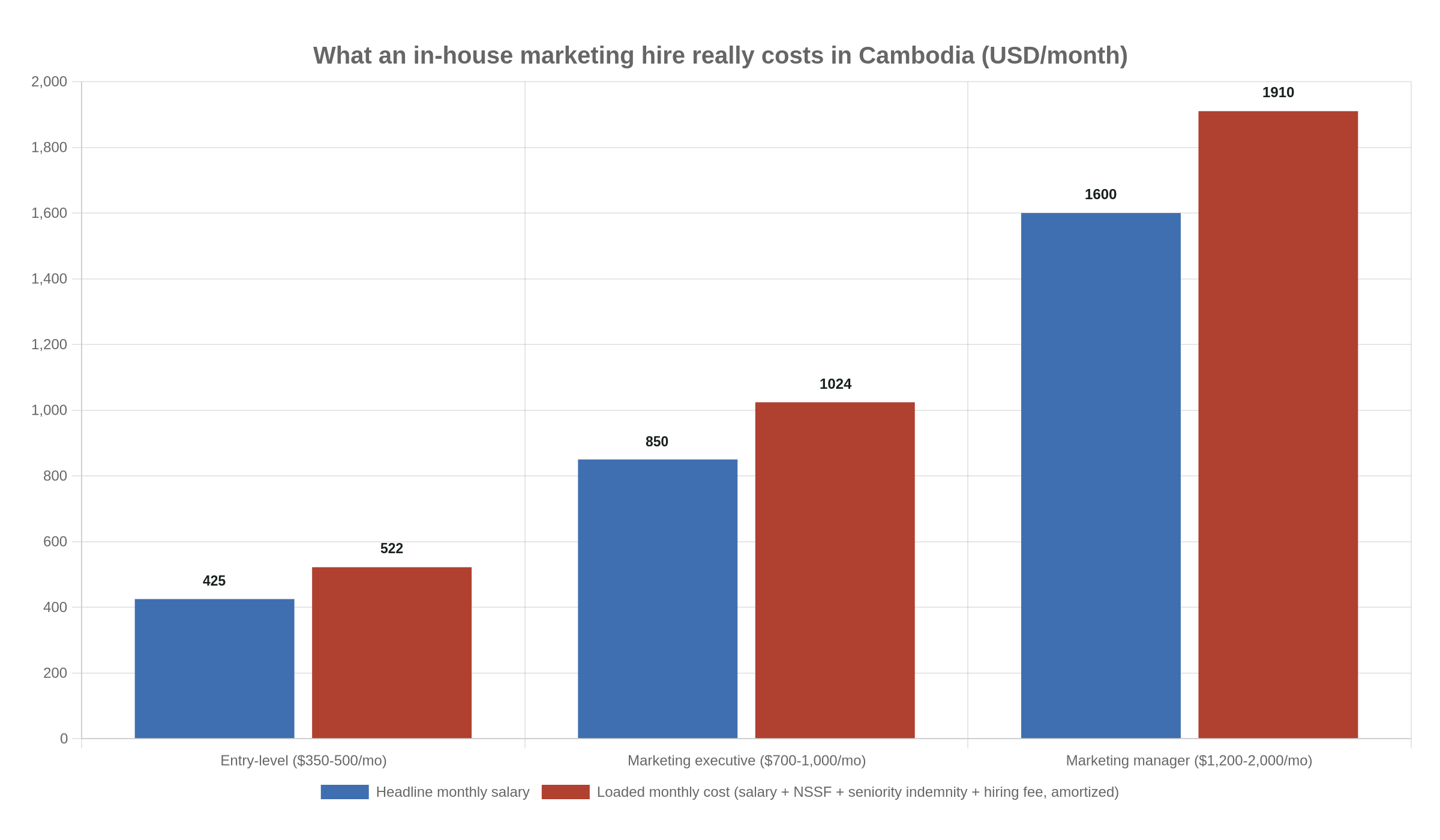
Three line items turn a headline salary into a loaded cost. First, NSSF: employer contributions (occupational risk, health care and pension combined) run around 5.4 percent, but they are calculated on a wage ceiling, not the full salary, and that ceiling is moving. It sits close to $300 a month today and rises to KHR 1,500,000, about $365, starting with November 2026 wages (contributions paid in December), under Inter-Ministerial Prakas 234/26 and NSSF Notification 3135/26 (NSSF; HRForte, 2026). Run the math on the ceiling that will actually apply for most of this article's shelf life and the NSSF cost for a $1,600 earner is roughly $20 a month, not $86 (NSSF, Aplus Consulting, 2026). This is the opposite of what most founders assume, and it means NSSF is the smallest of the three additions, not the largest. Second, the seniority indemnity: Cambodia's Labor Law requires 15 days of wages a year, paid in two instalments each June and December (Andersen Cambodia Labour Booklet, 2026), which works out to roughly 4.8 percent of monthly salary, or about $77 a month for a $1,600 hire. Third, the recruitment fee: Cambodian recruitment agencies typically charge 15 to 25 percent of a placed candidate's annual salary (JBHired, 2025). Spread that fee over an average tenure rather than treating it as a one-off, because marketing is one of the three functions with the highest staff turnover in Cambodia, alongside sales and operations, a recurring finding across editions of the HRINC Cambodia Annual Compensation Survey rather than a single dated statistic. HRINC's public materials confirm that turnover ranking but do not publish a specific average-tenure figure, so the amortization below models 18 months, a conservative estimate for a high-turnover function in this market, rather than citing it as a direct HRINC statistic. Amortized over that modeled 18 months, a 20 percent fee on a $19,200 annual salary adds about $213 a month. Add the three together and a $1,600-a-month manager costs the business closer to $1,910 a month, before a single campaign runs.
Take an 8-room boutique guesthouse group with three properties around Siem Reap, currently spending about $900 a month on Facebook and Telegram promotion with no dedicated headcount. Hiring even an entry-level marketing coordinator at $425 a month still loads up to roughly $522 once the same three additions apply, which already exceeds the guesthouse group's entire current marketing budget before the salary is even spent on activity. That is the arithmetic a hiring plan needs to survive before the interview stage, not after.
Two more line items belong in the same plan, even though neither changes the monthly number directly. Hiring through a recruitment agency in Cambodia typically takes three to eight weeks from brief to signed offer, longer for specialist or senior roles, so a vacant marketing seat usually stays vacant for a month or two before it costs anything at all (JBHired, 2025). An employer of record, which handles payroll and statutory compliance without the business opening a local payroll entity, typically charges a flat fee of about $399 per employee per month rather than a percentage of salary (Playroll, 2026). For a $1,600-a-month hire, that fee alone runs close to a quarter of the salary, which is worth knowing for a foreign-owned SME still deciding whether to hire directly or through an intermediary, but it does not replace the NSSF, seniority or recruitment-fee math above, since an EOR still passes those costs through.
Ramp-up is the line item a spreadsheet never shows and a hiring manager always underestimates. A new marketing hire in Cambodia, even an experienced one, typically needs four to eight weeks to learn the product, the brand's existing channels and the tools already in use before output starts resembling what the job description promised. Against the 18-month tenure modeled above, two months of ramp-up is roughly 11 percent of the hire's useful working life spent at reduced output, a cost no payroll line captures but every founder who has made this hire before will recognize. An agency, by contrast, starts closer to full output in week one, because the specialists on the account are already working across other clients in the same market.
What Does a Marketing Agency Actually Cost in Cambodia?
A marketing agency in Cambodia typically charges a monthly retainer between $500 and $3,000, scaled to scope rather than to a single job description, and that retainer usually buys several specialisms (strategy, content, paid media, reporting) rather than one person's time. We cover the full breakdown of retainer, project and percentage-of-spend pricing, plus the VAT and withholding tax that sit on top of the invoice, in our guide to digital marketing agency costs in Cambodia; the short version is that a flat retainer under about $5,000 a month of ad spend is the safer structure, and a written, numbered scope (a set count of posts, creatives and reports) is the only way to tell whether a month was delivered.
What an agency retainer buys that a single in-house hire structurally cannot is skill breadth without hiring risk. A $1,500-a-month retainer at a small Phnom Penh agency typically spans a strategist, a content or creative resource, a paid-media operator and an account lead checking the work, because the agency amortizes each specialist across several clients. A single in-house hire at the same loaded cost is one person, covering strategy, execution, reporting and whatever the business needs that week, with no backup when they are on leave, sick, or gone at the 18-month mark this article models as this function's average tenure, statistically the most likely outcome of the three.
The trade-off runs the other way once activity needs daily, inside-the-business judgment: pricing changes, inventory updates, same-day replies to a Telegram inquiry, or sitting in the weekly ops meeting. An agency bills for defined deliverables, not for being reachable at 4pm on a Tuesday because a shipment got delayed. That is the gap a $25-staff restaurant group in Phnom Penh, running four locations and already paying an $1,800 retainer, usually feels first: campaigns run fine, but nobody on the agency side can update a menu price across four Facebook pages the same afternoon it changes in the kitchen. If that gap sounds familiar, our guide to choosing a marketing agency in Phnom Penh covers how to renegotiate scope before assuming the whole structure needs to change.
Tax sits on top of either structure, and it changes the real comparison more than most founders expect. A VAT-registered agency adds 10 percent to its own invoice, and a further 10 percent VAT applies to the ad spend itself when it is rebilled through the agency, so an $1,800 retainer plus $2,000 of rebilled Meta spend can land closer to $4,180 once both VAT lines are counted, before any withholding tax the client owes on the agency's behalf is added. An in-house hire carries none of that VAT exposure on the salary itself, which is one of the few places the in-house column gets genuinely simpler, not more complicated, than the agency column.
In-House Marketing in Cambodia: Myths vs the Numbers
Myth: in-house is always cheaper than an agency. Reality: once NSSF, the seniority indemnity and an amortized recruitment fee are counted, a loaded in-house hire frequently costs more per month than a comparable agency retainer, not less. The $1,910 loaded manager above sits above the median of the $500-3,000 retainer range the market actually charges.
Myth: NSSF is the expensive part of hiring someone. Reality: NSSF is capped at a wage ceiling, close to $300 a month today and rising to KHR 1,500,000 (about $365) from November 2026 wages onward (Inter-Ministerial Prakas 234/26; NSSF, HRForte, 2026), so it adds roughly $20 a month going forward regardless of whether the hire earns $600 or $2,000. The seniority indemnity and the recruitment fee, not NSSF, are what actually move the number.

Myth: an agency guarantees results where an in-house hire is a gamble. Reality: neither guarantees anything. An agency guarantees a scope of work, written in the contract; an in-house hire guarantees a set of working hours. Results, in both cases, depend on whether the scope or the job description matches what the business actually needs, which is a judgment call no pricing model makes for you.
Myth: one marketing hire covers "marketing" the way one developer covers "the website." Reality: marketing in 2026 spans paid media, content, analytics, CRM and at least two messaging channels (Facebook remains the largest platform in Cambodia at roughly 14.0 million users in late 2025, with Telegram dominant for direct business messaging; DataReportal, Digital 2026 Cambodia). One junior-to-mid hire rarely covers all of it well, which is the real argument for either an agency's bundled specialists or, past a certain budget, more than one hire.
Myth: switching from an agency to in-house, or back, is a simple, low-risk change. Reality: an agency contract usually locks in a notice period, and the business rarely owns the ad account history, the creative files or the campaign data unless that was written into the agreement from the start. An in-house hire who leaves after the 18-month tenure this article models for a high-turnover function in Cambodia takes undocumented process knowledge with them unless someone insisted on a shared folder and a handover document from day one. Neither path is reversible for free; both deserve a written exit clause before they start, not after the relationship sours.
How Should a Cambodian SME Actually Choose?
A Cambodian SME should decide between in-house and agency by working through six checks in order, because each one eliminates an option faster than debating price alone.
- Total monthly marketing spend. Below roughly $2,500 to $3,000 a month, the loaded cost of even an entry-to-mid hire consumes most or all of the budget before any media runs; an agency retainer at a comparable price still leaves money for the actual campaigns. Above that threshold, the maths starts to favour a hire, because the agency's bundled-specialist premium stops outweighing one dedicated person's output.
- How much of the work is reactive. If the job is mostly same-day: price changes, stock updates, replying to Telegram or Messenger inquiries inside business hours, no agency retainer is structured to cover that well. That pulls the decision toward in-house, or at minimum a hybrid.
- How much of the work needs specialist breadth. Paid media strategy, conversion tracking, and creative production each reward a different skill set. A single in-house hire rarely has all three at a competitive level; an agency retainer usually bundles them.
- Tolerance for turnover risk. Marketing sits among the three functions with the highest staff turnover in Cambodia, a recurring finding across editions of the HRINC Cambodia Annual Compensation Survey. A business that cannot absorb a two-to-three-month capability gap while it re-hires should weight that risk into the decision, not just the monthly invoice.
- Time available to manage the relationship, either way. An in-house hire needs a manager who can set goals and judge the work; an agency needs a client-side owner who can approve briefs and read a report critically. Neither option runs unsupervised, and businesses that assume otherwise tend to be disappointed by both.
- How fast the business needs to move if the arrangement fails. A hiring process to replace a departed employee runs three to eight weeks at best (JBHired, 2025); ending an agency contract and onboarding a replacement can move faster if a notice period is short, or slower if one is not. Check the exit terms before signing either kind of agreement, not after the relationship has already soured.
Running a 25-staff Phnom Penh restaurant group through these six checks: spend sits around $2,200 a month (check 1 points toward agency), roughly a third of the work is reactive menu and promotion updates (check 2 points toward a hybrid), paid media and content both matter (check 3 points toward agency breadth), the group has had no unexpected staff turnover on the agency side in two years so check 4 does not change the read, the owner has no spare time to manage a new hire's ramp-up (check 5 points toward agency), and the current agency contract runs month to month with no lock-in (check 6 removes the main risk of staying put). Four of six checks favour keeping the agency, which is the correct read even though the owner's first instinct, after two years of retainer invoices, was to "finally just hire someone."
A Hybrid Model: One In-House Lead Plus an Agency Retainer
Past roughly $5,000 a month of total marketing spend, the strongest structure for most Cambodian SMEs is neither pure in-house nor a full agency retainer, but a hybrid: one in-house marketing coordinator who owns the reactive, same-day work and the relationship with the agency, paired with a narrower agency retainer covering strategy, paid media and content production. Run the numbers and the case is concrete, not just directional: a loaded entry-tier coordinator at roughly $522 a month plus a trimmed $1,200 agency retainer totals about $1,722, against roughly $1,910 for a single loaded manager working alone, or $2,500 and up for a full-scope agency retainer at the same spend level. The hybrid covers both the reactive and the strategic side for less than either pure option, because it splits the work along the line each structure is actually good at, rather than asking one structure to stretch across both.
A 40-employee exporter operating from an industrial zone near Phnom Penh, selling business to business with Khmer and English buyers split roughly evenly and most inbound inquiries arriving through Telegram, is the clearest case for this structure. A single in-house coordinator fields and triages Telegram inquiries same-day and manages the WhatsApp-and-Telegram side of the relationship with existing buyers, while the agency runs the slower-moving work: English and Khmer content, a lead-capture funnel, and campaign strategy that does not need an answer within the hour. Building that lead-capture side properly is its own project; our 90-day sales funnel build is the structure we would put under the agency half of this arrangement.
A mid-sized residential real estate developer marketing two active projects in Phnom Penh fits the same pattern for a different reason: show-unit inquiries and walk-in follow-ups need a same-day, in-house response, while the quarterly brand campaign, the sales-gallery content and the paid lead generation for each launch are exactly the kind of bounded, specialist work an agency retainer handles without the developer carrying a full marketing department on payroll between launches.
The failure mode to avoid in a hybrid is unclear ownership. If both the coordinator and the agency believe the other is responsible for, say, tracking which Telegram inquiries convert, neither tracks it. Write the split down in one page before either party starts: who owns which channel, who approves which spend, and who the agency reports results to.
So, Should a Cambodian SME Hire In-House or Keep the Agency?
Our verdict, as a short recap of the thresholds above:
- Under about $3,000 a month of total marketing spend: keep the agency, and insist on a written, numbered scope rather than a vague "social media management" line.
- Between roughly $3,000 and $5,000 a month: run the six-check framework above before deciding either way; the right answer at this level depends more on how reactive the work is than on the budget alone.
- Above roughly $5,000 a month: move to the hybrid, one in-house coordinator paired with a narrower agency retainer, which beats either pure option on cost and on coverage at this spend level.
- Regardless of budget: if the work is mostly same-day, reactive and inside-the-business, no retainer structure handles that well, and the honest answer tilts toward in-house.
The number that should move a founder's decision is not the headline salary on a job post, it is the loaded cost, roughly 19 to 23 percent higher than it looks once NSSF, the seniority indemnity and a realistic hiring fee are counted in.
Whichever side of that line a business sits on, the sales funnel underneath the marketing spend usually matters more than who runs it. A sales funnel system that captures and qualifies leads properly is what makes either an agency retainer or an in-house hire worth the monthly cost in the first place; without it, both options spend the same budget chasing leads that were never going to convert. This is also the first question our own scoping and audit step surfaces before any contract is scoped: who will actually run the lead-generation work day to day, because that answer decides which part of the system we build first. If the honest answer after reading this is "we are not sure which side of the $3,000 line we actually sit on," that is a scoping conversation, not a hiring decision: talk to us and we will work through the real numbers for your specific budget before you sign anything.
Prefer to chat? Message our founder directly on Telegram (@maxgrolier), or book a call with the team.