

Before you hire a web development company in Phnom Penh, ask what it actually delivers: technical scoping, the build, a CMS your team can run without calling back, SEO groundwork from the start, and integrations to your CRM, booking tool, or payment page. That is the deliverable, because much of what Google shows for this query is job boards and internship listings for people who want to work in web development, not businesses that want to hire it.
This guide is for the second group, part of our broader web development in Cambodia coverage, narrowed to one question: how do you shortlist and brief a company in the capital?
What does a web development company in Phnom Penh actually build?
A web development company in Phnom Penh builds five things, not one: technical scoping, the build, CMS implementation, SEO groundwork, and integrations. That split matters: a large share of directory-listed providers sell only a slice of it and leave the rest to the client.
- Technical scoping: a stack recommendation made against your project, not against the vendor's habit.
- The build: clean, tested pages, whether that lands on Webflow, Shopify, or custom code.
- CMS implementation: collections and permissions your own team can actually use after handover.
- SEO groundwork: structure, speed, and on-page basics built in, not bolted on after launch.
- Integrations: forms, scheduling, CRM, analytics, and payment, wired and tested before go-live.
A company stopping at the second item sold you a website; one covering all five sold you working business infrastructure. On Concorde, a Cambodia-based sustainability-sector client needing credibility with both local and international partners, that meant branding, UX/UI and the Webflow build landing as one engagement, not five separate vendors (TechFlow Agency project record).
Company, freelancer, or website developer: who should you brief in Phnom Penh?
Company, freelancer, or a single website developer: the right choice depends on how much coordination you can absorb yourself. Twine currently lists 15 freelance web developers in the country, a small enough pool to review every profile in an afternoon (Twine, 2026).
A solo developer suits a small, tightly specified job, but you own the risk if that person becomes unavailable mid-project, with no handover documentation to fall back on. A company spreads that risk across a team.
We think an SME briefing anything beyond a single landing page should default to a registered company over a solo developer, the moment a CMS handover and post-launch changes enter the picture.
Why Cambodia's web development directories undercount your real shortlist
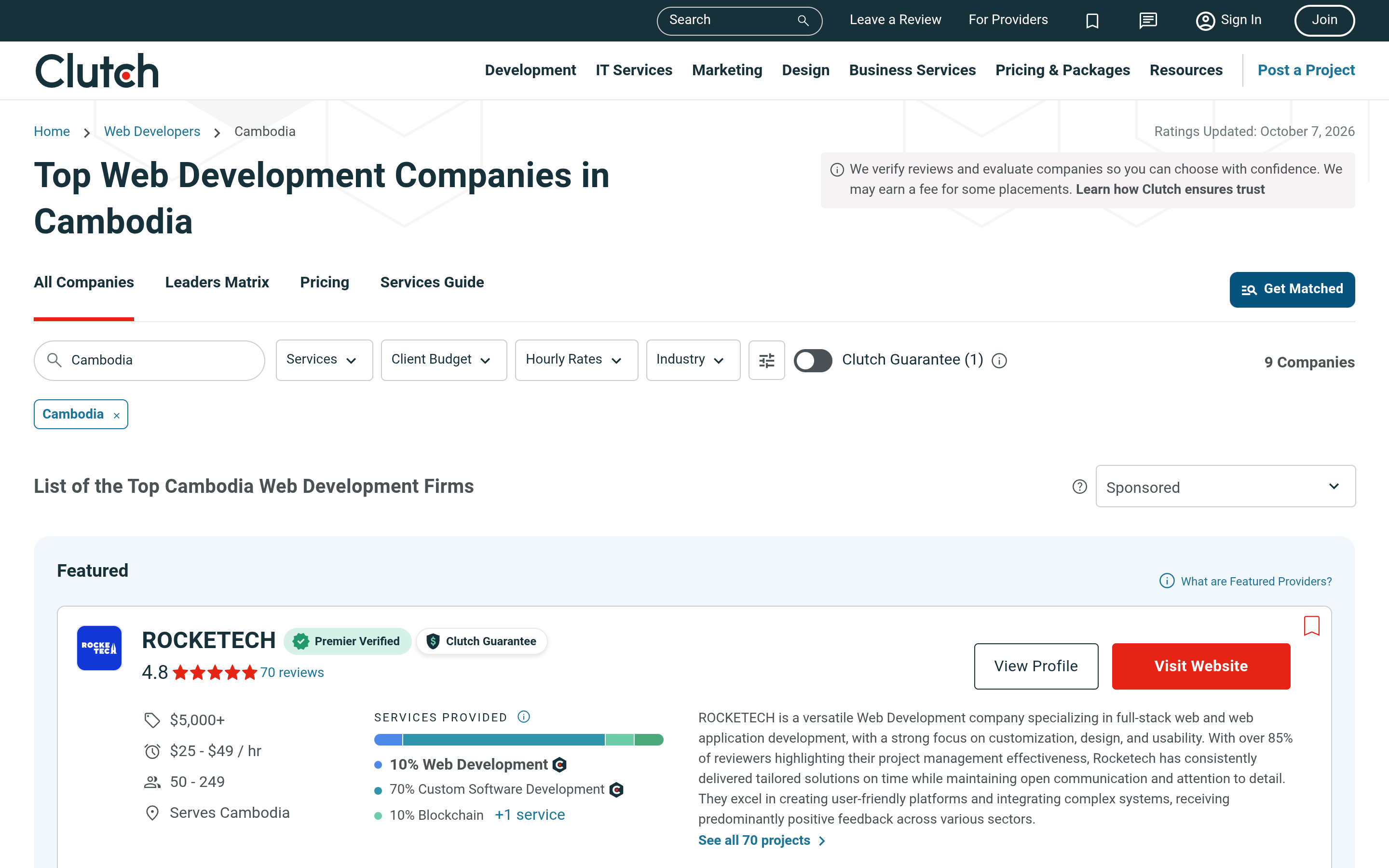
Cambodia's web development directories undercount your real shortlist because each one measures a different, narrower slice of the market, and no single page cross-references them. TechBehemoths lists around two dozen companies for the whole country, a figure that moves as the directory updates (TechBehemoths, checked 2026-10-07). Clutch lists 9 companies across four price tiers: in the top $150 to $199 band, Dotfusion Digital carries 13 verified reviews, all five stars, while NuForm, the other firm in that tier, publishes no review count (Clutch, checked 2026-10-07). Twine's freelancer count above counts individuals, not companies, and LinkedIn Cambodia's few dozen open roles at any time are a workforce signal, not a company count (LinkedIn Cambodia, checked 2026-10-07).

None of these lists talks to the others, or tells you which entries are still active. The practical fix is a three-step check we run on any shortlisted name: confirm the company is registered (a Facebook page is not a business), check its Google Business Profile for a review count and a response pattern, not just a star average (Web Essentials, a Phnom Penh software company, carries a solid run of reviews with visible owner replies), and load one of its live sites on a phone. No directory runs this check for you, because none has a reason to flag how much of its own listing is stale.
How much does web development cost from a company in Phnom Penh?
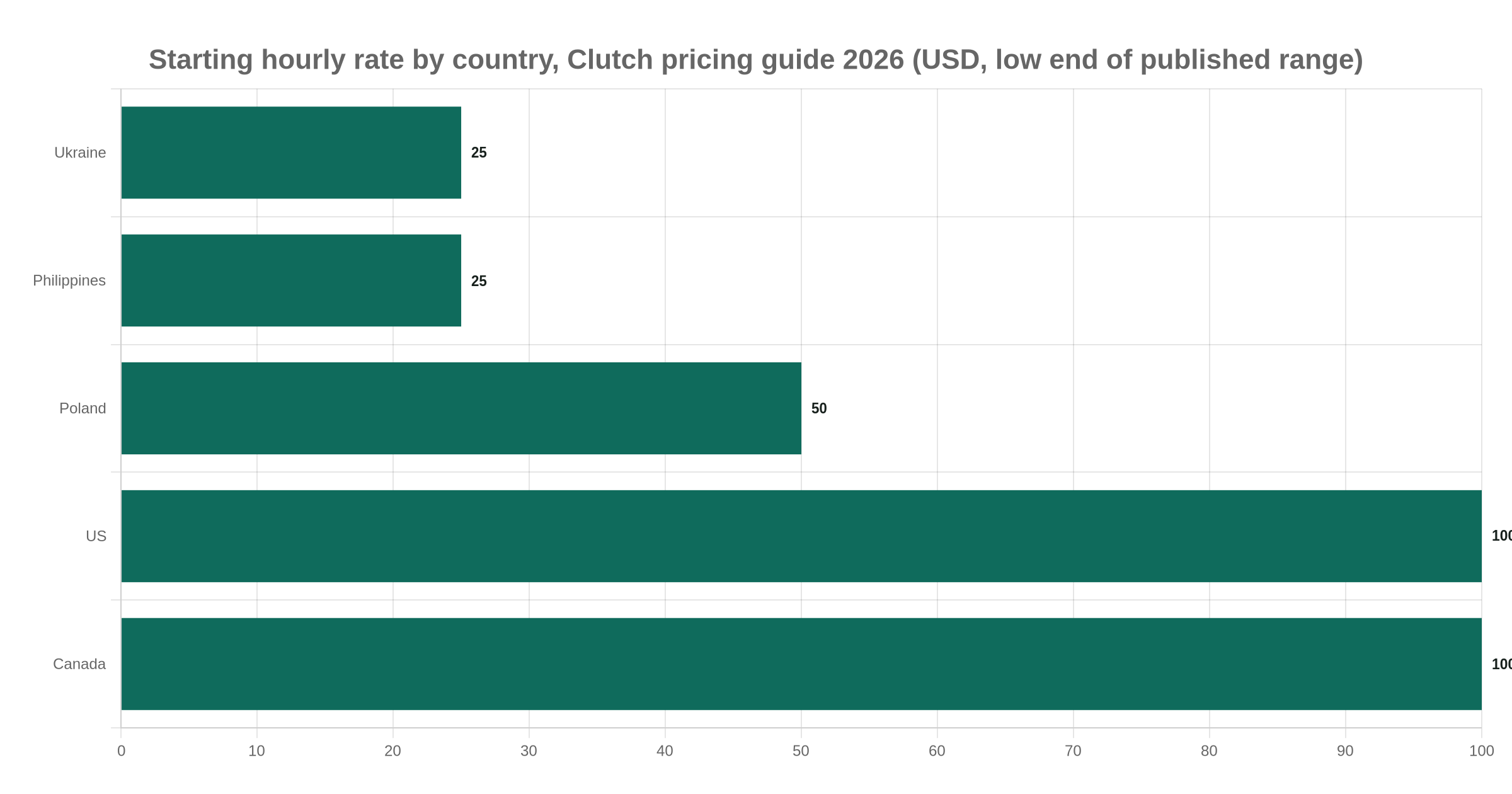
Neither Clutch's pricing guide nor solohourly's 2026 freelance rate guide tracks Cambodia as its own line, so any "Cambodia vs the world" number quoted elsewhere is invented. What both sources give directly is a set of country bands: Clutch puts Ukraine and the Philippines at $25 to $49 an hour, Poland at $50 to $99, the US and Canada at $100 to $149, and India under $25 (Clutch, 2026). Solohourly's freelance figures run a little higher on the same countries, the US at $60 to $150-plus and India at $40 to $80-plus (solohourly, 2026).
| Pricing model | How it works | Watch for |
|---|---|---|
| Per-page quote | Fixed price per page, scoped before work starts | Whether CMS setup and SEO groundwork are included or billed separately |
| Freelance day rate | Paid by time, tracked informally | No documented handover if the relationship ends mid-project |
| Retainer-only agency | Monthly fee, no fixed scope | Ambiguity over what "included" actually covers month to month |
TechFlow Agency prices on quote after a scoping call, not a public rate card, since a five-page showcase site and a database-backed platform use very different hours. Against agencies in Europe serving the same Southeast Asia clients, we position our rates roughly 35 percent lower, a positioning claim rather than a measured figure. A 5 to 8 page SME showcase site typically runs 40 to 60 build hours: priced at the US/Canada band above, $100 to $149 an hour, that is $4,000 to $8,940, comfortably under Clutch's $10,000 ceiling. At TechFlow's roughly 35 percent lower positioning, the same scope lands closer to $2,600 to $5,810. Whichever model a company you're briefing uses, ask for the number broken down by the five deliverables above before comparing quotes. If branding and UX/UI sit outside that quote, our companion guide to web design in Cambodia covers that half of the budget.
What should go in your brief before the first call?
Your brief before the first call should answer four questions in writing: what the site needs to do, who edits it after launch, what assets already exist, and what "done" looks like.
We would rather lose a pitch than start a build on a verbal scope; the projects that run over budget in this market are almost always the ones where the brief lived in a chat thread instead of a document. On projects like Mandil Avocats, a law firm serving digital-sector clients, we moved from mockups in Figma to a full technical audit with Screaming Frog before touching a single page, mapping broken links and redirect chains so nothing working disappeared at launch. That audit step only happens when the brief states upfront that the site is a redesign, not a new build, exactly the kind of detail a verbal conversation loses.
How do you check a shortlisted Phnom Penh company can actually deliver?
Checking that a shortlisted Phnom Penh company can actually deliver takes four questions on the first call.
- Ask for live URLs, not a portfolio deck, and test them on mobile data.
- Ask who owns the stack decision: a serious team names Webflow, Shopify, Bubble, Xano, or custom code, and explains why.
- Ask who edits the site after launch: if the answer is "us," you have bought a dependency, not a CMS.
- Ask what a redesign audit involves: a team that has never heard of a redirect map has never protected a client's rankings through a relaunch.
A company that answers all four without hedging has done this before; one that only answers the first has a case study, not a process. Picture two names on a shortlist: the first names Webflow for your redesign because a 5 to 8 page site needs a CMS your team can run, not custom code. The second says it can build anything and names no stack. Six months later, the first client edits a price change themselves; the second is still waiting on the original developer for a one-line copy fix, the same handover risk a solo freelancer carries into a company engagement.
Working with a Phnom Penh team: timezone, language, and local payments
Working with a Phnom Penh team means Indochina Time, UTC+7: a morning of overlap with Europe and a full working day with the rest of Asia. Locally, that means rendering Khmer script correctly, wiring KHQR into checkout, and knowing Telegram carries more day-to-day business communication here than email.
DataReportal counted 12.0 million internet users as of October 2025, a 67.3 percent penetration rate, with 21.7 million mobile connections active, 121 percent of the population (DataReportal, Digital 2026: Cambodia). On payments, KHQR merchant acceptance has reached roughly 4.5 million merchants nationwide and mobile banking has passed 10 million users, with KHQR payment volume exceeding $105 billion annually (Cambodia Investment Review, citing National Bank of Cambodia data, 2026). A site that cannot take a KHQR payment is not fully built for this market.
Bringing your brief to TechFlow Agency
With the four answers from the brief section above, you are ready for a call. TechFlow Agency runs web development as one line of a full-stack practice from Phnom Penh: scoping and audit, design and prototype, sprint-based development, and post-launch follow-up, each with its own deliverable.
You can review our shipped projects before you talk to us, the same check recommended above. When ready, book a call: 30 minutes with the founder, no obligation, to put your brief against a real scope and timeline.
Prefer to chat? Message our founder directly on Telegram (@maxgrolier), or book a call with the team.
Frequently asked questions
How long does a website project take with a Phnom Penh company?
Most showcase sites run 3 to 6 weeks from kickoff to launch; platforms or database-backed applications run 2 to 4 months. First mockups are typically ready within two weeks.
Do I need to hire a company that is legally registered in Cambodia?
Not strictly, but we recommend it. A registered company gives you a contract counterparty, a verifiable address, and someone to escalate to if the builder becomes unreachable.
What does web development in Cambodia typically cost?
Neither Clutch nor solohourly tracks Cambodia specifically, but both place comparable regional markets near the bottom of their published bands. The honest answer is an itemized quote against the five deliverables above.
Can a Phnom Penh company build a bilingual Khmer and English site?
Yes, and it is worth confirming before you sign, since Khmer script has real technical requirements: word breaking without spaces, subscript stacking that a Latin-tuned line height clips, and a smaller pool of production-ready webfonts than English has. Ask to see a live bilingual site the company has already shipped, not a mockup.
What happens if the company I hire shuts down after launch?
This is why handover terms belong in the brief: hold the domain, the CMS access, and the hosting account under your own name from day one, not the agency's. A company that resists handing these over is a warning sign worth acting on before signing, not after.
Is a Webflow specialist better than a generalist developer for my project?
For most showcase and corporate sites, yes: a Webflow specialist ships a visual CMS your team can run without a developer on standby. A generalist earns their fee back only on projects with real application logic or a custom database, a smaller share of Cambodian business sites than the directories suggest. Our Webflow agency piece explains where Webflow ends.