
A written scope, a real timeline and a named handoff plan: those three documents are what actually tell you whether a web development company in Cambodia will still answer the phone, stay on budget and finish what it promised three months from now. A directory ranking cannot give you any of them. The question most buyers bring to this search is "who is the best web development company in Cambodia," but the one worth answering is narrower: how to choose a web development company in Cambodia that proves those three things in writing before any money changes hands, and this guide is built around exactly that.
We write this from the inside. TechFlow Agency is itself a web development company based in Phnom Penh, so read the opinions below as a competitor's honest account of its own market, not a neutral referee's. Where we say "ask for this," it is because we have watched its absence go wrong on other people's projects, not because asking it flatters us.
Key points
- A directory ranking tells you who paid for a listing, not who finishes a project on time. Ask for a written scope and a timeline before you ask anyone for a price.
- Cambodia's digital economy still contributes only 1.8 percent of GDP (Asian Development Bank, August 2026), a thin market where the buyer, not the ranking, has to do the vetting.
- The hourly rate you are quoted matters less than what happens after launch: who fixes a broken payment form in month four, and whether that duty is written down anywhere.
What makes a web development company in Cambodia worth hiring?
A company is worth hiring when it can show a live, running site it actually built, quote a timeline that matches the scope you give it, and put its post-launch support in writing before you sign. Everything else, logos, star ratings, a slick pitch deck, is decoration around those three facts, and the rest of this guide is really just a longer version of how to check for them before you commit any money.
Search "best web design company cambodia" or "web design company cambodia" today and the first page is mostly directory pages and listicles, not editorial reviews. One such directory, ensun, currently lists 38 companies under "web development" for Cambodia alone, most with no public client work attached to the listing (ensun.io, accessed November 2026). Several local sites repeat the same five or six names across a "top agency," a "top branding firm" and a "top hosting firm" page on the same domain, a pattern that points to a templated list, not a researched one.
None of this means every company you find through a directory is unreliable. It means the ranking itself carries no evidence either way. A five-star profile with twenty reviews can be entirely genuine and still tell you nothing about whether that team has shipped a project your size, in your timeframe, in the last twelve months. Even a long-established name can have quietly shrunk to one person juggling five clients, and a brand-new one can be three experienced developers who just left a bigger studio to work for themselves; a ranking position captures neither situation.
We would treat any directory listing as a lead worth a phone call, never as a finished reference. A reference is a named project you can click through on the live web right now, built by that exact team, still running today, not a screenshot in a portfolio deck. That one habit, insisting on a live reference before a quote, removes more bad fits than any ranking position ever will.
The brief, not the pitch, decides the price
Before comparing anyone, write down four things on one page: what the site has to do (showcase, online store, booking, a platform with user logins), who maintains the content after launch, which languages it needs on day one (English, Khmer, or both), and the deadline you actually have, not the one you would prefer. That single page changes who you should even be talking to, because a five-page showcase site, a CMS-driven brand site and a logged-in platform are three different jobs that should never be quoted the same way or by the same kind of provider.
Our own Cambodia web development work illustrates the range. A bilingual English and Khmer car-brand site ran 12 weeks end to end. A tutoring centre redesign with a simpler scope ran 8 weeks. A sustainability-sector site with a content management system for the client's own team ran 10 weeks, and a smaller NGO site with a lighter brief ran 9 weeks.
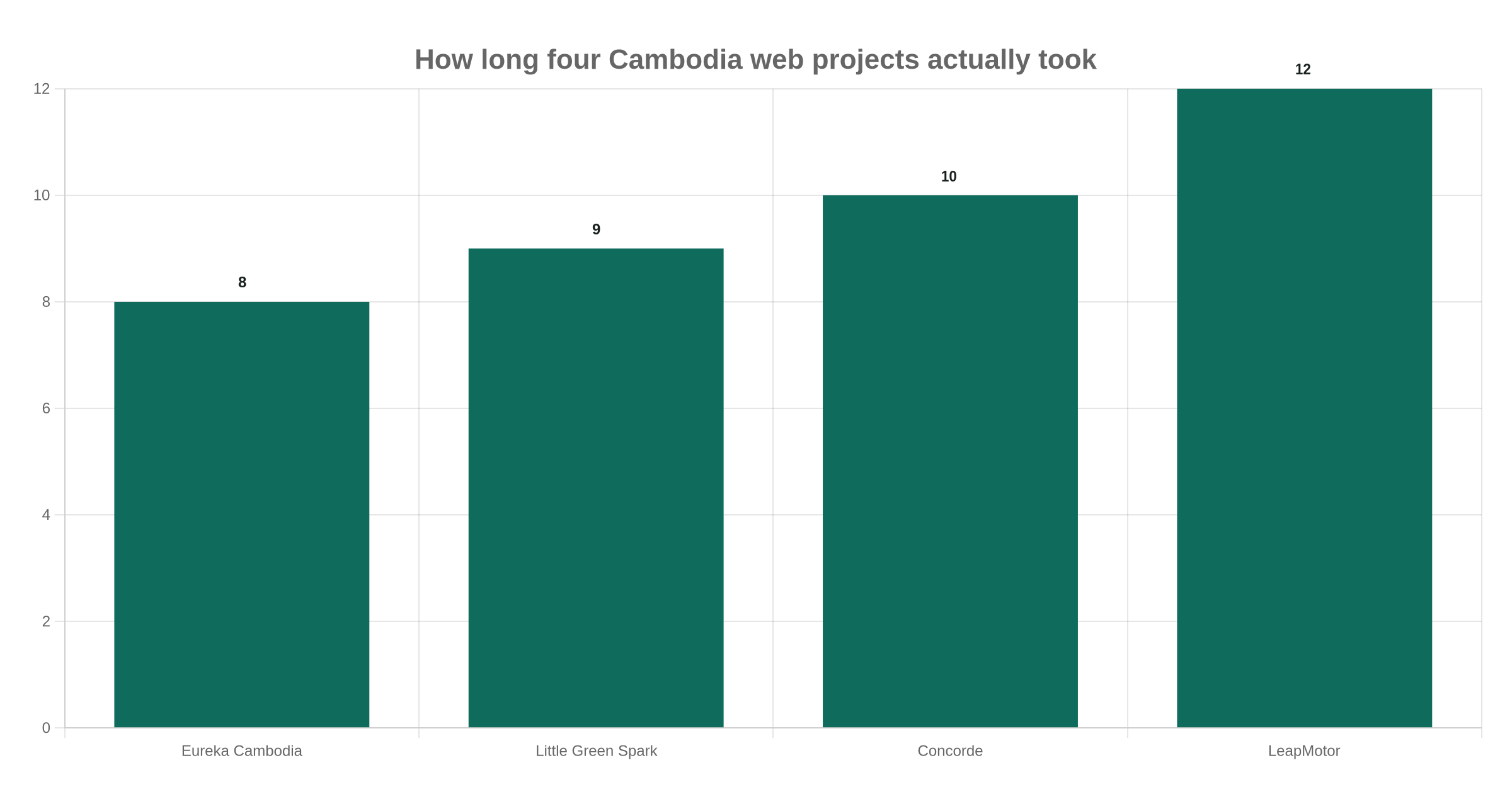
The pattern holds across our own work and it is not unique to us: scope, not luck or team size, is what moves a Cambodia web project from eight weeks to twelve. If a company gives you a single number before it has asked what the site needs to do, that number is a guess, not a quote.
Bilingual builds deserve their own line in the brief. Khmer script has different line-height, spacing and font-rendering needs than Latin script, and a team that designs in English first and "adds Khmer later" usually ends up fixing layout bugs after launch instead of before it.
One concrete pitfall shows up again and again on bilingual sites: a button or menu label sized to fit the English word runs out of room once the Khmer equivalent goes in, because Khmer compound terms frequently take more horizontal space than their English counterpart. A navigation bar that looks clean in the English version can wrap, truncate or overlap in the Khmer one, and nobody notices until a Khmer-speaking visitor sends a screenshot. The fix costs nothing at the brief stage: ask the team to design and test both language versions in the same layout before launch, not translate the English version afterward and hope it still fits.
Here is why the brief matters more than the quote. Take a mid-sized Phnom Penh retailer who wants an online store with a product catalogue, delivery zones and a local payment option. A freelancer reading only "we need an online shop" might price that as a five-page showcase site, because nothing in the ask mentions inventory, delivery logic or a payment gateway. Once those requirements surface mid-build, the honest options are a change order, a missed deadline, or a shortcut that leaves the catalogue unmanageable six months later. None of those are the freelancer being dishonest. They are the predictable result of a brief that never named the actual job.
The fix costs almost nothing: list the features that make the project what it is (how many product variants, which delivery areas, whether staff need their own login) before any call. A company that reads that list and comes back with questions about edge cases, what happens when stock hits zero, how returns are handled, is telling you it has built this kind of thing before. A company that just returns a number is telling you the opposite.
Why does a Cambodia web development company's hourly rate tell you so little?
Not much, on its own: the number alone hides how far the real scope has drifted. Southeast Asia web development rates run wide. Independent freelancers charge roughly $15 to $35 an hour, agencies charge roughly $25 to $50 an hour, and a typical straightforward project runs $800 to $6,000, according to Project Cost Estimator's 2026 country rate guide (April 2026). A separate comparison from Highfive Global puts Southeast Asian developer-only rates at $20 to $45 an hour against $100 to $180 an hour in the United States, with offshore team costs landing around 30 to 45 percent of the equivalent US cost (Highfive Global, April 2026).
None of these numbers are a quote. They are a sanity check: if a figure you are given sits far outside these ranges in either direction, ask why, because both a suspiciously low number and a suspiciously high one usually mean the scope was never really pinned down.
| Provider type | Typical rate or project cost (2026 benchmarks) | Best fit | Main risk |
|---|---|---|---|
| Independent freelancer | $15 to $35 an hour (Project Cost Estimator, Apr 2026) | A single landing page or a small fix | No backup if the person goes quiet |
| Boutique local studio | $800 to $6,000 per project (Project Cost Estimator, Apr 2026) | A showcase site with real design care | Small team, one point of failure |
| Full-stack agency (design and development) | $25 to $50 an hour (Project Cost Estimator, Apr 2026) | A brand relaunch alongside the site, or an SEO-sensitive migration | Costs more than a lone freelancer |
| Offshore developer-only team | $20 to $45 an hour (Highfive Global, Apr 2026) | Extra development headcount on a spec you already own | Time zone gaps, no local presence for support |
A rate card says nothing about how many hours a vague brief will actually consume, and a vague brief always consumes more hours than a clear one. Run the math on the retailer above. At the Southeast Asia freelancer rate of $15 to $35 an hour, a catalogue build that was quoted at 60 hours because the brief looked simple can easily run to 100 or 120 real hours once delivery zones, stock rules and a payment gateway get added mid-project, pushing a $1,500 estimate past $3,000 without anyone technically lying about the rate. A fixed-fee quote built from the full brief avoids that drift, because the provider, not the client, absorbs the cost of underestimating.
A second example makes the same point from the other direction. A Phnom Penh logistics company asked for "a quote request and tracking page for customers," priced by a freelancer at roughly 40 hours because the brief read like a single feature. Once the real requirements surfaced, a tracking lookup tied to three different carriers, a multi-currency invoice display in dollars and riel, and a login for repeat business clients, the job doubled to closer to 85 hours. The freelancer absorbed the gap rather than renegotiate mid-project, delivered six weeks late, and still billed the original hourly rate throughout. A fixed-fee quote priced from that full brief, instead of the first two-line request, would have set the real cost on day one and protected both sides from the slippage that followed.
"The value is in understanding the client's problem, choosing the right tools, integrating them into daily work, and checking what comes out." Maximilien Grolier, Founder and CEO, TechFlow Agency, LinkedIn, 5 November 2026.
That is the honest answer to why one quote can cost twice another for what looks like the same brief. A team that spends two hours asking what the site has to achieve before writing a number is not padding the bill. It is the reason the number holds once work actually starts. We would be suspicious of any quote delivered in the same call as the first pitch, regardless of who is giving it.
If the budget is genuinely tight, outsourcing part of the build rather than handing over the whole relationship is a legitimate option, and often a better one than chasing the cheapest full-service bid. Our own notes on outsourcing web development to Cambodia cover where that saves real money and where it adds coordination work you have to manage yourself, day to day, not just at kickoff.
What does a portfolio actually prove?
A good-looking case study tells you a designer has taste. It does not tell you the team shipped on time, kept the client's content editable after handoff, or fixed the bug that always shows up in week three of real traffic, once actual visitors start clicking things in an order nobody designed for. Ask for one thing a portfolio cannot fake: a live site you can click through right now, ideally one that has been running for at least six months, plus the name of someone at that client you are allowed to call directly.
Hypothetical scenario, for illustration only, not a real TechFlow client. A Siem Reap guesthouse owner picks the cheapest of three quotes for a new booking site. No written scope gets signed, just a WhatsApp message confirming "a nice modern website, 5 pages." Eight weeks later the site is still "almost done," the booking form was never actually connected to an inbox, and the freelancer has gone quiet. The owner has paid half up front and has no document to point to when chasing a refund. This is the exact failure mode a one-page scope, agreed in writing before any deposit, is built to prevent, and it costs nothing to write.
Two further checks cost nothing and catch most of the risk a portfolio hides. First, Cambodia's Ministry of Commerce runs an online business registration lookup, and it is worth five minutes before any deposit: only 6.5 percent of Cambodian micro-enterprises are formally registered with the state, according to CamFinTech Insights, citing MISTI (the Ministry of Industry, Science, Technology and Innovation)'s 2022 Economic Census (updated November 2026). A sizeable share of the names you find through a Facebook page or a directory listing may not be registered businesses at all, and that single check filters out more unreliable providers than any star rating does. Second, ask how the team actually communicates day to day. A team that works over Telegram with a shared channel and a standing weekly check-in is far easier to hold accountable than one that goes quiet between emails for a week at a time.
A short list of direct questions does more work here than any amount of browsing a portfolio. Ask who on the team will actually write the code, not just design it, since a studio can subcontract development without saying so. Ask what happens to the site's source files and hosting login if the relationship ends, and get that answer in writing, because a provider that keeps the keys can hold a client hostage on the next renewal. Ask for one example of a project that ran into a real problem and how it was fixed, since a team with no story at all has either not shipped much or is not being straight with you.
If hiring one person directly, rather than a team, is closer to what the brief actually needs, our breakdown of hiring a developer in Cambodia covers what that choice trades away against a small studio or a full agency.
Most Cambodia web projects fail quietly after launch, not during it
Most buyers judge a web company by the build, because the build is the part you can watch happening. The part that actually determines whether you regret the hire is what the company does once the site goes live: who answers when a payment integration breaks at 11pm, who updates a page when the business changes its pricing, and whether that support duty was ever written down or just implied in a sales call nobody recorded.
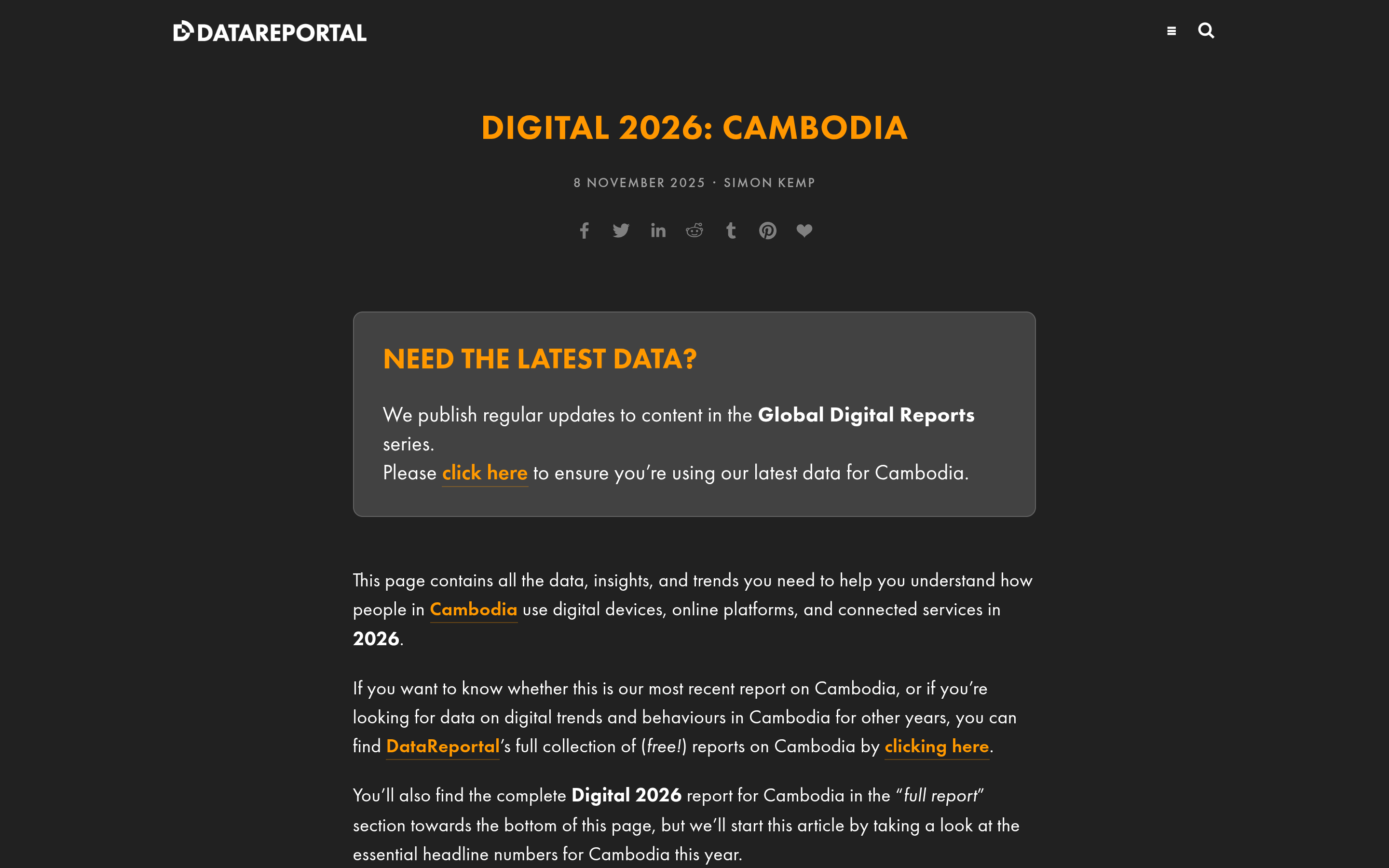
Context matters here too. Cambodia had 12.0 million internet users and 67.3 percent penetration at the end of 2025, with 14.0 million social media user identities, 77.9 percent of the population (DataReportal, "Digital 2026: Cambodia"). That growth is real, but the country's digital economy still contributes only 1.8 percent of GDP, with a Digitalization Index score of 19.3 out of 100 (Asian Development Bank Brief No. 399, August 2026). A thin digital economy means fewer teams anywhere in the country with genuine after-launch capacity, and more who are comfortable building a first version but not sticking around to maintain it.
Local payment rails are the clearest test of whether a provider actually understands the Cambodia market, rather than bolting on a generic template. KHQR alone processed roughly 1.48 billion transactions worth about $105.6 billion in 2025, and mobile banking users in Cambodia passed 10 million, according to Indo-Pacific Insight's reporting on National Bank of Cambodia data (June 2026). A web development company that has never wired up a KHQR or ABA PayWay checkout before is not disqualified, but it should say so plainly rather than promising to "figure it out" once the contract is signed.
Ask three concrete questions before signing anything. What happens if a KHQR or ABA PayWay payment integration stops working on a weekend. What happens to support if the one person who built the site leaves the company. And is there a number, in writing, for how many hours of post-launch support are included in the price, not just a verbal "we will take care of you" from the sales call.
We delivered a redesign for Eureka Cambodia, a Phnom Penh tutoring centre, in 8 weeks, and it now generates an average of 22 appointment requests a month with a 1.5-second load time. That outcome came from a defined handoff, not from the design alone: the client's own team can edit and publish content without our help, and the scope of what we owed after launch was written down and agreed before the contract was signed. That is the standard we think any company you hire should be held to, regardless of who ends up building the site.
How do you decide, once you have a shortlist?
Three moves, in order, once two or three names are left on the list. First, hand each of them the same one-page brief and compare what comes back: what the site does, who maintains it after launch, which languages it needs, and the real deadline. A company that improves that brief on the first call is worth more than one that simply prices it as written, word for word.
Second, before any deposit changes hands, ask for one live reference site that has been running for at least six months and check the company's business registration. That single pair of checks removes more risk than reading five more reviews would.
Third, get the post-launch terms written into the contract, not promised on a call. If a company cannot answer, in one sentence, who fixes a broken page in month four and at what cost, that answer alone tells you whether to hire them.
A second opinion on a brief, a scope or a quote you already have is a smaller ask than a full project, and it is one we are glad to give. Our Phnom Penh team runs on exactly the written-scope, named-timeline approach described above, from the first short call through to the post-launch handoff, working in Cambodia's own time zone (ICT, UTC plus 7).
None of this removes all the risk. A written scope cannot force a team to show up, and a business registration check cannot guarantee a team's code is good. What these three moves do is shift the odds in your favour before you have spent anything, which is the only point in the process where that is still cheap to do. Everything after signing costs more to fix than it would have cost to ask about beforehand, including the things that feel too basic to ask.
Want a second read on a quote before you sign it? Bring us a scoped estimate request and we will tell you plainly whether the number in front of you matches the brief, even if you end up hiring someone else.
Prefer to chat? Message our founder directly on Telegram (@maxgrolier), or book a call with the team.
Keep reading
- the full web development guide: stack choices, scope and what a Cambodia build involves end to end.
- outsourcing the build to Cambodia: where the savings are real and where time zones quietly eat them back up.
- shortlisting in Phnom Penh: questions to put to a local company once your list is down to two or three names.
Need this built? Branding, UX/UI and development run as one project under our own roof in Phnom Penh, using the written-scope method this guide argues for; our development services page lays out each step from the first call to launch.