

Chatbot development in Cambodia is usually sold as a technology problem: which model, which platform, how fluent the Khmer is. It mostly is not. In every chatbot project we have scoped for a Phnom Penh business, the model choice took an afternoon and the arguments that actually decided whether the bot shipped well, who owns the conversation data, what happens when it cannot answer, which channel the business's customers already use, took weeks. This article treats chatbot development in Cambodia as what it actually is: a procurement decision with an AI component, not an AI decision with a procurement afterthought.
How Does a Chatbot Development Project Actually Start in Cambodia?
A chatbot development project in Cambodia should start with a scoping audit, not a model pick. The process we run for any AI agent build, chatbots included, has four stages: a free process-mapping audit of 1 to 2 hours, a costed action plan delivered within 5 days, deployment over 1 to 4 weeks depending on complexity, and continuous improvement with monthly reports once it is live, as laid out in our own services. We run that audit from Phnom Penh, on ICT (UTC+7), and deliver the costed plan, the build and the monthly reports in English and French. The audit is the stage most quotes skip, because it is unbillable and because "build me a chatbot" sounds like a build request, not a discovery one.
Skipping it shows up later as scope creep. A guesthouse in Siem Reap that asks for "a booking bot" during the first call usually means three different things depending on who in the business is asked: a front desk clerk means "something that answers at 11pm when nobody is on shift," a manager means "something that stops double bookings," and an owner means "something that looks modern on the website." A 1 to 2 hour audit surfaces which of those three the budget is actually buying before a single intent gets written, which is cheaper than discovering the gap after the build is half done. The costed action plan that follows should name the channel, the handoff rule and the data source in writing, not just "a chatbot," because that is the document a buyer can hold a vendor to later. A chatbot is one build inside that wider practice: see AI development in Cambodia for how the same four-stage process plays out across other agent types.
Which Channel Should a Cambodian Business Build Its First Chatbot On?
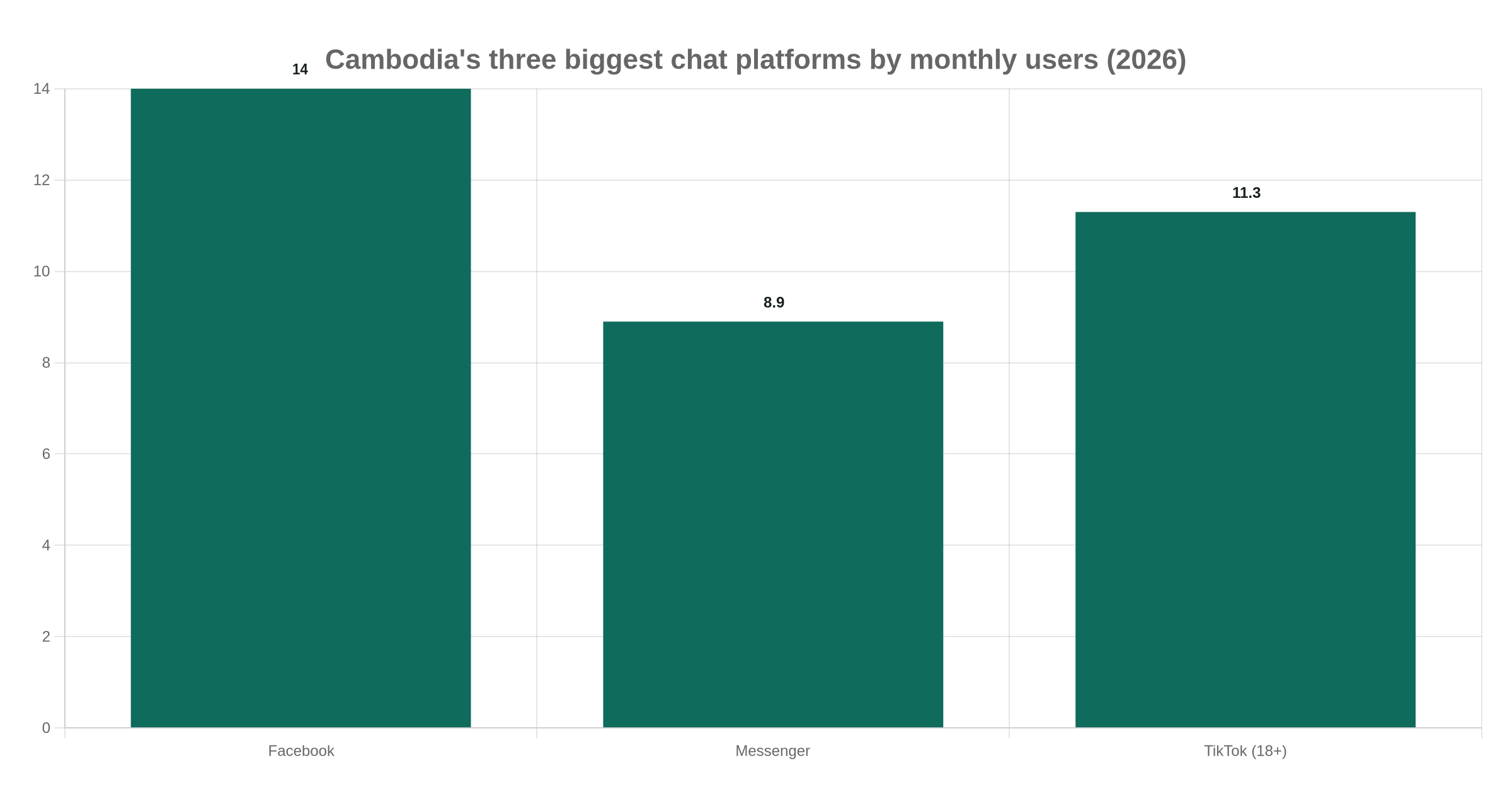
A Cambodian business should build its first chatbot on whichever channel its customers already use to message it, not on the channel a vendor finds easiest to build on. Facebook itself reaches 14.0 million people in Cambodia, 77.9 percent of the population, and Messenger specifically reaches 8.9 million, 49.7 percent, according to DataReportal's Digital 2026 Cambodia report. TikTok reaches a comparable 11.3 million users per the same report, but it is a video and discovery platform rather than a messaging one, so it belongs in the chart below as a scale reference, not as a chatbot channel. That raw reach is why Messenger is still the default channel for Cambodian commerce bots: Casstack, a Phnom Penh startup listed in the government's Startup Cambodia ecosystem directory, built what the directory describes as the first system in Cambodia able to accept customer orders directly inside Facebook Messenger, letting a business respond and take payment without a customer ever leaving the chat thread they were already using.
Telegram complicates that default. By WMTips' 2026 count of platform integrations across Cambodian websites, Telegram now edges out Facebook, 44.7 percent to 40.1 percent, a reversal that Cambodia-focused outlets including Angkor Times trace to Telegram overtaking WhatsApp as the country's dominant messaging app after 2021, driven by its larger group and channel size limits and its encrypted calls and chats. The two statistics are not measuring the same thing, Messenger's raw user count versus Telegram's share of website integrations, and a business should not treat them as interchangeable. What they mean together is that Messenger still wins on reach for a retail or hospitality bot answering individual customers, while Telegram wins for a business that needs to broadcast to a group, a community or a distributor network at the same time it answers one-to-one questions.
We think the channel choice should follow where a business's messages already land, not whichever platform is trendiest to build on; a polished web widget nobody opens because customers already message the Facebook page is a wasted build. A web widget still earns its place for a business whose buyers research before they message, law firms, B2B consultancies, higher-ticket services, because it can sit on a page the buyer is already reading rather than asking them to leave the site and open an app.
What Does Chatbot Development Actually Cost in Cambodia?
Chatbot development in Cambodia costs less for the chatbot than most buyers expect and more for what sits around it than most buyers budget for. Complexity moves the one-time price fast: Antino's 2026 chatbot cost guide bands an entry-level bot at 2,000 to 10,000 US dollars, a difficulty-level build (multiple intents, a real knowledge base, basic integrations) at 8,000 to 20,000 US dollars, and an advanced build (multi-channel, custom retrieval, CRM-wired) at 25,000 to 110,000 US dollars. Running costs do not stay flat once the bot is live: the same guide puts a custom chatbot's ongoing hosting and model cost at 5,000 to 20,000 US dollars a month, a figure that tracks message volume and model choice rather than the one-time build fee, and a number a buyer who only asked about the build price will not see coming.
The subscription route looks cheaper on the invoice. A no-code SaaS platform runs from Quickchat AI's Basic plan at 29 US dollars a month (500 AI credits, 300 knowledge-base articles, 1 seat) up to its Essential plan at 99 US dollars a month (3,000 credits, 500 knowledge-base articles, 1 seat), per Quickchat AI's 2026 pricing breakdown. Quickchat's own worked example fits a small shop's FAQ bot inside the Basic allowance, a size framing we would use, not one the pricing page states itself. Run the comparison over a year and the gap narrows: 99 dollars a month is 1,188 dollars a year, against a one-time custom build around 8,000 to 20,000 dollars for a difficulty-level bot that a SaaS template usually cannot match on a business's own Khmer-English phrasing or its specific escalation rule. A business planning to run the bot for more than 4 to 5 years, or whose FAQ outgrows a template's canned flows, comes out ahead on the custom build; a business just testing whether a chatbot earns its keep should start on the subscription and commission a custom build once that demand is proven.
| Approach | Typical cost | Time to launch | Best for |
|---|---|---|---|
| No-code SaaS widget | $29 to $99/month | 1 to 2 weeks | Testing demand, a simple FAQ bot |
| Custom-built bot (our approach) | $2,000 to $20,000 one-time, plus hosting | 1 to 4 weeks | A business-specific knowledge base, CRM or booking integration |
| WhatsApp Business Platform messaging | Per-message, by category and country | 2 to 4 weeks (API approval included) | A business already running WhatsApp-based customer service |
WhatsApp sits outside both models. Meta bills WhatsApp Business Platform messages per delivered template rather than per conversation, with the rate set by the category and the recipient's country. Marketing, utility and authentication messages have been billed that way since July 1, 2025; service messages, free since November 2024, resumed per-message billing on October 1, 2026, with a 1,000-message monthly free allowance per phone number, so today all four categories are billed, just not all of them since July 2025. Meta has since added a fifth category, Meta Business Agent, billed per token rather than per message for conversations its own AI handles end to end; that category sits outside the scope of the kind of custom-built, human-escalation chatbot this article is about, according to Meta's own developer documentation. That per-message structure means a WhatsApp bot's running cost scales with message volume, unlike a flat SaaS subscription, which matters for a business planning around a predictable monthly number rather than a usage-based one.
The Real Bottleneck Is Who Owns the Handoff, Not Which Model Answers
The question that actually decides a chatbot project in Cambodia is who owns the conversation data and the escalation rule, not which language model answers the message. Most chatbot pitches we see lead with the model, Claude, GPT, a fine-tuned open model, because that is the part a vendor can demo in five minutes. The part that determines whether the bot still works in month six is duller: can the business export its own conversation logs, is the escalation rule (who gets paged, on what channel, within what time) written down anywhere the business can audit it, and does the contract say what happens to the bot's configuration if the business switches vendors.
Case: G.A.T.O Tower For the sales operation behind G.A.T.O Tower, a 67-storey off-plan residential tower in Phnom Penh's BKK1 district, we built a lead-scoring system that gives every contact a score from 0 to 100 based on budget, timing and engagement. A hot lead, scored 70 or above, goes to the sales team in real time with the source and stated interest, for a call within 24 hours. A warm lead, scored 40 to 69, is followed up automatically on WhatsApp and through retargeting rather than waiting for a human to notice it. The handoff rule, which leads a human touches immediately and which ones the system keeps warming on its own, was decided and tested before launch, not improvised after the first missed lead. The detail of that case lives on our GATO Tower project page; we are citing only what that page states.
That same discipline, deciding the handoff rule before launch and testing it, is what a chatbot needs and what most Cambodia chatbot quotes do not mention at all. We would rather a client spend two extra days negotiating data ownership and an escalation SLA than save those two days and find out six months in that the bot's conversation logs live in a vendor's dashboard they cannot export.

How Do You Tell a Chatbot Vendor From a Chatbot Reseller?
A real chatbot development company can show you how their last build failed a test and what they changed; a reseller can only show you the demo. We would not sign with a chatbot vendor who cannot show us a case where their own bot failed a test and what they changed, because a vendor who has never shown you a bot failing has probably never tested one hard enough to find out. Four questions separate a chatbot development company from a reseller in a first call:
- Can we export our own conversation data, in a standard format, at any time? A "yes" with a format named on the spot (CSV, JSON, a direct database connection) is a vendor. A "we'll look into that" is a reseller running a white-labelled platform they do not control.
- What happens when the bot cannot answer, and who tested that path? The answer should name a person or a channel (a WhatsApp number, a shift roster), not "it escalates to support."
- Has this bot been tested on mixed Khmer and English in the same message? Cambodian customers routinely code-switch between scripts inside one sentence, and a bot tuned only on clean single-language input will quietly misfire on exactly the customers a Cambodian business serves most. This is the one question a khmer chatbot developer should answer without a pause; a developer who has never tested code-switched input has never tested the customer this business actually has.
- What does the 90-day plan after launch look like? A vendor should have a named cadence for reviewing missed intents and updating the knowledge base. A reseller treats launch as the finish line.
An AI consulting audit run before signing anything puts these four questions in writing before a contract does, which is cheaper than finding the gaps after the invoice is paid. The same test applies whether the quote comes from a freelancer or from a full AI agency in Phnom Penh: size does not answer these four questions, process does.
Telegram's Bot API Is Simple. Building a Good Conversation on It Is Not.
Telegram's own documentation for building a bot is a short, clean page: register a bot with BotFather, get a token, start receiving messages at a webhook. That simplicity is exactly why so many Cambodia chatbot quotes default to Telegram first, the platform side of the work genuinely takes an afternoon.
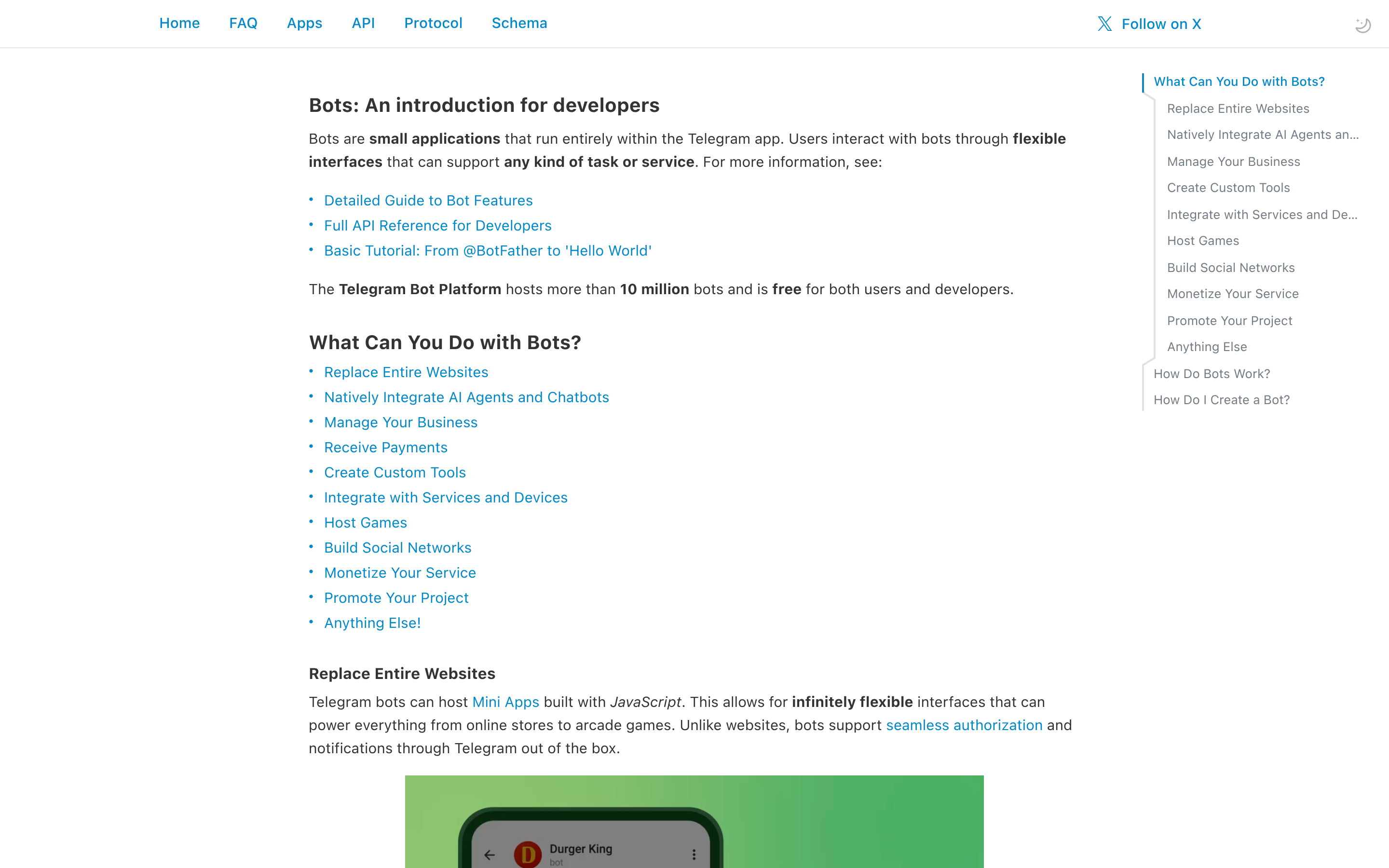
The hard part starts after that page. A Telegram bot that only replies to exact-match commands feels like a phone menu with extra steps, and most of the customers it frustrates will not complain, they will just stop using it and call instead. Building a conversation that holds up means mapping the real intents a business's customers actually ask (not the ones a product manager assumes), writing a fallback that admits uncertainty instead of guessing, and wiring the escalation path discussed above into the same bot rather than bolting it on later. None of that shows up on the Bot API documentation page, because Telegram's spec defines the pipe, not what flows through it.
What Goes Wrong After a Chatbot Launches, and How Do You Test for It First?
Most chatbot failures in production are not model failures, they are untested paths that nobody walked before launch. The most common one is the escalation loop: a customer asks something the bot cannot answer, the bot escalates, and the human on the other end never sees the alert because the escalation channel was configured but never tested with a real message. The second most common is a code-switched message, Khmer and English inside the same sentence, that breaks whatever intent-matching the bot relies on, a failure mode that will not show up in a demo scripted entirely in clean English.
The order we run those checks in matters as much as running them. We test escalation first, before tuning a single intent, because well-tuned intents behind an untested escalation path are worse than a blunt bot with a loud one: a customer rerouted to a human forgives a bot that could not answer, but silence earns no such forgiveness. Only once a human demonstrably receives the alert do we tune intents, then run the code-switched test last, since a Khmer-English failure caught earlier just means re-testing escalation twice for nothing.
Put a number on what an untested escalation path actually costs. A retailer running 300 Messenger conversations a month who hits an untested escalation on even 5 percent of them is looking at roughly 15 conversations a month where a human never saw the alert. That is not 15 missed messages, it is 15 customers who experienced the business as unresponsive, because a customer who gets silence after asking a real question does not distinguish between "the bot broke" and "nobody at this business answers." Testing that path end to end, before launch, costs an afternoon. Finding it broken in production costs the customers who already decided not to ask twice.
A pre-launch test plan that only checks "does the bot answer the ten questions in the brief correctly" will pass and still fail in week one. The test plan that catches more: run five code-switched messages through the bot before anyone outside the team sees it, trigger the escalation path end to end and confirm a human actually receives it on the channel the contract named, and ask the bot three questions it was never trained on to see whether it admits it does not know or confidently invents an answer. That last failure mode, confident invention, is the one that costs a business the most trust, because a customer who gets a wrong answer delivered with total confidence stops trusting every answer after it, including the correct ones.
What We Would Ship First, and the Open Question That Still Has No Good Answer
Given a Cambodian business with one shot at a first chatbot, we would ship a narrow, well-tested bot on the single channel its customers already use, Messenger for most retail and hospitality businesses, Telegram for a business that leans on groups or broadcast updates, answering a fixed set of real questions with a tested, visible handoff to a human for everything else. We would not start with a multi-channel, multi-intent build before that first narrow version has run for a month and shown where it actually gets asked things nobody predicted. AI agents for small business earn their cost the same way: narrow and tested first, broad only once the narrow version is proven.
The open question we cannot answer for every business is how much a Cambodian customer will tolerate from a bot that gets a code-switched message wrong before they give up and call instead, since that tolerance clearly differs by sector, age group and how urgent the question is, and nobody we know of has published a number for it. Our recommendation is to treat that tolerance as something to measure on the narrow first version, not something to assume, and to budget the 90-day review cycle described above specifically to catch it. If a scoped first build is the right next step, AI agents is where that conversation with our team starts, and a book a call with the founder costs nothing to find out whether a chatbot is actually the right tool before committing to build one.
Prefer to chat? Message our founder directly on Telegram (@maxgrolier), or book a call with the team.
Frequently Asked Questions
How long does chatbot development take in Cambodia?
A no-code SaaS chatbot can launch in 1 to 2 weeks. A custom-built bot with a business-specific knowledge base typically takes 1 to 4 weeks from a costed action plan to launch, and a WhatsApp Business Platform build adds time for Meta's API approval, usually landing the total closer to 2 to 4 weeks.
Can a chatbot actually understand Khmer and English mixed in the same message?
Only if it was tested on that specific case before launch. Cambodian customers routinely code-switch between Khmer and English inside one sentence, and a bot trained or tested only on clean single-language input will misfire on exactly those messages, which is why it belongs in the pre-launch test plan, not left to be discovered after a customer complains.
Do we need a custom build, or is a no-code platform enough?
A no-code SaaS platform is enough to test whether a chatbot earns its keep, and it is the cheaper way to start, 29 to 99 US dollars a month against 2,000 dollars or more for a custom build. Move to a custom build once the SaaS version shows real demand or once the business needs integration with its own CRM, booking system or knowledge base that a template cannot reach.
What happens when the chatbot cannot answer a question?
A properly built bot escalates to a named human channel rather than guessing, and that escalation path should be tested end to end before launch, not assumed to work because it was configured. The businesses that get this wrong usually configured an escalation rule nobody ever sent a real test message through.
Is WhatsApp a realistic channel for a Cambodia business chatbot?
Yes, but it comes with Meta's per-message pricing rather than a flat subscription: WhatsApp Business Platform bills per delivered message template, with rates set by the recipient's country. Marketing, utility and authentication messages have been billed that way since July 2025; service messages stayed free until Meta resumed per-message billing for them on October 1, 2026, with a 1,000-message monthly free allowance per phone number. A fifth, token-billed category covers AI-handled conversations and is out of scope for a standard customer-service bot. That makes WhatsApp a stronger fit for a business already running customer service there than for a business picking a first channel from scratch.
How much does a chatbot cost to run every month after launch?
A custom-built bot's ongoing hosting and model cost commonly runs 5,000 to 20,000 US dollars a month, tracking message volume and model choice rather than staying flat. A SaaS subscription runs 29 to 99 US dollars a month flat instead. A WhatsApp-based bot's monthly cost scales with message volume and category on top of either model, which is worth modelling against expected message volume before choosing that channel.