
Webflow and WordPress both promise the same thing: a business site a non-technical team can update. They get there in opposite ways. Webflow bundles the CMS, hosting, CDN and security patching into one flat subscription. WordPress ships free, open-source software, then leaves hosting, the plugin stack and patching as separate decisions someone has to keep making correctly, every month.
For a business in Phnom Penh weighing Webflow against WordPress, the launch-day sticker price is the wrong number to compare. The real gap opens in year two, keeping either platform fast, secure and online.
Webflow and WordPress solve the same problem differently
WordPress runs 40.2 percent of all websites and 58.7 percent of every site that runs a CMS (W3Techs, September 2026). That dominance comes from an open plugin and theme marketplace: tens of thousands of add-ons, including WooCommerce for stores, built by a large independent developer community.
Webflow took the opposite bet: a visual builder, a hosted CMS and a managed infrastructure layer shipped as one product, instead of an open plugin ecosystem. There is no plugin folder to audit, because most of what a plugin would do on WordPress is already built in or handled through a smaller set of vetted apps.
Neither model is wrong: they shift the same work elsewhere. WordPress puts more of it on whoever maintains the site after launch; Webflow puts more of it on the subscription price. For the fuller picture on choosing a platform, see our web development in Cambodia overview.
Which platform is faster, Webflow or WordPress?
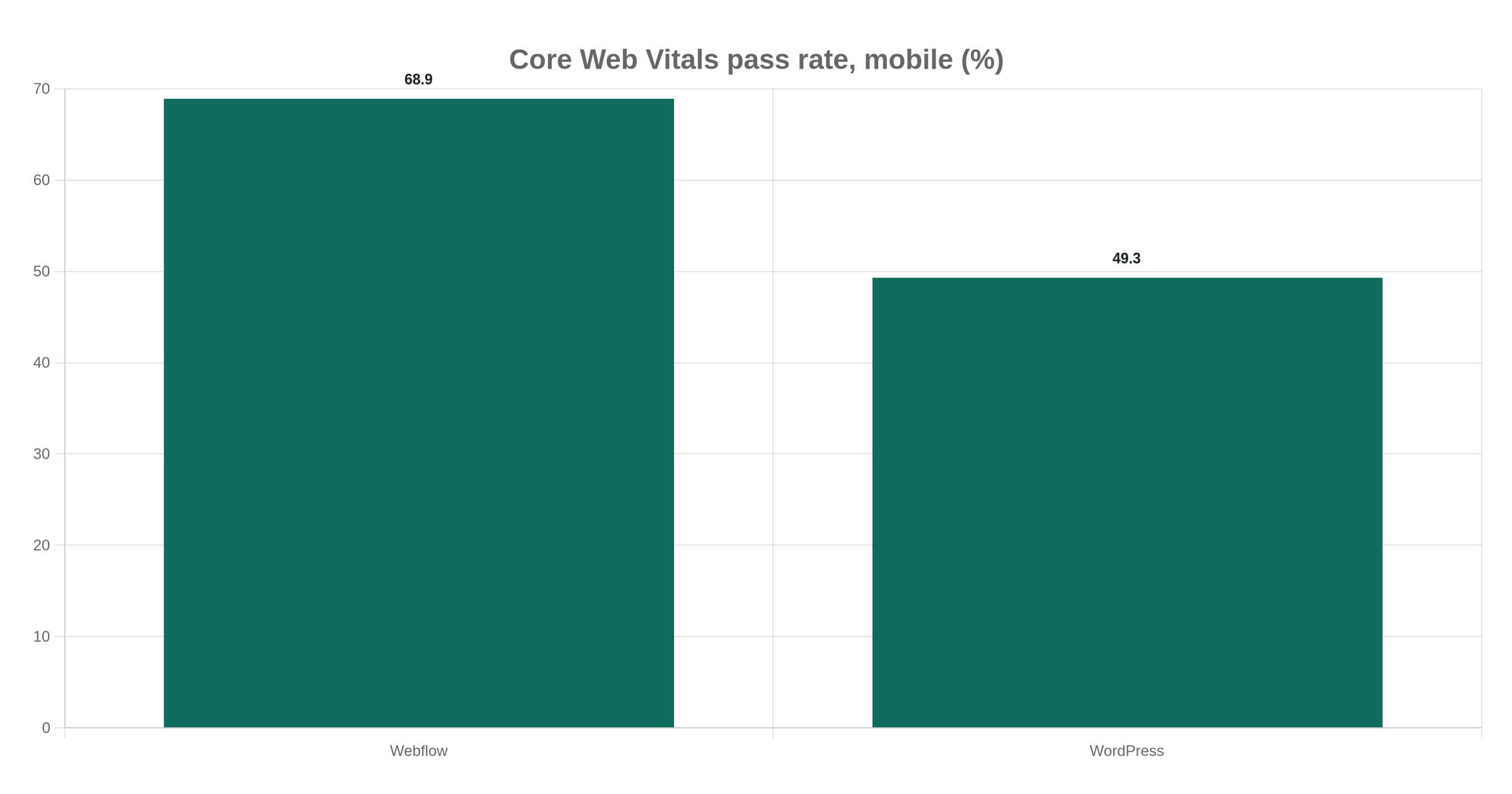
Webflow loads faster than WordPress for most business sites, backed by independent field data, not just marketing claims. In the May 2026 Chrome UX Report crawl, 68.9 percent of Webflow origins passed all three Core Web Vitals on mobile, against 49.3 percent of WordPress origins (HTTP Archive, Core Web Vitals Technology Report).
Most of that gap traces back to one metric: Time to First Byte. Only 24.8 percent of WordPress origins return a good mobile TTFB, versus 55.5 percent on Webflow (HTTP Archive, same crawl). Webflow pre-builds pages and serves them from a CDN, so the response is close to instant. WordPress assembles most pages with PHP and a database query on every request, unless someone has paid for caching and a fast host.
That is not a fixed law: a WordPress site on quality managed hosting, a light theme and proper caching can match Webflow's numbers. The problem for a Cambodian SME is that "quality managed hosting" is itself a recurring cost, which is what WordPress actually costs to keep fast and current.
Which platform is more secure, Webflow or WordPress?
WordPress carries far more security risk than Webflow, simply because so much of it is optional third-party code. The ecosystem logged 11,334 new vulnerabilities in 2025, a 42 percent increase over 2024 (Patchstack, State of WordPress Security in 2026): 91 percent in plugins, 9 percent in themes, only six in WordPress core itself.
The timeline is the part most comparison articles skip. Nearly half of high-impact WordPress vulnerabilities are exploited within 24 hours of disclosure, and the weighted median time to first exploit on the most heavily targeted flaws is 5 hours (Patchstack, 2026): 46 percent had no developer patch available at the moment of disclosure.
Picture a small NGO running a WordPress blog with a dozen plugins: a contact form, a slider, an SEO toolkit, a backup tool, a caching plugin, two or three more nobody remembers installing. Webflow carries no equivalent surface.
Webflow's own attack surface is not zero: a subscription still needs a strong password, two-factor authentication and careful editor permissions, but it is far smaller than that same plugin stack.
How much does Webflow cost compared to WordPress?
Webflow costs less than WordPress for almost every small business site, once the comparison includes hosting, maintenance and plugin licences, not just the sticker price. Webflow's Premium plan runs $25 a month billed annually and includes hosting, the CDN, 20,000 CMS items and 40 collections (Webflow, pricing update, May 2026): nothing else is required to keep the site online and patched.
WordPress software is free, but running it responsibly is not. Budget $100 to $300 a month for a professional maintenance retainer, $20 to $200 a month for quality hosting, and $42 to $125 a month for common premium plugin licences such as a form builder, a caching tool and an SEO plugin (Codeable, 2026).

| Webflow | WordPress | |
|---|---|---|
| Platform, hosting, CDN | $25/month (Premium plan) | $20 to $200/month (hosting only) |
| Maintenance and patching | Included | $100 to $300/month (retainer) |
| Plugin or app licences | Rarely needed | $42 to $125/month |
| Typical monthly total | $25 | $162 to $625 |
| Running cost over 3 years | roughly $900 | roughly $5,800 to $22,500 |
Run that against a real project, not a rate card. A professional 5 to 10 page brochure build through Codeable's vetted freelance network costs $2,500 to $7,500 on WordPress (Codeable, WordPress Developer Pricing Guide, 2026); a smaller, 3 to 8 page brochure build through a boutique Webflow agency runs $5,000 to $15,000 or more (Krishaweb, Webflow Website Cost, 2026). Even with that narrower Webflow page count, the two ranges overlap from $5,000 to $7,500: build effort barely changes with the CMS underneath it. If you are vetting agencies for that build, our hiring checklist walks through what to verify before you sign. The three-year gap above is what happens after launch, the number most comparison pages leave out.
What running WordPress actually looks like for a business in Cambodia
Running WordPress in Cambodia means owning a maintenance problem most local businesses are not staffed for. TechBehemoths currently lists just over 20 web development companies for the entire country, a thin bench to call on for an emergency patch on a Saturday night, and most of it defaults to WordPress. For Webflow specialists in the region, our profile of Webflow agencies in Southeast Asia covers who does that work well.
Bilingual sites add another layer most global comparisons skip entirely. Khmer script renders differently on a hosted builder than on a self-hosted WordPress theme stack, and a theme picked for its English typography can still break on Khmer text: glyph shaping has to stack and reorder subscript consonants correctly, and line height needs extra room for Khmer's taller ascenders and descenders. Webflow loads its fonts through the same CDN as the rest of the page, so Khmer renders as reliably as English; on WordPress, that depends on the theme's font loading, where a plugin update can quietly change the method or the line-height rule without flagging it as a regression, the kind of break that only shows up on a real phone after the fact.
That thinness matters more given the Patchstack exploit-speed numbers above. A five-hour to twenty-four-hour window between disclosure and exploitation needs either a managed WordPress host that patches automatically, adding to the monthly cost, or a local team on retainer that actually answers on a weekend, which very few Cambodian SMEs have in place.
Cambodia's digital base keeps growing regardless of platform: internet penetration reached 67.3 percent of the population by October 2025, 12.0 million people online (DataReportal, Digital 2026: Cambodia), and more traffic only helps if the site behind it is actually patched.
We would not put a Cambodian SME's brochure site on unmanaged WordPress hosting. An ecosystem that logged 11,334 new vulnerabilities in 2025 does not forgive a missed update, and a five-person team without a dedicated ops person will miss one, the kind of miss that turns into an emergency migration off the unmaintained site once it is already compromised.
Is Webflow good for SEO, and does WordPress do it better?
Webflow is good for SEO out of the box, and so is WordPress once properly configured: the real gap is what each platform makes easy by default. Webflow ships clean semantic HTML, automatic sitemaps, native redirects and fast Core Web Vitals scores without a plugin, all factors Google has confirmed matter for ranking.
WordPress can match or exceed that with the right setup: an SEO plugin, a caching layer, a lean theme, and someone who keeps all three current. WordPress SEO performance depends on configuration and upkeep; Webflow's baseline is closer to correct on day one.
Neither platform writes the content or earns the links that move rankings. The platform choice affects how much technical SEO work you have to do yourselves before the content gets a fair shot. Good structure at the design stage helps too: our web design Cambodia guide covers the branding and UX/UI side of the same build.
When does WordPress actually make sense over Webflow?
WordPress still makes sense over Webflow in one case: a content team already living inside its editorial workflow, with the capacity to maintain it. Think a publisher running ten writers a day, a multi-author newsroom, or a team with a library of custom plugins it depends on.
For a standard Cambodian SME brochure site, a services site, or a lead-generation landing page, that case rarely applies. The team editing the site wants to change a headline or add a project, not manage a plugin update schedule.
We think WordPress still earns its place, but only for one kind of client: a content team that already lives inside the WordPress editorial workflow and has the headcount to patch it. For every other brief we scope in Phnom Penh, Webflow wins on total cost by year two.
TechFlow Agency runs web development services as one line of a full-stack practice from Phnom Penh. Browse recent projects for examples, or skip straight to a scoped estimate against your actual brief, not another comparison page.
Prefer to chat? Message our founder directly on Telegram (@maxgrolier), or book a call with the team.
Frequently asked questions
Is WordPress outdated in 2026?
No, WordPress is not outdated. It still runs 40.2 percent of all websites and gets active core development (W3Techs, September 2026). What changed is the ongoing cost of running it safely, which now outweighs its zero licence price for most small sites.
Is Webflow good for SEO?
Yes. Webflow ships clean HTML, automatic sitemaps, native redirects and strong Core Web Vitals scores without a plugin, covering most of the technical SEO groundwork a WordPress site needs a plugin and caching to match.
Can I move a WordPress site to Webflow later, or does it mean a rebuild?
It generally means a rebuild, not a direct import. Content, images and URLs can migrate with a technical audit and a redirect map, but WordPress themes and plugin functionality do not carry over: the two platforms use entirely different systems.
Does Webflow support e-commerce as well as WordPress with WooCommerce?
For a standard catalogue, Webflow's e-commerce holds up well. For complex commerce needs such as multi-warehouse inventory or highly custom checkout logic, WooCommerce on WordPress, or a dedicated platform like Shopify, typically offers more flexibility.
For a Cambodian storefront, the payment rail matters as much as the catalogue. ABA Bank publishes an official WooCommerce plugin that takes KHQR and ABA Pay straight at checkout (PayWay Developer Suite, 2026). Webflow has no equivalent native connector, so accepting KHQR there means a custom integration or a payment link workaround: worth confirming with your developer before you commit to either platform.
Which platform costs less over three years for a small business site?
Webflow costs less over three years for almost every small business site once hosting, maintenance and plugin licences are counted. Our comparison above puts Webflow's three-year running cost around $900 (the flat Premium plan price), against roughly $5,800 to $22,500 for a responsibly maintained WordPress site.
Do I need a developer to run either platform day to day?
No, for day-to-day edits. Both platforms let a non-technical team update pages, images and posts. The difference is in the background: WordPress needs someone watching plugin updates and patches; Webflow's maintenance is included.