

Should your customer service run on a chatbot or an AI agent? That is the question behind every "ai chatbot vs ai agent" search, and most of what ranks for it online ducks the question with a feature table. A chatbot answers from a script or a knowledge base and stops at the edge of what it was told to say. An AI agent reads the situation, decides what to do next, and takes an action inside your systems, a refund, a booking change, a status update, before it ever hands off to a person. For a business serving customers in Cambodia, on Telegram, Facebook Messenger or a website widget, the honest answer is that most teams need the first one before they are ready for the second, and the two are priced and built differently enough that guessing wrong costs real money.
This article sets out exactly how the two differ, when each one is the right call for a Cambodian business, what a real local example looked like when a Messenger-connected chat tool replaced guesswork, and what each option costs and takes to build using TechFlow's own published delivery windows, not a global agency's price list that never mentions Phnom Penh.
What is the real difference between an AI chatbot and an AI agent?
An AI chatbot matches what a customer types to a scripted reply or a knowledge-base answer, while an AI agent reasons about the request, checks or changes something in your systems, and decides the next step on its own. A chatbot is what most people actually mean when they say "conversational AI": natural language in, scripted or retrieved language out, with no action attached. Gartner frames the distinction the same way at the vendor level: by 2029, agentic AI is predicted to autonomously resolve 80 percent of common customer service issues without a human, cutting service operating costs by 30 percent (Gartner, March 2025). The gap between that prediction and today's reality is autonomy, not conversational polish. A chatbot can hold a long, fluent conversation and still never do anything: it answers "what are your hours" and "how do I reset my password" from a script, and the moment a customer asks something it was not built to handle, it loops back to the same suggested replies or hands off to a person. An AI agent, by contrast, is judged by what it does, not how it talks: checking an order status in a spreadsheet, applying a refund rule, rebooking a reservation across three calendars.
Zendesk's own research puts a number on how blurred this looks from the customer's side: 48 percent of customers say it is getting harder to tell whether they are talking to a bot or a human agent (Zendesk, 2026), which is exactly why the functional distinction, what the system is allowed to touch, matters more than the conversation quality a demo shows off. It also explains why the market for both is growing at once rather than one replacing the other: World Bank data put 68.5 percent of Cambodia's population online in 2024 (World Bank, via Trading Economics, 2024), a large enough digital audience that the choice between a chatbot and an agent is no longer about whether customers will use a chat channel, it is about which one of the two systems behind that channel actually fits the question being asked. That is also why the label on a vendor's slide deck is the least useful signal in the whole decision: ask what the system is permitted to check or change, not what it is called, and the chatbot-or-agent question usually answers itself within a few minutes of conversation.
When is a chatbot the right tool for your customer service?
A chatbot is the right tool whenever most incoming questions repeat and the answer does not require touching another system. Opening hours, shipping times, a price list, a return policy, a Telegram bot that answers "is this in stock" from a fixed catalog: this is exactly the volume a scripted or knowledge-base chatbot handles well, cheaply, and fast to launch. The best evidence for this is not a vendor's demo, it is a small Cambodian business that actually ran the numbers.
Phare Circus, a social enterprise circus company based in Battambang, connected a Tidio live chat widget to its Facebook Messenger page because its audience was already there. Over five months between May and October 2020, the business logged more than 2,000 conversations through the connected channels, collected 101 qualified leads through Messenger, and raised ticket bookings by 30 percent (Tidio case study, 2020).
None of that required an agent: no booking system was rewired, no refund logic was coded, the tool simply caught customers where they already were and answered consistently instead of losing them to an unanswered Messenger message at 11pm. The mistake we see most often in Cambodia is skipping this step because "AI agent" sounds more impressive on a sales deck. A chatbot that correctly deflects 60 percent of repeat questions is a better first investment than an agent that was supposed to do everything and ships six weeks late because nobody mapped which fraction of conversations actually needed a decision.
The order we follow on a chatbot-first engagement does not change from client to client. We ship the narrow chatbot, then wait a full two weeks before reading the logs, not one: the first week still carries the launch-week spike of staff and curious contacts testing the thing, not real customer volume. Every logged question then gets tagged by one fact only: did answering it correctly require checking or changing something outside the conversation, or not. The tag is what decides the next build, not the raw question count. A high volume of repeat questions a chatbot already answers correctly is not evidence for an agent; a smaller, recurring slice tagged "needed a system check" is, and it is also the slice that tells us exactly which systems the agent would need to touch, which is the scoping work an agent-first brief would otherwise have to guess at.
When do you actually need an AI agent instead?
You need an agent once answering the question requires checking or changing something that lives outside the conversation: an order status, a refund amount, a reservation across more than one calendar, an account balance. A guesthouse fielding booking requests across Telegram, Facebook Messenger and a website widget is a textbook case. A chatbot can tell a guest the published room rate, but only an agent can check real-time availability across all three channels, hold the room, and write the confirmed booking back into whichever calendar the owner actually uses, instead of the owner copying the same date into three places every evening. The same logic applies to a refund: a chatbot can explain the refund policy in plain language, but an agent is what actually checks the order, applies the rule, and issues the refund without a person opening a dashboard.
This is also where the build gets genuinely different, not just the branding. Our own AI agent examples piece walks through twelve concrete cases we see built in Cambodia, many of them n8n workflows that wire a model, a tool the model can call, a CRM, a calendar, a spreadsheet, a payment record, and a memory of the conversation so far. Strip out the tool-calling step and what remains, however fluent the replies sound, is a chatbot wearing an agent's name. That distinction is also the one most vendor pitch decks blur on purpose, because "agent" commands a higher price than "chatbot" for work that is, underneath, the same scripted flow.
When a client opens a conversation already asking for an agent, the first thing we check is not the budget, it is whether they can name the one external action the system needs to take on its own. If the honest answer after ten minutes of questions is still "it should just answer customers better," we say so directly and scope a chatbot instead of the agent they asked for. The trade-off we pick, every time, is the uncomfortable conversation now over the expensive one six months later: building the tool-calling layer, the permission rules and the monitoring an agent needs, for a task that never required touching another system, is infrastructure spend nobody will use.
Myth versus reality: five claims about AI agents in Cambodia's customer service
Myth: an AI agent is just a smarter chatbot. Reality: the two solve different problems. A chatbot is a conversation layer; an agent is a decision-and-action layer that happens to talk. Upgrading a chatbot's underlying model does not turn it into an agent if it still cannot touch your booking system or your order database. The conversation gets smoother; the capability does not change.
Myth: an agent always resolves more than a well-built chatbot. Reality: Gartner's 80-percent resolution figure is a prediction for 2029, not a 2026 baseline (Gartner, March 2025), and the same research house warns that more than 40 percent of agentic AI projects will be canceled before the end of 2027 (Gartner, June 2025), usually because the scope was wider than the team could actually build and maintain. A narrow, well-scoped chatbot shipped this month often resolves more real conversations than an ambitious agent still in development.
Myth: a chatbot cannot handle Khmer, so you need an agent for that instead. Reality: language coverage and autonomy are unrelated problems. An agent built on the same underlying language model as a chatbot inherits the exact same Khmer-language limitations; relabelling the system "agent" fixes nothing about translation quality or tone.
Myth: once you have an agent, you no longer need the chatbot. Reality: most working setups we would recommend keep both, with the chatbot as the front door for simple, repeat questions and the agent handling the smaller slice that genuinely needs a decision. Routing every question through the agent instead means it spends its reasoning budget answering "what are your hours," which is a waste of the more expensive system, and it also means every small wording mistake now carries the operational risk of a system that can actually change a booking or issue a refund.
Myth: customers can tell the difference and prefer the more advanced one. Reality: close to half of customers say it is getting harder to tell whether they are talking to a bot or a human agent (Zendesk, 2026). What a customer actually notices is whether the answer was correct and fast, not which category of system produced it, which is one more reason to scope by the task, not by which label sounds more impressive.
What does each option cost to build and run in Cambodia?
A scripted or knowledge-base chatbot costs the least to build, and an agent that takes real actions costs the most, and the gap between them is large enough to change which one you should scope first. Global benchmarks put a scripted chatbot at roughly $4,500 to $12,000, an AI chatbot that answers from a business's own content at $24,000 to $60,000, and an enterprise agent that takes actions inside connected systems at $72,000 to $210,000 (RaftLabs, 2026), with full multi-agent orchestration systems starting around $150,000 and running past $400,000 for the most complex builds (Azilen, 2026).
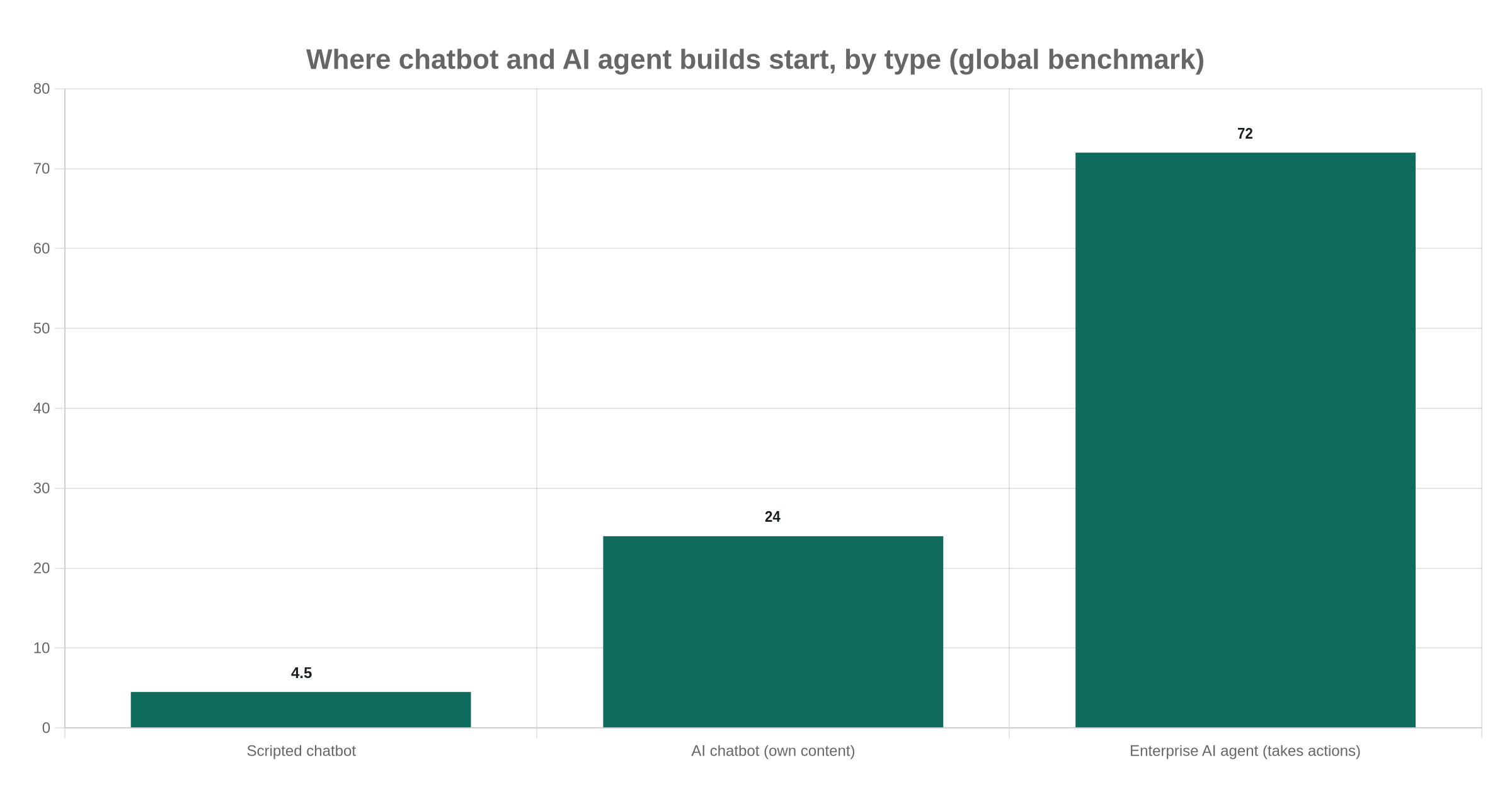
Those figures describe a US or European agency's price list, not a Cambodian one, and we would treat them as a ceiling to avoid rather than a quote to expect. What the ratios show, though, travels regardless of which market set the dollar figures: the enterprise agent tier starts at roughly 16 to 17 times the scripted-chatbot tier at matching ends of each range ($72,000 against $4,500, $210,000 against $12,000), and the AI-chatbot-on-owned-content tier sits at roughly 5 times the scripted tier. That is the real size of the mistake in guessing wrong: not a 20 percent overrun, a build that costs an order of magnitude more than the question actually needed answered. TechFlow does not publish a fixed price for AI agent work because every build depends on how many systems it has to touch, but the entry point costs nothing to find out: a free process-mapping audit of 1 to 2 hours, followed by a costed action plan delivered within 5 days. That sequence exists specifically so a Cambodian SME is not pricing a build against a Western benchmark that assumes Western integration costs, Western compliance overhead and a Western support team. For the full breakdown by build tier, see AI agent cost in Cambodia.
Running costs matter as much as the build. A chatbot's main ongoing cost is the model and hosting bill, usually modest at the conversation volumes a Cambodian SME actually sees. An agent adds the cost of whatever it calls, API usage on a CRM or a payment gateway, plus the monitoring needed to catch a wrong action before a customer notices it, since a chatbot's worst failure is a bad answer while an agent's worst failure is a wrong refund or a double-booked room. The monitoring line item is the one businesses budget for the least and need the most: an agent that silently fails a tool call and still replies fluently to the customer looks fine in every demo and only shows the problem once a real booking or refund goes missing, which is why we treat alerting on a failed action, not just a wrong answer, as part of the build rather than an optional add-on.
How long does it take to go from zero to live?
A chatbot for a defined set of repeat questions can go live in days; an agent that needs to reason over several systems takes weeks, and the gap again tracks directly to how much it has to touch. TechFlow's own published delivery windows put a single AI skill, essentially a well-scoped, narrow chatbot task, at 24 to 48 hours once the underlying process is mapped, and a full autonomous agent at 1 to 4 weeks, with sovereign or private infrastructure adding 4 to 8 weeks when a client needs the data to stay inside Cambodia or a chosen jurisdiction. The process that gets you there runs in four steps: a free 1-to-2-hour audit of the actual process, a costed action plan within 5 days, deployment in the window above, and continuous improvement afterward with monthly reports once the system is live. Those monthly reports matter more for an agent than for a chatbot, because an agent's mistakes compound quietly: a wrong matching rule or a stale calendar sync can run for weeks before a customer complaint surfaces it, while a chatbot's wrong answer is usually visible and correctable the same day.
The step most businesses skip, and the one that costs them the most time later, is the audit. A team that jumps straight to "build us an agent" without mapping which questions actually arrive, in what volume, through which channel, ends up paying agent-build time to discover facts a chatbot's first two or three weeks of logs would have handed over for free. We would always sequence it the other way: launch the chatbot, read three to four weeks of real conversation logs, and only then scope the agent around the specific decisions those logs show customers actually need made. Cambodia's draft National AI Strategy 2025-2030 names sector adoption among its six priorities (OECD.AI policy tracker, 2026), and a customer-service chatbot or agent is exactly the kind of sector-level adoption that strategy is pointed at, which is one more reason to get the sequencing right rather than rushing a mislabeled build.
A Phnom Penh case: a boutique hotel's booking line, worked through
This is a hypothetical scenario, built from the cost and timeline figures above, not a real TechFlow client; we have not yet published a case study on an AI agent engagement. Picture a 24-room boutique hotel near the riverside in Phnom Penh, taking booking enquiries across a website contact form, a Facebook page and a Telegram channel, the way most independent hotels in the city actually operate. Today, the front-desk manager answers each channel by hand, checking a shared spreadsheet before confirming a date, and loses track of a double-booking roughly once a month during high season.

Phase one is a chatbot, live within 24 to 48 hours once the room types, rates and cancellation policy are mapped, trained on that same information: it answers "do you have a room for the 14th" with the published rate and a link to book, and it deflects the majority of questions that never needed the spreadsheet at all. Phase two, scoped only after three or four weeks of chatbot logs show how often a guest actually needs a real-time availability check across channels, is an agent that reads the shared calendar, holds a tentative booking for 30 minutes, and writes the confirmed reservation back once payment clears, closing the exact gap that caused the monthly double-booking. Built in that order, on TechFlow's own delivery windows, the chatbot phase would land inside the 24-to-48-hour AI-skill window and the agent phase inside the 1-to-4-week autonomous-agent window, with the chatbot's three weeks of logs doing the scoping work an agent-first build would otherwise have had to guess at.
A short checklist: decide this week whether you need a chatbot or an agent
Run through these five questions before you brief anyone, us included, on a build:
- Does the question need an action, or just an answer? If the honest answer is "just an answer," start with a chatbot.
- How many systems would the build need to touch? Zero or one, a chatbot can likely cover it; two or more, you are scoping an agent.
- Do you have at least two or three weeks of real conversation logs? If not, launch a chatbot first and use its logs to scope the agent properly instead of guessing at the mix.
- Can you name the exact decision the system would make on its own? If you cannot describe it in one sentence, "check availability across three calendars and hold the room," the scope is not ready for an agent build yet.
- What is the cost of the system being wrong once? A wrong FAQ answer is a minor annoyance; a wrong refund or a double-booked room costs money and trust, which is exactly why agent builds need the monitoring step the audit scopes in from day one.
Most Cambodian businesses we talk to are sold an agent when a chatbot would already answer the bulk of what actually comes in; we would rather scope the smaller build first and prove the case for the bigger one with real data than sell a project that spends its first month rediscovering what a chatbot's logs would have shown for free. If your team is somewhere in this decision, a free process-mapping audit with our AI agents team is the fastest way to find out which side of this checklist you are actually on, and if customer channels beyond text matter too, our AI voice agent piece covers the phone-line version of the same decision. Once you know which one you need, get a scoped estimate.
Prefer to chat? Message our founder directly on Telegram (@maxgrolier), or book a call with the team.