

An AI voice agent can already answer a hotel or clinic phone line in Phnom Penh around the clock, in English, and it can book, confirm, cancel and remind without a coffee break. What it cannot yet do reliably is take that same call in Khmer. That gap, not the technology itself, is the real decision most Cambodian SMEs are facing this year.
The usual pitch for an AI voice agent skips straight to the labor-saving story: replace a receptionist, cut costs, run 24 hours a day. We think that framing is backwards for a Phnom Penh clinic or hotel in 2026. The more useful question is narrower: which calls are you losing money on right now, and which of those can an AI voice agent, sometimes also called an AI receptionist or AI phone agent, actually handle today without quietly failing your Khmer-speaking customers.
What does an AI voice agent actually do on a hotel or clinic phone line?
An AI voice agent picks up an inbound call, understands what the caller is asking in real time, and responds in a synthesized voice that can book, confirm, cancel, reschedule or hand off to a person, all without a human on the line. Under the hood it chains three systems: speech-to-text to hear the caller, a language model to decide what to say or do, and text-to-speech to answer, usually glued together by an orchestration platform that also connects to the booking calendar or clinic management system.
The global category is growing fast enough that it no longer counts as experimental: Grand View Research sizes the AI voice agent market at 3.5 billion USD in 2026, rising to 35.2 billion USD by 2033 at a 39.0 percent compound annual growth rate, and names Asia Pacific as the fastest-growing region over that period (Grand View Research, 2026). None of that growth number tells a Phnom Penh clinic owner what to do this quarter, which is exactly the gap this article tries to close.
For a hotel, the agent's job is usually availability and rate questions, new bookings, modifications, and late check-in instructions after the front desk closes. For a clinic, it is appointment booking, reminder calls that cut down no-shows, and triage questions simple enough to answer without a nurse ("are you open Saturday", "do you take walk-ins"). Both are narrower jobs than "replace the receptionist", and that narrowness is what makes them buildable in weeks rather than months. The time at stake is real either way: a 2026 analysis of hotel front-desk call logs found staff spend up to 45 percent of their working time on repetitive phone tasks, exactly the kind of work that does not need judgment (Qcall.ai, 2026). This is a task-specific case of what we mean more broadly by an AI agent: software that pursues a goal across a conversation rather than answering a single prompt.
What decides whether the call feels competent or broken has less to do with which language model answers and more to do with the system wrapped around it: the retry logic when speech-to-text misfires, the rule for when to stop guessing and hand off, the logging that lets a human review what happened. We cover that distinction in more depth in our piece on the agent harness, and it applies to a voice agent as much as to any other kind.
Why do Phnom Penh hotels lose more revenue to missed calls than to bad reviews?
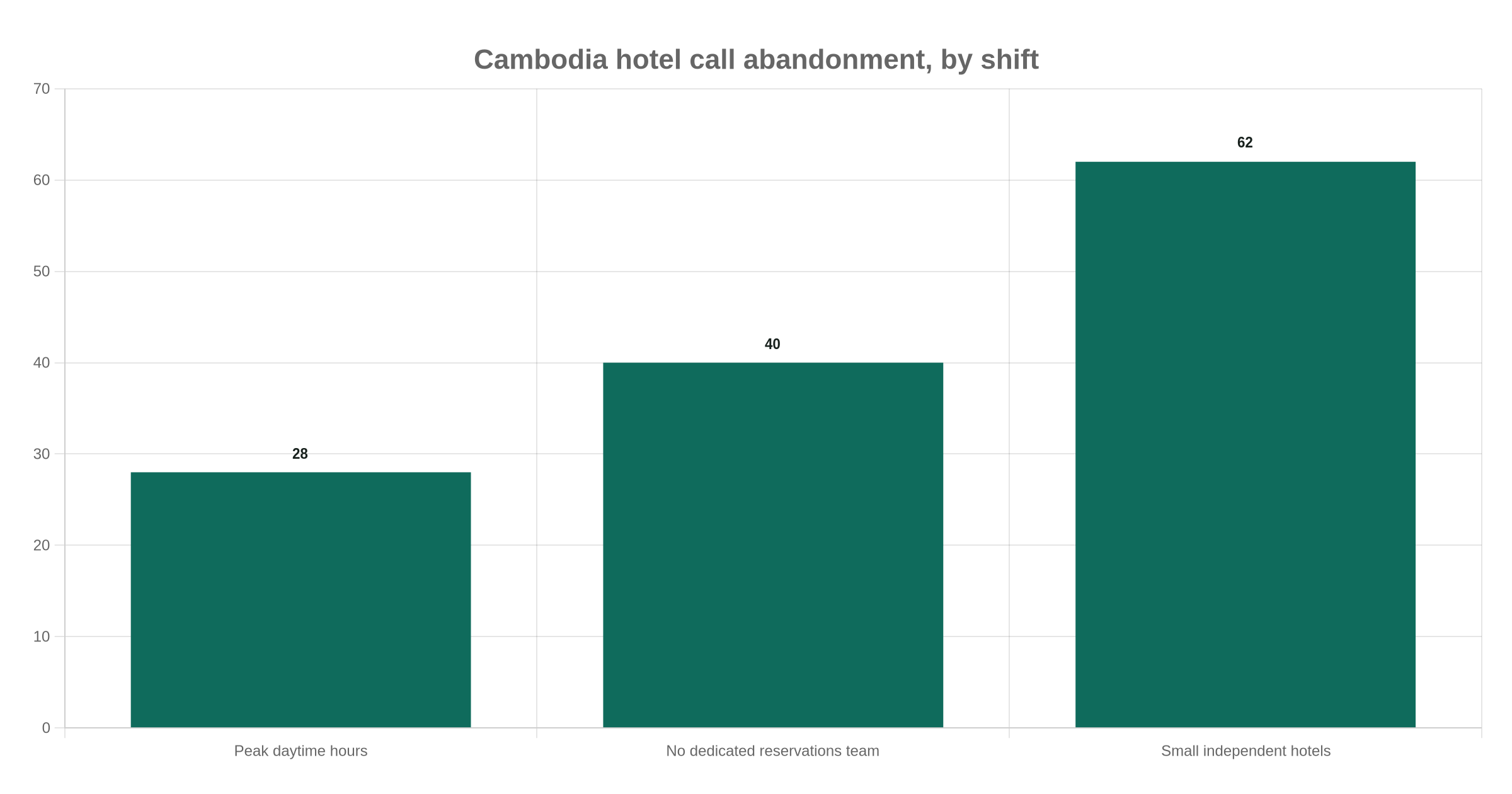
Phnom Penh hotels lose more booking revenue to an unanswered phone than to a bad TripAdvisor review, because a missed call is a guest who was already ready to pay and simply called the next property instead. Hospitality call-data analysis puts missed-call rates at around 28 percent during peak hours at a typical hotel, climbing to roughly 40 percent at properties without a dedicated reservations team, and as high as 62 percent at smaller independent properties where the general manager doubles as the front desk (HelloHotel, 2026).
The caller rarely waits around. Seventy-six percent of callers who reach voicemail do not call back, and the average value of a missed reservation call runs near 127 USD. AgentZap's 2026 call-data analysis puts the total at around 32,000 USD a month in lost reservation revenue for a mid-sized hotel missing 28 percent of its calls (AgentZap, 2026; HelloHotel, 2026). Phone bookings also carry a 23 percent higher average daily rate than OTA bookings, so the calls a boutique Phnom Penh property is missing are disproportionately its best-paying ones (AgentZap, 2026).
Picture a 20-room guesthouse near the riverside taking 12 inbound calls a day. At the 28 percent peak-hour abandonment rate reported above, that is a little over 3 missed calls daily. We do not have a Cambodia-specific figure for how many of those calls would have turned into a booking, so take a deliberately conservative one in three: that is roughly one lost booking a day, which at a modest 35 USD average nightly rate works out to about 1,050 USD a month left on the table, before counting the length of stay many Phnom Penh guesthouses actually get. That is the number an AI voice agent is built to close, not the glossier problem of winning more five-star reviews.
This matters more this year than last. Cambodia's international tourist arrivals fell 44.4 percent in the first eight months of 2026, to 2.25 million from 4.05 million a year earlier, even as domestic tourist trips rose 48.5 percent to 25.65 million over the same period, according to Ministry of Tourism figures reported by Khmer Times. A property chasing a smaller pool of international guests and a larger, more price-sensitive domestic one cannot afford to let any inbound call go unanswered, and the domestic traveler calling to book is increasingly online to begin with: Cambodia now counts 12.0 million internet users, 67.3 percent of the population (DataReportal, 2026), the same base that makes a phone-first AI voice agent viable rather than a novelty.
Why does a Cambodian clinic's real money problem start before the patient walks in?
A clinic's real money problem starts before the patient ever walks in, because an empty appointment slot cannot be sold again once the time passes. A 2016 study in BMC Health Services Research tracking a decade of outpatient visits across ten clinics found a mean no-show rate of 18.8 percent, ranging from 12.6 percent in audiology to 25.7 percent in gastro-intestinal clinics (Kheirkhah et al., BMC Health Services Research, 2016). That is a US dataset, not a Cambodian one, but it is the kind of order-of-magnitude figure most outpatient clinics anywhere will recognize from their own booking sheet.
An AI voice agent does not fix why people forget or skip appointments; that is a behavior problem every clinic already manages differently, with deposits, SMS reminders, or simply tolerance. What it does fix is consistency: a reminder and reschedule call that happens for every booked slot, every day, including the early morning and evening hours when front-desk staff are busiest with patients physically in the room and reminder calls are the first thing to slip.
Take a clinic booking 35 consultations a day. At the 18.8 percent reference rate, that is roughly 6 to 7 no-shows daily, each one an empty slot nobody reused on short notice. A same-day confirmation call, placed automatically the evening before and again two hours ahead, converts some share of those into either a kept appointment or a freed slot filled from a waitlist, neither of which depends on hiring another staff member to make the calls.
Can an AI voice agent actually take a call in Khmer yet?
An AI voice agent can take a call in Khmer in a controlled demo, but not yet reliably on a real, noisy phone line, and this is the one question every vendor page ranking for "AI voice agent" skips entirely. Khmer is classified as a low-resource language for AI training: there is comparatively little transcribed speech and annotated text available to build and test models against, the script carries no spaces between words, and Khmer phonation uses a two-register system with no real equivalent in English (academic Khmer ASR research via ResearchGate).
Published lab results look encouraging at first glance: a CMUSphinx-based Khmer speech recognition system reached up to 89.91 percent word accuracy and 90.02 percent sentence accuracy. Look closer and the test conditions explain the gap with production: these figures come from small, controlled datasets of isolated words and clean audio, not the overlapping speech, phone compression artifacts and background noise of a real reception desk call. A system that performs well on a lab test set of a few dozen speakers and a few hundred words is not the same system that needs to understand a rushed, accented caller through a Cambodian mobile network.
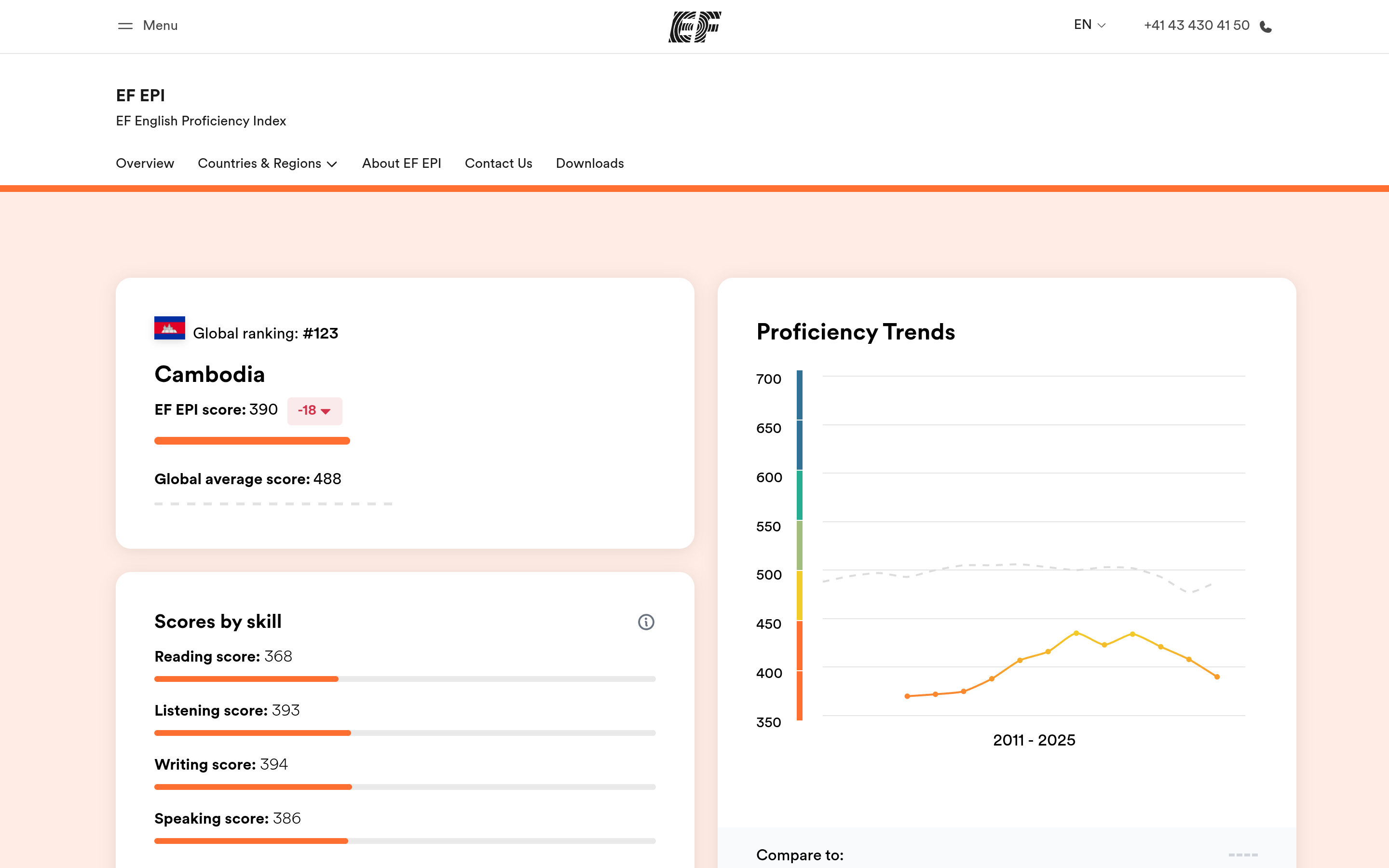
Language readiness cuts both ways here. Cambodia scores 390 on the 2026 EF English Proficiency Index, last among the countries ranked (123rd), which is a weak case for leaning on English alone nationally. Phnom Penh itself scores meaningfully higher at 472 (EF EPI, 2026), which is closer to the capital's actual caller mix and part of why an English-first build is a defensible starting point for a Phnom Penh clinic or hotel specifically, even if it would not travel as well to a provincial town.
This is also where latency compounds the problem. Humans expect a reply within about 500 milliseconds in ordinary conversation, and voice AI teams treat that figure as the benchmark for a natural-feeling simple turn; once the gap passes a full second, callers perceive a clear, awkward lag (Telnyx, 2026). Every extra model call needed to handle uncertain Khmer transcription, a retry, a clarifying question, a fallback, eats directly into that half-second-to-one-second window, and stacking two or three of them is what pushes a call from a brief pause into territory that feels broken rather than merely imperfect. English and Mandarin transcription, by contrast, run on models trained on orders of magnitude more audio, so the retry rate (and the latency it adds) stays low enough in practice to hold close to that half-second benchmark.
None of this means Khmer voice AI is permanently out of reach. It means the published accuracy numbers available today describe a research benchmark, not a production guarantee, and a business betting its front desk on a Khmer-speaking bot this year is testing a feature most of the industry has not shipped yet, not buying a mature product.
We would not promise a Khmer-speaking AI voice agent to a Phnom Penh clinic or hotel today. The honest build ships the English version first (and, given the current mix of Chinese arrivals in Cambodia's tourism numbers, ideally Mandarin as a second language), with Khmer-speaking callers routed to a person by default until a vendor proves accuracy at real call volume, not in a demo.
Inside a hypothetical case: a Phnom Penh clinic's Tuesday no-show problem
This is a hypothetical scenario built to illustrate the mechanics, not a real TechFlow client or a reported outcome.
A general practice clinic near Phnom Penh's Tuol Kork area books 40 appointments every Tuesday. Historically, the front desk calls to confirm only when staff have a free moment between patients, which in practice means roughly half of Tuesday's bookings get a reminder call and half do not. At something close to the 18.8 percent reference no-show rate, the confirmed half sees fewer no-shows than the unconfirmed half, a pattern the clinic has noticed informally for years without ever measuring it.
An AI voice agent scoped narrowly for this one job, outbound reminder calls the evening before and a same-morning follow-up for any booking still unconfirmed, does not touch triage, diagnosis, or anything requiring clinical judgment. It calls every booked slot, not just the ones staff had time for, and logs a confirm, a reschedule request, or no answer back into the booking calendar automatically. The clinic's own no-show rate, not an industry average, is what tells them afterward whether it worked, which is also why a scoped pilot with a before-and-after comparison matters more than any vendor's marketing number.
What does an AI voice agent cost to run in Cambodia?
Running an AI voice agent costs roughly 0.09 to 0.22 USD a minute on 2026 published pricing, depending on the platform, voice and model chosen, and that per-minute bill is separate from what it costs to build and configure the agent in the first place. Vapi's advertised 0.05 USD a minute platform fee becomes 0.09 to 0.14 USD all-in once transcription, language model and telephony are added, rising toward 0.22 USD if a premium voice such as ElevenLabs is chosen over a cheaper alternative (Beri.net, 2026; Klariqo, 2026). Retell AI runs close to 0.11 to 0.13 USD all-in on its own voices and a lighter model (Beri.net, 2026; Klariqo, 2026). Bland AI is the one with a catch: its per-minute rate alone runs 0.12 to 0.14 USD, but it also carries a separate monthly platform fee starting around 299 USD, not included in that per-minute number (Beri.net, 2026; Klariqo, 2026).
Run the numbers for a mid-size Phnom Penh hotel or clinic handling about 500 relevant calls a month at an average 3 minutes each, which is 1,500 minutes. At Vapi's all-in range that is roughly 135 to 210 USD a month, climbing to about 330 USD with a premium voice. At Retell AI's range it is roughly 165 to 195 USD. Bland AI's per-minute cost alone comes to about 180 to 210 USD, but the 299 USD monthly platform fee on top of it pushes the real total to roughly 479 to 509 USD, which makes Bland AI the most expensive of the three at this call volume once the fee is counted, not the cheapest. Compare any of these running costs to a Cambodian hospitality receptionist salary of roughly 300 to 450 USD a month, with entry-level front-desk roles starting near 300 USD (WorldSalaries, 2026): Vapi and Retell AI undercut one salary while covering hours a single receptionist physically cannot (nights, lunch breaks, a second language line), but Bland AI's platform fee alone is already close to that salary before a single minute is billed.
That comparison has a limit worth stating plainly: the AI voice agent does not replace a receptionist's judgment, only a slice of the call volume, and it still needs a build. Our AI agent cost guide breaks down that separate build price, and pairs with a free 1 to 2 hour process-mapping audit that scopes exactly which calls are worth automating before any number gets quoted.
Our recommendation: start with the three calls that cost the most
Our recommendation is to not build a full AI receptionist on day one. Start with the two or three call types that already cost the most money every month, the after-hours booking a hotel is currently losing and the reminder call a clinic's front desk never has time to make, and prove the narrower build works before expanding its scope.
That staged approach also sidesteps the Khmer question for now rather than pretending it is solved: an English-first (and, where the guest mix justifies it, Mandarin) voice agent handling bookings and reminders, with every Khmer-speaking caller routed straight to a person, ships in weeks and avoids the accuracy risk of a language the underlying models are not ready for yet. The open question we cannot answer from a desk in Phnom Penh is when that changes: Khmer speech recognition is improving, newer proprietary models trained on larger audio sets report stronger results than the older academic benchmarks cited here, and the right year to revisit a Khmer-language build is a moving target, not a fixed date on a roadmap.
TechFlow Agency builds these as scoped AI agent work, not off-the-shelf bots: orchestration through n8n and OpenRouter across Claude, GPT, Mistral or Llama, deployed on a private cloud or sovereign server, wired into the booking calendar or clinic system already in use, starting with a free 1 to 2 hour process-mapping audit and a costed action plan within 5 days. We price this work at roughly 35 percent below European agencies serving the same Southeast Asia clients, a positioning claim rather than a measured saving. If you are weighing an in-house build against hiring a vendor, our agent development company guide lists the questions worth asking before you sign anything.
If the call-volume math above looks like your hotel or clinic, a scoped estimate is the next step for the calls worth automating first, or look through our project work for how we scope a build before quoting it.
Prefer to chat? Message our founder directly on Telegram (@maxgrolier), or book a call with the team.
Frequently asked questions
Can an AI voice agent speak Khmer today?
Not reliably on a real phone line yet. Published Khmer speech recognition research tops out around 90 percent accuracy on small, clean test sets of isolated words, which does not hold up against noisy, continuous call audio from a mobile network. Until a vendor proves accuracy at real call volume, we route Khmer-speaking callers to a person.
How much does an AI voice agent cost to run for a small hotel or clinic in Cambodia?
Running cost, the per-minute platform bill, typically lands between 0.09 and 0.22 USD a minute on 2026 published pricing, plus a monthly platform fee on some platforms (Bland AI charges roughly 299 USD a month on top of its per-minute rate). For roughly 500 calls a month at 3 minutes each, that works out to about 135 to 330 USD a month on a platform with no separate fee, separate from the one-time build and integration cost.
Will callers know they are talking to an AI, and does that matter in Cambodia?
Most platforms disclose it by default in the opening greeting, and for bookings and reminders that disclosure rarely changes whether the caller completes the task. What matters more locally is whether the caller can finish the call in a language they are actually comfortable in.
Can an AI voice agent handle a cancellation or reschedule, not just a new booking?
Yes, and it is usually the easier half of the job. Confirming, cancelling or moving an existing booking needs less open-ended understanding than a first-time inquiry, which is why reminder and reschedule calls are a sensible first build.
What happens when the AI voice agent cannot answer the caller's question?
A properly scoped agent hands off to a human line or takes a message with a callback promise instead of guessing at an answer. Where that handoff point sits is a design decision made during scoping, not something the platform decides on its own.
How long does it take to set up an AI voice agent for a hotel or clinic in Phnom Penh?
Through our process, a narrow voice skill limited to bookings or reminders can ship in 24 to 48 hours once a process-mapping audit defines the call flow. A fuller build with calendar and CRM integration typically runs 1 to 4 weeks.