
An AI customer service agent is software that reads an incoming Messenger or Telegram message, decides what the customer actually needs, and answers, books or escalates without a person typing the reply, and in Cambodia it matters because Facebook Messenger already reaches 81.6 percent of the population (NapoleonCat, 2026). The platform your customers are already using is not in question. What is in question is which one to automate first, how much it costs to run, and when to let it answer alone versus when to hand off to a person.
Most vendor content treats Messenger and Telegram as interchangeable channels you simply "connect" to the same bot. We think that is backwards for a Cambodian SME. The two platforms run on different rules for when a business is even allowed to message a customer, and that single difference should decide which one you build on first, not which one has the nicer logo.
What an AI customer service agent actually does on Messenger and Telegram
An AI customer service agent on Messenger or Telegram chains three pieces: a trigger that catches the incoming message, a language model that reads intent and drafts or selects a reply, and an orchestration layer that decides whether to answer directly, pull a fact from a system of record, or hand off to a human. It is also called an AI customer support bot or an AI support agent, three names for the same underlying job.
For a Cambodian SME the typical scope is narrow on purpose: opening hours, delivery timelines, stock availability, a KHQR or ABA PayWay payment confirmation, an order status check. None of that needs a human's judgment, which is exactly what makes it buildable in weeks rather than months. This is a messaging-specific case of what we mean more broadly by an AI agent: software that pursues a goal across a conversation, not a single scripted reply tree.
The orchestration layer is the part vendors rarely show in a demo. We build these on n8n, wired into the Facebook and Telegram APIs and routed through OpenRouter to whichever model (Claude, GPT, Mistral or Llama) fits the task and budget, because a customer asking "are you open Sunday" does not need the same model as one disputing a charge. If you are weighing a chatbot against something closer to a full agent, our chatbot versus agent piece lays out where that line actually sits.
A plain chatbot, the kind most SME Facebook Pages already run through a free rule-based builder, matches a message to a keyword and fires a canned reply. An AI customer service agent reads the intent behind the message instead, so "do you still have the blue one in stock" and "is the blue one still available" trigger the same lookup even though they share almost no keywords. That distinction is what separates a frustrating keyword bot from one a customer will actually keep using.
Why do most Cambodian customers expect to message a business on Facebook first?
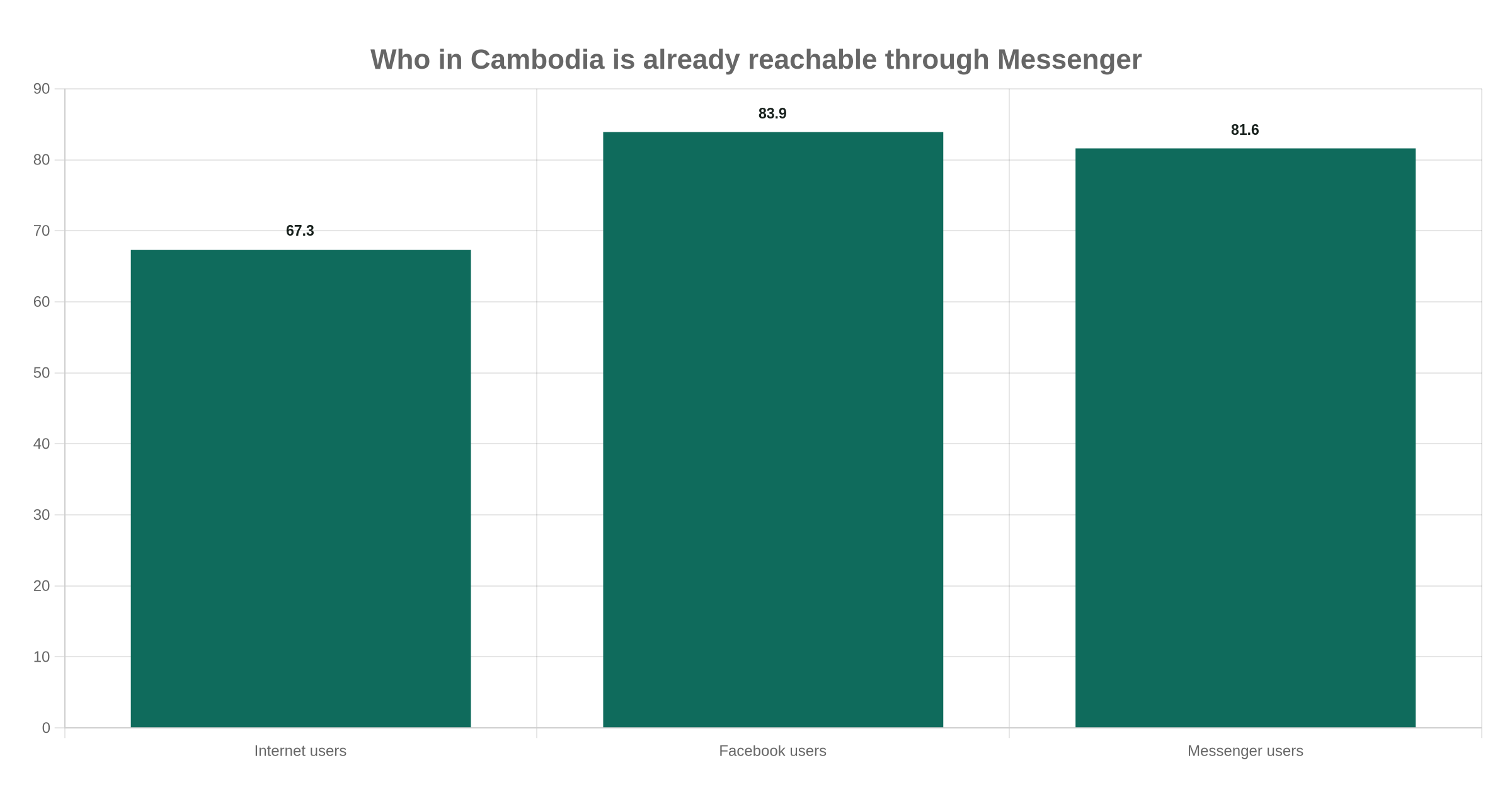
Most Cambodian customers expect to message a business on Facebook first because Facebook and Messenger are already where they are: 15,427,800 Facebook users and 14,995,400 Messenger users in Cambodia as of September 2026, 83.9 percent and 81.6 percent of the population respectively (NapoleonCat, 2026). Cambodia counts 12.0 million internet users overall, 67.3 percent of the population (DataReportal, 2026), which means Messenger alone reaches more people than the internet-user base itself once shared devices and multiple accounts are factored in.
Telegram's own reach is harder to size precisely with a public, citable count for Cambodia specifically, but its adoption by serious financial institutions is a stronger signal than any usage estimate. Wing Bank built and trained its own Khmer-language model for a Telegram chatbot that accepts a voice note in English or Khmer and answers in kind, text and voice, aiming for round-the-clock customer queries, a project GSMA's Mobile for Development team covered as a case study with a planned launch toward the end of 2025 (GSMA, 2026). A bank does not put a channel behind a customer-facing voice model unless its own data says that channel is where the volume already is.
Telegram's pull in Cambodia also runs deeper than any single bank chatbot. Several Cambodian government ministries run Telegram bots for public information, and even the national police operate Telegram hotlines, alongside Wing Bank's own verified Telegram channel for customer support. An SME's AI agent arriving on an app Cambodians already associate with official, trustworthy information has a shorter trust gap to close than one arriving cold on a platform with no institutional track record.
That reach is also why the global chatbot market keeps growing regardless of any single country's numbers: Grand View Research sizes it at 11.8 billion USD in 2026, growing at a 19.6 percent compound annual rate through 2033 (Grand View Research, 2026). None of that global figure tells a Phnom Penh shop owner which platform to build on first, which is exactly the gap the next section closes.
The one rule that decides whether you build on Messenger or Telegram first
The one rule that decides your build order is Meta's standard messaging window: a Facebook Page can message a customer freely for 24 hours after that customer's last action, and after that window closes it needs an approved Message Tag, a One-Time Notification, News Messaging status, or a paid Sponsored Message to say anything else (Meta Messenger Platform policy, 2026). Reply inside the window and an AI agent can say almost anything relevant. Reply outside it and the agent is boxed into a handful of Meta-approved use cases, logged and auditable, with "use of tags outside approved use cases" carrying the explicit risk of restrictions.
Telegram's Bot API carries no equivalent rule. Once a customer has started a conversation with your bot, the bot can message that customer at any time, with no 24-hour window, no message-tag approval process and no per-conversation fee (Telegram Bot API documentation, 2026). The one real constraint is the mirror image of Messenger's: a Telegram bot cannot open the first message, the customer has to message or start it first, same as Messenger's own opt-in requirement.
We would not start a Cambodian SME's first build on Messenger. Start on Telegram, where the orchestration logic does not need a message-tag fallback branch at all, prove the conversation flows there with lower platform risk, then port the same logic to Messenger once it works, building in the tag-handling and hand-off paths Messenger actually requires. Building Messenger first means designing for the harder constraint from day one, for a channel most Cambodian SMEs reach for out of habit rather than because it is the easier build.
How much does an AI customer service agent cost to run in Cambodia?
An AI customer service agent costs roughly 0 to 100 USD a month in platform fees for a small Cambodian SME's volume, plus a separate one-time build cost, and the platform fee alone rarely tells the full story. ManyChat's 2026 pricing starts at a free tier for 25 active contacts, with Essential at 14 to 17 USD a month for 250 contacts and Pro at 29 to 39 USD a month for 2,500 contacts; the free and Essential tiers cover any two of Instagram, TikTok, Messenger and Telegram, so choosing Messenger and Telegram together already uses the whole allowance, and WhatsApp only unlocks from Pro up (ManyChat, via Tidio review, 2026). Chatfuel's Business plan runs 20 USD a month (18 USD billed yearly) with 20 USD of AI usage credit bundled in, unlimited contacts, and every channel included (Chatfuel, via Macha review, 2026).
Picture a Phnom Penh homeware shop running 800 Messenger and Telegram conversations a month, most of them opening-hours, stock and delivery questions. On ManyChat's Pro tier that is 29 to 39 USD a month in platform fees, comfortably inside the 2,500-contact cap; on Chatfuel's Business plan it is a flat 20 USD plus whatever share of the bundled AI credit those 800 conversations consume. Either way, the platform bill lands well under the roughly 799 USD a month that Plane's remote-hiring data puts a Cambodia-based customer service representative at (Plane, 2026), an international benchmark rather than a Phnom Penh walk-in wage, which still makes the comparison that actually matters: the agent is not competing with a human's judgment, it is covering the repetitive share of messages so that one person, local hire or remote, is not reading "are you open today" forty times a day.
That platform fee is also the smaller number. The build, the conversation flows, the system integrations, the fallback and hand-off logic, is the real cost, and it is the reason we do not quote a number before scoping one. Our AI agent cost guide breaks that build price down in more depth, separate from the running cost shown here.
The four-step process we run to scope and launch one
We run the same four-step process on every AI customer service agent build, regardless of whether it ends up on Messenger, Telegram, or both, from a Phnom Penh team working ICT hours (UTC+7), which matters when a fix or an escalation cannot wait for a time zone on the other side of the world to wake up:
- Free process-mapping audit, 1 to 2 hours. We go through the existing message and call log to find which questions actually repeat, not which ones feel most important.
- Costed action plan, 5 days. A written scope: which platform first, which questions the agent answers alone, which ones it hands off, and a fixed price, before any build work starts.
- Deployment, 1 to 4 weeks. A narrow AI skill (a single flow, like order-status lookups) can ship in 24 to 48 hours; a fuller autonomous agent handling multiple intents and a CRM or inventory integration runs 1 to 4 weeks.
- Continuous improvement, monthly reports. We review what the agent handled, what it escalated, and where the handoff logic needs tightening, every month after launch.
We price this work at roughly 35 percent below European agencies serving the same Southeast Asia clients, a positioning claim rather than a measured saving, since the AI agents line is new enough that we do not yet have published case studies to cite instead.
Should your AI agent resolve the conversation alone, or hand off to a person?
Your AI agent should resolve a conversation alone only when the question is one it answers correctly almost every time, and hand off everything else, because the data on fully autonomous support is not as settled as the marketing suggests. Intercom's own Fin product reports an average resolution rate of 76 percent across 12,000 customers, but industry resolution rates typically range from only 40 to 60 percent at initial deployment (Intercom Fin, 2026), a wide gap between what is achievable once tuned and what a new build actually hits on day one.
Customer sentiment adds a second reason not to automate everything. Gartner found that 87 percent of customers say access to a human agent is essential even when a company uses generative AI (Gartner, September 2026), and the same research house tracked AI spending by customer service leaders rising 38 percent against overall service budget growth of just 2 percent (Gartner, August 2026), which tells you the investment is accelerating faster than the trust is.
A full, handoff-free AI agent is the wrong first build for most Cambodian SMEs. Scope it to the three or four questions that already eat the most staff time (opening hours, KHQR payment confirmation, stock and delivery status) and route everything else, complaints, disputes, anything with money or a reputation attached, straight to a person. Gartner projects agentic AI will autonomously resolve 80 percent of common customer service issues by 2029 (Gartner, March 2025), which is a reason to start narrow now and widen the scope as the technology and your own data catch up, not a reason to over-promise what a 2026 build can do today.
A small Phnom Penh beauty salon runs an AI agent scoped to booking confirmations and opening hours. A customer messages asking for a refund after a service they were unhappy with. A narrowly scoped agent recognizes that this falls outside its approved intents, a refund is money and reputation at once, and routes it straight to the owner with the conversation history attached, rather than guessing at a policy it was never given. That single hand-off rule is what keeps a scoped agent useful instead of becoming the thing that quietly damaged a customer relationship while no one was watching the inbox.
What results should you expect in the first 90 days?
You should expect an AI customer service agent to resolve 40 to 60 percent of the questions it sees in its first weeks, closer to Intercom's lower deployment range than its 76 percent trained average, because a new build has not yet seen the full range of how your customers actually phrase things (Intercom Fin, 2026). That number should climb each month as the continuous-improvement review catches misroutes and adds the phrasings the agent missed the first time.
Take a hypothetical Phnom Penh online shop handling 30 Messenger and Telegram messages a day, split roughly evenly between the two platforms. At a 50 percent resolution rate in month one, that is 15 conversations a day the agent closes without a person typing a reply, freeing up something close to an hour of staff time daily if each of those messages previously took two to three minutes to answer and look up. The other 15 still need a person, which is the point: the agent is covering the repetitive half, not replacing the judgment half.
Prefer to chat? Message our founder directly on Telegram (@maxgrolier), or book a call with the team.
Frequently asked questions
Can one AI customer service agent run on both Messenger and Telegram at once?
Yes, the same orchestration logic can connect to both platforms' APIs, but the conversation flows still need separate handling for Messenger's 24-hour window and Telegram's lack of one. Building Telegram first and porting the proven flows to Messenger is the lower-risk order, not building both simultaneously from scratch.
Will Cambodian customers know they are talking to an AI, not a person?
Most platforms disclose this by default in the opening message or a visible bot label, and for straightforward questions like opening hours or delivery status that disclosure rarely changes whether the customer gets what they came for. What matters more is whether the handoff to a person is fast and visible when the question needs one.
Can an AI customer service agent reply in Khmer?
It can, with real limitations. Wing Bank's own Telegram chatbot was built on a Khmer-trained model specifically because off-the-shelf models handle Khmer poorly, and even that project scoped itself to voice notes and text rather than claiming full Khmer fluency across every use case (GSMA, 2026). English-first, with Khmer added once a build proves accurate on your specific question set, is the safer starting scope.
What happens when the agent cannot answer a customer's question?
A properly scoped agent hands off to a person or takes a message with a promised callback window instead of guessing. Where exactly that handoff point sits, which questions trigger it, is a decision made during the costed action plan, not something the platform decides for you by default.
How much does it cost to build an AI customer service agent, separate from the monthly platform fee?
That is a separate number from the 0 to 100 USD a month platform fee discussed above, and it depends on how many intents the agent handles and what it needs to integrate with. Our build price breakdown guide covers that in detail.
Do we need to abandon our existing Facebook Page or Telegram channel to add this?
No. The agent plugs into the Page or bot account you already run; customers keep messaging the same account they already know, and the automation sits behind it rather than replacing it.
The open question we cannot answer from a desk in Phnom Penh is how fast Meta keeps changing Message Tag rules: several tags were already retired or restricted in 2026, and a build that leans too heavily on a specific tag risks breaking when Meta tightens the list again. Our recommendation stands regardless of that churn: start on Telegram, scope narrowly to the questions that already cost the most staff time, and treat the 40 to 60 percent first-month resolution rate as the honest starting point, not the 76 percent ceiling a trained, year-old deployment can reach.
TechFlow Agency builds these as scoped AI agent work: orchestration through n8n and OpenRouter across Claude, GPT, Mistral or Llama, starting with a free 1 to 2 hour process-mapping audit and a costed action plan within 5 days. If the conversation volume above sounds like your shop, book a call to scope which three questions are worth automating first, or look through our project work for how we scope a build before quoting it.