
Every Cambodian cybersecurity talk aimed at small businesses repeats the same number: 60 percent of hacked SMEs go out of business within six months. A senior Phnom Penh IT consultant cited it at a bank-sponsored event in 2025. Dozens of vendor blog posts cite it worldwide. The number has no verifiable source, and the organisation most often credited with it has publicly said it never produced the study.
That matters for more than accuracy. A scare number that collapses under scrutiny gives an SME owner a reason to dismiss the whole subject as marketing exaggeration, right when the real, measurable risk, a patched website, an unprotected inbox, a weekend of downtime, deserves their attention. That gap matters more in 2026 than it did a few years ago: as we have covered in how digital marketing in Cambodia already assumes an always-on inbox and a scannable QR code on every receipt, a Cambodian SME's attack surface is no longer just a brochure website nobody visits twice. This article drops the myth and replaces it with the numbers that actually hold up: what puts a Cambodian SME's website, email and payments at risk, what Cambodia's own regulators are building, and what a shown cost comparison says about paying for prevention.
Cambodia's Cybersecurity Advice Still Repeats a Debunked Closure Statistic
The claim that 60 percent of small businesses close within six months of a cyberattack has no traceable primary study behind it, and Cambodia's own cybersecurity advice keeps repeating it anyway. The statistic has circulated since roughly 2011, usually credited to the National Cybersecurity Alliance (NCSA), until the NCSA issued an official statement in 2022 confirming it never produced that data and asking that it no longer be cited. Michael Kaiser, the Alliance's executive director, said the original source of the 2011 figure could not be confirmed.
The number still shows up in Cambodia. A 2025 cybersecurity event hosted by the Association of Banks in Cambodia (ABC) featured it in a presentation reported by Khmer Times, attributed loosely to "a study" with no citation. That is not a knock on the speaker, the figure is everywhere, including in the United States Congress at one point. It is a reason to stop repeating it here.
What survives the scrutiny is less dramatic and more useful. Verizon's 2026 Data Breach Investigations Report breaks out breaches at organisations under 1,000 employees specifically: vulnerability exploitation leads at 26 percent, credential abuse follows at 13 percent, and phishing sits third at 9 percent. Recovery, not closure, is the typical outcome: industry claims data shows most SMEs lose five to fourteen business days during an incident, a real cost in lost orders and staff time, but a cost most businesses absorb and survive rather than one that reliably ends the business. We think that is the more honest motivator. A business owner who hears "you will likely lose a working week and several hundred dollars" can plan around that. A business owner who hears an unverifiable "you have a 60 percent chance of closing" either panics or, more often, tunes the whole topic out.
What Actually Puts a Cambodian SME Website at Risk?
A Cambodian SME website is most often compromised through an outdated CMS or an unpatched plugin, not through a targeted attack. Sucuri's 2023 Hacked Website and Malware Threat Report found that 39.1 percent of compromised CMS installations were already out of date at the point of infection, and 13.97 percent of compromised sites carried at least one vulnerable plugin or theme at the time of cleanup. Those are global figures, but nothing about Cambodia's web stack makes it an exception: the same WordPress, the same page builders, the same plugin ecosystem run sites here as anywhere else.
The pattern lines up with a broader shift Verizon's 2026 report flags for the first time in its 19-year history: exploiting a known, unpatched software vulnerability, not a stolen password, is now the single most common way attackers get in, accounting for roughly 31 percent of analysed breaches. A small business running an auto-updating, actively maintained CMS is a materially harder target than one running whatever version was current when the site launched two or three years ago and has not been touched since.
When we take over a site we did not build, we work the same order every time, because the order matters as much as the individual tasks. Patch and take a clean backup first, before anything else changes, so there is a safe point to roll back to if the next step turns up something worse. Audit every login second: admin accounts, FTP credentials, API keys, anything a previous vendor issued and never closed, and revoke what is not clearly needed today. Only then map which pages actually touch money or personal data, because those are the ones that get hardened and watched first, not the blog. The pitfall we check before anything else is a single shared admin login passed from agency to agency over several years: one leaked credential compromises the whole site at once, and no amount of plugin patching fixes that if the login itself is the weak point. Given the choice, we would rather schedule a short, announced hour of downtime to move every stakeholder onto an individual login than quietly rotate one shared password, because a quiet rotation tends to get re-shared within a month and a scheduled cutover does not.
The second common gap is access, not code. Warren Daly, a senior IT business consultant based in Phnom Penh, put it bluntly at the same 2025 ABC event:
"It is high time we come out of the '123456' password, which reflects our lack of seriousness towards ensuring cybersecurity."
Shared admin logins, passwords that double as the Wi-Fi password, and a web agency's temporary account left active a year after launch are the pattern we see most often behind a compromised small business site, not a sophisticated exploit. Daly's recommended baseline, strong individual passwords, device updates, limited access, secured Wi-Fi, encrypted data and a secured website, is unglamorous and that is the point: it is the set of habits that closes the gap Sucuri's numbers describe.
A third factor is specific to how Cambodian SMEs commission sites. Cambodia's ICT sector adds freelance and informal capacity faster than it produces senior engineers, which we have covered in how an IT company in Cambodia can mean five different kinds of vendor. A site built fast and cheap by a vendor who disappears after launch rarely gets patched again. Nobody owns that job once the invoice is paid, and an unpatched CMS is exactly the profile Sucuri's report describes as the typical entry point.
How Exposed Is a Cambodian Business's Email to Phishing?
A Cambodian business's email is exposed to the extent its domain lacks SPF, DKIM and an enforced DMARC record, the three protocols that let a receiving mail server verify a message actually came from your domain. A February 2026 study of 5.5 million domains by DMARCguard found SPF adopted on 56.0 percent of domains, DMARC on 30.4 percent, and DKIM, the lowest of the three, on just 22.7 percent. Adoption is not the same as protection: only 12.8 percent of all domains enforce a DMARC policy strict enough to actually block spoofed mail, while 57.9 percent of DMARC-enabled domains sit in monitor-only mode (p=none).
That gap matters even though phishing is not the leading way into a small business's systems. Verizon's SMB-specific breakdown puts phishing at 9 percent of initial access for organisations under 1,000 employees, behind vulnerability exploitation at 26 percent and credential abuse at 13 percent, but it is still a real and cheap vector: a spoofed invoice email, sent from a domain that looks like a supplier's but is not, costs an attacker almost nothing to run and does not require breaking into anything. It only requires that the receiving mail server has no way to check whether the message is genuine, which is exactly what an unprotected domain cannot do.
The fix costs nothing beyond a DNS change and an afternoon. Publishing SPF and DKIM records, then moving DMARC from "none" to "quarantine" over a few weeks of monitoring, is a task most web hosts and email providers support natively. The reason it is not already done on most Cambodian SME domains is not cost. It is that nobody assigned the task, the same pattern we see with an unpatched CMS: a domain, like a website, needs one named owner after launch, not just at launch.
Two-factor authentication on every email account closes most of what a domain record cannot. A correctly configured DMARC policy stops a forged sender address from reaching your customer's inbox, but it does nothing if an attacker gets your actual password through a reused credential or a convincing fake login page, which is still how a large share of account takeovers start. A password manager and a second factor on the business inbox, the accounting login and the Bakong or banking app account cost nothing beyond ten minutes of setup per account, and they close the gap a DNS record cannot touch.
KHQR and Bakong Security Is Not the Same Job as Checkout Security
The National Bank of Cambodia (NBC) is responsible for Bakong and KHQR's own settlement security, not your business. Bakong is the interbank settlement system NBC operates behind the scenes; KHQR is the QR standard built on top of it that a customer actually scans. NBC recorded 1.325 billion Bakong transactions in 2025, a scale that makes the rail itself a national financial-infrastructure question, governed and audited at that level, not something an individual merchant configures or hardens.
What is yours to secure is everything on your side of that QR code: the website or app that generates the payment request, any checkout form that touches a customer's card details, and the device or account you use to manage your KHQR profile. The Payment Card Industry Data Security Standard (PCI DSS) applies to any business that stores, processes or transmits cardholder data, with no size exemption, so a small shop is not automatically excused because it is small. The PCI Security Standards Council's own small-merchant guidance is unambiguous on the safest answer: do not store raw card data at all. Route payments through a PCI DSS compliant gateway or a hosted payment page, which keeps card numbers off your own servers entirely, an approach we recommend to every SME client building or rebuilding ecommerce in Cambodia.
| Risk area | Who is actually responsible | What to actually do |
|---|---|---|
| Bakong and KHQR settlement | National Bank of Cambodia | Nothing to configure. It is NBC's architecture, not yours. |
| Card or QR data on your own checkout | Your business | Never store raw card data. Use a PCI DSS compliant gateway or hosted payment page. |
| Website malware and outdated plugins | Your business, or whoever maintains the site | Keep the CMS and plugins patched, limit admin accounts, keep an offsite backup. |
| Business email spoofing | Your business, via your domain host | Publish SPF and DKIM, move DMARC to an enforced policy. |
| A future data breach notification | Your business, as data controller | Name a Data Protection Officer, keep a 72-hour notification plan ready. |
We would weight the two rows an owner tends to flip: most of the SMEs we talk to worry about the Bakong rail they do not control and barely think about the checkout form they do. That emphasis should run the other way. Asking a vendor "do you store card numbers anywhere" is a better due-diligence question before launch than asking whether KHQR is secure, because the second question has already been answered at the national level and the first one has not.
Run the numbers on a realistic small Phnom Penh retailer, our illustrative figures rather than a client's actual data: a website and KHQR checkout generating $3,000 a month in combined orders and qualified leads, or roughly $136 a working day across 22 working days. A malware infection that takes the site offline for five business days, the low end of a typical SME recovery window, costs around $680 in orders lost outright or pushed to a competitor who stayed reachable that week. Cleaning the infection, restoring a clean backup and patching the vulnerability that let it in runs about 10 hours of a Cambodia-based developer's time; at the top of the $25 to $49 an hour band Cambodia-based developers typically bill on outsourced work, that is $490. One incident, on this scale: close to $1,170.
Compare that to prevention: three hours a month of basic hygiene, patching, backup checks, a log review, at a blended $35 an hour comes to $105 a month, or $1,260 a year. A single bad week can cost nearly as much as the entire year's prevention budget. That is the comparison we would put in front of an owner instead of an unverifiable closure statistic: not "you might go out of business" but "one incident costs about as much as twelve months of not having one."
What Will Cambodia's New Data Protection Law Require of SMEs?
Cambodia's forthcoming Law on Personal Data Protection will require any business that controls personal data, which includes most SMEs with a customer database or an online order form, to appoint a Data Protection Officer and notify the Ministry of Posts and Telecommunications of a serious data breach within 72 hours of becoming aware of it. The Ministry published its draft on 23 July 2025 and has continued consulting on it since, including a verification workshop on 5 August 2026; as of this writing it is not yet enacted. Proposed penalties run up to 600 million riel, roughly 150,000 US dollars, or 10 percent of a company's annual turnover, whichever framework applies, with an expected transition period once the law passes.
A parallel draft Cybersecurity Law is moving on a similar but separate track. MPTC's Secretary of State led a technical meeting with the Ministry of Justice in July 2026 to review its inspection and penalty chapters, with further sessions scheduled to refine the text. Neither law is final yet, but the direction is clear enough to plan around: a named point of accountability for data and a fast breach-notification clock are both coming.
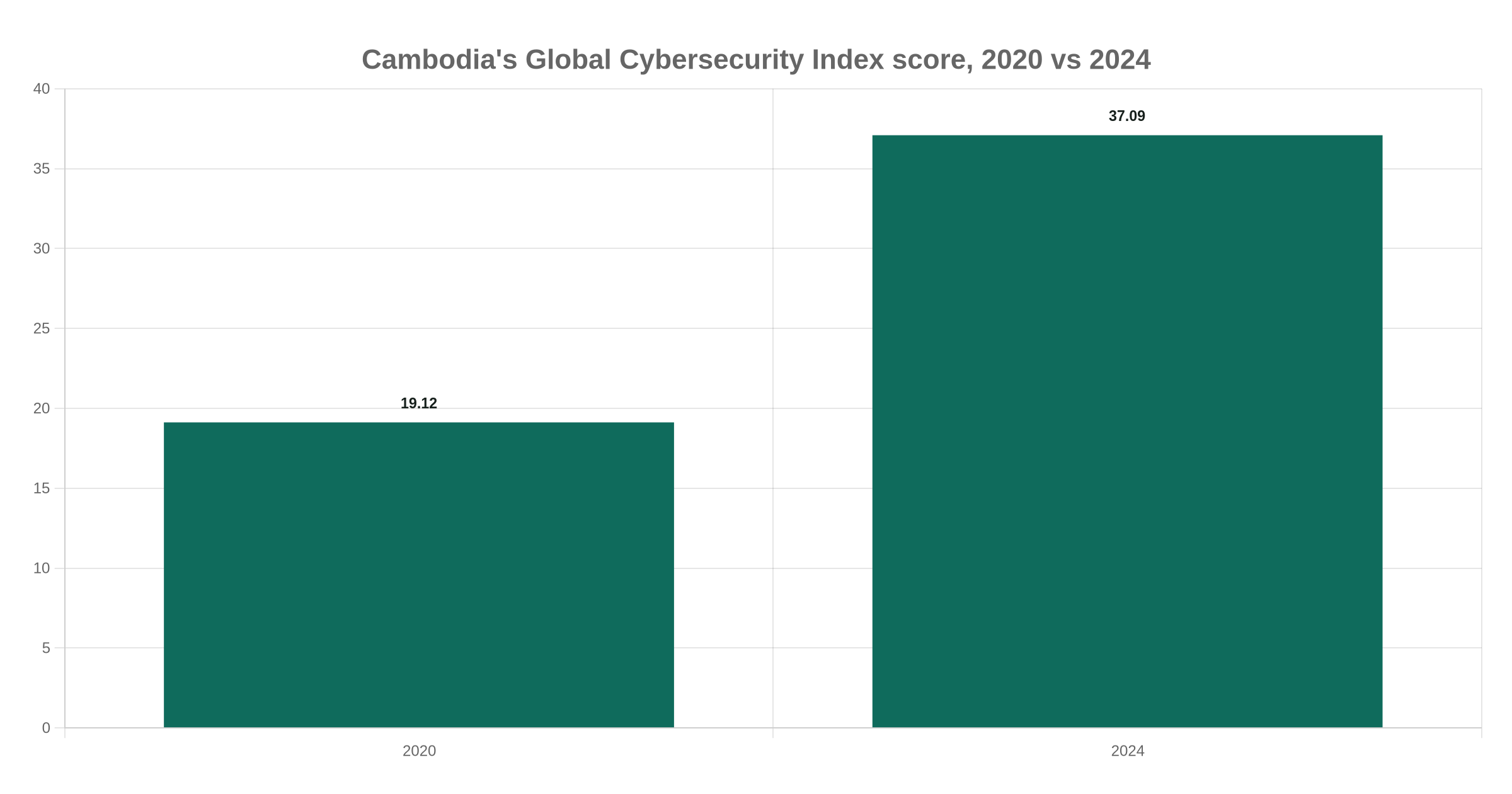
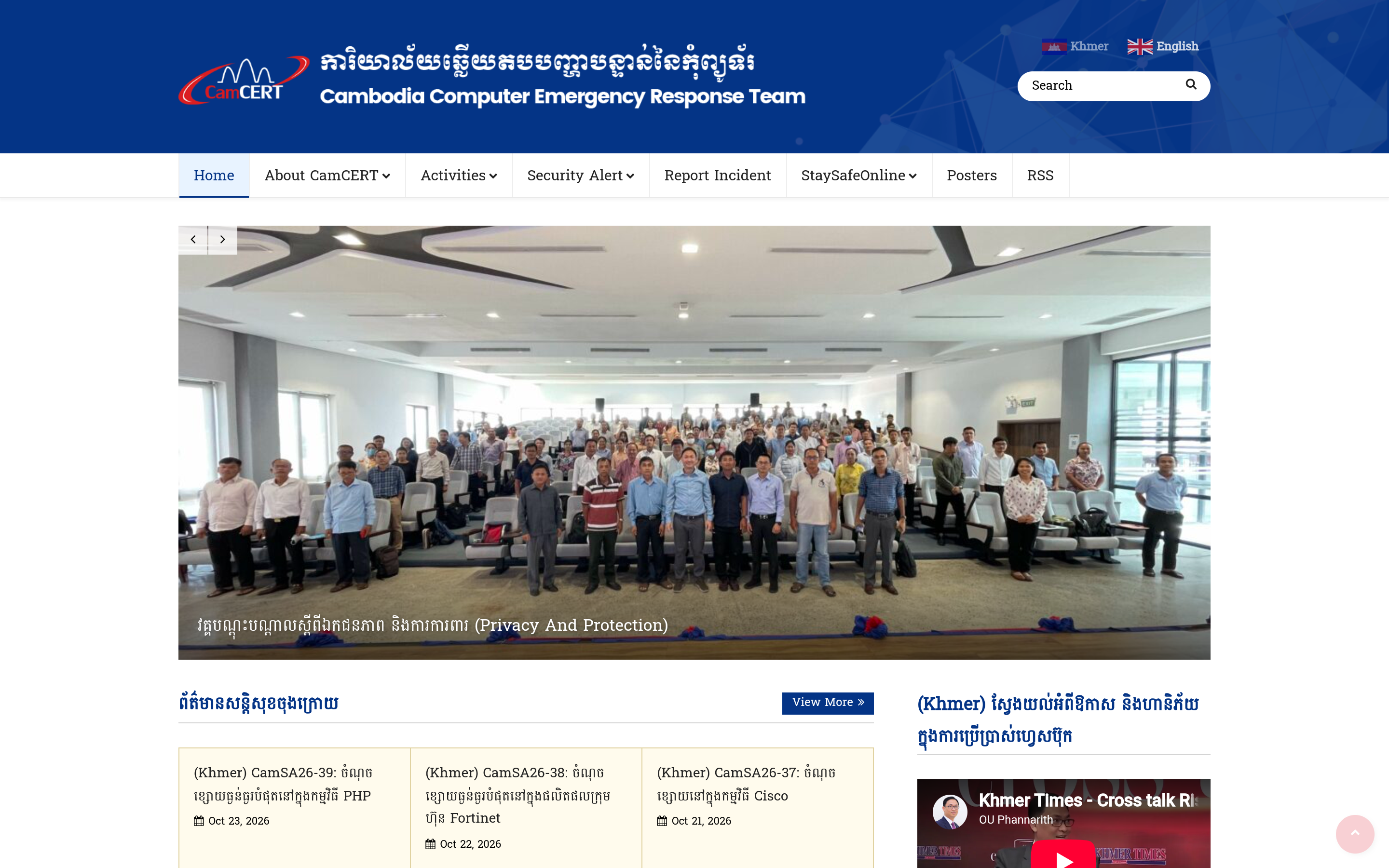
Cambodia already has an incident-response body for the interim. CamCERT, the country's national Computer Emergency Response Team, was established in December 2007 and sits under the ICT Security Department of MPTC's General Department of ICT, based in Phnom Penh. It is the contact point for reporting a security incident today, ahead of whatever the new laws formalise. MPTC has also said publicly that cyberattacks in Cambodia are increasing by close to 25 percent a year, and the country's banking sector still imports much of its senior cybersecurity expertise from India and elsewhere, a sign that Cambodia's institutional capacity is catching up but has not caught up yet. Cambodia's score on the ITU's Global Cybersecurity Index nearly doubled from 19.12 in 2020 to 37.09 in 2024, real progress, but still a rank of 132nd globally on a 100-point scale.
That gap between national progress and national capacity is exactly why an SME cannot outsource its own basics to "the government will handle it." A young, accelerator-backed company is in the same position: the kind of early-stage business we described in how Cambodia's startup ecosystem actually funds new ventures rarely has a dedicated security hire either, and the same patch-your-CMS, protect-your-domain, do-not-store-card-data basics apply just as much to a funded six-month-old startup as to a ten-year-old family retailer.
We would also flag what "personal data" covers once the draft law is enacted, because most SME owners assume it means only payment details. A customer's name, phone number or delivery address collected through a Telegram order or a web form already counts in most draft frameworks modelled on this one, which means the 72-hour notification clock is not an edge case reserved for banks and telecom operators. It applies to the order spreadsheet a small retailer keeps today, long before anyone calls it a database.
Our view: the SMEs who handle this well will be the ones who start the paperwork now, not once the law passes and a deadline is already running. That starts with naming who holds the Data Protection Officer role. It does not have to be a new hire; for a business of under twenty people, the owner or the operations manager can carry the title alongside their existing job. Next comes the one-page breach plan, written calmly before an incident forces a rushed one, and a short audit of what personal data actually sits in which spreadsheet, CRM or order form today. None of that needs a lawyer or a compliance budget. It needs the same afternoon and the same named-owner discipline this article keeps coming back to.
What Should a Cambodian SME Do About Cybersecurity This Week?
A Cambodian SME should start with the five items that cost the least and close the most exposure: patch the website, lock down email, confirm nobody is storing card data, name an owner for both, and write down what happens in the first 72 hours of a breach before the law requires it.
None of this needs a security team. It needs one afternoon and a named person who checks it again next quarter, the same discipline we run on our own six-step delivery process, scoping and audit, technical recommendations, design and prototype, sprint-based development, testing and go-live, post-launch follow-up, where security hygiene is a named deliverable at the testing and go-live step, not an afterthought bolted on when something breaks. It is also the same discipline behind every other service line of our agency: a named owner and a dated deliverable beat a generic promise.
"Named owner" breaks down in a specific, common Cambodian way: the domain and hosting account were set up under a freelance developer's or a departed vendor's personal email, and that person has since stopped answering. There is no one left who can log in when the renewal notice bounces or a DMARC alert needs action. Register the domain and hosting under a business email at least two people can access, and confirm that today rather than at the next renewal deadline.
Run this checklist this week:
- Update your CMS, plugins and any admin passwords that are shared, reused or older than a year.
- Publish SPF and DKIM on your domain, and move your DMARC policy from monitoring to enforcement.
- Confirm your checkout never stores raw card numbers; route payments through a PCI DSS compliant gateway instead.
- Name one person, inside the business or at your web developer, who owns the site and domain after launch, not just during the build.
- Draft a one-page plan for the first 72 hours after a suspected breach, ahead of the data protection law making it mandatory.
See how we structure a project around deliverables like these in our work, or talk to our development team in Phnom Penh about auditing what your current site and checkout actually expose. If you want the shorter version first, book a call and we will walk through the five items above against your own setup.
Prefer to chat? Message our founder directly on Telegram (@maxgrolier), or book a call with the team.