

A guesthouse owner in Phnom Penh, Cambodia, decides to hire a web developer this week and posts a one-line brief: "need someone to build our website." By the next morning the replies span a 5-dollar-an-hour individual on a freelance marketplace, a three-person studio quoting 1,200 dollars flat, and a Clutch-listed agency quoting 15,000 dollars for the same one-line brief. All three are honest quotes. None of them is wrong. The brief is.
This article is for the founder or operations lead standing in that gap, trying to hire a web developer in Cambodia without first learning the market's own vocabulary: local rate versus international rate, in-house versus freelance versus agency, and the two pieces of paperwork, the National Social Security Fund and the work permit, that change the real cost of each option. We work through what each path actually costs, a step-by-step process for hiring in-house, and how to vet whoever you pick before money changes hands.
Who Actually Builds Websites in Cambodia?
Search "hire web developer cambodia" today and Google does not show you a market built for buyers. It shows a results page built for job seekers: LinkedIn job listings, a Facebook recruiting group with technical postings, a page of internships, and a local pack of three Phnom Penh agencies sitting below the job listings, not above them. Related searches reinforce the same read: "hire web developer cambodia salary," "job description," "internship." A founder researching how to hire ends up reading pages written for the people who want to be hired.
Underneath that noise, four distinct ways to get a website built actually exist in this market, and they rarely get compared against each other because they live on different platforms. Individual freelancers work through Upwork and Twine, pricing themselves per hour with no overhead and no bench. Small studios and boutique agencies, the kind Clutch lists for Cambodia with employee counts from 2 to a few hundred, price per project and carry a team behind the one person you talk to. A direct employee works exclusively for you, on your payroll, subject to Cambodian labour law. And a foreign remote hire or contractor sits outside all three, priced in a different currency and governed by a different visa.
Our broader web development in Cambodia guide covers the build itself, the stack and the CMS. This one stays one layer earlier: who does the building, and what that choice actually costs.
What Does a Web Developer in Cambodia Actually Cost?
A web developer in Cambodia costs a different number depending on who is asking, and the gap between those numbers is the single most under-reported fact in this market. SecondTalent's 2026 rate card for Node.js developers in Cambodia, the most detailed public breakdown we found, prices a senior developer (5 to 8 years' experience) at 18 to 25 US dollars an hour for a local Cambodian company, 28 to 40 US dollars an hour on freelance platforms, and 32 to 45 US dollars an hour when the client is international. SecondTalent states the pattern directly: international clients typically pay 40 to 60 percent more than local companies for the same skill level.
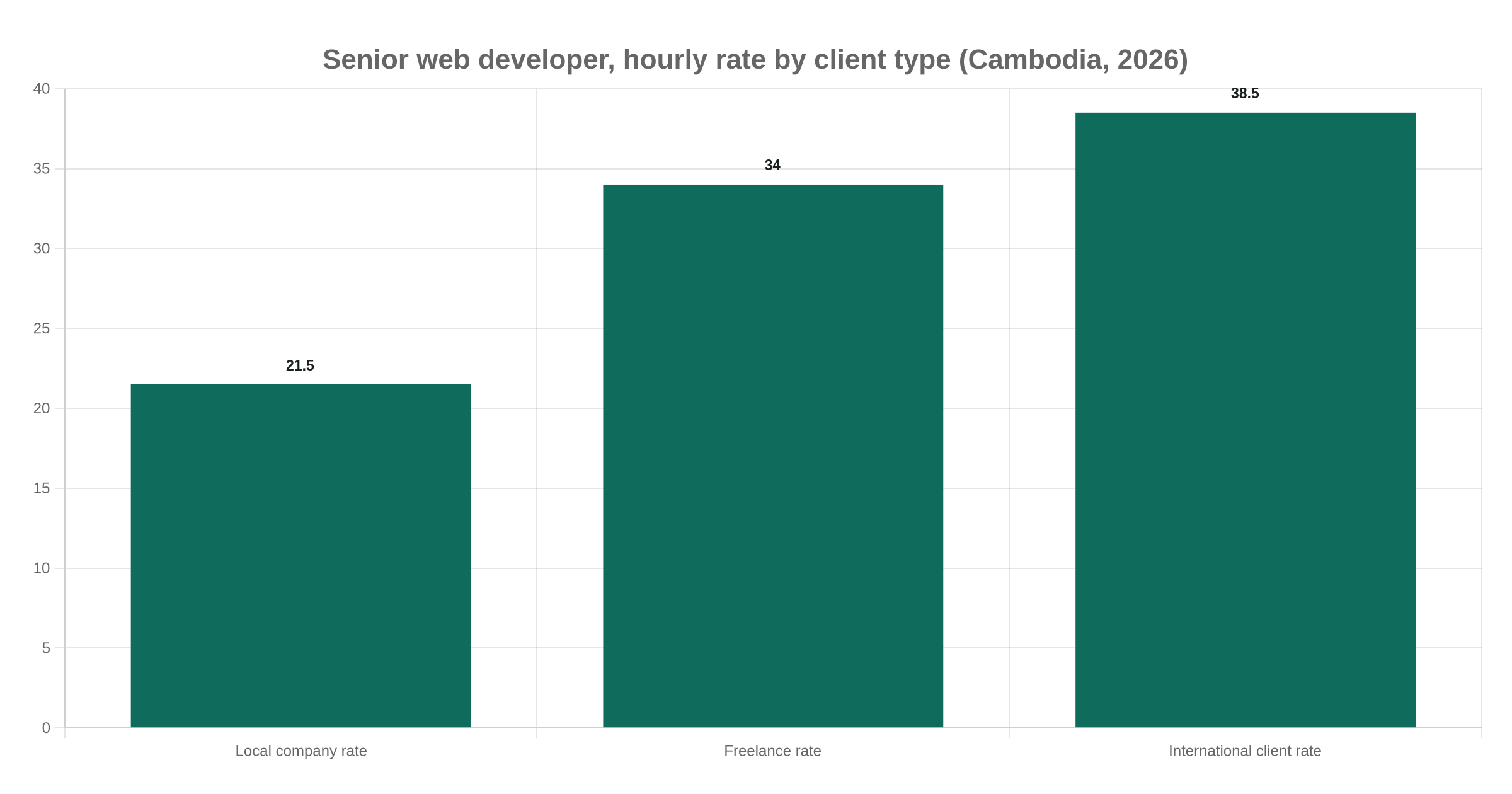
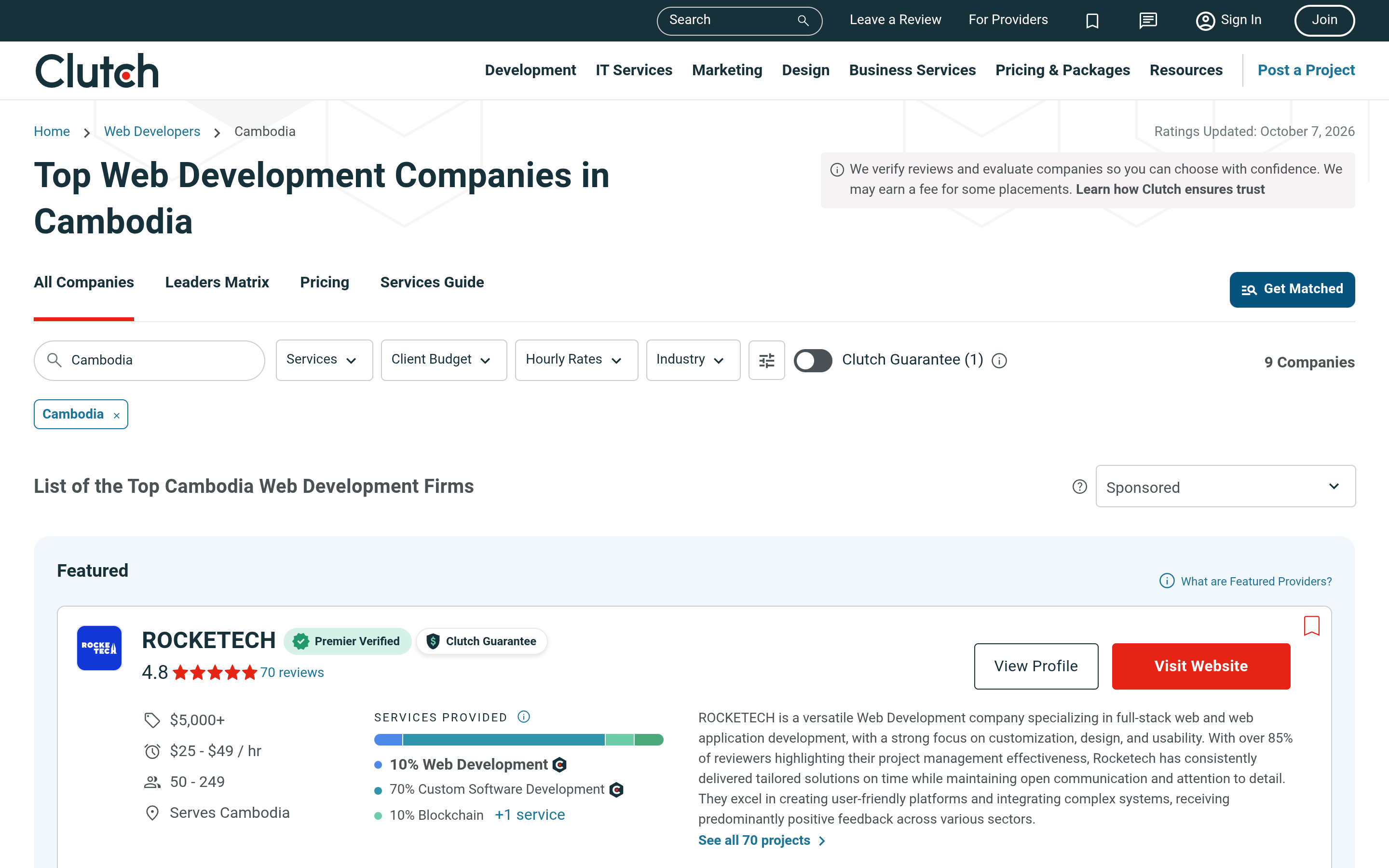
That spread holds at the agency level too. Clutch's own Cambodia listings run from under 25 US dollars an hour for a small studio like Mango Byte up to 150 to 199 US dollars an hour for a B Corp-certified firm like Dotfusion Digital, with project minimums from 1,000 US dollars to 50,000 US dollars across the same country. Qubit Labs' 2026 offshore rate comparison puts Cambodia's blended agency band at 25 to 49 US dollars an hour, narrower than Vietnam's or the Philippines' wider 25 to 99 US dollar range, which means Cambodia is not automatically the cheapest regional option once an agency's top end is in play.
We think most foreign buyers overestimate Cambodia's statutory cost of doing business and underestimate the rate-card gap. Before comparing any two quotes, ask each bidder plainly which rate they are quoting you, local, freelance, or international client. A 30 percent difference between two quotes is often just two different rate cards for the same underlying developer, not two different skill levels.
Should You Hire a Freelance Developer or a Full-Time Employee in Cambodia?
Hire a freelancer when the job is small, fully specified, and finished in weeks, not months: a landing page, a content fix, a one-off integration. Hire a full-time employee when the site is a living product that needs someone accountable for it for years, not a one-time deliverable. Between those two sits the agency, which trades a higher day rate for a bench that does not disappear when one person takes another contract.
| Freelancer | In-house employee | Agency or studio | |
|---|---|---|---|
| Typical cost | 15-34 USD/hr (SecondTalent, 2026) | Salary plus roughly 6% statutory overhead | 25-199 USD/hr blended (Clutch, 2026) |
| Speed to start | Fast, days | Slow, weeks of hiring | Medium, a scoping call away |
| Backup if unavailable | None | None without a second hire | Built in, a team |
| Who owns the process | You | You | The agency |
| Best fit | A single, well-scoped task | An evolving product needing a dedicated owner | A project with design, dev and testing combined |
A freelancer is the cheapest path per hour and the riskiest path per project. Twine and Upwork's Cambodia listings are real but thin: most individual profiles carry a handful of completed jobs, not the review volume you would see in a larger freelance market, so there is less history to vet against before you commit. A full-time employee removes that single-point-of-failure risk but adds a hiring process you have to run yourself, covered next. An agency sits in between: more expensive per hour than a freelancer, but the risk of one person disappearing mid-project moves from your desk to theirs.
A Step-by-Step Process for Hiring Your First In-House Developer
Hiring a developer directly in Cambodia follows a sequence, not a single job post. Skipping a step is usually where a six-week search turns into a three-month one.
- Write the scope before the job ad. List the stack, the deliverables, and what "done" looks like in one paragraph. A vague posting attracts vague candidates and wastes your first two weeks screening people against a brief that was never actually written down.
- Post on the channels Cambodian developers actually use. LinkedIn and the larger local job boards cover formal applicants; the IT-focused Facebook groups and Telegram channels reach developers who never touch a job board at all, including strong juniors still building a portfolio.
- Screen for a working sample, not a resume line. Ask for a link to something live they built, not a list of frameworks. A GitHub profile with real commit history tells you more than three bullet points about "proficient in React."
- Run a small, paid trial task. One to three days of real work, paid at their quoted rate, before any offer. This catches the gap between what a portfolio shows and what a candidate actually ships under your direction.
- Check registration and continuity, not just the portfolio. For a studio or freelancer operating as a registered business, ask how long they have been active. A strong portfolio can be built in a weekend; a continuous operating history cannot.
- Make the offer in writing, with the probation and notice terms stated. Cambodian labour law sets notice periods by tenure, from 7 days under 6 months to 3 months past 10 years (Acclime, Understanding Employment and Labour Law in Cambodia, 2026). State them in the contract so neither side is guessing later.
What Does It Actually Cost to Employ a Developer Directly?
Employing a developer directly in Cambodia costs roughly 6 percent more than the salary line, once the National Social Security Fund and seniority indemnity are added in, which is a far smaller statutory load than many foreign buyers expect walking in.
Take a mid-level hire at 1,200 US dollars a month. The employer's NSSF pension contribution is 2 percent of wage, capped at a ceiling of 1.2 million riel a month, roughly 6 US dollars. Work injury insurance is 0.8 percent, capped at a 9,600 riel contribution, roughly 2.3 US dollars. Health care is 2.6 percent, capped at a 31,200 riel contribution, roughly 7.6 US dollars (Acclime, Understanding Employment and Labour Law in Cambodia, 2026). Because all three are capped in riel terms, NSSF costs the employer roughly 16 US dollars a month whether the salary is 800 dollars or 2,000 dollars, a flat amount that shrinks as a percentage the higher the salary climbs.
Seniority indemnity adds the bigger piece: 7.5 days of wages paid each June and December, 15 days a year in total. At a daily wage of roughly 46 US dollars (1,200 dollars over a 26-day working month), that is close to 690 US dollars a year, about 4.8 percent of the annual salary. Add the NSSF figure and the direct cost of a Cambodian employee runs about 6 percent above the salary itself, before recruitment time, equipment or management overhead.
That is a smaller number than the payroll-tax load in many Western markets, and we think it is worth saying plainly: the real cost risk of hiring in Cambodia is rarely the statutory overhead. It is the time an unscoped hiring process takes, and the quota and visa paperwork if the developer you want is not a Cambodian national.
Hiring a Foreign Developer Means a Work Permit and a Quota
Hiring a foreign web developer to work inside Cambodia, rather than remotely from abroad, brings in rules a Cambodian hire never touches. The number of foreign employees at a company cannot exceed 10 percent of its Cambodian headcount, under Prakas 277/20 on special conditions for employing foreign nationals (Acclime, Hiring Foreign Employees in Cambodia, 2026). A company with 10 Cambodian staff can sponsor one foreign hire under that rule; a four-person studio cannot sponsor one without filing a justification to the Ministry of Labour and Vocational Training explaining why no Cambodian candidate fits the role.
The paperwork itself is straightforward once the quota clears. A Cambodia work permit costs 100 to 300 US dollars a year in government fees, plus a 30 to 50 US dollar medical check, plus an optional 50 to 150 US dollar agent fee if you use one to handle the filing (SiemReapHub, Cambodia Work Permit: Cost, Process and Quota Rules, 2026). Processing normally takes 2 to 4 weeks, though the March-to-April renewal season can push that to 4 to 6 weeks, so a foreign hire needs runway built into the plan, not a start date set the week the offer goes out. The permit is valid for one year and renews annually alongside the employee's visa.
For most Cambodia-based web projects this entire section is avoidable: the development itself rarely requires a developer to be physically present in the country, and remote contractors abroad sidestep the quota and the permit entirely. The quota mostly matters when the role genuinely needs someone in the Phnom Penh office day to day.
A Hypothetical Case: Hiring for a 6-Week E-Commerce Build
Here is a hypothetical, built from the numbers above rather than a real client, to show how the three paths actually compare on one brief. A Siem Reap tour operator needs a booking site with a payment integration, scoped at roughly six weeks of work.
Routed to a freelancer at 25 US dollars an hour, full-time for six weeks (240 hours), the build costs about 6,000 US dollars, cheapest on paper, with one person carrying the entire project and no one to call if that person gets sick or takes another contract mid-build.
Routed to a Clutch-listed studio billing a blended 40 US dollars an hour across a small team, the same scope runs closer to 9,600 to 12,000 US dollars once design, project management and testing are counted separately from raw development hours, but the operator is buying a bench: if one developer is unavailable, another on the same team can step in without the project stalling.
Run the same brief with a revision buffer built in, which almost every real project needs, and the freelancer path narrows. A single contractor working alone has no one to absorb a scope change or a bug found in testing without extending the calendar: a two-week delay on a six-week build is a real possibility, not a tail risk, because there is no second person to reassign the work to. Price that delay at the same 25 US dollar hourly rate for an extra 80 hours of fixes and rework, and the freelancer total climbs to roughly 8,000 US dollars, closer to the studio's floor than the headline 6,000 US dollars suggested. The studio's 9,600 to 12,000 US dollar quote already prices in a project manager and a tester, the two roles most likely to catch that same bug before launch rather than after it. The cheaper number on the first quote is not always the cheaper number by the time the site is live.
Routed to a new direct hire, the six-week build is the wrong use case entirely. Recruiting, screening and onboarding alone would eat most of the six weeks before a line of code is written; a direct hire pays off on an ongoing product, not a single fixed-scope build.
For a one-time build with a real payment integration and a hard deadline, we would steer this operator toward the agency path even at the higher price, for the same reason we would not hand a business-critical build to a single freelancer with no backup.
When Should You Skip Hiring a Developer Entirely?
Skip hiring a developer when the site is a simple showcase a non-technical team can build and maintain inside a visual, no-code platform. A Phnom Penh business selling a handful of services, publishing basic content, and collecting contact form leads often needs a well-configured platform, not a payroll decision or a freelance search.
The trade-off is real, not theoretical. No-code platforms remove the hiring question entirely, at the cost of the custom logic a developer provides: complex integrations, non-standard data models, performance tuning for a product with real scale. Our no-code development piece covers which Cambodian businesses fit that trade-off and which outgrow it within a year. If your brief is "update the homepage copy twice a month and nothing else," a developer is very likely the wrong hire before you have even started comparing rates.
How Do You Vet a Web Developer in Cambodia Before You Commit?
Vet a web developer or agency in Cambodia on four things before signing anything: a working sample you can click through yourself, a quoted rate you have confirmed is local, freelance or international, a registration history if they operate as a business, and a named person who answers when the project hits a snag.
Portfolio links deserve a direct click, not a glance. A live site loads differently than a screenshot, and a slow, broken, or template-identical "portfolio" site tells you more than the sales call does. For a studio or agency, cross-check the same project against their own site and against Clutch or a similar directory: a project claimed on two different company pages is a flag worth asking about directly, not ignoring.
We run our own projects against a documented six-step process, scoping and audit, technical recommendations, design and prototype, sprint-based development, testing and go-live, post-launch follow-up, and we would ask any web development company or software development company you are considering to name theirs with the same specificity. A vendor who cannot describe more than two or three steps between "we start" and "we deliver" has probably not run enough projects to have standardised one.
Our own pricing sits roughly 35 percent below comparable European agency rates, a positioning we are direct about rather than pretending it comes from a special discount, and it is worth asking any Cambodia-based option you shortlist the same plain question: is this rate structurally lower, or is it a junior-heavy team priced to look that way.
Before you hire, run this checklist this week:
- Write the one-paragraph scope yourself before requesting a single quote.
- Ask whether the rate you are quoted is local, freelance, or international client.
- For a one-time build with a hard deadline, weight an agency's bench against a freelancer's lower hourly rate.
- If hiring a foreign developer physically in Cambodia, confirm the 10 percent quota clears before you make an offer.
- Click through a real, live portfolio project, do not take a screenshot at face value.
See how we scope projects at our development team in Phnom Penh, browse our project work for examples, or book a call to talk through your brief directly.
Prefer to chat? Message our founder directly on Telegram (@maxgrolier), or book a call with the team.