

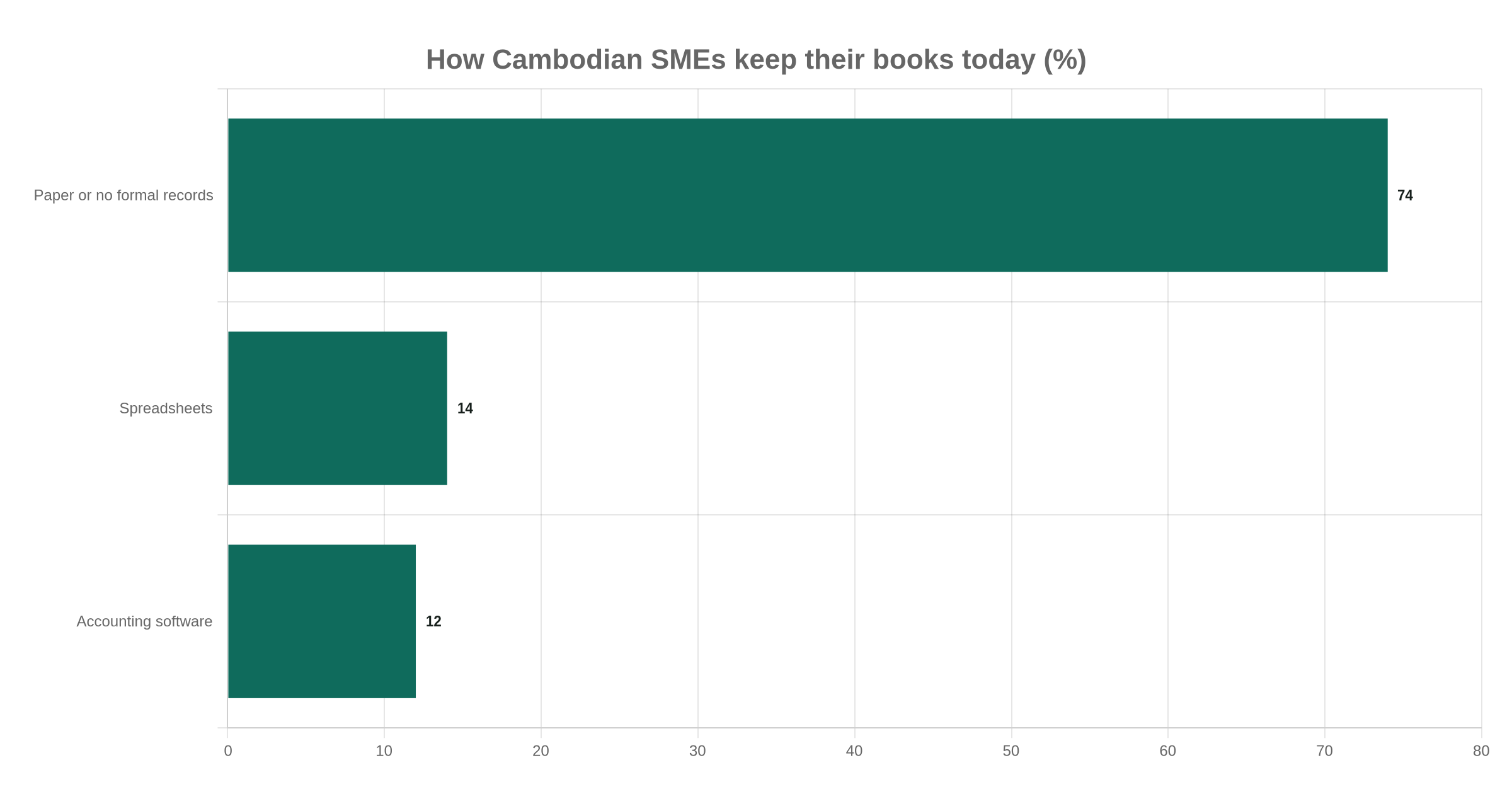
Only 12 percent of Cambodian SMEs run any accounting software at all, and 74 percent still keep their books entirely on paper or with no formal records (World Bank Cambodia Enterprise Survey, 2023). That gap matters more now than it did two years ago, because AI for accounting no longer requires the step most of those businesses skipped: buying and learning a full accounting package before anything gets automated. A finance team in Phnom Penh can now photograph a stack of receipts, or export a Bakong statement, and have an AI layer draft the reconciliation and the VAT categorisation before a human opens a spreadsheet.
That changes what AI for accounting should mean for a Cambodian business: not a full ERP replacement, but a layer that removes the slowest, most error-prone parts of reconciliation, invoice capture and month-end close, while a human controller still signs off on VAT and the final numbers. The sections below cover what AI actually automates today, what Cambodia's own tax system is doing in parallel, what it costs against hiring a second bookkeeper, and where it still breaks on a Cambodian ledger.
What does AI actually automate in a Cambodian accounting workflow?
AI automates four things well in an accounting workflow: reading documents, matching transactions, flagging anomalies and drafting reports, in that order of maturity. Optical character recognition pulls line items off a scanned invoice or a handwritten receipt, a categorisation model assigns each transaction to a chart-of-accounts line, a matching engine reconciles bank or payment-rail entries against the ledger, and a reporting layer drafts a balance sheet or a VAT summary from whatever is already matched.
None of that is new to global accounting software. What changed in the last two years is that these four functions moved from a single vendor's proprietary module into something an AI agent can run on top of whatever ledger a business already has, including a spreadsheet. That matters specifically in Cambodia, where 88 percent of SMEs are not using dedicated accounting software to begin with (World Bank, 2023): the AI layer does not require replacing the ledger first.
The order above is also the order of risk. Document reading and transaction matching are mechanical and easy to check: either the receipt total matches the ledger entry or it does not, and a human can confirm that in seconds. Anomaly flagging sits a step higher, since it asks the AI to decide what counts as unusual against a business's own transaction history, which takes a month or two of real data before it is reliable. Drafting a report or a VAT return touches a number the General Department of Taxation will hold the business to, which is why the next three sections treat reconciliation, VAT and month-end close as three different levels of trust, not one feature.
Reconciliation is the fastest win, and the easiest one to get wrong on a dual-currency ledger
Bank and payment-rail reconciliation is where AI for accounting pays for itself first, because it is the most repetitive task on a Cambodian finance desk and the easiest to verify once it is done. AI-assisted bank reconciliation cuts total reconciliation time by 70 percent, with error rates under 0.5 percent against 1 to 8 percent for manual work (AICPA 2025 and SolveXia 2026 benchmarks, aggregated by StealthAgents), and most Cambodian SMEs now have more than one feed to reconcile: a USD bank account, a KHR till, and a Bakong or ABA PayWay export that rarely lines up with either on the first pass.
The National Bank of Cambodia reports that Bakong processed 1.33 billion transactions in 2026, with total value exceeding four times the country's GDP (Cambodia Investment Review, 2026). An AI reconciliation layer that reads a Bakong CSV export, matches it against invoices, and flags the entries it cannot match with confidence turns what used to be a half-day manual exercise into a short review of the exceptions list, which is the part that still needs a human.
Picture a 20-person import and distribution business in Phnom Penh, paid partly in USD by corporate clients and partly in KHR through Bakong by retail buyers. Before automation, its bookkeeper spent roughly two days a month manually matching two currencies across three payment rails, re-typing each Bakong line into a spreadsheet already split by currency. With an AI matching layer built on n8n-based automation pulling from each feed directly, that work drops to a half day of reviewing the 10 to 15 percent of entries the system could not confidently match on its own, mostly partial payments and bundled transfers, which is where the human judgment still lives.
How does AI handle VAT filing for a Cambodian accounting team?
AI drafts a VAT return by categorising transactions against the standard 10 percent rate and pre-filling the GDT's electronic forms, but it does not file that return on its own, and it should not. Cambodia's standard VAT rate is 10 percent, administered by the General Department of Taxation (GDT), which has spent 2026 consolidating its digital filing tools into a single platform, GDT HomeTax, launched at the February 2026 Tax Forum (Khmer Times, 2026). Khmer Times also reported in 2026 that almost all tax in the country is now collected electronically, a sharp shift from the paper-filing norm of only a few years earlier.
Cambodia's centralised e-invoicing platform, CamInvoice, is rolling out in phases rather than all at once. Phase 1 (2024 to 2025) made it mandatory for business-to-government transactions with national ministries, while B2B stayed voluntary. Phase 2 (2025 to 2026, the current phase) expanded the mandatory side to 14-plus ministries, and a defined group of private-sector taxpayers is slated to enter the mandatory net during this same phase. General B2B e-invoicing remains voluntary today; full compliance across government entities and a broader range of businesses is not expected before Phase 3, 2027 onward (Kreston Cambodia, Q3 2026 tax briefing). A small or medium Cambodian business filing B2B invoices is still largely on the older, voluntary process right now, with the mandatory net arriving on a government-first timeline rather than a size-based one, which is exactly the kind of mid-transition inconsistency an AI drafting layer handles well and a rules-based template handles badly. Input VAT credits are the clearest example: an AI categorisation layer can flag which purchase invoices qualify for a credit against output VAT as it reads them, instead of a bookkeeper rediscovering the eligible ones during the final week before a filing deadline.
We would not let an AI agent file a VAT return unsupervised in Cambodia. A human controller should check every AI-drafted return against GDT HomeTax before submission, because a tax system still mid-rollout punishes a wrong filing faster than it rewards a fast one. The AI's job here is to turn a week of manual VAT categorisation into a morning of review, not to remove the review.
Month-end close shrinks from weeks to days, not to zero
The median finance team closes its books in 6.0 days, and top performers do it in five days or fewer, across more than 10,198 organisations benchmarked by APQC as of August 2026. A Cambodian SME running a mostly manual process is typically well past the median, often closer to two weeks once VAT categorisation, multi-currency reconciliation and a single overworked bookkeeper are all factored in.
AI-assisted bookkeeping does not erase that timeline, it compresses the mechanical half of it. Take a 15-person trading company closing its books for the first time with AI-assisted reconciliation: document capture and matching that used to take five working days now takes one, because the AI layer has already cleared the routine entries by the time the controller sits down. The remaining four to five days of the old close, reviewing exceptions, confirming VAT treatment and signing off the final statements, stay roughly the same length, because that work was never mechanical to begin with.
That is the honest version of "AI shortens month-end close": it removes the data-entry days, not the judgment days. A close that took 12 working days can realistically land at 6 to 7, which is close to APQC's median, not at zero. The value of that compression is not just speed: a controller who gets the exceptions list on day 2 instead of day 9 has five extra working days to chase a missing invoice or query a supplier before the books actually need to close, instead of discovering the gap too late to fix it cleanly.
Why do most Cambodian finance teams still close the books by hand?
Most Cambodian finance teams still close the books by hand because the digital habits that usually come before bookkeeping software, a bank account with an API, a single consistent payment rail, a formal chart of accounts, are themselves still new for most SMEs. The World Bank's 2023 Cambodia Enterprise Survey found 74 percent of SMEs keep paper or no formal records and only 12 percent use any accounting software, a gap this wide is rare even within Southeast Asia.
ADB's 2024 brief on digital adoption among Cambodian MSMEs found that record-keeping tools are typically the last digital step a small business takes, arriving well after a Facebook page or a KHQR payment code. A business can be fully digital on the sales side, taking payment by QR code and messaging customers on Telegram, while its books are still a notebook or a loose folder of receipts. That sequencing is the opposite of how AI-for-accounting vendors assume adoption happens: their playbooks assume a business already runs QuickBooks or Xero and wants to add an AI layer on top. Most Cambodian SMEs have no layer to add AI on top of yet.
That gap is also the opportunity the generic AI-accounting guides miss, because none of them write for a business that is going from paper directly to an AI-assisted process, skipping the traditional software step entirely. That is the realistic path for most Cambodian SMEs: not QuickBooks plus an AI plugin, but a phone camera, a Bakong export and an AI layer built around both. It also changes the sales pitch a Cambodian business should expect from a vendor: the first question worth asking is not which accounting package the tool plugs into, but whether it can start from nothing more than a folder of phone photos and a bank statement.
The real cost comparison: an outsourced bookkeeper vs an AI-assisted accounting process
A 5 to 10 employee Cambodian SME typically spends USD 300 to 1,000 a month on accounting and compliance work out of a total monthly operating cost of USD 7,200 to 16,100 (MoveToAsia, 2026). A larger 15 to 30 employee SME runs a total monthly opex of USD 20,000 to 40,000 on the same source, but MoveToAsia does not break out an accounting-and-compliance line for that tier, so the cost comparison below stays on the smaller tier where the figure is actually sourced. Hiring a second full-time bookkeeper to handle growing transaction volume adds a fixed monthly salary on top of that range, whether or not that month's workload actually needs a full extra person.
Without that case study to cite yet, the order we actually follow when scoping this kind of build is worth stating plainly, because it is not the order a generic AI-accounting pitch assumes. The process-mapping audit starts with the document mix, not the ledger: how many feeds, how many currencies, how much of the paper trail is informal and handwritten. A business with three payment rails and a pile of Khmer-script receipts gets a different automation order than one with a single USD bank account and typed invoices. The trade-off we make early, every time, is to automate the highest-volume, lowest-complexity feed first, usually the main USD bank account or a Bakong export, and leave the informal vendor invoices in a manual queue until the model has seen enough of that business's own documents to be trusted with them. The pitfall we check first, before any of that, is whether the business already has a consistent chart of accounts. Without one, an AI categorisation layer has nothing stable to categorise against, and the real first task on the project becomes building that structure, not deploying AI on top of it.
An AI-assisted process scales differently from hiring. We run these as a process-mapping audit first, free and taking one to two hours, followed by a costed plan within five days and a working build in one to four weeks, with monthly reports once it is live, the same timeline we cover in more detail in what an AI agent costs to build and run. We price this work in Cambodia at roughly 35 percent less than a comparable build from a European agency, our own position on cost, not a measured industry average. Industry-wide, small businesses using AI-assisted bookkeeping report a 40 to 50 percent reduction in bookkeeping costs compared to a fully manual process (Intuit and AICPA data aggregated by StealthAgents, 2026).
Run the numbers for the 5 to 10 employee SME above, spending USD 300 to 1,000 a month on accounting and compliance today. A 40 to 50 percent reduction brings that down to roughly USD 150 to 600 a month, which is a saving of roughly USD 120 to 500 a month depending on where in the original range a business sits and which end of the reduction applies to it. Spread a one to four week AI-agent build over its first year of use, and that saving covers most or all of the build cost for a business at the lower end of the spending range, with a larger net saving left over for one at the higher end. From year two on, with no further build cost to recover, that same USD 120 to 500 a month drops straight to the bottom line. Carried over three years, that saving totals roughly USD 4,300 to 18,000 depending on where the business sits in the original range, money that would otherwise go to a second bookkeeper's fixed salary regardless of how light that month's transaction volume actually was.
We would not pitch AI bookkeeping as a bookkeeper replacement to a Cambodian SME. The job that disappears is data entry and matching, not the judgment calls a controller makes at month end. The right comparison is not "AI versus a bookkeeper," it is "a bookkeeper doing data entry versus a bookkeeper reviewing an AI's exceptions list," and the second version is the one worth paying for.

Which tools should a Cambodia-based finance team actually trust?
A Cambodia-based finance team should trust tools that can ingest a USD and KHR ledger, connect to a local payment rail, and keep data under a jurisdiction the business actually controls, which rules out most generic AI-accounting browser plugins by default. QuickBooks and Xero remain the two foreign platforms most commonly used where Cambodian SMEs do run software at all, both with their own AI-assisted bookkeeping features layered in over the past two years. Odoo, which we use directly in client builds, covers the same ground with more flexibility for a business that needs its accounting module wired into inventory or a CRM, not running alone.
For the AI layer itself, the orchestration usually matters more than the model. We build these on n8n to connect a bank feed, a Bakong export and a chart of accounts without locking a client into one vendor's proprietary automations, with document extraction and categorisation running through OpenRouter against models from Claude, GPT or Mistral depending on the task. Two Cambodian-built platforms are worth a look before reaching for a foreign one. Localize, sold as LocalizeBook and based on Monivong Boulevard in Phnom Penh, calls itself a "proudly Khmer product" and lists Khmer first among the nine languages it supports, with financial reports that come out in Khmer alongside English and a daily exchange-rate feed pulled straight from the National Bank of Cambodia. Its own marketing makes no AI claim at all, which matches the gap the editor flagged: it is the right pick for the Khmer-first-interface use case, not for an AI-feature comparison. MAQSU ERP, with a decade in the Cambodian market and a stated 1,000 active users, markets itself as "Cambodia's first AI accounting software," though it does not publish specifics on what that AI layer actually does under the hood. Worth a live demo before a contract either way: a Phnom Penh address does not by itself guarantee the AI feature set matches an international platform's, and neither vendor backs its headline claim with public technical detail.
What we would not trust by default: a browser-based "AI bookkeeping" tool with no stated data residency, built for a US or EU small business and bolted onto a Cambodian ledger as an afterthought. Those tools rarely handle KHR correctly, rarely know what GDT HomeTax expects, and rarely say where the data actually lives. A simple test before signing up for any of them: ask what happens to a KHR transaction under one dollar, and whether support can name the Cambodian tax authority without being prompted. Most fail one of the two.
Where AI reconciliation breaks on a Cambodian ledger
AI reconciliation breaks most often on a Khmer-script receipt, because the optical character recognition behind most AI accounting tools is trained overwhelmingly on Latin-script documents and misreads Khmer numerals and vendor names at a far higher rate than it misreads English or French ones. A receipt from a small Phnom Penh supplier, handwritten in Khmer with no standard layout, is exactly the document type these tools handle worst, and exactly the document type a Cambodian business receives constantly from vendors too small to issue a formal invoice.
Three other failure points recur on a Cambodian ledger. Multiple payment rails, a USD bank account, a KHR till, Bakong, ABA PayWay and sometimes Wing, each export data in a different format, and an AI layer only reconciles the feeds it was actually configured to read. Informal vendor invoices, common among smaller suppliers operating outside the real regime, often carry no structured data at all, just a photo of a handwritten slip. Staff turnover, a known pressure point for Cambodian SMEs, means the institutional knowledge of which recurring transaction belongs to which exception category frequently leaves with the bookkeeper who knew it, which an AI model trained on that business's own history should, in principle, retain better than the next hire does.
None of these are reasons to skip AI-assisted accounting. They are reasons to configure it around a Cambodian business's actual document mix rather than around a template built for a business that only ever sees a typed USD invoice. In practice that means training or tuning the document model on a sample of the business's own receipts before trusting it on live data, and keeping a short manual queue for anything the model flags as low confidence rather than forcing every document through automatically.
What should a Cambodian finance team do before the next VAT deadline?
A Cambodian finance team should check its reconciliation process before it touches VAT automation, because reconciliation mistakes are reversible inside a day and VAT mistakes involve the General Department of Taxation. Start with reconciliation, not with VAT automation: it is the safer place to prove an AI layer works on this business's actual documents before trusting it anywhere near a tax filing.
The practical order is: automate document capture and bank or Bakong reconciliation first, measure how much of it the AI clears without human correction after a month, then move to VAT draft preparation only once that first stage is reliably accurate. A business that has not run an AI readiness assessment against its own records and process ownership should do that before scoping either stage, because the gap this article opened with, 74 percent of Cambodian SMEs on paper or no formal records, means the records themselves are often the real blocker, not the AI.
If reconciliation is already slow and VAT season keeps arriving faster than the books get caught up, that is the point to look at an AI agent build rather than hiring around the problem. Ask for a scoped estimate and we start with the same free process-mapping audit mentioned above, before any commitment is made.
Prefer to chat? Message our founder directly on Telegram (@maxgrolier), or book a call with the team.