
We leave Webflow for our own site in October 2026, and nothing about that decision says Webflow is a bad tool. It says the opposite, in fact: the site we moved off Webflow was a showcase site, the exact kind of project Webflow is built for, and we still think most businesses in that position should stay on it.
So this is not a "why Webflow is dying" article. It is the account of one specific move, techflow-agency.com going from Webflow to Next.js, Sanity and Vercel, written down with the numbers we actually have and the ones we do not. We still hold Webflow Certified Partner status and we still build client sites on it every quarter. If you are weighing whether to move off Webflow yourself, the honest answer is "it depends on what you're building," and this article is the long version of that answer.
Key points
- We moved our own site off Webflow in October 2026 for cost and flexibility reasons, with no dollar figure attached to either claim; we still recommend Webflow for editorial and showcase sites and still build on it for clients.
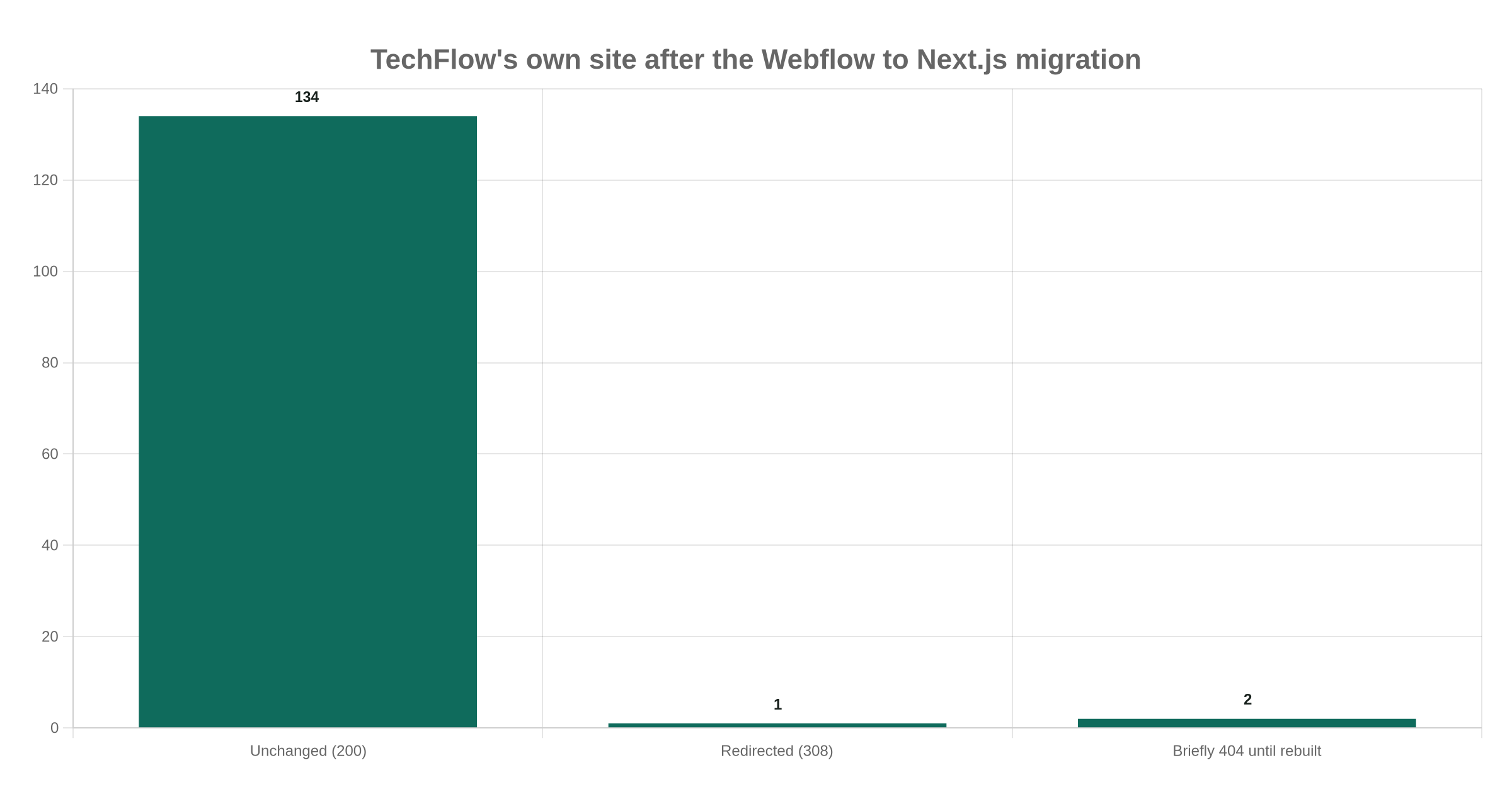
- Of the 137 URLs on our old Webflow sitemap, 134 answered 200 unchanged on the new site, one needed a redirect, and two returned 404 until we rebuilt the pages, which is the real measure of a migration that keeps its SEO.
- The riskiest part of a migration away from Webflow is not the code, it is the content and functionality that quietly disappear in the move: our own contact form only opened the visitor's email client instead of sending anything, caught during pre-launch testing on 2 October 2026 and fixed the same day production went live.
Why did we decide to leave Webflow for our own site?
The decision, recorded in our own project notes on 2 October 2026, was that Webflow had become too expensive and not flexible enough for what we wanted to do with techflow-agency.com, and that we wanted strong performance without necessarily hosting our own data on Webflow's infrastructure. That is the whole stated reason. No invoice amount, no plan tier, no percentage saving appears anywhere in our internal documentation, and we are not going to invent one here. "Too expensive" stayed a qualitative judgment, not a line item.
That matters because most "why we left X" articles manufacture a number to make the story land. We would rather tell you we do not have one. What we can tell you is the sequence: a short-lived attempt to rebuild the site in Astro over the summer, abandoned without it ever replacing the live Webflow site, then a rebuild in Next.js with Sanity as the CMS that did go live. We cover that path in the next section, because the "why" only makes sense next to the "what we tried first."
Here is the opinion we will defend for the rest of this article: leaving Webflow was the right call for our own site, and it would be the wrong advice for most of the SME clients we build for. We are not walking away from the platform. We are a Webflow Certified Partner today, and the case studies on our own web development work show why: law firms, training providers, NGOs and real estate brands that want to edit their own content without touching code are still better served by Webflow than by anything we could build custom for the same budget and timeline.
Should clients leave Webflow just because we did?
No. We still describe Webflow, in writing, as the right tool for editorial and showcase sites where the content team wants autonomy, and we still point clients toward custom development only once there are user accounts, complex payments or business logic specific enough that a page builder gets in the way. That line gets argued project by project, never assumed, and it has nothing to do with what we chose for our own domain.
The evidence sits in our own project list. Sixteen of our published case studies are built on Webflow, and in most of them the client's own team edits content through the CMS with no developer involved: Eureka Cambodia, a tutoring centre, edits and updates its own content without advanced technical skills; AMA Campus, a training provider, manages a catalogue of more than 60 courses through a structured CMS its own team runs alone; Place des Aînés has its public side, editorial content, facility profiles and blog, managed directly by the client team; Groupe Revive gives its communications team the autonomy to publish its own case stories and news. If leaving Webflow for our own site meant we had quietly soured on the platform, that list would be the first thing to change, and it has not.
What actually shifts the recommendation toward custom, in projects we have shipped, is a specific kind of complexity. Place des Aînés needed logged-in spaces for three different audiences and a matching engine behind the scenes, so the public, editorial half of the site stayed on Webflow while the backend ran on Odoo. Ooinvestir kept its static marketing pages in Webflow and moved its dynamic blog to Drupal for SEO reasons specific to that content type. Neither project "left Webflow." Both drew the line in a different place than our own site did, because the problem they were solving was different from ours.
Our own site had none of that complexity. It is a showcase site: pages about services, a case-study library, a blog, a contact form. The move was not forced by a missing capability. That is worth repeating plainly, because it is the single most common misreading of this kind of story: a company can migrate away from Webflow for reasons that have nothing to do with what Webflow can or cannot do.
The stack we moved to, and why that combination
We moved to Next.js for the front end, Sanity as the headless CMS, and Vercel for hosting, a combination picked as a genuine Webflow alternative for a custom website rather than a collection of separate experiments. Each piece answers a specific requirement we wrote down before building anything.
The front end runs on Next.js 16 with React 19 and TypeScript, styled with Tailwind CSS 4, with Motion and Lenis handling animation and Three.js used for a handful of 3D effects; video testimonials are served through Mux. The package manager is pnpm across the whole project, a small detail that matters once a team standardises tooling across several client builds, which is exactly what our internal "Website Factory" planning document (dated 21 October 2026) sets out to do: Next.js as the single standard stack for new software development work going forward, with the earlier Astro attempt dropped rather than extended. No technical failure is recorded against Astro; the document simply states a preference for one standard over two.
Sanity holds the content: projects, tools, articles, team members, client reviews, FAQs, sectors, article categories, redirects and per-page SEO fields are all Sanity documents, in project ce31dig5, dataset production. French is the base language, and English exists as a separate, linked document through Sanity's internationalisation plugin rather than as a translation layer bolted on top. The Studio itself, the authoring interface content editors use, is not embedded in the Next.js app; it is built as a standalone static site served by nginx in a Docker container on our own VPS, behind Traefik with Let's Encrypt certificates, at a dedicated subdomain. A GitHub Action rebuilds it on every push to the main branch that touches the Studio folder, deployed through a restricted account that can only write into that one folder. The Content Lake itself, the actual document store, stays in Sanity's cloud; it cannot be self-hosted, a constraint worth knowing before you promise a client "full data ownership" on a Sanity build.
Hosting runs on Vercel, under a team project, with the main branch serving production at the live domain and a separate staging branch serving a public but noindexed preview. That split was chosen deliberately on 2 October 2026 and it shapes how every later change gets tested, which we cover in the section on staged rollout below.
Choosing a stack is also choosing a list of small operational traps you now own yourself, and Webflow quietly absorbs most of them for you. On our own build, the developer's Sanity account needed a specific CORS permission before the Studio origin would even load, and the founder had to grant it by hand. Client components that accidentally import the server-side Sanity client add roughly 37 KB (gzip) to every page that ships them, a cost that only shows up if someone checks the build output. The Studio itself served a blank page at first, until the nginx configuration was told to serve .mjs files as JavaScript and a Traefik router was renamed to force certificate issuance. Vercel's own rate-limit and bot-challenge system, built to protect production traffic, can disrupt scripted tests run against the live site if nobody accounts for it. None of this is a reason to avoid the stack. It is a reason to budget for the kind of infrastructure literacy that a page builder makes optional and a custom stack makes mandatory.
The contact form, analytics and search visibility also depend on pieces Webflow would have handled natively. Our site generates an /llms.txt and /llms-full.txt file straight from Sanity, refreshed hourly, so that AI assistants crawling the site get a current, structured summary rather than a stale export. The whole deployment is enrolled in our own health-check registry, the same monitoring we would wire up for a client's platform. None of that is exotic engineering, but all of it is now our responsibility rather than a vendor's.
One opinion, stated plainly: a Webflow limitation is a reason to extend the architecture, not necessarily to replace the whole platform. We will come back to that with a concrete example from a client project, because it cuts against the idea that this article is building toward "leave Webflow" as a universal recommendation.
How do you keep your SEO equity when you move away from Webflow?
You keep it by treating the URL as the one thing that must not move, and by measuring every single address before you flip the switch, not after. We kept Webflow's exact URL scheme on the new site, French at the root and English under /en/, specifically so that only genuinely renamed pages would need a redirect.
The numbers from our own migration, checked against the old Webflow sitemap on 2 October 2026: of 137 URLs, 134 stayed identical and answered 200 directly on the new site, one needed a 308 redirect (the old search page, pointed at our insights hub), and two, the French and English privacy policy pages, returned 404 until we built replacement pages for them. A separate, wider audit comparing roughly 250 rows of old Webflow pages, CMS items and legacy redirects against the new site found 136 URLs unchanged, 70 redirected, and 2 Webflow utility pages (the password and 404 templates) deliberately left to 404 because nothing should link to them anyway. Fifty-one legacy Webflow redirects, carried over from earlier site changes, were loaded into Sanity as redirect documents on 3 October 2026.
Redirects are not a one-time export in this setup. Sanity redirect documents are read by the Next.js configuration at build time, and the build is deliberately made to fail if that fetch fails, so the site can never ship without its redirects attached. Permanent redirects return HTTP 308, which search engines treat the same way as a 301. Every page also outputs its own title, description, a self-referencing canonical tag, hreflang for French, English and the default, Open Graph and Twitter tags, and the sitemap itself lists both languages with hreflang alternates while leaving out noindexed and redirected pages. Before the switch, we verified all of it by script: a 139-URL sitemap all returning 200, canonicals matching the sitemap exactly, hreflang reciprocal in both directions, no stray noindex on a page meant to be indexed, and no redirect chains. That checklist, not a gut feeling about "the new site looking fine," is what we would call the actual migration test.
Search Console verification carried over without a fresh setup step, because the verification meta tag on the new site matched the one Webflow had used, so a property verified that way simply kept working. Our own SEO notes also recommended adding a DNS-verified domain property, submitting the new sitemap, requesting indexing on the main pages and watching the "Not found (404)" and "Page with redirect" reports for a few weeks afterward. Whether every one of those follow-up steps was actually carried out is not something we tracked closely enough to state here, and we would rather say that plainly than imply a tidier story than the one we have. What we can say is that the pre-launch checklist, run before the DNS ever changed, is the part that actually protects rankings; the post-launch watch is a safety net, not a substitute for it.
What breaks quietly when you migrate away from Webflow, and how do you catch it?
What breaks quietly is almost never the thing you were worried about. Our own content comparison, run on 2 October 2026 by placing the old and new sites side by side, found that the contact form on the new build only opened the visitor's email client instead of actually sending or storing anything, Google Analytics was missing entirely, a five-step "what happens next" section had been dropped from the service pages, and several statistics that used to appear on those same pages were simply gone. None of that showed up by eyeballing the new design; it only showed up by comparing page against page, field against field.
We fixed the form by wiring it through Resend's API on 3 October 2026, the day of go-live, adding a required consent checkbox, a hidden honeypot field, a minimum-time trap that silently drops any submission completed in under four seconds or without JavaScript, a gibberish filter, and a Vercel firewall rule capping each IP address to five submissions every ten minutes. Analytics went back in behind a cookie-consent banner on production builds only. The privacy policy pages, which existed on the old Webflow site but not yet on the new one, got built the same day so the two indexed URLs would stop returning 404.
Three English articles and the English version of one client case study were simply missing from Sanity at first, imported on 2 October 2026 once we noticed, alongside twenty-two English drafts that had been sitting unpublished on Webflow and were carried over as Sanity drafts rather than dropped. A separate, sharper lesson: publishing an old draft in the Studio replaces the entire published document, which on 2 October 2026 meant three client projects briefly lost their sector tags and accent colour because drafts made the day before got published over newer data. We restored them by script, and we now know to check what a draft actually contains before publishing it, not just what changed since the last edit.
One smaller trap worth naming because it is the kind of thing that only shows up under load: pages cache their Sanity data for sixty seconds, including a "not found" result, so a page requested seconds before its document exists in the CMS keeps returning 404 for up to a minute after the document is created. If you are scripting a go-live sequence, build that minute of lag into your verification step, or you will chase a phantom bug.
Bilingual handling needed its own pass, even though our own site only runs French and English. French sits at the root, English under /en/, and the two are separate Sanity documents linked together rather than one document with a language switch bolted on; slugs are translated, and the language toggle follows the translated slug rather than appending a locale code. A page requested in a language that does not exist yet falls back, temporarily, to whichever language does exist, and hreflang tags are only emitted for the languages that are actually present for a given page, never for a placeholder. One honest limit worth stating here: Khmer is not a language of our own site, so we have no first-hand Khmer migration to report. The Khmer experience we can point to comes from a client project instead, LeapMotor's bilingual English and Khmer site, where every screen was designed in both languages from the first Figma mockup to anticipate Khmer typography constraints such as line height and spacing, built natively in Webflow rather than migrated into anything. A team moving a bilingual Khmer site off Webflow would be solving a different, harder problem than the one documented here, and we would say so rather than imply our experience covers it.
The old English content had come through Weglot, Webflow's translation layer, on the previous site, and that left a stray prefix in some English meta descriptions that a script had to clean up during the import. It is a small thing, but it is exactly the kind of small thing a visual comparison of the two sites would miss, because the meta description never renders on the page a human reviewer is looking at.
We staged the switch instead of doing it over one weekend
We moved in stages, over roughly a week of visible build steps, and we kept the old platform alive as a fallback afterward rather than switching everything in one weekend. The Sanity integration landed on 29 September 2026, with project listings, tools, articles, team data and reviews reading from Sanity for the first time. Content got aligned with the live site on 1 October, with sectors and article categories turned into proper Sanity lists and FAQs moved across. On 2 October we decided hosting, built the SEO layer described above, produced the redirect map, and saved a backup of the DNS zone before touching anything live. Go-live was 3 October 2026: the production domain started serving from Vercel, the apex domain redirecting to the www version, the CMS and staging subdomains went live, the contact form got tested end to end, five English articles were published, and we ran a full-site performance audit the same day.
We kept the Webflow site reachable as a fallback for about two weeks afterward, with cancellation of the Webflow subscription planned for around 17 October 2026. Whether that cancellation actually happened on schedule, and what became of the old Webflow staging project, is not something we tracked carefully enough to state here, so we are saying plainly that we do not know rather than guessing. What we did formalise, on 19 October 2026, is a staging-first rule that now governs every change to the site: everything goes to the staging branch first, and only the founder's explicit approval pushes it to production, with Sanity's staging and production environments reading the same underlying dataset so that edits sit as drafts until someone chooses to publish them. A security audit on 2 and 3 November 2026 produced its own fix list, a framework update and stronger security headers among them, handled the same staged way.
The local Lighthouse scores recorded on 3 October 2026, the day of go-live, showed Accessibility, Best Practices and SEO at 100 on every page and form factor we audited, desktop performance between 98 and 100, and mobile performance between 85 and 95, itself up from a range of 81 to 93 measured earlier that same day. We never measured the old Webflow site with the same tool and settings, so there is no honest before-and-after comparison to offer here, only the fact that the new numbers were strong on day one.
Here is our third opinion, and it is the one we would push back on hardest if a client tried to compress their own timeline: a migration is not finished at go-live. The fallback period, the two weeks where the old platform keeps running in case something was missed, matters more than the cutover itself. Everything we fixed in the content-diff section above was caught precisely because we had not yet switched off the old site and could compare the two side by side.
When should a business not follow us off Webflow?
A business should stay on Webflow when the problem it needs to solve is still about editorial content, not about accounts, payments or business logic that a page builder cannot express cleanly. That line, drawn project by project rather than assumed, is the one argument this whole article rests on.
AMA Campus is the clearest counter-example to "leave Webflow when it gets hard." The client, an online training provider with a catalogue of more than 60 courses, ran into Webflow's native limit on multi-reference fields per collection: the richness of the catalogue outgrew what a single collection could natively model. Rather than moving the project off Webflow, we rebuilt the CMS data architecture around that limit and paired it with Finsweet's CMS Filter component, letting learners browse the catalogue by profile, theme or funding scheme. The project stayed on Webflow, and the results after launch were a 7% conversion rate on course pages (54 additional enrolments every month), traffic up 38% over the first six months, and a load time of 1.1 seconds against 3.6 seconds on the old WordPress site. If a Webflow ceiling always meant "time to migrate," this case would have gone the other way.
Place des Aînés shows the other honest answer: sometimes the right move is neither "stay" nor "leave," but "split." The public side of that platform, editorial content, facility profiles, a blog the client team edits without technical help, runs on Webflow. The business logic behind it, a CRM, a back-office and a matching engine connecting families with senior-care facilities across several hundred listings, runs on Odoo, synchronised with Webflow through bespoke integrations. Since launch, that platform has generated an average of 150 new family requests a month, with the average time to an introduction brought down to 48 hours. Nobody on that project needed to migrate away from Webflow; they needed to extend what sat behind it.
So here is the decision we would actually walk a client through, in three moves, and it is the same one we applied to our own site before anyone else's:
- List what the site has to do that a content team cannot do themselves through a page builder. If the honest answer is "nothing, really," Webflow is very likely still the right tool, and a migration would cost you flexibility you are not using today in exchange for complexity you do not need yet.
- Check whether the limitation is structural or just a current ceiling. AMA Campus hit a real Webflow limit and solved it without leaving. Before you treat any constraint as a reason to migrate away from Webflow, ask whether a bespoke CMS architecture, a Finsweet component or an integration like Odoo's would remove it just as well.
- If accounts, payments or logic genuinely outgrow the platform, decide whether the whole site needs to move or only the part that outgrew it. Our own site moved entirely, because the whole thing was a showcase site with no such requirement standing in the way. Place des Aînés moved only the back-office. Both were deliberate, scoped decisions, not a reflex.
If you are at that third step and the honest conclusion is a full custom web development project, that is the conversation worth having before a single line of code gets written, not after.
Prefer to chat? Message our founder directly on Telegram (@maxgrolier), or book a call with the team.
Frequently asked questions
Is Webflow bad for SEO?
No. Our own migration numbers make the opposite case: 134 of 137 old URLs answered 200 unchanged on the new stack, which means Webflow had already built pages that behaved correctly for search engines. The SEO risk sits in the migration itself, in redirects, canonicals and hreflang done carelessly, not in the platform you are migrating away from.
Does TechFlow still build Webflow sites for clients?
Yes. We are a Webflow Certified Partner, and sixteen of our published case studies are built on it, with client teams editing their own content through the CMS. Leaving Webflow for our own site changed nothing about that offer.
How long does a move away from Webflow actually take?
Our own visible build steps ran from 29 September to 3 October 2026, about a week from the first CMS integration to go-live, with a staging-first rule added afterward for every change since. We did not track total person-days spent, so we are not going to quote one; a realistic estimate depends on how much content and how many integrations the site carries.
What does it cost to run a custom stack instead of Webflow?
We cannot give you a number here. No cost figure for Webflow, Vercel, Sanity or the VPS appears anywhere in our own documentation, so no saving or break-even claim would be honest either. What we can tell you is that commercial use of Vercel requires a paid plan, and Sanity's content store cannot be self-hosted even if you wanted to cut that cost later. If you want a figure that applies to your own project, ask for a scoped estimate rather than trusting a generic range.
Can a small team run Sanity and Next.js without a dedicated engineer?
It takes more ongoing attention than a Webflow site edited through its built-in CMS. Our own Studio runs as a self-hosted container behind a reverse proxy, with a dedicated deployment pipeline, which is a reasonable setup for a team with engineering capacity and a real trade-off for one without it.
What happens to your old Webflow URLs after you move away?
We kept our old Webflow site reachable as a fallback for about two weeks after go-live, with cancellation of the subscription planned for roughly two weeks later. Whether that cancellation happened exactly on schedule is not something we tracked closely enough to confirm here. A fallback window, not an immediate shutdown, is the part of the plan we would defend to any client doing the same move.
Does a bilingual or Khmer-language site change this advice?
Yes, enough that we would not extend our own experience to cover it without saying so. Our own migration was French and English only; we have no first-hand Khmer migration to draw on. A bilingual English and Khmer build, like our client project LeapMotor, carries typography and layout constraints from the first mockup onward that a Webflow-to-custom-stack migration would need to test separately.
Keep reading
- No-code development: the wider no-code picture, for teams comparing Webflow against Bubble, Shopify or Xano rather than against a fully custom build.
- Webflow agencies in Southeast Asia: where we still stand as a Webflow partner, and what that work looks like day to day.
- Web hosting in Cambodia: the hosting side of this same decision, for teams weighing Vercel, a VPS or something in between.
Need a second opinion on your own stack? We scope custom web development projects, Webflow included, the same way we scoped our own move: by listing what the site actually has to do before picking a platform for it.