
Picture a ten-person accounting firm in Phnom Penh feeding the same messy, forty-page loan file to two assistants at once. One answer comes back from Claude, one from ChatGPT, and the partner reading both can tell within a minute which one actually held the numbers together to the last page. That difference, not a marketing slide, is what decides which model a business should trust with which job.
That is the real question behind every "Claude vs ChatGPT" search a Cambodian business runs in 2026, and it does not have one answer. TechFlow Agency builds on both models for different clients, and the honest answer we give is never a single name. It is a short, task-by-task list of which model wins which job, backed by what the enterprise spending data, the published benchmarks and our own projects actually show, not by which logo is more familiar.
Key points
- Claude currently leads ChatGPT on enterprise coding and long-document work and is now outselling it inside a growing share of tracked business spending, while ChatGPT still leads on integration breadth and on day-one familiarity for most new hires (Menlo Ventures, December 2025; Ramp AI Index, May 2026).
- Team-level pricing is close for both (around 20 to 25 dollars a seat). Enterprise pricing is not: Claude publishes a seat price plus usage, OpenAI does not publish an Enterprise price list at all.
- We do not standardise on one model. We route client work through whichever one tests best for that specific task, through a single orchestration layer, so the choice stays reversible.
There Is No Single Best LLM for Business, Only a Best Fit Per Task
"Best LLM for business" is the question most buyers type into Google, and it is the wrong question. The right one is narrower: best at what, for whom, handling what kind of input. We judge Claude against ChatGPT on five things that actually move a business outcome, not on which one writes a snappier poem.
- Reasoning depth and long context. Can it hold a forty-page contract, a quarter's worth of support tickets or a full codebase in view without losing the thread.
- Coding and automation. Does it ship working code or a working n8n workflow on the first or second try, not the tenth.
- Integration breadth. How many of the tools a business already runs (CRM, helpdesk, spreadsheets, Slack or Telegram) does it plug into without custom glue code.
- Security and compliance posture. What certifications and contractual guarantees come with the plan a regulated business actually needs to sign.
- Cost structure. Seat price, usage price, and whether the vendor will even quote a number before a sales call.
None of these five swings cleanly to one model across every task, which is exactly why "best LLM for business" is a trap question. A business that buys a seat licence for one assistant and tries to force every job through it is optimising for the vendor's roadmap, not its own.
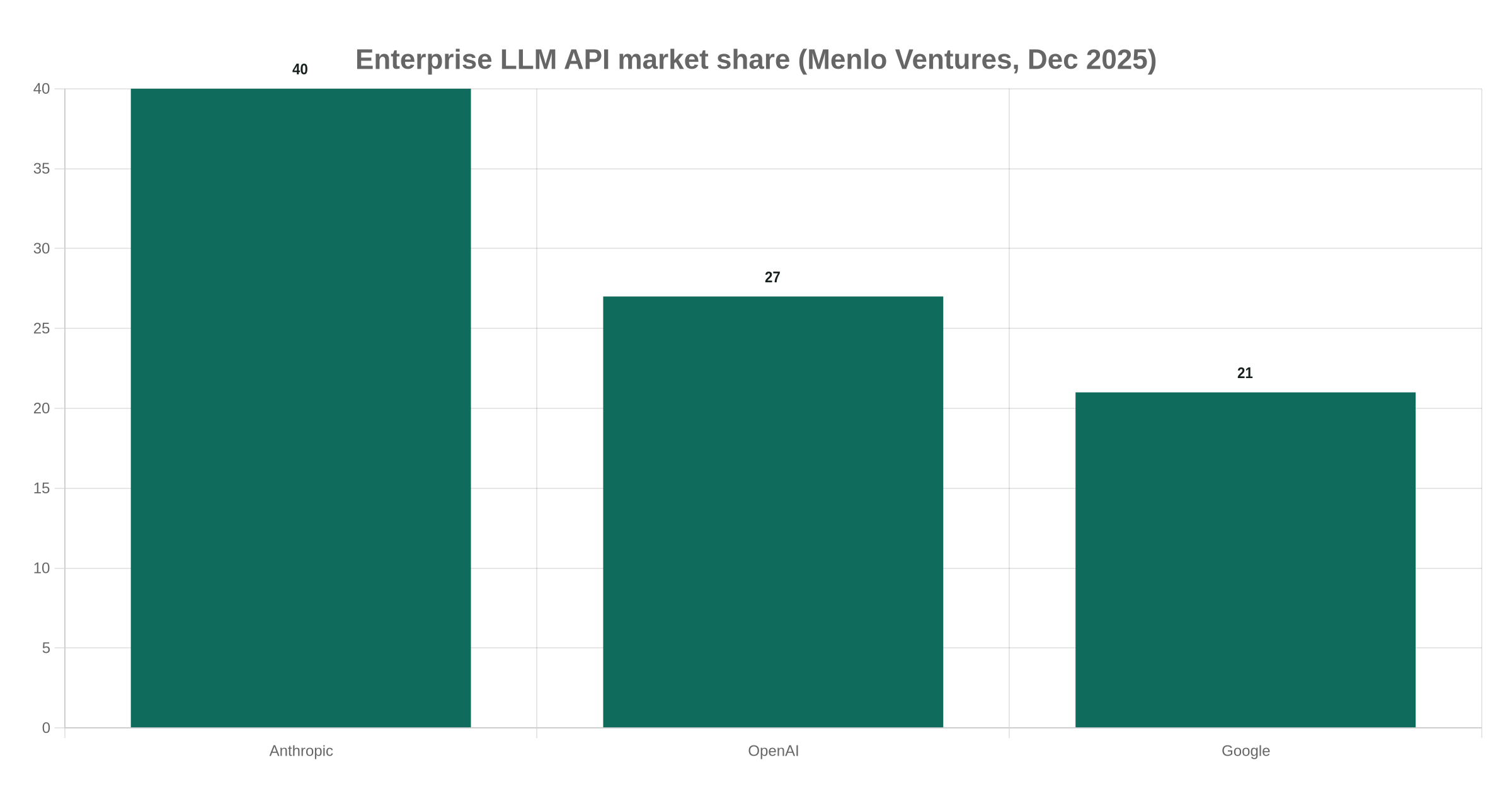
Google's Gemini sits in the same market, holding 21 percent of enterprise LLM API share against Anthropic's 40 and OpenAI's 27 (Menlo Ventures, December 2025), and a fair comparison has to acknowledge it exists even when it is not the headline act. Those three vendors alone already account for 88 percent of all enterprise LLM usage, so a buyer who shortlists only Claude and ChatGPT is, in practice, choosing between two of the three names that matter, not gambling on a long tail of untested alternatives. We leave Gemini out of the task-by-task calls below because most of the Cambodian SMEs asking this question have already narrowed their shortlist to Claude and ChatGPT by the time they call us, not because Gemini is weaker on every task. A buyer doing a from-scratch shortlist should still put it on the list.
Take a concrete case: a 12-person law firm handling immigration and business-registration filings. Its highest-value task is reading a 60-page due-diligence file and flagging the three clauses that matter, its lowest-value task is drafting routine client update emails. Judged on our five criteria, the due-diligence read rewards long context and low hallucination rates (Claude's strength), while the routine email drafting rewards speed and a tool everyone on staff already knows how to prompt (ChatGPT's strength). The same firm, the same month, two different right answers.
Go back to the accounting firm from the opening scene. Its forty-page loan file is a long-context, low-tolerance-for-error task, exactly like the law firm's due-diligence read, which is why Claude held the numbers together where ChatGPT's answer thinned out near the end. But the same firm also sends routine client reminder emails every week, a task that rewards speed and staff familiarity over context depth, the opposite end of our five criteria. A business does not have one task profile. It has as many as it has recurring jobs, and the "which LLM" question has to be asked separately for each one.
The money backs up which task is worth fighting over in the first place. Menlo Ventures' same December 2025 survey breaks enterprise AI spend down by function: coding alone draws 4.0 billion dollars, 55 percent of all departmental AI spend and what the report calls generative AI's first "killer use case," while the legal function, home to exactly the kind of due-diligence read in the example above, draws a comparatively modest 650 million dollars across its whole vertical (Menlo Ventures, December 2025). That gap is not a verdict on which task matters more to a twelve-person law firm. It says where the vendor fight is loudest: coding is both the biggest and the most contested line item, which is why the next two sections lean on coding data first, and why a firm buying mainly for document review should expect a quieter, narrower vendor market than a firm buying for its developers, not a weaker tool.
Where Does Claude Actually Pull Ahead of ChatGPT?
Claude pulls ahead of ChatGPT on three things business buyers actually pay for: long, messy documents, coding work, and the compliance paperwork a regulated team needs signed before it will touch a model at all. Anthropic's Claude Opus 4.5 scored 80.9 percent on SWE-bench Verified, the first model to clear 80 percent on that coding benchmark, and a separately published 2026 benchmark comparison put GPT-5.1 at roughly 76 percent on the same test (Anthropic, November 2025; Vellum, 2026). That gap is not enormous, but in a benchmark built from real GitHub issues, a few points is the difference between a pull request that merges clean and one an engineer still has to fix by hand.
The same pattern shows up at the market level. Menlo Ventures' December 2025 enterprise AI report put Anthropic at 54 percent of the enterprise coding market against OpenAI's 21 percent, inside an overall enterprise LLM API market where Anthropic holds 40 percent against OpenAI's 27 (Menlo Ventures, December 2025). Long documents are the other side of the same coin: Claude's standard context window has sat at 200,000 tokens since Opus 4.5, and Anthropic made a 1 million-token option generally available to Team and Enterprise customers on Claude Opus 4.6 and Sonnet 4.6 in March 2026, enough to hold a contract bundle or a whole support archive in one pass without chunking it first.
That 54 percent figure is also moving, not fixed. Menlo Ventures' own trend data puts Anthropic's enterprise coding share at 42 percent only six months before the December 2025 reading, a 12-point jump in half a year. The same report found that half of all developers already use an AI coding tool every working day, rising to 65 percent inside the organisations it rates as the most mature AI adopters (Menlo Ventures, December 2025). A model gaining coding share that fast, among developers who already touch an AI tool daily, says more about where buyers are testing hardest and switching fastest than any single benchmark score does.
That is also where our own tooling sits, not just our client recommendations. TechFlow's engineering team runs Claude Code for the harness agents that power this very blog's publishing pipeline, alongside OpenRouter and n8n for everything that needs to stay model-agnostic. We did not pick Claude Code because the brand is trendier. We picked it because it is, today, the better tool for the specific job of writing and reviewing our own automation code, and we would swap it the day a benchmark and our own testing said otherwise.
On paper, that is the gap between a chatbot that answers one message well and what an AI agent does: keep enough of a document, a process or a conversation in view to act on it, not just reply to it. A 60-page due-diligence file runs to roughly 35,000 to 45,000 words once scanned and cleaned up, which lands comfortably inside Claude's 200,000-token standard window with room left for the model's own reasoning, and nowhere near the 1 million-token ceiling Anthropic opened on Opus 4.6 and Sonnet 4.6 in March 2026. The practical effect is fewer chunking tricks, fewer "summarise this summary of a summary" workarounds, and fewer places for a clause to quietly fall out of context.
Run the cost of a missed clause instead of the cost of the subscription. A due-diligence file that needs a second human pass because the first summary dropped something on page 34 costs a partner's billable hour, and at a conservative 150 dollars an hour, one extra hour of re-review wipes out an entire month of either vendor's Team seat price in under a day's work. The benchmark gap between the two models is a few points. The gap between catching that clause once and catching it twice is the entire reason to pay for either tool at all.
Claude's certification scope backs the same strength for regulated work. Its Enterprise plan and API both carry SOC 2 Type II, ISO 27001, ISO/IEC 42001 and a HIPAA Business Associate Agreement, a wider scope than its own Team plan, which skips HIPAA (Anthropic Trust Center, checked November 2026). For a law firm, an audit practice or a healthcare-adjacent business, that is not a nice-to-have. It is the line item that decides whether the model is allowed to touch the document at all.
Where Does ChatGPT Actually Pull Ahead of Claude?
ChatGPT pulls ahead of Claude on breadth, not depth: more ready-made connectors, a feature set most teams have already used somewhere, and an admin layer built for organisations running many workspaces at once. OpenAI's 2026 Global Admin Console lets a company manage multiple ChatGPT and API workspaces from one tenant-level control panel, with domain verification and SSO spanning every account under it, a problem most single-product Claude deployments do not yet need to solve at that scale (OpenAI, 2026).
A Phnom Penh holding company running four separate subsidiaries, a hospitality group, a logistics arm, a retail chain and a small fintech, is the kind of buyer that console was actually built for. Four subsidiaries mean four domains and four sets of logins, and without a tenant-level panel, four separate contracts with no shared view of spend or security settings. Folding all four under one roof with one SSO policy is a real administrative saving before anyone even asks which model answers a prompt better.
ChatGPT Enterprise is also SOC 2 Type 2 certified, with encryption in transit and at rest and a guarantee that customer conversations are not used to train OpenAI's models, so on paper security parity with Claude is closer than the marketing from either side suggests (OpenAI, 2026). What ChatGPT wins outright is familiarity. It reached mainstream recognition first, most job candidates have already used it somewhere, and that lowers the training cost of a company-wide rollout in a way no benchmark score captures. For a business whose main AI need is broad, low-stakes drafting across many small tasks rather than one deep, document-heavy workflow, that familiarity is a real advantage, not a consolation prize.
Think of a 15-person retail brand rolling out AI for the first time: product descriptions, social captions, reply drafts for customer messages, the odd internal memo. None of those tasks need a 200,000-token window or a top coding score. What they need is a tool the marketing intern and the warehouse manager can both pick up without training, that already talks to the Shopify or WooCommerce stack through an existing connector, and that the team will actually open every day instead of avoiding because it feels unfamiliar. For that company, ChatGPT's breadth and familiarity beat Claude's depth, even though the same law firm from the earlier example would make the opposite call.
That buy-first instinct is also now the default across the whole enterprise AI market, not just at a 15-person retail brand's scale: 76 percent of enterprise AI solutions in use today were purchased off the shelf rather than built in-house, up from 53 percent a year earlier (Menlo Ventures, December 2025). Marketing and customer-success teams are the next two line items after coding in that same spending breakdown, 660 million and 630 million dollars respectively in 2025, both still a fraction of coding's 4 billion but growing fast from a near-zero base in 2024. Both are exactly the broad, many-small-tasks workflows where ChatGPT's familiarity compounds: a marketing team's social captions and a support team's reply drafts do not each need a procurement review, they need a tool nobody has to be retrained on.
Side by Side: What Each Plan Costs and What It Actually Includes
| Plan | Price per seat, per month | Seat range | What stands out |
|---|---|---|---|
| Claude Team, Standard | $20 billed annually ($25 monthly) | 2 to 150 seats | Full feature set, admin controls, pooled API credits |
| Claude Team, Premium | $100 billed annually ($125 monthly) | 2 to 150 seats | Same plan, 5x the usage, for heavy individual users |
| Claude Enterprise | $20 per seat billed annually, plus usage at API rates | 20-seat minimum | SOC 2, ISO 27001, ISO 42001, HIPAA BAA in scope |
| ChatGPT Business (formerly Team) | reported near $20 to $25 by vendor-comparison trackers | reported 2-seat minimum | Closest ChatGPT equivalent to Claude Team |
| ChatGPT Enterprise | quote-only; trackers commonly report a figure near $60 | reported 150-seat minimum | Global Admin Console across every workspace |
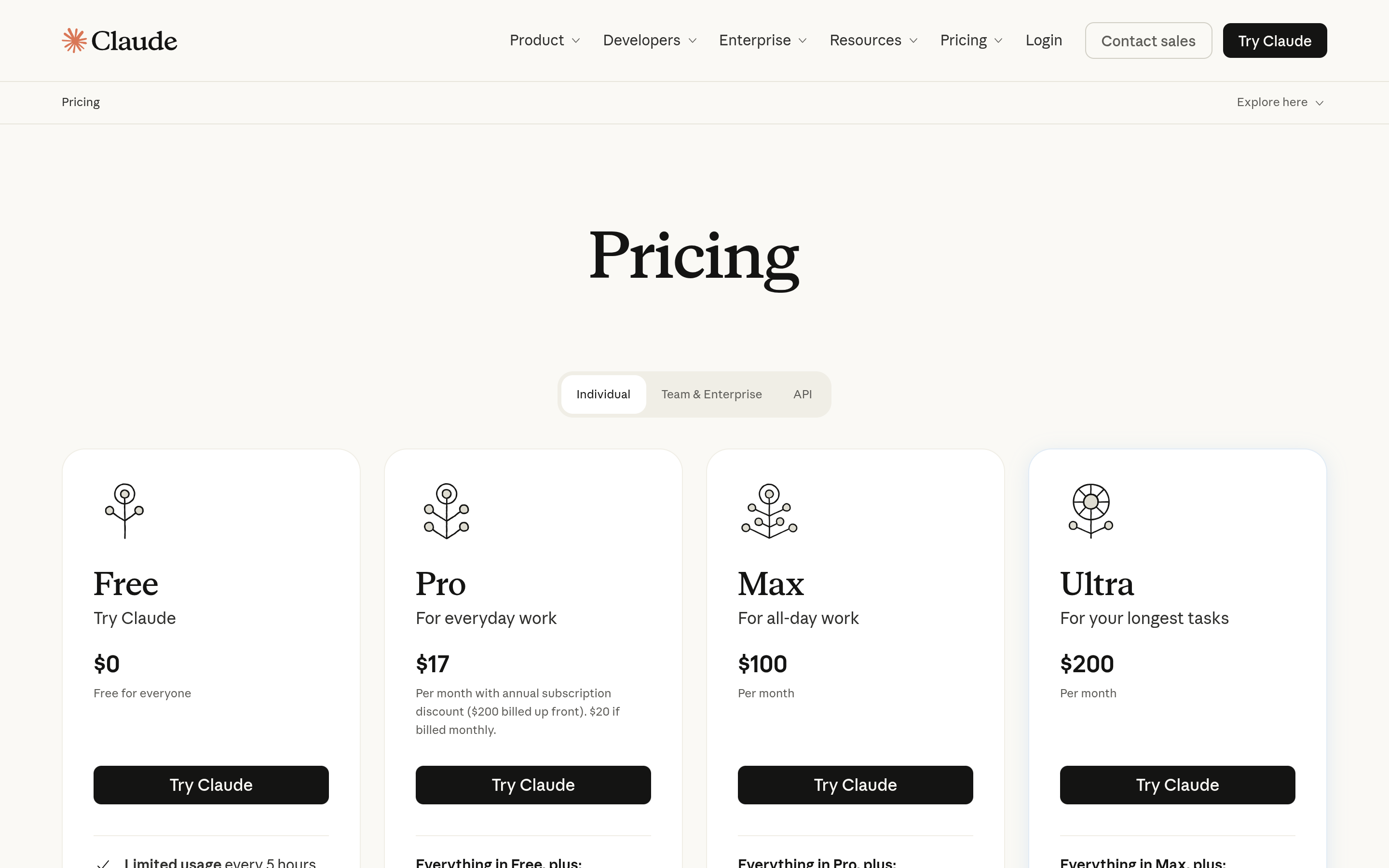
The Claude rows above come straight from claude.com's own pricing page, checked directly in November 2026. The ChatGPT rows do not carry the same confidence: OpenAI has never published an Enterprise price list, and its own Business pricing page returned an error on direct fetch during our research for this article, so those two figures are what 2026 vendor-comparison trackers report, not a number OpenAI itself confirms. For a business comparing real quotes, that gap in transparency is itself a data point worth weighing before anyone talks about model quality at all.
Run the three-year math for a 10-seat team and the seat price stops being the whole story. Ten Claude Team Standard seats at 20 dollars a month come to 2,400 dollars a year, 7,200 dollars over three years, before a single dollar of API usage for anything beyond the plan's pooled credits. Ten ChatGPT Business seats at a reported 20 to 25 dollars land in roughly the same 2,400 to 3,000 dollar yearly band. At that scale the two plans are close enough that the task-fit questions above, not the invoice, should decide the pick. The gap only opens wide once a business crosses into Enterprise territory, where Claude's 20-seat minimum against ChatGPT's reported 150-seat minimum means a 25-person company can get an Enterprise-grade Claude contract that OpenAI's own minimum would not even let it buy.
A 30-person company sits right on that fork. It clears Claude's 20-seat Enterprise minimum with room to spare, which unlocks an audit log, SCIM provisioning and a HIPAA option it can switch on later even if it does not need it on day one. The same company is 120 seats short of ChatGPT's reported 150-seat Enterprise minimum, so its only real options are the lighter admin controls on ChatGPT Business or a direct sales conversation with no published price to anchor the negotiation. That is not a reason to pick Claude on principle. It is a reason a 30-person buyer should ask both vendors the Enterprise question before assuming the Business-tier feature set is enough to run the company on.
Usage-based pricing cuts both ways once a team moves past typical use. Claude's Enterprise plan bills seats at 20 dollars a month but meters everything beyond the plan's pooled allowance at API rates, so a team with a handful of power users running long documents through the model daily will see its bill move with actual consumption, not just headcount. ChatGPT Business and Enterprise fold usage into a flat seat price instead, simpler to budget for, but a lighter-using majority effectively subsidises the heaviest users under the same flat fee. Neither approach is wrong. A finance team that already tracks usage per employee should prefer Claude's meter; a finance team that wants one number to budget regardless of who uses what should prefer ChatGPT's flat fee.
The compliance columns in the table above are not abstract line items either. Healthcare is the fastest-growing vertical in Menlo Ventures' spending breakdown: 1.5 billion dollars in 2025, more than triple the 450 million dollars spent in 2024, with ambient-scribe tools (AI that drafts the clinical note during the consultation) more than doubling year over year inside that figure. None of TechFlow's own Cambodian clients are hospitals, but a clinic group, an insurer or a health-adjacent fintech asking the Claude-or-ChatGPT question is asking it inside a vertical where the HIPAA line in the pricing table above is the reason a purchase clears legal review at all, not a box ticked for form's sake.
There is a Phnom Penh-specific wrinkle under all of this seat math: neither vendor bills in Cambodian riel or settles through the National Bank of Cambodia's Bakong rail, so a company that already runs most of its other software spend through Bakong or a Wing wallet still needs a Visa or Mastercard on file to hold either subscription. That is one more reason the seat price is not the whole cost of either plan here: card access and who on the finance team controls it decide which model actually gets bought, before anyone compares benchmarks.
Is Claude Actually Winning the Business Market Now?
Claude is now outselling ChatGPT inside a growing share of the businesses that actually pay for AI tools, judged by where the money goes rather than by download counts or headlines. Ramp's AI Index, which tracks corporate card and subscription spending across more than 50,000 US businesses, found Claude's adoption had passed one-third of its tracked companies by April 2026, while OpenAI held 32 percent, down nearly three points from the month before (Ramp AI Index, reported by CIO Dive, May 2026). That followed Menlo Ventures' broader December 2025 finding that total enterprise generative AI spend reached 37 billion dollars in 2025, more than triple the 11.5 billion dollars spent in 2024, with Anthropic's share of that spend climbing from 24 percent to 40 percent in a single year.
Zoom out far enough and the overall AI market dwarfs this particular rivalry: global AI spending is forecast to reach 2.59 trillion dollars in 2026, up 47 percent year over year, with spending on the underlying models themselves nearly doubling to almost 33 billion dollars and projected to reach roughly 60 billion dollars in 2027 (Ramp AI Index, reported by CIO Dive, May 2026). Claude and ChatGPT are fighting over a growing share of a market that is itself growing fast, which is part of why neither vendor's current lead should be mistaken for a settled outcome.
"The truth is, we have never seen a software industry as dynamic, where newcomers can disrupt market leaders in a matter of months."
Ara Kharazian, Ramp's Lead Economic Indicator analyst, wrote that in May 2026, after Ramp's own payments data showed Claude pulling past ChatGPT inside the businesses it tracks. We would add one thing to that quote: a lead built on a few points of spending share is not a verdict, it is a snapshot, and the next one could move again before this article is six months old.
Ramp has tracked generative AI payments across its platform since January 2023, and the shape of that three-year chart matters more than any single month's snapshot: Anthropic has roughly quadrupled its user base over the past year while OpenAI's has stayed close to flat (Ramp AI Index, reported by CIO Dive, May 2026). Google's own three-year curve tells a similar story from a different angle. Its enterprise LLM API share grew from 7 percent in 2023 to 21 percent by the end of 2025, while OpenAI's fell from 50 percent to 27 percent over the same stretch (Menlo Ventures, December 2025). Three years of data point the same direction: this market is still being won and lost in real time, by whichever vendor ships the feature a buyer needs next, and nobody's current lead looks safe on a three-year chart.
That instability is exactly why we do not pick a side. We route Claude, ChatGPT, Mistral and Llama through one model-agnostic orchestration layer on client projects, so switching the model behind a workflow is a configuration change, not a rebuild. We do not standardise on one model and we would not recommend a client do it either, because the vendor currently ahead on a spending index is not guaranteed to be the vendor best suited to next quarter's task.
None of this market data is about Cambodia specifically. Menlo Ventures surveyed roughly 500 US enterprise decision-makers and Ramp's data comes from US corporate card spending, so a Phnom Penh business reading these numbers is reading a proxy for where the global market is moving, not a local survey. We treat it that way too: useful for sensing direction, useless for predicting which model will handle Khmer-language customer messages better next year. That gap between global adoption data and local task performance is exactly why we test on a client's own material before recommending either model, not after.
Task by Task: What We Would Run on Each Model
A business does not actually choose "Claude or ChatGPT" once. It makes that choice separately for every task it hands to a model, and the two answers are often different inside the same company.
- Contract and document review. Claude first, for the long-context handling and the lower error rate on documents past a few dozen pages. A model that drops a clause on page 34 is worse than no model at all, because the reviewer trusts the summary instead of re-reading the source.
- Sales call analysis and transcription scoring. Claude first, for the same reason, and because it is what we already run in production (see the case box below). Scoring a call against a grading grid is a long-context task wearing a short-answer costume.
- Internal coding tools and automation scripts. Claude first, on the strength of its coding benchmark lead. The gap is a few points on SWE-bench, but on an n8n workflow with a dozen nodes, a few points is the difference between shipping it and debugging it twice more.
- Customer-facing marketing copy and broad content drafting. ChatGPT first, for the lower training cost on a team that already knows it, and because the quality gap on this kind of task is small. Nobody needs a 200,000-token window to write a product description.
- Anything needing a long bench of ready-made connectors on day one. ChatGPT first, for the integration breadth. Buying three months of developer time to wire up a connector Claude does not yet ship natively rarely pays for itself on a low-stakes task.
- Voice and image generation inside a workflow. ChatGPT first, for now, on native feature coverage. This is the one row most likely to flip as both vendors keep shipping, which is exactly why we revisit this list every few months rather than treating it as settled.
- Customer support ticket triage at volume. ChatGPT first for the first-pass split between routine and complex tickets, where speed and broad helpdesk integration matter more than reasoning depth, then hand the complex, judgment-heavy tickets to Claude for drafting the reply a human still signs off on. Customer-success AI spend is growing fast off a small base (Menlo Ventures, December 2025), which means most teams asking this question today are standing up the workflow for the first time, not replacing an existing one.

Case in point. On the Kretz Club account, the real estate investment club's sales team records every closing call through Allo, and we have Claude plugged directly into that pipeline: each call is transcribed, summarised and scored out of ten against a grading grid before it reaches a Notion database the sales director can consult (Kretz Club). That is not a demo environment. It is a call-scoring layer running inside a live sales operation, and it sits squarely in the document-heavy, judgment-adjacent category where we would default to Claude first, every time, not because the brand is trendier but because that is the task it has already proven on.
We do not think a vendor who insists a business should run everything through one model is being straight with that business. That kind of advice usually protects the vendor's own integration work, built around one API, rather than the client's actual mix of tasks. A chatbot wrapper built only for ChatGPT and a workflow built only for Claude both lock a client into one roadmap, and neither lock is necessary once the workflow sits behind an orchestration layer instead of a single vendor's SDK.
That stance is not new marketing either. TechFlow's own AI practice is built around three levels of client maturity: a team using off-the-shelf AI skills inside tools it already owns, one running autonomous agents on top of a defined workflow, and one running what we call harness infrastructure, a stack the client owns outright with the model treated as a swappable engine behind it. Kretz Club sits in the second category today: closing calls scored by Claude as described above, thousands of inbound emails classified by a model into roughly forty standing situations, and an agent that proposes website copy and funnel changes with a human approving every change before it goes live (Kretz Club). None of that pipeline depends on which brand name sits behind the API key, which is exactly the architecture point we are making.
What's Still Missing, and Which One Would We Actually Pick?
No one publishes the one number that would actually settle this: cost per completed task, not cost per seat, broken down by task type. Seat pricing tells a buyer what a licence costs. It says nothing about which model finishes a contract review, a support reply or a sales call summary for less total spend once retries, review time and error correction are counted in. Until a vendor or an independent lab publishes that, every "Claude vs ChatGPT" comparison, this one included, is really comparing capability and price, not the fully loaded cost of getting a specific job done.
We would build that number for a client who asked, and the method is not complicated: log every retry, every human correction and every re-review alongside the task, for both models, over a real week of work, then divide the total time cost by the number of tasks actually closed. Most businesses never run that experiment, because it takes a week of logging discipline nobody budgets for, which is exactly why the comparison keeps getting made on seat price instead.
Our recommendation, task by task, stands as written above: Claude first for anything long, document-heavy or code-heavy, ChatGPT first for broad, low-stakes drafting and for teams that already live inside it, and both of them routed through one orchestration layer so the choice is never permanent.
Even the market data agrees that process decides more than brand loyalty here. Across the whole enterprise AI market, only 47 percent of AI deals convert from pilot to production, against 25 percent for traditional SaaS, which sounds like AI is doing well until the comparison flips: more than half of every enterprise AI purchase, Claude or ChatGPT, never makes it past the pilot stage (Menlo Ventures, December 2025). The model picked is rarely what kills those pilots. The process question nobody wrote down is.
The model is rarely the real bottleneck anyway. Most of the Cambodian SMEs who open a call with us by asking "Claude or ChatGPT" have not yet written down who owns the task the model is supposed to help with, what counts as a wrong answer, or who checks the output before it reaches a client. A business can win that argument and still lose the project, because the gap between the two models on most everyday tasks is smaller than the gap between having a reviewed process and not having one. Pick a model, write down the process it sits inside, and revisit the model choice later. Doing it in the other order is how a company ends up with an expensive seat licence and no actual workflow change to show for it.
A subscription to either model stops being the real answer when two or three signs show up together. The task mix keeps changing instead of settling into a fixed shortlist, so whichever model wins today's task-by-task list is not guaranteed to win it by the next renewal. More than one model is already needed inside a single workflow, a draft out of ChatGPT handed to Claude for a long-context check, say, which turns "pick one" into a routing problem no single seat licence solves. Or the process question above is still open: nobody has written down who owns it. Any one of those three on its own is a reason to test harder before renewing. Two or more together mean the next purchase should be a workflow, not another seat.
Put a number on it and the diagnostic gets easier to apply. A ten-person services firm whose task mix has not changed in a year, that runs everything through one model today, and that has already written down who signs off on the model's output, is probably fine renewing whatever it already pays for. A fast-growing team adding a new workflow every quarter, mixing models inside the same task without meaning to, and still routing sign-off through whoever happens to be free, is the one we would tell to slow down and fix the process before the next renewal, regardless of which logo is on the invoice.
Prefer to chat? Message our founder directly on Telegram (@maxgrolier), or book a call with the team.
Frequently asked questions
Is Claude cheaper than ChatGPT for a small team?
At the team level, the two are close: Claude's Standard seat lists at 20 dollars a month billed annually, and vendor-comparison trackers report ChatGPT Business in the same 20 to 25 dollar range. The real cost gap opens at enterprise scale, where Claude publishes a seat price plus usage and OpenAI does not publish a price at all.
Can a business use both Claude and ChatGPT at the same time?
Yes, and we think most should. Running both through one orchestration layer, rather than standardising on a single vendor's app, lets a team send each task to whichever model tests best for it without rebuilding a workflow every time a new model ships.
Does Claude or ChatGPT handle Khmer better?
Neither Anthropic nor OpenAI publishes a Khmer-specific benchmark, so there is no sourced answer to give here. We have seen how much a Cambodian audience cares about native-language quality on our own projects: LeapMotor's bilingual English/Khmer site sees 54 percent of its pages viewed in Khmer (LeapMotor). That is not an LLM deployment, but the demand it shows for a genuinely native experience, not a translated one, is the same demand a Khmer-language chatbot would have to meet. The honest approach, and the one we use on our own bilingual projects, is to test a business's actual Khmer prompts against both models before committing, not to assume either one from its English-language reputation.
Which one is safer for confidential client documents?
Both Claude Enterprise and ChatGPT Enterprise carry SOC 2 Type 2 certification. Claude's Enterprise plan and API add a HIPAA Business Associate Agreement and an ISO/IEC 42001 AI-management certification, the standard that governs how an organisation builds and oversees AI systems rather than just how it stores data, that its own Team plan does not carry. That distinction matters specifically for regulated document handling, not for general use.
Do we need a developer to switch between the two?
Not if the workflow is built on an orchestration layer like OpenRouter from the start. Switching the model behind a task becomes a configuration change: the same workflow, the same prompts, a different model answering behind the scenes. Without that layer, switching means rebuilding whatever was wired directly to one vendor's API, which is exactly the lock-in this article is arguing a business should design its way out of from day one.
Is this comparison likely to be out of date soon?
Probably, in parts. Anthropic's enterprise coding share moved from 42 to 54 percent in six months, and Claude's adoption overtook ChatGPT's inside Ramp's tracked businesses within about a year, so a snapshot comparison like this one has a shelf life measured in months, not years. We revisit the task-by-task list above every few months for exactly that reason, and the one piece of advice unlikely to change soon is to test a business's own tasks against both models rather than trust whichever one led last year's headlines.
Keep reading
- what an AI agent is: the distinction between a chatbot that replies and an agent that acts, which decides more of this comparison than either brand name does.
- a chatbot or an agent: why the Claude-or-ChatGPT question is often really a chatbot-or-agent question in disguise.
- the right AI agent partner: what to check before hiring someone to build on either model.
Need this built around your own tasks, not a generic comparison? TechFlow Agency designs and runs AI agents on whichever model fits the job, wired through one orchestration layer so the choice never locks you in. See AI agent projects.