
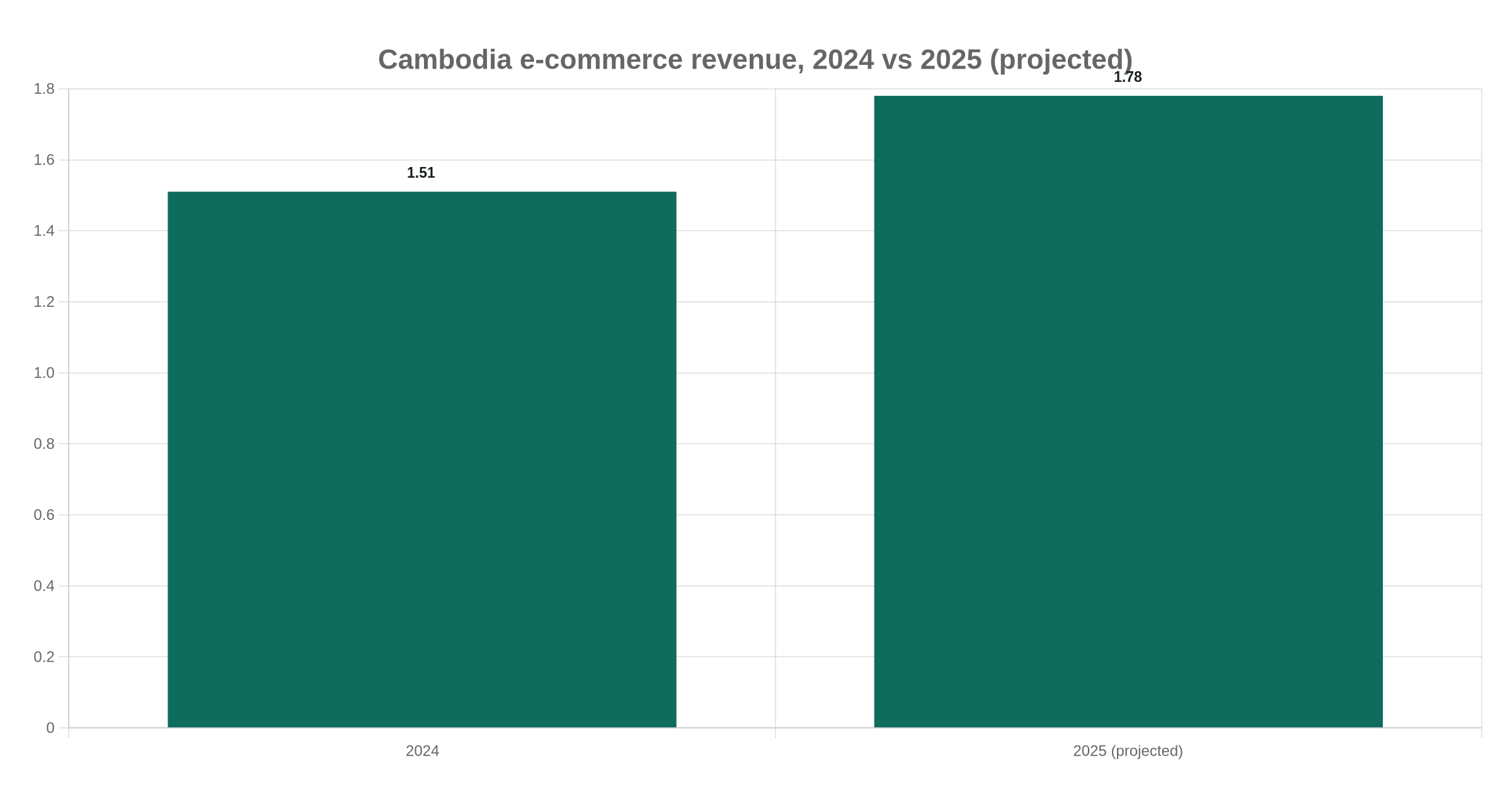
Most Cambodian sellers doing steady business on Facebook or Telegram should not rush to build an ecommerce website, not yet. Cambodia's ecommerce sector generated an estimated $1.51 billion in revenue in 2024, about 6.7% of national GDP, and the U.S. International Trade Administration projects it will reach $1.78 billion in 2025 (International Trade Administration, November 2025). That growth is real, but most of it runs through channels no market-research firm fully counts: a Facebook post, a Telegram thread, cash handed to a motorbike driver at the door.
That growth does not make a website the obvious first move for every business. A garment exporter in Kandal and a skincare seller running a Facebook page from a Phnom Penh apartment face completely different decisions about platforms, payments, and delivery. This guide walks through the numbers, the players, and the point at which a Cambodian business actually needs its own online store instead of a marketplace listing.
How Big Is Ecommerce in Cambodia Right Now?
Cambodia's ecommerce sector was worth $1.51 billion in 2024, or 6.7% of GDP, according to the U.S. International Trade Administration's Cambodia eCommerce Guide (November 2025). The Ministry of Commerce's own figure, reported by Khmer Times, put the same year's GDP contribution at 6.68%, close enough to treat as the same estimate.
The drivers behind that number are concrete, not aspirational. Cambodia has 17.3 million people and roughly 21.9 million mobile subscriptions, a mobile penetration rate of 126.6% (International Trade Administration, 2024 data). Internet penetration sits at 115.6%, about 20 million connections. Facebook alone counts 11.65 million users in the country, more than two-thirds of the population, and TikTok has grown to 9.96 million users (International Trade Administration, 2024 data).
| Metric | Figure | Source |
|---|---|---|
| Ecommerce revenue, 2024 | $1.51 billion (6.7% of GDP) | International Trade Administration, Nov 2025 |
| Ecommerce revenue, 2025 (projected) | $1.78 billion | International Trade Administration, Nov 2025 |
| Population | 17.3 million | International Trade Administration, 2024 |
| Mobile subscriptions | ~21.9 million (126.6% penetration) | International Trade Administration, 2024 |
| Facebook users | 11.65 million | International Trade Administration, 2024 |
| TikTok users | 9.96 million | International Trade Administration, 2024 |
Why the Published Ecommerce Figures for Cambodia Don't Agree
Search for Cambodia's ecommerce market size and several numbers turn up, and one of them is the same figure wearing two bylines. The $1.78 billion projected for 2025, the number this guide leads with, traces back to a single Ministry of Commerce estimate that both the U.S. International Trade Administration and the regional outlet CJBI cite, not two independent counts. Genuinely separate estimates sit alongside it: $904 million for 2025 from ECDB, $1.1 billion for 2025 rising to $1.8 billion by 2029 from a separate remark by Cambodia's Minister of Commerce (Xinhua, September 2025), and $2.10 billion projected for 2027 by Statista (Khmer Times, January 2023). None of these sources is wrong, they measure different things, and even the headline figure used here is one methodology among several, not a settled fact.
The gap comes down to what counts as ecommerce. Some estimates track only registered online stores with a formal checkout; others fold in the gross value of goods sold through Facebook Marketplace and Telegram group orders, which by most accounts still make up the bulk of Cambodia's online retail activity. A Techo Startup Center and PROFITENCE analysis found 78% of the population already used Facebook back in 2022, enough social selling on one platform to swing a national estimate by hundreds of millions of dollars.
The practical lesson is not which number is correct. It is that most of Cambodia's real ecommerce activity happens outside anything a market-research firm can easily measure, which is exactly why a Facebook page with a phone number in the bio still outperforms a lot of formal online stores here.
Who Is Actually Buying and Selling Online in Cambodia?
The typical Cambodian online shopper is young, mobile-first, and rarely opens a desktop browser to buy. Fashion, electronics, and beauty or personal care products are consistently the three best-selling categories, cited across both the International Trade Administration's guide and the Ministry of Commerce's 2024 ecommerce report.
Sellers skew just as young. Cambodia's ecommerce growth has been driven less by large retailers building web stores and more by individual sellers, often in their twenties, running a shop entirely from a phone: photographing stock, posting to a Facebook page or Telegram channel, and fulfilling orders through cash on delivery or a KHQR scan. A store built the way a European or American brand would build one, heavy product pages, a slow multi-step checkout, loses to a seller who can close a sale in a five-message Telegram thread.
Where Cambodian Shoppers Actually Go
Ask which platform dominates Cambodian ecommerce and the honest answer is: none of the ones a foreign visitor would guess first. Amazon does not run a local storefront here. Local marketplaces exist, among them L192, VTENH, Smile Shop, and AEON Online, the online arm of the AEON supermarket chain, alongside cross-border options like Ubuy Cambodia, Shopee, Taobao, Alibaba, and AliExpress for shoppers buying directly from China or the wider region.
None of them come close to matching the volume that moves through plain social commerce. Facebook groups, Facebook Marketplace, and Telegram channels remain the default storefront for most small Cambodian sellers, not because the marketplaces are bad but because trust in this market is personal: a shopper messages a seller directly and asks a question in Khmer before paying.
| Channel | What it's good for | What it's weak at |
|---|---|---|
| Facebook or Telegram selling | Fast to start, high trust, zero setup cost | No real checkout, no order history, breaks down past a few dozen orders a day |
| Local marketplace (VTENH, L192, Smile Shop) | Built-in shopper traffic, delivery already integrated | Limited brand control, listing fees, shared shelf space with competitors |
| Cross-border marketplace (Shopee, Taobao, Ubuy) | Reaches buyers who want imported goods | Not useful for a Cambodian brand trying to sell to Cambodian buyers |
| Owned ecommerce website | Full control of data, pricing, and brand, no per-order platform fee | Needs its own traffic, payment integration, and delivery setup |
We would not tell a seller doing twenty orders a week on Facebook to abandon it for a website. The trust and the traffic already sit on the platform their customers use every day, and an empty new store is a worse outcome than an active Facebook page.
How Do Cambodians Pay for What They Buy Online?
Most Cambodian online purchases are settled through KHQR, the interoperable QR payment standard built by the National Bank of Cambodia and carried by its Bakong system, or through cash on delivery when the buyer does not yet trust the seller. Bakong itself processed 1.325 billion transactions in 2025, 771 million in Khmer riel and 554 million in US dollars, worth a combined $224 billion, up from $150.6 billion in 2024, an increase of about 49% in value (National Bank of Cambodia figures, reported by Kiripost, Cambodianess and Ledger Insights, January 2026). Transaction count grew even faster over the same period, from roughly 608 million in 2024 to 1.325 billion in 2025, more than double.
Bank-linked gateways sit alongside KHQR for merchants who need card-based checkout. ABA Bank's PayWay is the most commonly integrated gateway among the builds we track, and Wing serves a large base of customers who bank mostly through mobile money rather than a traditional account.
What Still Holds Cambodia's Ecommerce Market Back?
Logistics outside Phnom Penh is the most commonly cited constraint, not payments. Payment infrastructure has matured fast, Bakong's volume alone proves that, but last-mile delivery to provincial towns still depends on motorbike couriers and bus-based parcel networks rather than one national carrier (Techo Startup Center and PROFITENCE, 2024 E-commerce Report).
The market has come a long way from its starting point. Cambodia had no domestic payment gateway and no major ecommerce sites to speak of in 2012 (Phnom Penh Post), and by 2020 ecommerce still accounted for only about 1 to 2% of the country's overall retail market (Cambodia Securities Plc research report, December 2024). Most of the infrastructure that made KHQR, PayWay, and delivery apps possible arrived in the years since.
Rural digital literacy is the other honest gap. A shopper in Phnom Penh scanning a KHQR code at a cafe counter is a different customer from a first-time buyer in Mondulkiri deciding whether to trust an online payment at all, and most ecommerce guidance here still assumes the first customer.

Do You Need an Ecommerce Website, or Is a Marketplace Enough?
You need your own ecommerce website once Facebook selling starts costing more time than it saves, not before. The clearest signal is volume: once a seller is retyping the same order into a delivery app for the third time today, or losing track of who already paid, a real catalogue and checkout starts paying for itself in hours saved.
Take that math literally with the Phnom Penh skincare seller mentioned earlier: a page selling serums and sheet masks in the $8 to $15 range, doing about 20 orders a week, roughly 80 a month, through comments and direct messages. Confirming each order, checking a KHQR payment screenshot, and retyping the address into a delivery app runs 3 to 5 minutes with mistakes and re-sends counted, call it 4 to 7 hours of admin a month. One missed or duplicated order a week, easy to lose in a scrolling thread, is 4 more gone every month at an average $12 ticket, close to $50 in revenue nobody notices leaving. A basic KHQR-enabled catalogue site with a delivery-partner integration earns that back in admin hours and recovered orders well before it earns back its own build cost.
Our second strong opinion follows from the first: a business that has outgrown Telegram-thread selling but skips building a real store is leaving revenue on the table it cannot even see, in abandoned conversations, orders lost between apps, and customers who wanted to pay by card and could not. A marketplace listing solves discovery but not control.
Building that store does not require starting from nothing. A custom ecommerce build with KHQR and PayWay support and a delivery-partner integration matters more than the platform brand on the invoice, and our guide to web development in Cambodia compares Webflow, no-code, and custom builds side by side. Driving shoppers to a finished store is a separate project, covered in our guide to digital marketing in Cambodia.
If you are weighing a marketplace listing against a real store, talk to us or look at recent project work we have shipped, or read our guide to choosing a digital agency in Phnom Penh first.
Prefer to chat? Message our founder directly on Telegram (@maxgrolier), or book a call with the team.
Frequently asked questions
Is Amazon available in Cambodia?
No. Amazon does not operate a storefront or local fulfillment in Cambodia, and shoppers who want Amazon-listed products typically use a cross-border reseller like Ubuy Cambodia instead. Local marketplaces such as VTENH, L192, and AEON Online cover everyday categories without the cross-border wait.
What is the difference between Bakong, KHQR, and ABA PayWay?
Bakong is the National Bank of Cambodia's payment system, and KHQR is the interoperable QR code standard that runs on top of it, letting a shopper scan one code regardless of which bank or e-wallet they use. ABA PayWay is a commercial payment gateway, built by ABA Bank, that merchants integrate into a website to accept card and KHQR payments together. A Cambodian ecommerce site typically needs KHQR support at minimum, and a gateway like PayWay if it also wants card payments.
Do I need an ecommerce license to sell online in Cambodia?
Businesses operating a registered online platform fall under Cambodia's E-commerce Law, administered through the Ministry of Commerce's E-Commerce Licensing portal, which uses a dual licensing system covering the platform and the underlying business activity. Informal sellers running only a Facebook page sit in a greyer position, and a business planning to scale past casual selling should check its licensing status rather than assume it is exempt.
How much does an ecommerce website cost in Cambodia?
Cost depends heavily on scope. A simple catalogue site with KHQR checkout is a different project from a multi-warehouse store with custom logistics integrations, and public pricing among Cambodia-based agencies is inconsistent enough to distrust a number quoted without a scope attached. The realistic move is a scoped estimate based on product count, payment needs, and delivery workflow.
Should a small Cambodian seller use Shopify or Webflow for an online store?
Both work for a Cambodian SME. The meaningful difference is less the platform brand and more whether the build supports KHQR and cash-on-delivery checkout, mobile-first product pages, and a delivery workflow that matches how the business ships. A platform choice made without those three answered first tends to need a rebuild within a year.