

Ecommerce delivery in Cambodia comes down to three couriers, one payment habit that breaks reconciliation if nobody plans for it, and a pricing decision most sellers get backwards in their first month of trading. None of the three is complicated on its own. Together, handled late, they are the single most common reason a storefront that looked finished at launch starts missing its own delivery promises within weeks.
This guide walks through that decision the way a Cambodian seller actually meets it: which couriers realistically cover the country, what delivery costs before and after a cash-on-delivery fee, why cash on delivery still runs most orders here, and how to price shipping so the number on your checkout page matches the number your courier actually bills you. Our wider look at ecommerce in Cambodia covers the platform and payment decisions that come before this one; here we go deep on the part most of those guides treat as an afterthought.
Which Couriers Actually Handle Ecommerce Delivery in Cambodia?
Almost every ecommerce parcel shipped domestically in Cambodia moves through one of three private couriers: J&T Express, Vireak Buntham Express, or Cambodian Express, with Cambodia Post and international carriers like DHL Express covering the narrower slice of state postal and cross-border volume.
J&T Express entered the Cambodian market in 2019 and now operates more than 230 branches across the country, with its regular service quoting 2 to 3 working days and a stated success rate of up to 95 percent on deliveries completed within 24 hours (J&T Express Cambodia, LinkedIn company page, checked November 2026). It is the courier most storefront platforms and marketplace sellers already know by name, in part because its cash-on-delivery program is built into its own terms rather than bolted on through a third party: standard merchants without a VIP account are charged a 3 percent cash-on-delivery service fee, while VIP rates are set per branch agreement (J&T Express Cambodia, Terms page, checked November 2026).
Vireak Buntham Express runs the comparison the other way. Its VET Express tier, known locally as Toan Chet, reaches 25 provinces, cities and districts in under 12 hours, while its VET Normal tier covers the same national footprint in under 24 hours and adds door-to-door, door-to-business and business-to-business delivery options (Vireak Buntham Express, company service page, checked November 2026). Where J&T leans on branch density, Vireak Buntham leans on its existing passenger-transport network, the same buses and routes that built its name in intercity travel, which is why its cash-on-delivery service promises the collected cash back to the sender within 2 days rather than the longer settlement window a pure parcel operator sometimes needs. Neither courier publishes a public tariff card online; both quote per shipment once weight, route and cash-on-delivery status are known, which is the first thing to ask about before comparing anyone's price.
Cambodian Express, usually shortened to CE Express, is the one of the three that does publish a tariff, and it anchors the cost comparison below. GrabExpress fills a different gap entirely: same-day, on-demand parcel delivery inside Phnom Penh, booked through the Grab app rather than a courier account, useful for a same-city rush order but not built for provincial coverage (Grab for Business, GrabExpress Cambodia service page, checked November 2026).
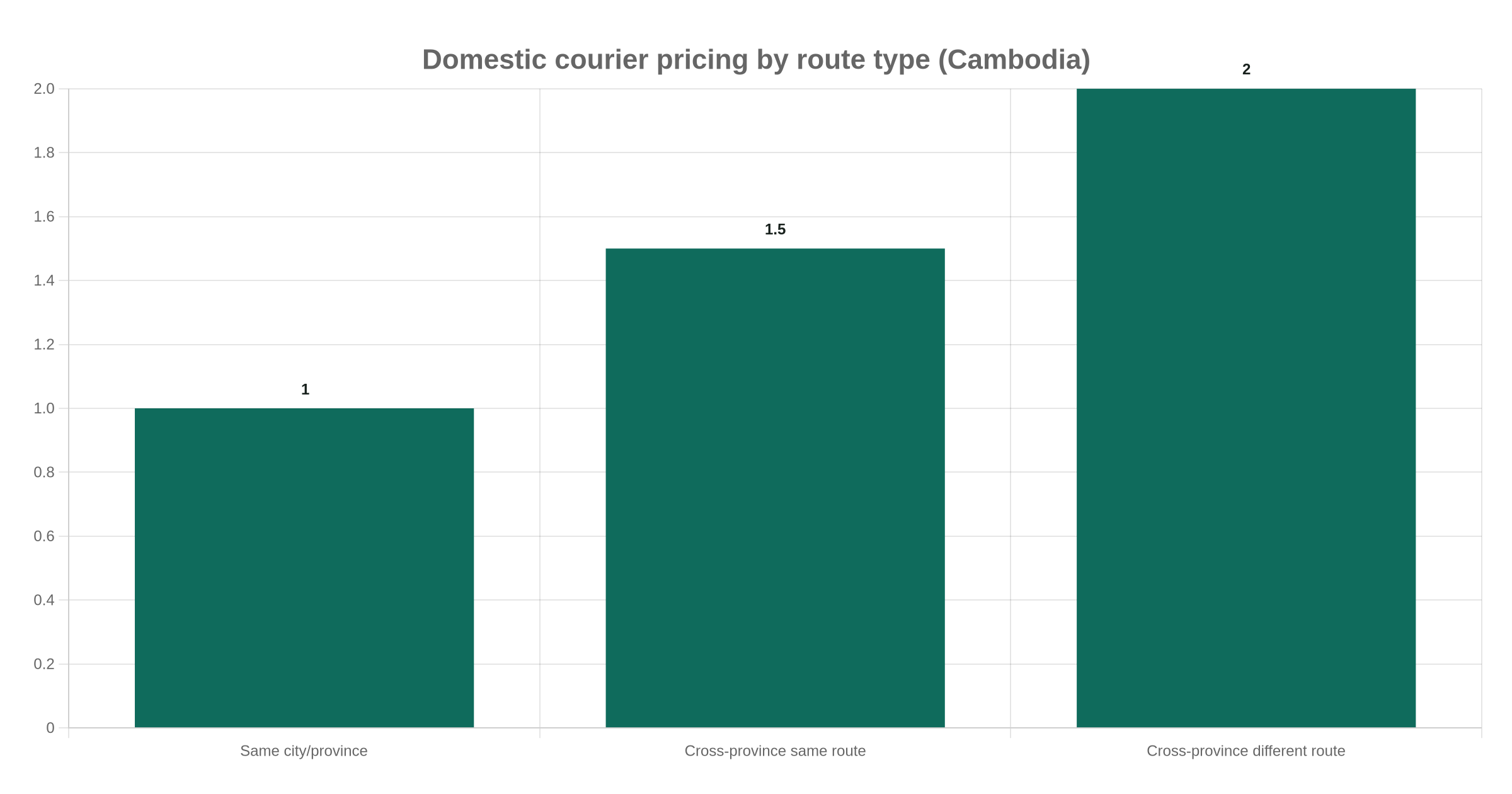
Ecommerce Delivery in Cambodia Costs 1 to 2 Dollars a Parcel Before Cash on Delivery
Domestic ecommerce delivery in Cambodia costs between 1 and 2 US dollars a parcel on Cambodian Express's own published tariff, before any cash-on-delivery handling fee is added on top. CE Express prices a parcel under 3 kilograms at 1 dollar within the same city or province, 1.5 dollars from Phnom Penh to a province or between two provinces on the same route, and 2 dollars between provinces on different routes, backed by a network of more than 300 branches and agents across the country's 25 provinces (Cambodian Express, company activity page, checked November 2026).
Picture a Siem Reap boutique shipping 80 orders a month, half within the city and half to Phnom Penh or another province. At CE Express's tariff, the local half costs 40 dollars a month in delivery fees and the provincial half costs 60 dollars, for a 100-dollar monthly delivery line before any cash-on-delivery fee. That number only holds if every parcel clears on the first attempt; a courier that charges per attempt, not per successful delivery, turns a refused parcel into a cost with no matching sale, the subject of the next section.
J&T Express and Vireak Buntham Express do not publish a comparable table because each quotes by account, weight bracket and cash-on-delivery status rather than a flat public card. The table below lines up what each courier covered here actually offers on the points that decide a seller's choice, not just price.
| Courier | Coverage | Typical domestic delivery time | Cash-on-delivery handling | Starting price |
|---|---|---|---|---|
| J&T Express | 230+ branches nationwide | 2 to 3 working days; up to 95% within 24h | Built-in, 3% fee for standard accounts | Quoted per shipment |
| Vireak Buntham Express | 25 provinces, cities and districts | 12h (Toan Chet express) to 24h (VET Normal) | Built-in, cash to sender within 2 days | Quoted per shipment |
| Cambodian Express (CE Express) | 25 provinces, 300+ branches/agents | Same route, 1 to 2 working days typical | Supported | 1 to 2 USD by route type |
| Cambodia Post (EMS) | Nationwide state network | EMS domestic, 1 to 3 days | Limited, varies by office | Generally the lowest of the group |
| GrabExpress | Phnom Penh, app coverage area | On-demand, same day | Handled through the Grab app, not courier-style COD | Per-trip, set in app |
Why Does Cash on Delivery Still Run Most Cambodian Ecommerce Orders?
Cash on delivery still runs most Cambodian ecommerce orders because QR and bank-app payment, while growing fast, have not displaced the habit of paying only once a parcel is physically in hand. In the payment-method breakdown of Cambodian online shoppers, QR code payment, chiefly KHQR, already leads at 47.15 percent, but cash on delivery still accounts for 26.5 percent and remains the default for a buyer who has not yet built trust with a new seller, ahead of money transfer at 13.3 percent (Techo Startup Center and PROFITENCE, E-commerce in Cambodia report, February 2024). The International Trade Administration's own country guide puts the operational consequence plainly: most transactions settle through cash on delivery, which it flags as raising both security and cost concerns for the businesses that depend on it (International Trade Administration, Cambodia eCommerce Country Commercial Guide, checked November 2026), precisely because the courier, not the seller, is the one holding and moving the cash. A seller who wants to capture that growing QR share directly, rather than leaving it to whatever payment option a marketplace or template defaults to, should look at a KHQR payment integration built into their own checkout.
That handling is not free, and the fee structures differ in a way worth knowing before picking a courier. J&T Express charges a flat 3 percent cash-on-delivery service fee to standard merchants and remits through its own account system; on MyParcel Asia's multi-carrier platform specifically, cash collected through J&T Express or DHL eCommerce becomes available to remit 7 days after the parcel is delivered (MyParcel Asia, 13 February 2023). Vireak Buntham Express, running its own direct cash-on-delivery service rather than a third-party platform, promises the cash back to the sender within 2 days (Vireak Buntham Express, company service page, checked November 2026).
A seller comparing couriers on cash on delivery alone should ask about the remittance window as closely as the handling fee: a 3 percent fee with a 2-day return beats a lower fee sitting on a week-long hold, once the cost of cash flow is counted.

Run the numbers on a refused parcel, the scenario every cash-on-delivery seller eventually hits. A Phnom Penh home goods seller ships a 25-dollar order to a province on Cambodian Express's 1.5-dollar tariff. The buyer refuses it at the door. The courier returns the parcel, the seller pays the 1.5 dollars again to have it shipped back, and the 25-dollar sale that justified the first shipment never clears.
The direct loss is 3 dollars in delivery fees alone, before counting the packaging, the staff time spent re-listing the stock, and the week the inventory sat unavailable in transit. At 100 orders a month and even a modest 5 percent refusal rate, that is 15 dollars in pure round-trip delivery cost with nothing sold against it, a number worth building into a margin calculation rather than discovering after the fact.
What's the Biggest Myth About Ecommerce Delivery in Cambodia?
The myth: once a storefront goes live, delivery is the courier's problem to manage, and a seller only needs to hand over the parcel and wait for the cash. The reality: delivery only runs itself when someone has already decided, before the first order ships, whether the courier pushes order-status updates automatically or whether a staff member has to check for them.
A courier that sends a status webhook back to the store flags a refused parcel or a failed delivery attempt the same day it happens. A courier that only lets a seller poll for updates, or worse, that confirms status over a phone call, turns every exception into a manual reconciliation task, discovered only when someone counts boxes or checks a bank balance at the end of the week. None of the three main couriers covered here advertises a public developer API; a seller running any real order volume should ask directly, before signing an account, whether status updates arrive automatically or have to be chased. That question costs nothing to ask and saves a rebuild of the reconciliation process later, the same gap we flag in our POS and ecommerce sync guide for the inventory side of the same problem.
A second myth sits underneath the first: that Cambodia Post's position as the national postal operator means private couriers are bound to similar, government-set rates. The OECD's 2021 competitive neutrality review found the opposite. It recommended Cambodia amend its legislation so no one retains the ability to regulate small-package delivery rates at all, and it recommended the Postal Law be clarified so that Cambodia Post's monopoly does not extend to private small-package courier services (OECD, Competitive Neutrality Review: Small-Package Delivery Services in Cambodia, 2021). In practice, that is exactly what the pricing gap above shows: J&T Express, Vireak Buntham Express and Cambodian Express each set their own rates, which is precisely why the quotes a seller gets from each one can differ meaningfully for the same route and weight. Price shopping between them is not just allowed, it is the entire point of the market the OECD was reviewing.
Cambodia's Delivery Pricing Should Start From Weight, Not Postal Zone
Delivery pricing for a Cambodia-based ecommerce store should start from weight and route type, not postal zone, because every courier covered in this guide already prices its own tariff that way rather than by the zone map most storefront platforms assume by default.
Take a seller with a mixed catalog: lightweight accessories under half a kilogram and bulkier home goods up to 5 kilograms, all sold at a single flat shipping rate of 2 dollars to keep checkout simple. On Cambodian Express's own tariff, that flat rate already loses money on every cross-province, different-route shipment of a heavier item, which the courier itself prices at 2 dollars before the seller's margin is even counted. Move the same catalog to a two-tier weight structure, 1.5 dollars under 2 kilograms and 2.5 dollars above it, and the seller covers the courier's actual cost on every route while only adding one extra decision at checkout, not a full zone lookup table. We would build that two-tier structure before touching a zone map, because it mirrors what the courier already charges rather than layering a second, invented pricing logic on top of it.
A seller whose pricing needs go further than two weight tiers, a wholesale buyer paying a different rate than a retail one, or delivery cost that genuinely depends on distance rather than a fixed route bracket, usually outgrows what a stock storefront checkout can calculate on its own. That is the same threshold we cover in our guide to choosing an ecommerce website platform: once pricing logic gets specific enough, the conversation shifts from which platform to use to what custom logic needs to be built into it.
How Fast Is Ecommerce Delivery From Phnom Penh to the Provinces?
Ecommerce delivery from Phnom Penh to the provinces takes anywhere from under 12 hours on Vireak Buntham Express's Toan Chet express tier to 2 to 3 working days on J&T Express's standard service, with the gap explained by route and service tier, not distance alone. Vireak Buntham's VET Normal tier, the one most ecommerce sellers actually use day to day rather than the premium express option, covers the same 25-province footprint in under 24 hours (Vireak Buntham Express, company service page, checked November 2026). Cambodia Post's EMS service sits at a similar 1 to 3 days domestically, generally at a lower price than the private couriers, though with a thinner delivery network outside major towns (Cambodia Post, EMS service information, checked November 2026).
International and cross-border orders run on a different clock entirely. DHL Express markets door-to-door delivery into Cambodia in as little as 2 working days for inbound international shipments (DHL Express, Discover Cambodia, checked November 2026), a timeline worth knowing if a Cambodian store also imports stock or ships to customers abroad, but it is not a domestic last-mile option for most local orders. GrabExpress fills the gap none of the four national couriers are built for: a same-day, inside-Phnom-Penh order that cannot wait for a next-business-day pickup, booked and tracked through the Grab app rather than a courier account.
Our recommendation: default to the courier whose branch footprint matches where your customers actually are, not the one with the best-known name. A Phnom Penh-only seller gains little from Vireak Buntham's provincial speed and more from Cambodian Express's published, predictable tariff. A seller shipping nationwide needs either J&T's branch density or Vireak Buntham's transport-network reach, and should pick based on cash-on-delivery remittance terms once coverage is equal.
We think a seller under a few hundred orders a month should settle on one courier's cash-on-delivery process rather than split volume across two or three to chase a better rate, because reconciling two or three remittance cycles costs more staff time than the rate difference ever saves. Keep DHL and GrabExpress as the exceptions they are: international orders and same-day city rushes, not the default delivery method.
Before signing with any courier this week, check the following:
- Ask for the cash-on-delivery fee and remittance timeline in writing, not a verbal estimate. A 3 percent fee with a 2-day return beats a lower fee on a week-long hold.
- Confirm whether status updates arrive automatically or need to be chased. A webhook-based courier flags a refused parcel the same day; a poll-only one needs a staff member checking on a schedule.
- Price shipping by weight tier, not a single flat rate, once your catalog spans more than one real weight bracket.
- Build the refused-parcel cost into your margin, not just the delivery fee on a successful order. Round-trip cost plus a lost sale adds up faster than it looks at low volume.
- Match courier coverage to where your customers actually are before comparing headline delivery speed between operators.
If your checkout logic has already outgrown what a flat rate or a simple zone map can handle, that is usually a sign the project needs real ecommerce development built around your catalog and your courier's actual pricing, not a generic plugin. Browsing recent project work shows the range of builds we ship, and if delivery is the piece holding your launch back, a scoped estimate is the fastest way to find out what it takes to fix.
Prefer to chat? Message our founder directly on Telegram (@maxgrolier), or book a call with the team.
Frequently asked questions
Does every courier in Cambodia charge extra for cash on delivery?
The three main private couriers covered here all do. J&T Express charges a flat 3 percent fee to standard merchant accounts, and Vireak Buntham Express and Cambodian Express build a handling cost into their quoted rate rather than publishing it separately. Expect a cash-on-delivery order to cost more than a prepaid one on every courier, not just the one you happen to pick.
Can I ship ecommerce orders to the provinces without a courier branch there?
Yes, through any of the three national couriers, which route a parcel through their own branch and agent network even when the final delivery point has no storefront of its own. Vireak Buntham Express and Cambodian Express both cover all 25 provinces this way; J&T Express's 230-plus branches reach most but not every district directly, which is worth confirming for a remote delivery point before you quote a customer a delivery date.
Is DHL or Cambodia Post a good option for domestic ecommerce delivery?
Not as your main option. DHL Express is built for international and cross-border shipping, not domestic last-mile delivery inside Cambodia. Cambodia Post's EMS service does move domestic parcels, typically in 1 to 3 days, usually at a lower price than the private couriers, but with a thinner branch network outside major towns, which makes it a secondary option rather than a primary one for most ecommerce sellers.
How do I calculate delivery cost before I set my product prices?
Start from your courier's published or quoted rate by weight and route, add the cash-on-delivery handling fee if you offer it, then add an estimate for refused or returned parcels based on your own order volume. Even a conservative 5 percent refusal rate, calculated on a round-trip delivery fee rather than the product price, changes the margin math enough to be worth building into your pricing from day one rather than finding out after a bad month.
Should a small seller use more than one courier at once?
Usually not before volume justifies it. Splitting shipments across two or three couriers to chase a marginally better rate adds a second or third cash-on-delivery remittance cycle to reconcile, which costs more staff time at low volume than the rate difference saves. One courier whose coverage matches your customer base, with a clear cash-on-delivery process, is the simpler and usually cheaper choice until order volume is high enough to justify the extra coordination.