

A guesthouse in Phnom Penh's BKK1 district relaunched its booking page in 2025 on the cheapest plan a local reseller offered, on the promise it would run faster for Cambodian guests, at a price above what an equivalent international server would have cost. Two months later, European travel agents were waiting eight seconds for a page that loaded instantly for walk-in guests inside the country: nobody had checked where those agents actually sat relative to the server, and the guesthouse was paying a premium for a speed advantage that only reached its smaller audience. That mismatch is the whole story of web hosting in Cambodia: a server physically inside the country serves Cambodian visitors well and the rest of the world badly, while a server abroad, almost always in Singapore, does close to the opposite, usually for less money.
For most business sites, hosting abroad is the better default today. The local option still earns its keep in a narrower set of cases, covered below, and almost never because a .com.kh domain requires it, which is the mix-up that sends plenty of Cambodian businesses toward a local plan they do not actually need.
What's the real difference between hosting in Cambodia and hosting abroad?
Hosting in Cambodia means the server answering your website's requests sits physically inside the country, typically in one of the Tier 3 facilities now operating in Phnom Penh. Hosting abroad means that server sits somewhere else, almost always Singapore, the closest major cloud and CDN hub to Cambodia. Several local operators run real infrastructure here: Kepstar's Phnom Penh facility covers around 110,000 square feet, Sinet's data centre runs roughly 11,000 square metres of floor space, and ByteDC opened its first Cambodian facility in 2023 (Data Center Map, 2026). None of that is small-scale hobbyist hosting; it is genuine colocation and cloud infrastructure, built for banks, telcos and government systems as much as for websites.

What changed the calculation is connectivity, not the local data centres themselves. Cambodia's international bandwidth used to run through a handful of links; it now also runs through the Sihanoukville-to-Hong Kong cable, a 2,938-kilometre system with up to 80 terabits per second of capacity, co-funded by the Ministry of Post and Telecommunications and China Unicom Global and described by MPTC as the country's first state-owned international submarine cable system (Telecom Review Asia, 2026). On the delivery side, Cloudflare opened a point of presence in Phnom Penh back in 2018, its 122nd data centre globally and 41st in Asia, and measured a tenfold drop in latency from the Cambodian ISP SINET to Cloudflare-fronted sites once it went live (Cloudflare, 2018). If your website's origin server sits in Singapore but static assets are served through a network like Cloudflare's, a Cambodian visitor is often not paying much of a penalty for that server living abroad at all. If you are choosing a build stack as much as a server, our wider guide to web development in Cambodia covers Webflow, no-code and custom builds; this article stays narrowly on where that build actually runs.
Does Cambodia legally require hosting your website locally?
No single law in Cambodia requires a business to host its website on a server physically inside the country, though two separate rules get confused with one, and untangling them is worth the five minutes before you pay extra for local servers you may not need.
The first rule is about domain names, not servers. Joint Notification 873, issued by the Ministry of Commerce and MPTC in April 2022, required Cambodia-registered companies to hold a .com.kh domain by 1 January 2023, alongside their existing domain if they wanted to keep it (ASEAN Briefing, 2022). The Ministry of Information followed up with Notification 047 on 18 February 2025, reiterating the requirement specifically for online businesses in the information and audiovisual sector and giving those still running a foreign domain until the end of 2025 to switch (Andersen Cambodia, 2025). Registering a .com.kh domain costs around 100 US dollars up front and 30 US dollars a year to renew, through MPTC's own registry (domain factsheet, 2026).
Myth versus reality: does a .com.kh domain force you onto a Cambodian server?
Myth: a national domain name means the website behind it has to run on Cambodian hardware. Reality: a domain name is a DNS record pointing wherever a server lives, not a hosting contract. Nothing in either notification specifies where the server behind a .com.kh domain has to sit, only that the domain itself has to be registered and renewed through MPTC's registry. A .com.kh domain can point at a server in Singapore, Frankfurt or anywhere else, exactly like a .com domain can.
The rule actually worth watching sits elsewhere. MPTC announced a draft Law on Personal Data Protection on 23 July 2025, broadly GDPR-inspired, carrying a two-year implementation window once it is formally promulgated; it had not been enacted as of this article (ppc.land, 2025). Earlier drafts of Cambodia's data legislation, under the same Article 24, required personal data collected inside the country to be stored domestically, a requirement later softened into the cross-border transfer language the current draft carries (Kiripost, 2025). We think that is the one to watch, not the domain rule: a business collecting payment details or personal data from Cambodian customers today should treat local hosting, or at least a local backup, as a reasonable insurance policy against a localization requirement, even while the draft law sits unpromulgated.
How much more does hosting in Cambodia cost than hosting in Singapore?
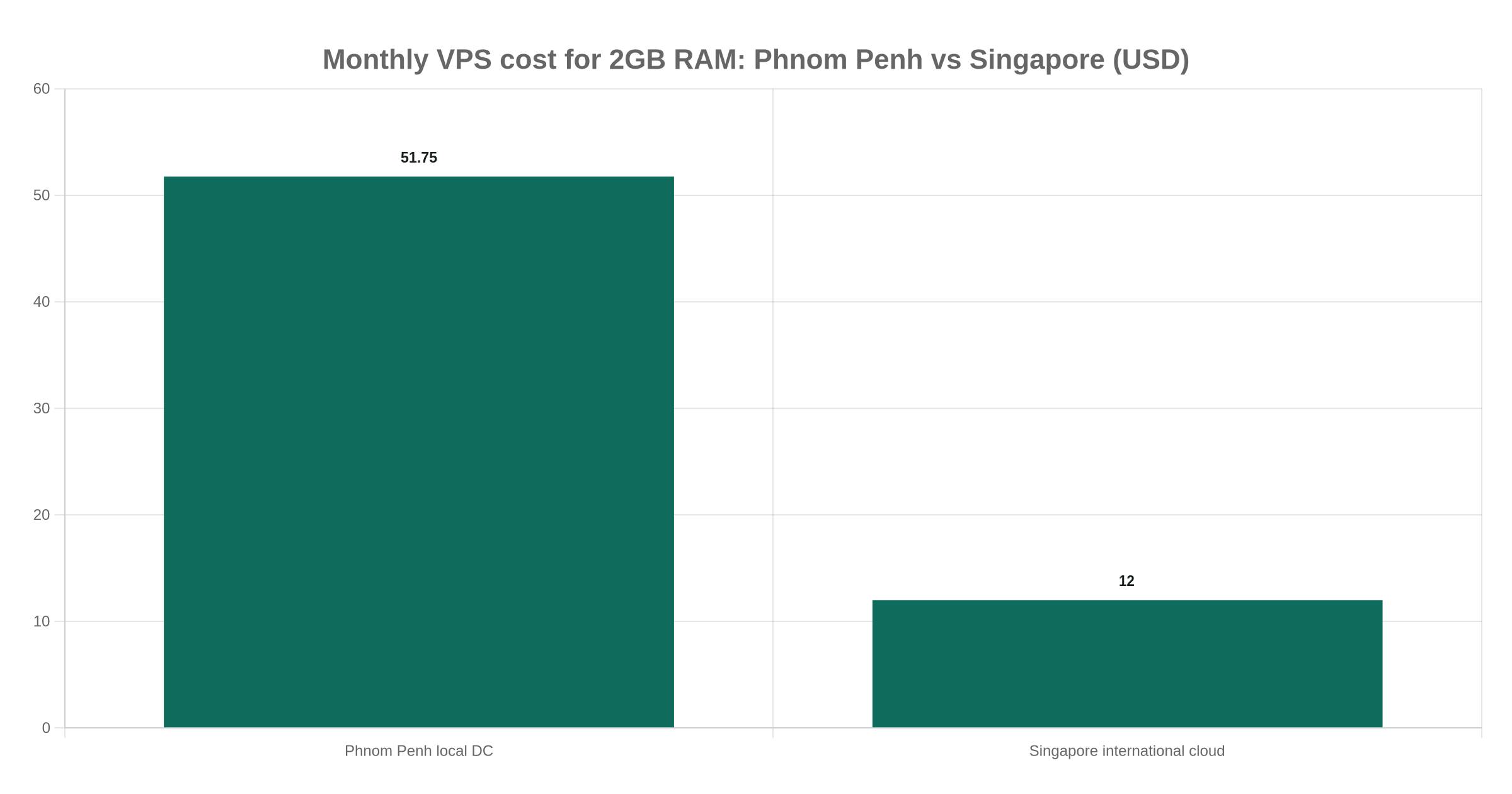
Hosting a standard business site in Cambodia on a local Tier 3 facility costs roughly four times what the same specification costs on an international cloud server in Singapore, at the small end of the market where most Cambodian SMEs actually shop. A 2 GB RAM, SSD-backed VPS on VinaHost's Phnom Penh facility lists at 51.75 US dollars a month; a comparable 2 GB Basic Droplet on DigitalOcean, deployed in Singapore, lists at 12 US dollars a month, the same price DigitalOcean charges in every region it operates (VinaHost and DigitalOcean 2026 pricing pages). The premium for staying local, on top of what the same specification costs in Singapore, comes to 477 US dollars a year (39.75 US dollars a month times twelve), for specifications most small business sites never grow into.
What the local premium buys is narrower than most sales calls suggest: slightly better latency for the share of traffic physically inside Cambodia, and sometimes simpler local billing. What it does not automatically buy is better reach for the rest of your audience, and for a lot of Cambodian businesses that rest of the audience is the bigger half. A Phnom Penh e-commerce seller shipping nationally but drawing close to half its browsing traffic from diaspora customers and overseas B2B buyers researching before a trip is paying the local premium for a latency benefit that only serves the smaller half of its visitors. A hosting decision this size is easiest to get right during a Cambodia website redesign, before traffic, backups and email all accumulate on the wrong server and moving becomes its own project.
Our recommendation: default abroad, keep a local option as insurance
Our default for a new Cambodian business site is an international server, usually in Singapore, sitting behind a CDN like Cloudflare's network that already reaches Phnom Penh at close to the latency a local server would offer on its own. Most of the sites we build at TechFlow run on Webflow or Shopify, both of which host on their own global infrastructure, so the local-versus-international question mostly resolves itself before a client has to make it. It becomes a real decision only once a project needs a custom backend, a Bubble or Xano application, a bespoke integration, where someone has to actually pick a server region. Webflow and Shopify hosting themselves is also one reason our Webflow versus WordPress comparison keeps coming up when this hosting question gets asked: a self-hosted WordPress site puts the local-versus-international call back on the client in a way a hosted platform does not.
When a custom build does put the region question on our desk, we check three things in that order, not whatever a reseller's sales page leads with first: where the client's existing analytics say traffic actually originates, whether the project will store any personal data collected from Cambodian customers, and how disruptive moving DNS, email and backups would be if the answer changed later. That third check is the pitfall: a region picked casually in month one becomes a pressured migration in year two, instead of a choice made once.
The one open question that could flip this advice is Cambodia's draft Law on Personal Data Protection. If the localization language MPTC circulated in earlier drafts survives into the final, promulgated text, any business storing Cambodian customer data will need a server inside the country regardless of cost. Until that happens, we would not pay the local premium pre-emptively; we would budget for it as a contingency, the same way we budget for a future redesign.
The same four questions we use for vetting a web development company apply almost unchanged to vetting a hosting reseller: who you can actually reach when the server goes down matters more than the number on the price list. If your project already needs a custom backend rather than a hosted platform, our development team can make that local-versus-international call against your actual traffic mix rather than a generic rule of thumb; browse our recent projects for the kind of custom builds where the decision genuinely matters, or get a scoped estimate for yours.
Prefer to chat? Message our founder directly on Telegram (@maxgrolier), or book a call with the team.
Frequently asked questions
Is it illegal to host a Cambodian business website on a server outside the country?
No. No current Cambodian law requires a website's server to be physically located inside the country. The only legal requirement in force today concerns the domain name itself, not where the server behind it sits.
What does a .com.kh domain actually cost, and who can register one?
Registration runs around 100 US dollars up front with a 30 US dollar annual renewal, through MPTC's own registry. Only Cambodia-registered companies, government agencies and Cambodian citizens are eligible to register one.
Does using Cloudflare count as hosting in Cambodia?
Not on its own. Cloudflare's Phnom Penh point of presence caches and delivers content faster for nearby visitors, but your website's origin server, the one holding the actual files and database, can still sit anywhere, including abroad.
Will Cambodia's data protection law eventually force local hosting?
Possibly, for data collected inside the country, if the localization language seen in earlier drafts survives into the final text. The law had not been promulgated as of this article, and carries a two-year implementation period once it is.
Is local or international hosting faster for visitors inside Cambodia?
With a CDN in front of either option, the practical difference is small for most visitors today. Without one, a local server still wins, but only for the share of traffic physically inside the country.