
No-code development in Cambodia means building a real website, internal tool or startup MVP on platforms like Bubble, Webflow, Xano and WeWeb instead of writing custom code line by line. It matters here because Cambodia has more demand for digital products than trained developers to build them.
For a founder or SME owner in Phnom Penh, no-code's legitimacy is no longer the question. The real question is which tool fits which job, what it actually costs to run, and how to tell a real no-code team from an agency that just resells someone else's template.
What counts as no-code development in Cambodia right now?
No-code development in Cambodia today covers four distinct jobs, not one tool that does everything. Webflow builds marketing sites and content-driven pages visually, hosting and a CMS included. Bubble builds full web applications, logins, databases, user roles and workflows, in a single visual editor. Xano is a no-code backend: an API and database layer other tools plug into. WeWeb is a no-code frontend that pairs with a backend like Xano when a team wants frontend and backend to scale independently.
Not every job needs the full stack. A boutique guesthouse in Siem Reap replacing a dated brochure site is a Webflow-only job: a CMS collection for room types and rates, a blog for search visibility, and a booking-request form wired to email covers the brief in a few weeks, with no backend logic, no user accounts and no database to maintain.
This is not a niche trend. Gartner forecasts the low-code and no-code market to reach 44.5 billion US dollars in 2026 (Gartner, cited via ToolJet's 2026 analysis), and separately forecasts these technologies will power over 70 percent of new enterprise applications by 2025, up from under 25 percent in 2020 (Gartner's Magic Quadrant for Enterprise Low-Code Application Platforms, 2021). Cambodia's own digital base supports that shift: 12.0 million people were online by October 2025, 67.3 percent of the population (DataReportal, Digital 2026: Cambodia).
Why Cambodian startups are moving faster into no-code than the region average
Cambodia's own developer supply drives local no-code adoption more than global hype does. A 2021 Cambodia Development Resource Institute study found Cambodian ICT curricula devote almost a quarter of coursework to general subjects, with almost no teaching in newer disciplines like machine learning, fintech or data science, even as surveyed firms expected ICT skill demand to grow around 30 percent a year (CDRI, 2021). That gap has not closed on its own, pushing founders toward tools that do not require a large in-house engineering team.
Policy is catching up too: the government finalized a National Strategy on Startup Development for 2026 to 2030, coordinated through Techo Startup Center and Khmer Enterprise, aimed at growing Cambodia's technology and startup base (Khmer Times, 2026). Cambodia's startup ecosystem grew 51.3 percent in 2026 on StartupBlink's global ranking, evidence that more local teams are shipping despite a thin developer bench. For the fuller picture on choosing a platform, an agency and a build approach, see our web development in Cambodia overview.
We think most early-stage Cambodian startups should default to a no-code MVP before touching custom code. Validating a business model does not need a bespoke backend on day one, and a no-code platform subscription costs less than one month of a junior developer's salary.
Bubble, Webflow or Xano: which no-code tool fits which job?
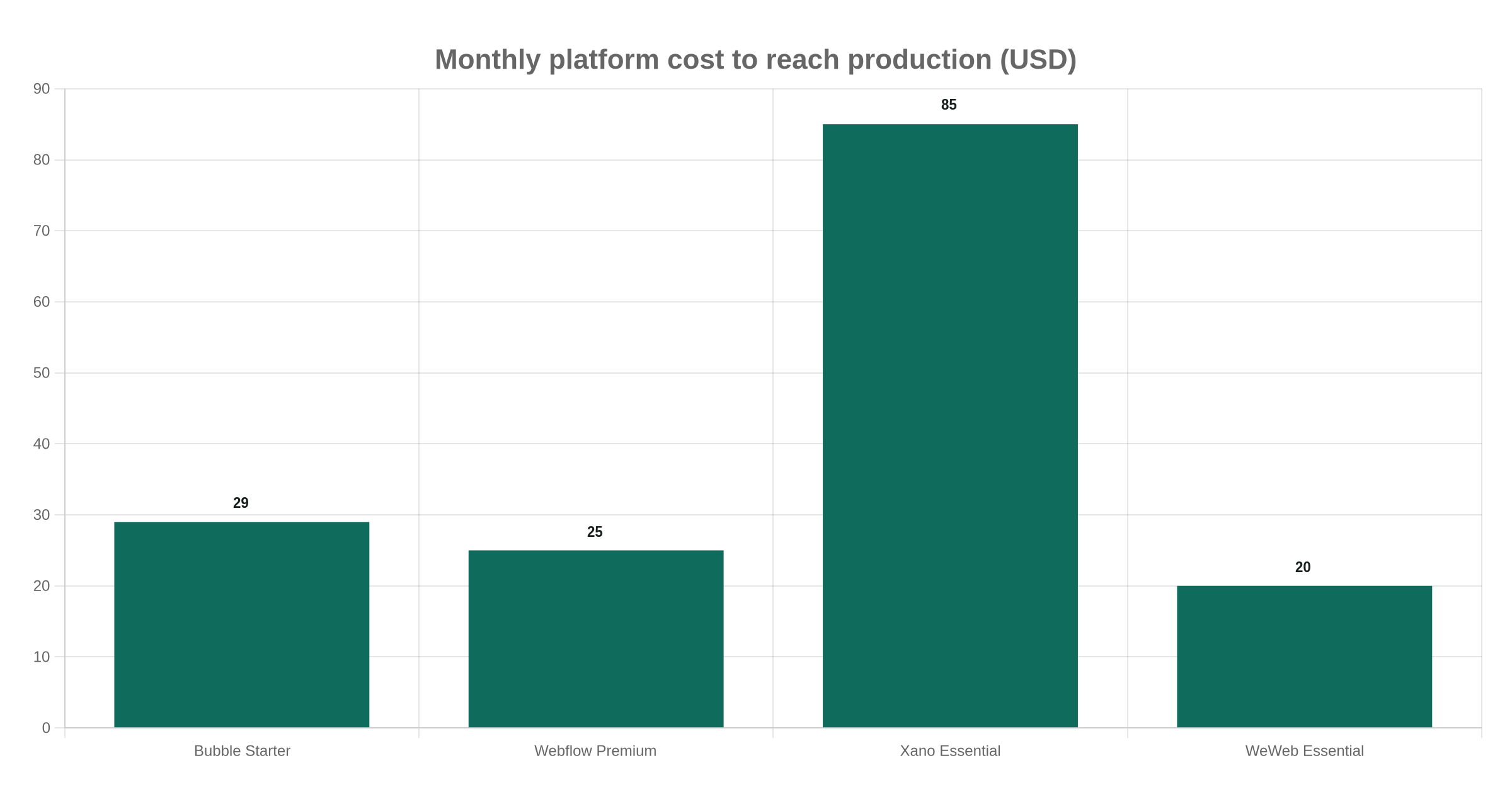
Bubble is the right choice when a single team needs one tool to build a full web application fast: logins, dashboards and workflows included, without stitching a frontend and backend together. Bubble's Starter plan runs 29 US dollars a month billed annually for a single production app; Growth, at 119 US dollars a month, adds more monthly workload and more live app versions for a busier app with a small team (Bubble, 2026 pricing).
Webflow is the right choice for a marketing site, a content-heavy page, or anything where design polish and page speed matter more than complex application logic. Its Premium plan costs 25 US dollars a month billed annually and bundles hosting, a CDN and a 20,000-item CMS (Webflow, pricing update, May 2026).
Xano paired with WeWeb is the right choice when a team wants a backend that scales or integrates independently of the screens users see: useful once an app needs custom API logic, a mobile app on the same backend, or heavier data processing than an all-in-one tool handles gracefully. Xano's Essential plan starts at 85 US dollars a month; WeWeb's Essential seat plan adds 20 US dollars a month billed monthly for the frontend layer (Xano and WeWeb, 2026 pricing).
| Tool | Best for | Entry monthly cost | Needs a specialist to run it? |
|---|---|---|---|
| Bubble | One tool, full app, fastest to ship | $29 (Starter) | Helpful past a simple app, not required to launch |
| Webflow | Marketing site, content, design | $25 (Premium) | No, a Webflow builder instead |
| Xano + WeWeb | Composable backend and frontend, room to scale | $85 + $20 | No, needs a no-code backend specialist instead |
Entry cost is not the whole story: a marketing site on Webflow rarely needs custom code, while choosing between Webflow and WordPress follows different logic, covered in our Webflow vs WordPress comparison. A dedicated Bubble developer is worth hiring once an app has real users and custom logic to maintain, not to launch a first version.
Inside a no-code build: wiring KHQR payments into a Xano backend
Take a hypothetical scenario: a Phnom Penh food delivery startup wants a two-sided marketplace app (riders, restaurants and customers) without a six-figure custom build. A realistic stack looks like WeWeb for the customer and restaurant screens, Xano for the backend (orders, riders, payouts), and n8n to move data between them and outside services.
The payment layer is where Cambodia-specific work actually happens: most no-code tutorials skip it entirely because they are written for a market with Stripe as the default. Bakong, the National Bank of Cambodia's instant payment platform, processed 608 million transactions worth about 150.61 billion US dollars in 2024, equivalent to roughly 330 percent of Cambodia's GDP (National Bank of Cambodia 2024 figures, reported by Khmer Times). A customer paying by KHQR needs the app to call the Bakong Open API to generate a QR code, then poll or receive a webhook confirming the transfer before an order is marked paid. On a no-code stack, that call typically runs through Xano's custom API endpoints, with an n8n workflow handling the webhook and updating order status back in Xano.
None of this is exotic: it is the part a generic Bubble or Xano tutorial never covers, because KHQR does not exist outside Cambodia.
How do you choose a no-code development agency in Cambodia?
Choosing a no-code agency in Cambodia comes down to four checks that matter more than the tool logos on their homepage. First, ask who owns the Bubble, Xano or Webflow account once the project ships: it should be transferred to you, not held under the agency's master account. Second, ask what happens past the platform's workload or CMS-item limits: every no-code tool has a ceiling, and a credible agency can describe it before you hit it. Third, ask whether they can show a live app, not just a marketing site: Webflow skill does not automatically transfer to Bubble or Xano application logic. Fourth, ask for a fixed scope and timeline rather than an open-ended retainer for a first build.
A no-code agency that will not hand you full admin ownership of your Bubble, Xano or Webflow account at delivery is not offering a partnership. It is renting you your own product.
That same account-ownership question applies whether you are vetting a no-code specialist, a broader web development company in Phnom Penh, or a wider software development company that offers no-code as one option among several.
What does no-code development actually cost in Cambodia?
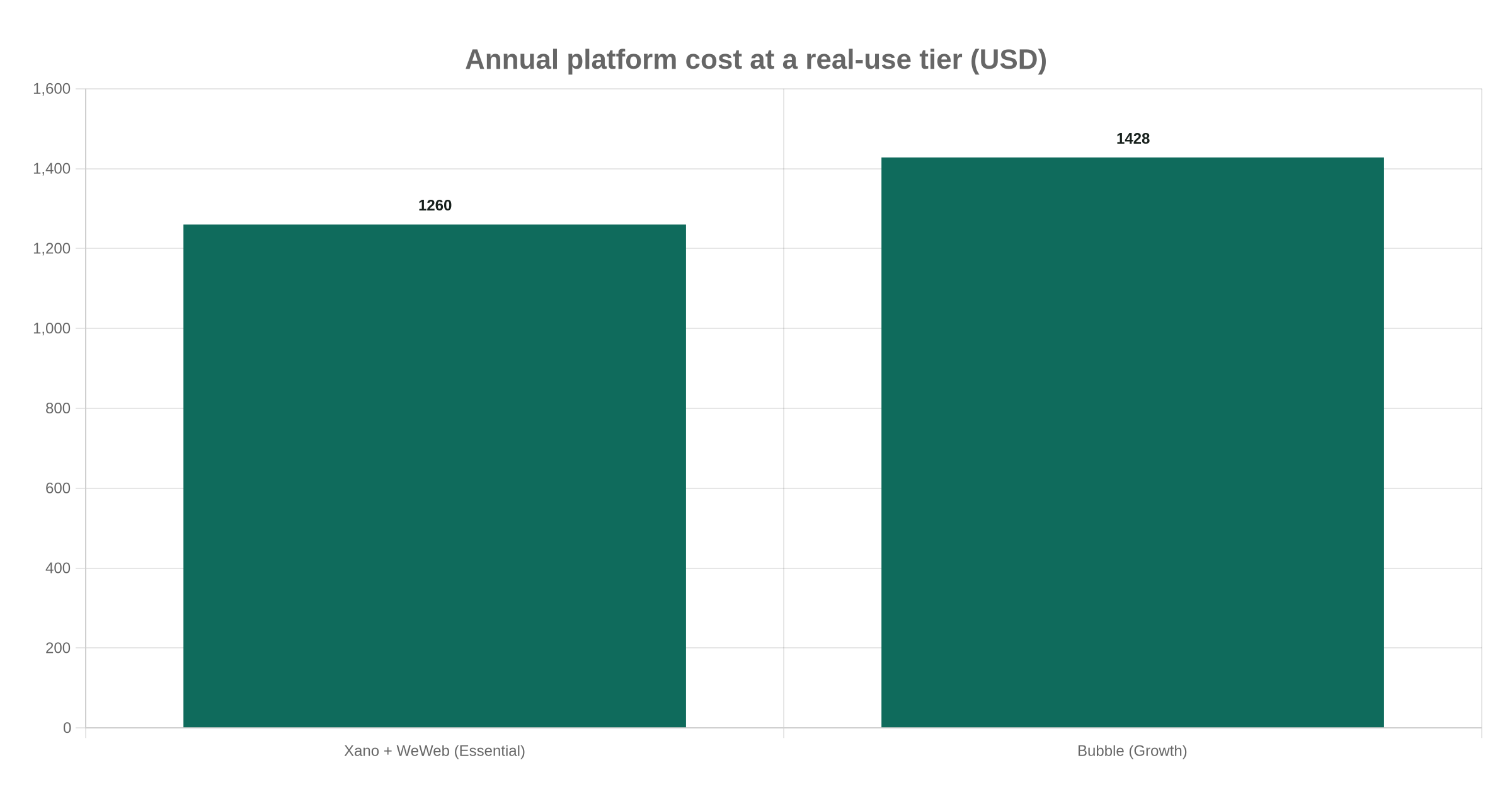
No-code costs in Cambodia break into two lines: the platform subscription, fixed and public, and the build itself, scoped per project because scope varies too much for a rate card to mean anything. On the subscription side, a Bubble-only MVP starts around 29 US dollars a month; a composable Xano-plus-WeWeb stack starts around 105 US dollars a month combined, roughly 1,260 US dollars a year against Bubble Growth's 1,428 US dollars a year at the tier most real apps need, the gap shown above.
On the build side, TechFlow scopes an MVP over roughly 30 days and a fuller platform or SaaS build over 2 to 4 months, sprint-based, including a technical audit and prototype phase (TechFlow Agency, internal process). We do not publish a fixed price list: a two-screen tool and a three-sided marketplace are not the same quote, and any agency quoting before a discovery call is guessing.
TechFlow Agency runs web development services as one line of a full-stack practice from Phnom Penh, no-code included alongside Webflow and custom builds. Browse recent projects for examples of what that looks like, or go straight to a scoped estimate against your actual brief.
Prefer to chat? Message our founder directly on Telegram (@maxgrolier), or book a call with the team.
Frequently asked questions
Is no-code development actually good enough for a real business, or just a prototype tool?
It is good enough for a real, revenue-generating business, not just a prototype. Companies run production marketing sites on Webflow, SaaS products on Bubble, and API backends on Xano at scale; the ceiling is technical, on complexity and volume, not credibility.
What is the difference between no-code and low-code development?
No-code means building entirely through a visual interface, no custom scripting required. Low-code means the same visual-first approach but with the option to drop into custom code for logic the visual tools cannot express, closer to what Xano supports through custom API functions.
Can a no-code app scale, or will we eventually need custom code?
Most apps scale well past their first few thousand users on Bubble, Xano or a Webflow and Xano combination, since the platform manages the infrastructure, not the no-code layer. Custom code usually becomes worth it only once you need logic or integrations the platform cannot express, not simply because user numbers grew.
Do we own the app if we build it with a no-code agency?
You should, if the agency is set up correctly: the account and app sit on your Bubble, Xano or Webflow subscription, transferred to you at delivery. An agency that keeps the account under its own name indefinitely is showing a warning sign, not standard practice.
Can a no-code app accept KHQR payments in Cambodia?
Yes. A no-code backend like Xano can call the Bakong Open API to generate a KHQR code and confirm payment through a webhook, typically wired with an automation tool like n8n rather than custom server code.
How long does a no-code MVP take to build in Cambodia?
A focused no-code MVP typically takes around 30 days from a scoped brief: a technical audit, prototype and sprint-based build. Timelines stretch for a fuller platform with more user roles, integrations or a two-sided marketplace structure.
Is Bubble or Webflow better for a Cambodian startup?
Neither is universally better: they solve different problems. Webflow fits a marketing site or content-driven page better; Bubble fits a full application with logins, workflows and a database behind it.