

.svg)

The Khmer token tax and what AI development in Cambodia really costs

AI development in Cambodia in 2026 is mostly the work of wiring language models into the tools a company already runs (Telegram, a CRM, an accounting file), not of training models from scratch. Three local variables matter more than the day rate: language, talent and rules still in draft. For the wider market, our guide to choosing a digital agency in Phnom Penh is the starting point.
We ran the same text in Khmer and in English through seven public tokenizers, and Khmer needed 3.3 to 15.6 times more tokens. The twist: at SME volume the bill barely moves; the waiting time does. Below, the numbers, then the use cases, the talent pool and the draft rules as of September 2026.
Which AI use cases pay off in Cambodia, sector by sector?
Start with repetitive, text-heavy work on channels Cambodians already use every day. DataReportal counted 12.0 million internet users (67.3 percent of 17.9 million people) and 14.0 million Facebook user identities in October 2025, and Messenger ads reach 8.90 million people: the conversations are already digital.
| Sector | First use case | Sizing figure | Khmer needed? |
|---|---|---|---|
| Finance | KHQR reconciliation, loan pre-screening | 601.3 million KHQR transactions, 75.8 billion USD (NBC, 2023) | Often |
| Garment | Order and compliance document extraction | 15.5 billion USD of exports in 2025 (Ministry of Commerce, via Xinhua) | Rarely |
| Hospitality | Booking assistant, review replies | 5.57 million international arrivals in 2025, down 16.9 percent (Ministry of Tourism) | Partly |
| Real estate | Qualifying Telegram and Messenger enquiries | Messenger ad reach of 8.90 million (DataReportal 2026) | Yes |
The KHQR figure is the latest full-year NBC number we could verify. Picture a hypothetical microfinance branch in Kampong Cham receiving loan questions in Khmer on Telegram: an agent that checks the file for missing documents before a loan officer calls back saves the officer's first call, which is where the hours go. Our guide to AI agents for small businesses details what such an agent handles beyond answering, and what it costs to run.
The garment sector, where the ILO estimated in 2016 that 88 percent of salaried garment and footwear jobs were at high risk of automation, is not where an SME should start. We would start where text volume is highest and the process already exists on paper; our piece on the AI consulting audit shows how to find it.
What drives the cost of AI development in Cambodia?
Four things set the price, and quotes usually ignore the fourth: scope, integrations, hosting and language.
| Cost driver | What moves it | Order of magnitude (TechFlow Agency) |
|---|---|---|
| Scope | AI skill, autonomous agent, sovereign infrastructure | 24 to 48 hours, 1 to 4 weeks, 4 to 8 weeks |
| Integrations | Each CRM, ERP, mailbox or database | Testing time per system |
| Hosting | Shared API, private cloud, sovereign server | Sovereign costs more, keeps control |
| Language | Tokens per message | Khmer: 3.3 to 15.6 times English |
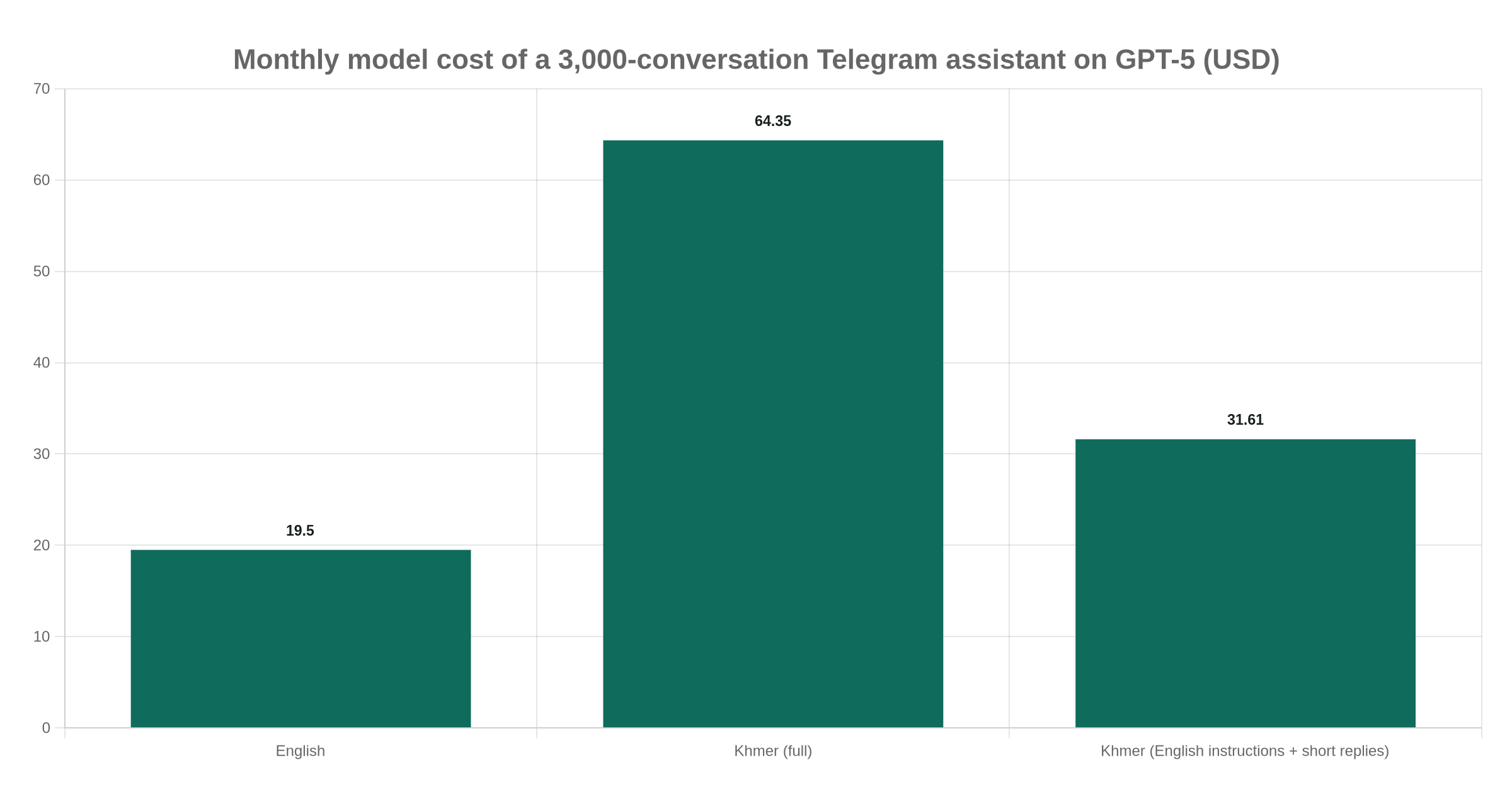
Take a hypothetical Phnom Penh real estate agency answering 3,000 Telegram conversations a month, each using 2,000 input tokens (1,500 of instructions and listings, 500 of customer messages and history) and 400 output tokens in English. GPT-5's list price is 1.25 USD per million input tokens and 10 USD per million output tokens (OpenAI pricing page, September 2026). In the mitigated case below, instructions and listings stay in English, the customer's 500 tokens of messages stay in Khmer (1,650 tokens at the 3.3 ratio) and replies are capped at 200 English-equivalent tokens (660 Khmer tokens).
| Scenario | Input tokens / month | Output tokens / month | Input cost | Output cost | Total |
|---|---|---|---|---|---|
| English | 6.00 M | 1.20 M | 7.50 USD | 12.00 USD | 19.50 USD |
| Full Khmer | 19.80 M | 3.96 M | 24.75 USD | 39.60 USD | 64.35 USD |
| English instructions, short Khmer replies | 9.45 M | 1.98 M | 11.81 USD | 19.80 USD | 31.61 USD |
Our first firm position: most Cambodian SMEs should not train or fine-tune a model. The budget belongs in integration and data cleaning, where the hours go; the per-token bill rarely sinks a project.
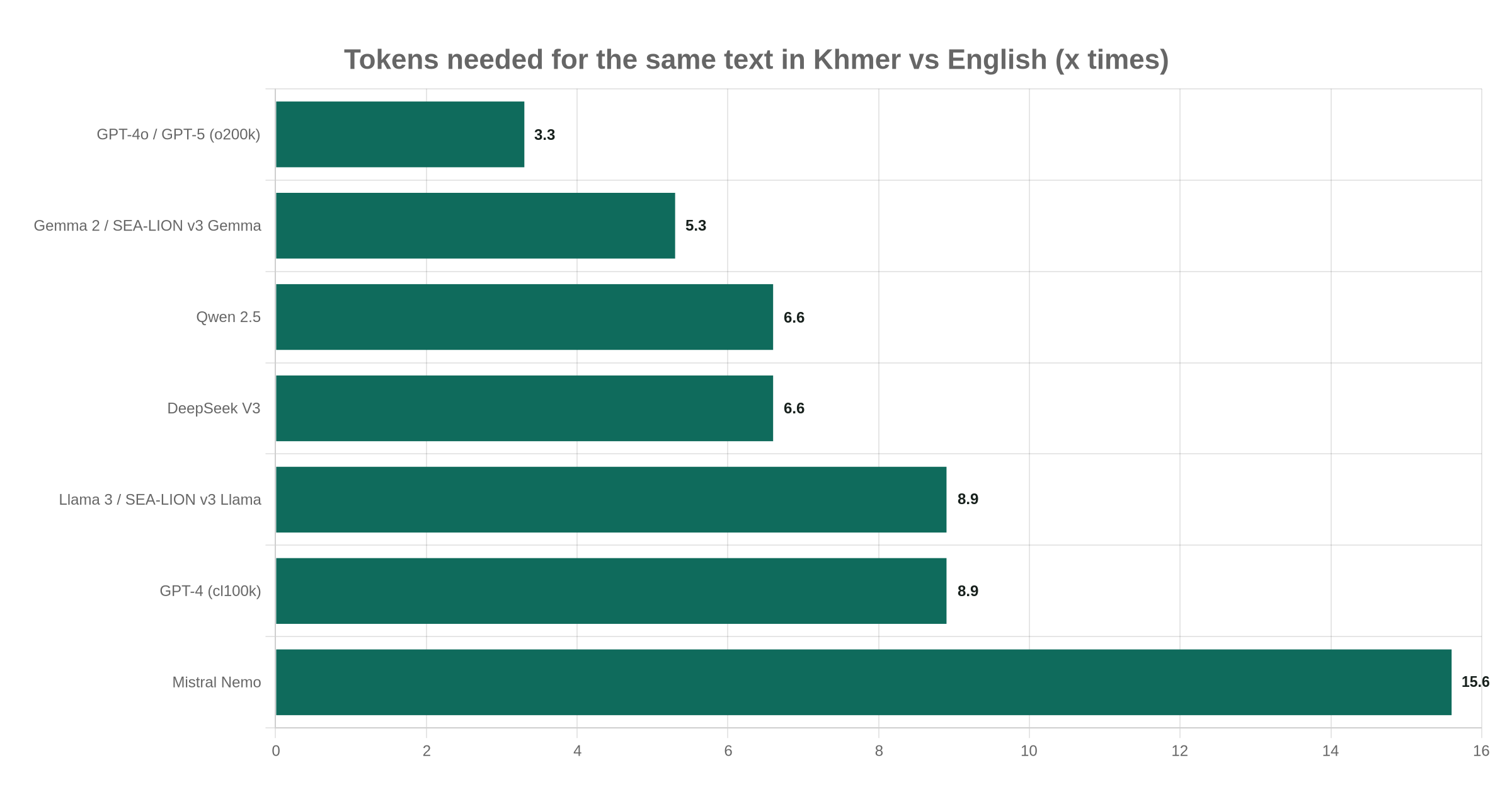
Our measurement: Khmer needs up to 15 times more tokens
Khmer multiplies the token count because most tokenizers were built mainly on English and a few large languages, so Khmer script is cut into small byte fragments instead of whole words. Khmer also writes without spaces between words, leaving fewer natural boundaries.
We took the Khmer and English texts of the Universal Declaration of Human Rights from the Unicode UDHR project (10,383 and 10,269 characters) and counted tokens on 23 September 2026 with OpenAI's tiktoken and the Hugging Face tokenizers library, on each model's published tokenizer, paragraph text only (headings excluded).
| Tokenizer (model family) | English tokens | Khmer tokens | Ratio |
|---|---|---|---|
| o200k (GPT-4o, GPT-5) | 1,888 | 6,271 | 3.3 |
| Gemma 2, SEA-LION v3 Gemma | 1,919 | 10,137 | 5.3 |
| Qwen 2.5 | 1,887 | 12,482 | 6.6 |
| DeepSeek V3 | 1,871 | 12,365 | 6.6 |
| Llama 3, SEA-LION v3 Llama | 1,887 | 16,817 | 8.9 |
| cl100k (GPT-4, GPT-3.5) | 1,887 | 16,817 | 8.9 |
| Mistral Nemo | 1,907 | 29,664 | 15.6 |
Claude and Gemini tokenizers are only exposed through their APIs' token-counting endpoints; we will add them in the next update of this measurement. A formal legal text is not a Telegram chat: treat these as orders of magnitude.
What does the Khmer penalty really cost a business?
The Khmer penalty costs speed and memory more than money. The table above shows a surcharge of 45 USD a month at most; the second-order effects are larger.
Take a self-hosted Llama 3.1 8B (128,000-token window), a common choice when data must stay on a sovereign server. For the microfinance branch above, a 300-token English answer becomes about 2,670 tokens in Khmer; at an illustrative 40 tokens per second, that is 67 seconds instead of 7.5, long enough to lose a customer on Telegram. The same window holds the English UDHR about 68 times and the Khmer version fewer than 8 times, so long files and conversation history run out of room far sooner.
A hypothetical 40-room boutique hotel in Siem Reap shows the other side: if 20 percent of its 1,200 monthly booking chats arrive in Khmer and the rest in English, only those 240 chats pay the penalty, and its GPT-5 bill moves from about 7.80 to 11.40 USD.
Hence our second position: choose the model for a Khmer-facing system by its Khmer token ratio before its benchmark score, then design around it (English instructions, short Khmer replies). The build and hosting choices behind that are in our article on AI development in Phnom Penh.
Is there enough AI talent in Cambodia to build and maintain these systems?
AI talent in Cambodia is scarce at the advanced end and growing at the entry level, so a company will find people to operate an AI system sooner than people to design one. The draft National AI Strategy sets a target of training 1,000 technical talents in AI, data science and related fields by 2030, which tells you how small the current pool is.
The Cambodia Development Resource Institute found in 2021 that ICT graduates earned about 10 percent more than comparable graduates, that employers expected ICT skill demand to grow about 30 percent a year, and that AI and data science electives were almost non-existent. CADT, the ministry's digital academy, leads Khmer language processing work and ran the UNESCO readiness assessment with 26 ministries and institutions (November 2024 to May 2025).
In practice, a Phnom Penh SME that commissions an agent should budget for someone in-house who owns it after launch (knowledge base, escalations), and ask any provider who maintains the prompts in month six. Our checklist of what an AI agency in Phnom Penh should deliver turns that question into contract terms.
Where do the AI strategy and data law leave AI development in Cambodia?
Neither the AI strategy nor the data law is in force in September 2026, but both already tell you how to approach AI development in Cambodia. The Ministry of Post and Telecommunications presented the draft National AI Strategy 2025 to 2030 to more than 450 participants on 1 July 2025; it sets six strategic priorities, starts with human resources, and includes MPTC's data collection for a national Khmer LLM. Cambodia ranked 118th of 195 countries in the Oxford Insights Government AI Readiness Index 2025 (score 33.5), up from 145th.
The draft Law on Personal Data Protection was released on 23 July 2025. Law firm HLC summarises its key terms: a two-year transition after promulgation, fines of up to 600 million riels (about 150,000 USD) or 10 percent of annual turnover, a certified data protection officer for every controller and processor, and a local representative for foreign companies. MPTC held a validation workshop with the European Union on 5 August 2026, still on a draft.
Sub-Decree 110 of 21 July 2017 on ICT licensing already applies to importers, distributors and developers of AI, according to the draft strategy. Our third position: do not wait for enactment. Build to the draft now (data inventory, consent at the start of each Telegram conversation, a named person responsible for data), because designing it in costs a few hours and retrofitting it costs a rebuild.
What we would do before commissioning an AI project
Before commissioning AI development in Cambodia, we would settle three questions on paper: which single workflow (in hours per week) the system takes over, which language customers use and what the chosen model's Khmer token ratio is, and which personal data passes through it and where it is hosted.
The Khmer model ecosystem is moving: AI Forum Cambodia and AI Singapore signed an agreement in January 2025 to extend the open SEA-LION models to Khmer. Our measurement shows a regional model does not automatically mean a lighter Khmer tokenizer, so test before you commit.
TechFlow Agency builds AI agents from Phnom Penh, on Cambodian time (ICT, UTC+7), with n8n and OpenRouter on Claude, GPT, Mistral or Llama, starting with a free 1 to 2 hour process-mapping audit. Bring one workflow to a 30-minute call: book a call and we tell you whether, and in which language, to automate it.
Frequently asked questions
Can an AI agent answer customers in Khmer?
Yes, the major language models read and write Khmer, but quality and cost vary by model. Khmer needs 3.3 to 15.6 times more tokens than English depending on the tokenizer, according to our September 2026 measurement.
How much does it cost to run an AI assistant in Khmer?
For a 3,000-conversation-a-month Telegram assistant at GPT-5 list prices, running fully in Khmer costs about 64.35 USD a month against 19.50 USD in English. Keeping instructions in English and Khmer replies short brings it to 31.61 USD.
Is there a law on AI in Cambodia?
Cambodia has no AI-specific law as of September 2026, and the National AI Strategy 2025 to 2030 is a draft. Sub-Decree 110 of 2017 on ICT licensing already covers AI suppliers.
Do I need to host AI data inside Cambodia?
No enacted rule requires AI data to be hosted in Cambodia today. The draft Law on Personal Data Protection would require a certified data protection officer and, for foreign companies, a local representative.
Have a project in mind?
Book a 30 minute call to see what we can do for you.
Recommended insights
The first 90 days with a marketing agency in Phnom Penh

Most marketing agencies in Cambodia fix the wrong bottleneck

Digital marketing in Cambodia in 2026 is won in the inbox, not the feed

What a digital marketing agency in Cambodia really costs after tax
Why one Phnom Penh digital agency beats three specialists (usually)

What 4 weeks of AI development in Phnom Penh looks like, week by week
The Khmer token tax and what AI development in Cambodia really costs

Before you buy AI in Cambodia, run a 4-criteria consulting audit

What AI agents do for a small business, and what they cost to run
Four things an AI agency in Phnom Penh should hand you

Webflow agency: how we use Webflow on SME projects

Web development Cambodia: Webflow, no-code and custom builds compared



.svg)

.svg)