

.svg)

Before you buy AI in Cambodia, run a 4-criteria consulting audit

AI consulting in Cambodia should begin with a map of how work moves through your company, not with a model or a chatbot demo. We score every recurring workflow on four criteria (weekly volume, rule clarity, cost of an error, data access) and automate only the one that scores highest. Our team in Phnom Penh runs that process-mapping audit free, in a 1 to 2 hour session, before any quote.
The reason is well documented. Gartner predicted in July 2024 that at least 30% of generative AI projects would be abandoned after the proof of concept by the end of 2025, citing poor data quality, weak risk controls, rising costs and unclear business value. None is fixed by a better model, and three of the four show up in a two-hour audit.
What does an AI consulting audit in Cambodia actually map?
An AI consulting audit in Cambodia maps each recurring workflow from trigger to last human touch, with the people who run it. For every workflow we record four things:
- Trigger: what starts it (a Telegram message, a KHQR payment alert, an email, a web form).
- Steps and owners: who touches it, in which tool, for how many minutes.
- Systems: CRM, ERP, spreadsheets, bank portals, chat groups.
- Exceptions: where someone has to think rather than follow a rule.
The documented process and the real one rarely match. The National Institute of Statistics counted 753,670 establishments employing 2.98 million people in its Economic Census 2022, about four workers each: at that size the process lives in people, a spreadsheet and two Telegram groups. The audit comes before the AI development choices on use cases, costs and talent.
Our first firm position follows. Do not buy an AI tool before the process map exists. MIT's Project NANDA report "The GenAI Divide" (2025) found that 95% of the generative AI pilots it studied had no measurable profit-and-loss impact, and blamed workflow integration, not models. A map costs two hours; a wrong licence costs a year of unused subscriptions.
How do we score a process on the 4 criteria?
We score each process from 1 to 3 on four criteria, for a maximum of 12; a process scoring 10 or more is a candidate to automate first. The grid is coarse on purpose, so a founder can score in the meeting.
| Criterion | Score 3 when | Score 2 when | Score 1 when |
|---|---|---|---|
| Weekly volume | 100+ repeats a week | 20 to 100 a week | A few a month |
| Rule clarity | Every step can be written as a rule | Rules cover most cases | Every case is a judgement call |
| Cost of an error | A colleague catches it before anyone outside sees it | It reaches a client but is easy to correct | It reaches the books, the tax office or a contract |
| Data access | Data arrives in a tool with an API or a structured feed | Data is digital but scattered (chats, PDFs) | Data is on paper or in one person's head |
High volume with unclear rules multiplies chaos. Clear rules without data access are a data project first. We also apply error cost as a gate: any process scoring 1 on error cost gets a mandatory human approval step, whatever its total.
Two processes at 10 go in sequence: the second reuses the first one's connectors.
The grid shifts by sector, as two hypothetical Phnom Penh cases show:
| Business | Top workflow | Volume | Rules | Error cost | Data | Total | Why it differs |
|---|---|---|---|---|---|---|---|
| Real-estate agency in BKK1 | Triaging Telegram and Facebook leads | 3 | 2 | 2 | 2 | 9 | A bad triage reaches the lead; one shared inbox (data 3) lifts it to 10 |
| Training centre in Toul Kork | Matching KHQR deposits to course bookings | 2 | 3 | 2 | 3 | 10 | Volume peaks at enrolment, not weekly |
Worked example: five workflows at a Phnom Penh distributor
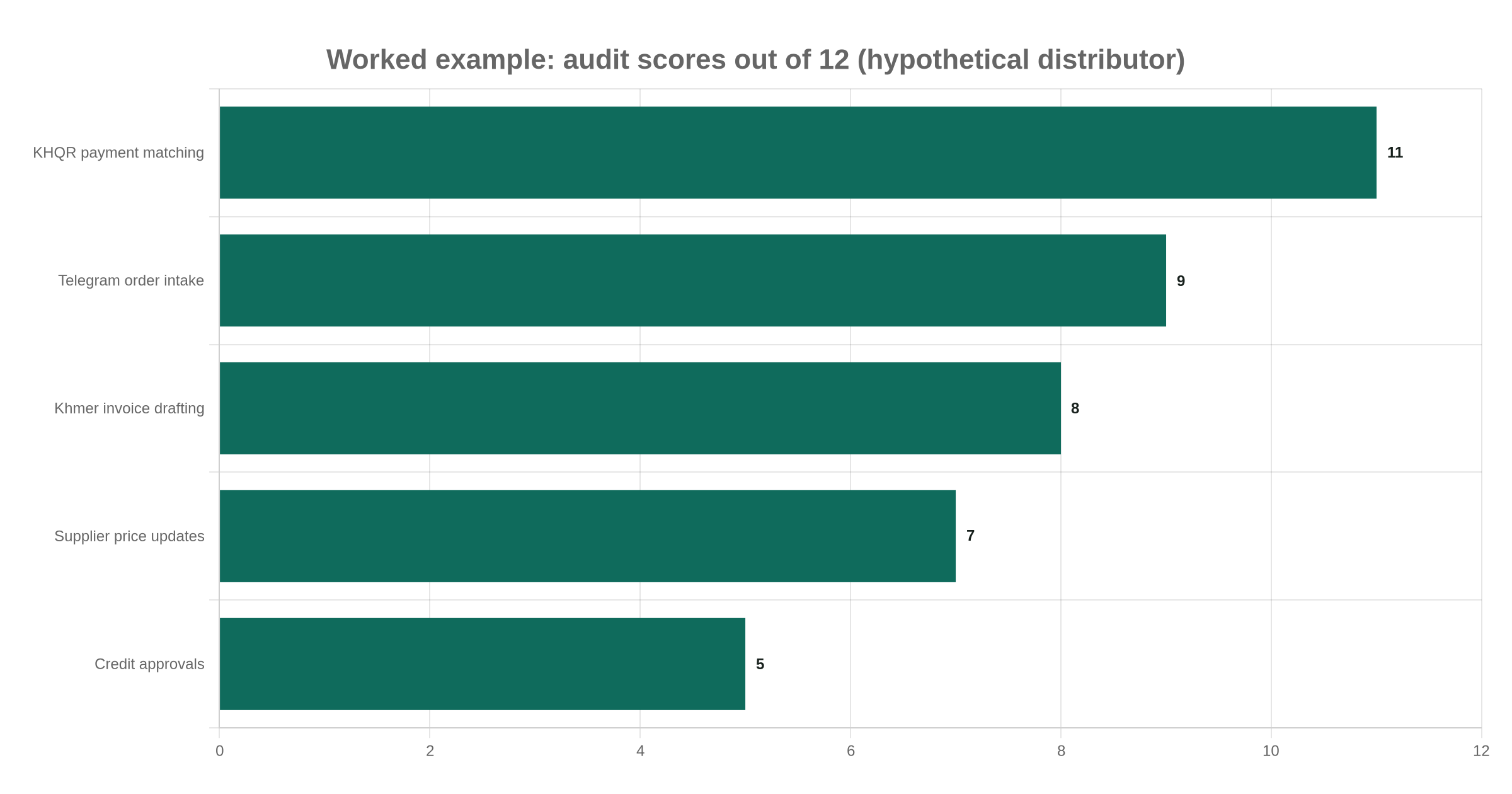
Take a hypothetical building-materials distributor in Sen Sok, Phnom Penh, with 30 staff: orders arrive on sales staff's personal Telegram accounts, customers pay by KHQR, invoices are bilingual. The audit scores five workflows.
| Workflow | Volume | Rules | Error cost | Data access | Total |
|---|---|---|---|---|---|
| Matching KHQR payments to orders | 3 | 3 | 2 | 3 | 11 |
| Taking orders from Telegram | 3 | 2 | 2 | 2 | 9 |
| Drafting Khmer and English invoices | 3 | 2 | 1 | 2 | 8 |
| Updating supplier price lists | 1 | 2 | 2 | 2 | 7 |
| Approving customer credit | 2 | 1 | 1 | 1 | 5 |
Telegram intake scores 2 on data access because a bot cannot read personal chats; it rises to 10 once orders move to one Telegram Business account. Payment matching goes first. Our assumptions, to swap for your own: 180 KHQR payments a week, 3 minutes each for an accounting assistant to find the order and mark it paid, 40% landing after 3 pm, 2% with a wrong amount. Matching alone takes 9 hours a week, roughly 39 hours a month.
In Cambodia, automate for speed and error rate, not to cut headcount. The Ministry of Labour's Cambodia Job Outlook Survey (second semester 2024) puts an accounting assistant at about $500 a month plus $174 in benefits. Over about 208 hours a month (a 48-hour week), that is roughly $3.25 an hour, so the 39 hours are worth about $126 a month, or about $1,500 a year, which on its own rarely repays a custom build. The speed gain is larger. The late 40% means 72 orders a week wait about 16 hours for the next morning; matched on arrival, they ship the same day. The 2% means 4 mismatches a week flagged the same day instead of about 16 piling up until month-end.
Which Cambodian checks does AI consulting add to the audit?
AI consulting in Cambodia adds two checks a European audit template misses: where conversations happen and how money arrives. Both set the data-access score.
Is the real inbox a Telegram account?
Many Phnom Penh companies sell on Telegram, so we check which kind. A bot built on the Telegram Bot API cannot read a salesperson's personal chats. Since 2024, Telegram Business lets a Premium account connect a chatbot that answers on its behalf: one shared business account is automatable, a dozen personal phones are not. Telegram's bot documentation also caps bot downloads at 20 MB, so a large scanned delivery note needs another channel, and group messages at 20 a minute.
How do KHQR payment alerts reach you?
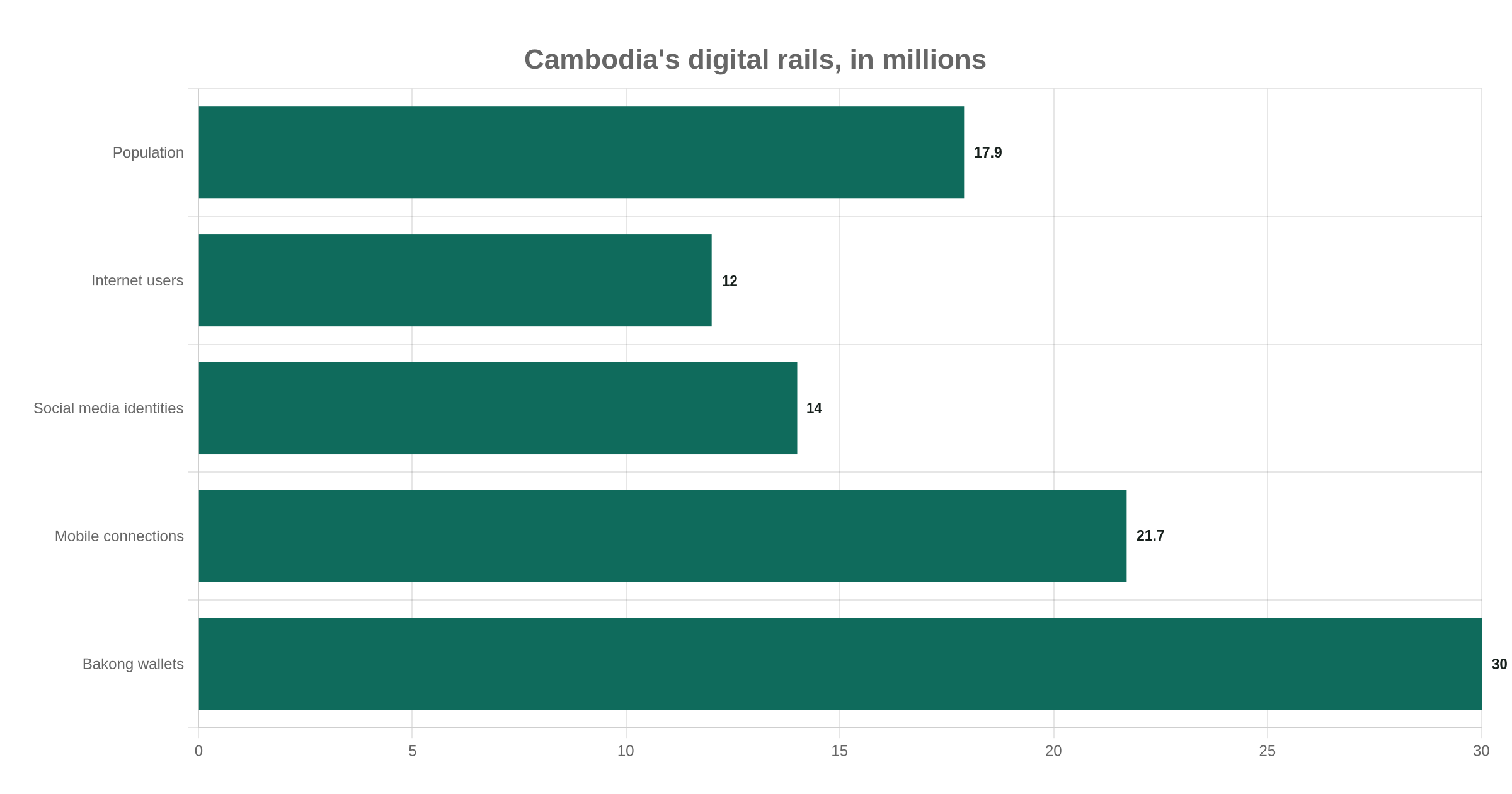
Payment matching depends on the alert format. The National Bank of Cambodia's annual report for 2024 recorded $148.9 billion of payments through Bakong, about 330% of GDP, roughly 30 million wallets and 4.5 million merchants able to accept KHQR. The question is whether alerts reach you through a gateway such as ABA PayWay with a structured feed, or as notifications someone reads on a phone. The first scores 3 on data access; the second needs a connector first.
How do Khmer documents and the draft data law change the design?
Khmer documents and the draft data protection law change the design more than the choice of model does: they decide what a human still checks and where data may sit.
On documents, the General Department of Taxation's Prakas 723 (2019) requires every invoice to be in Khmer, or in Khmer with the English under it, and large and medium taxpayers must keep invoices for 10 years. Hence the 1 on error cost in our example: a model prepares the bilingual draft, a Khmer reader approves it. During the audit we run the chosen model on 50 of your own invoices and receipts, compare every extracted field to the original, and set the approval threshold from the error rate we measure.
On data, the Ministry of Post and Telecommunications unveiled the draft Law on Personal Data Protection on 23 July 2025. The draft requires breach notification to the ministry within 72 hours, provides fines of up to 600 million riels or 10% of annual turnover for a company, and makes transfers abroad subject to ministry permission or listed exceptions. It was still a draft in September 2026, with a two-year implementation period planned after promulgation. We design as if it applied: customer data stays on a private cloud or sovereign servers where needed, and every agent logs what it read. The same ministry's draft National AI Strategy 2025-2030, still under development per OECD.AI, makes ethical and responsible AI one of six priorities, so logging and human approval will likely be expected.
What should you automate first, and what should you never automate?
You should automate first the highest-scoring process that is invisible to your customers, and you should never automate a decision that commits money, signs, files or disciplines. That is our third position, against most sales demos, which open with a customer chatbot.
A back-office process fails quietly: a mismatched KHQR payment lands in the accountant's exception list. A customer chatbot fails in public: it quotes last month's cement price to a contractor on Telegram, who then calls the owner. Start where a colleague catches the mistake, then move closer to the customer. When you reach that step, our guide to AI agents for small businesses sets out what customer-facing agents cost to run.
| Automate first | Automate with human approval | Never automate |
|---|---|---|
| Payment matching and exception flags | Invoice drafts in Khmer and English | Credit decisions and credit limits |
| Order capture from a Telegram Business account | Replies to routine customer questions | Pricing exceptions and discounts |
| Weekly sales and stock summaries | Supplier follow-ups | Tax filings, contracts, HR discipline |
The "never" column is about accountability: when a customer disputes a credit refusal, "the model decided" is not an answer a Cambodian business partner accepts.
From audit to action plan: how our AI consulting in Cambodia runs
Our AI consulting in Cambodia starts with the free 1 to 2 hour audit, followed within 5 days by a costed action plan naming the first process, its data and its hosting. Deployment of the resulting custom AI agents takes 1 to 4 weeks, orchestrated with n8n and OpenRouter on Claude, GPT, Mistral or Llama models.
We work from Phnom Penh on Indochina Time (UTC+7), in English and French, and position our work as 35% less expensive than European agencies. That is a pricing position, not a measured result. Our AI line is recent and has no published case studies yet, so the audit is also how you judge us. If you are still choosing a partner, compare what an AI agency in Phnom Penh should build, or how AI development in Phnom Penh moves from prototype to production. Browse our projects, then book a 30-minute call with Maximilien Grolier or request a quote.
Frequently asked questions
Is the AI process audit really free?
Yes, a free 1 to 2 hour session with the people who run the work. You keep the scored grid whether or not you continue with us.
What does an AI consultant in Cambodia deliver after the audit?
An AI consultant in Cambodia should deliver ranked processes, the data each needs, and a costed plan for the first. At TechFlow Agency the same team then builds and maintains the agent.
Can AI read Khmer documents reliably?
We measure it on 50 of your own documents during the audit, field by field. Whatever the result, a person who reads Khmer approves anything that reaches a client or the tax office.
Does the draft data protection law stop us from using cloud AI?
No, but it shapes the design. The draft law would make transfers abroad subject to ministry permission or listed exceptions, so we choose private cloud or sovereign hosting when customer data is involved.
Have a project in mind?
Book a 30 minute call to see what we can do for you.
Recommended insights
The first 90 days with a marketing agency in Phnom Penh

Most marketing agencies in Cambodia fix the wrong bottleneck

Digital marketing in Cambodia in 2026 is won in the inbox, not the feed

What a digital marketing agency in Cambodia really costs after tax

Why one Phnom Penh digital agency beats three specialists (usually)

What 4 weeks of AI development in Phnom Penh looks like, week by week

The Khmer token tax and what AI development in Cambodia really costs
Before you buy AI in Cambodia, run a 4-criteria consulting audit

What AI agents do for a small business, and what they cost to run

Four things an AI agency in Phnom Penh should hand you

Webflow agency: how we use Webflow on SME projects

Web development Cambodia: Webflow, no-code and custom builds compared



.svg)

.svg)