

.svg)

What AI agents do for a small business, and what they cost to run

AI agents for small business are software workers that read a request, look up your data, decide the next step and act inside your tools: they qualify a Telegram lead and write it into the CRM, or read a supplier invoice and post it to Odoo. The model is only one line of their running cost. On September 2026 list prices, a typical support conversation costs between 1 and 17 US cents in model usage; routing fees, hosting and the staff time needed to supervise the agent complete the bill.
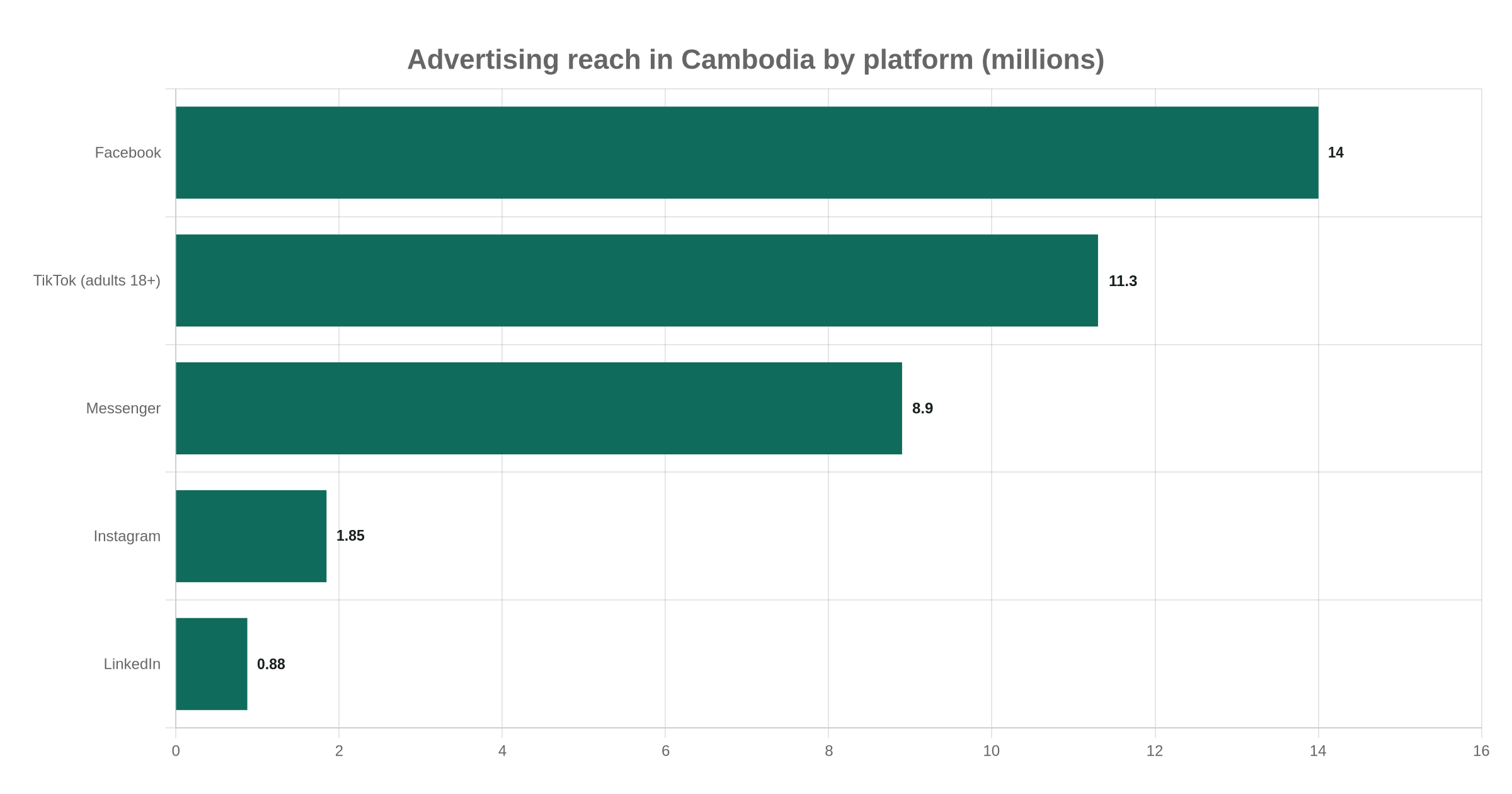
Below, we price a realistic case line by line, including a cost rarely mentioned for Cambodia: Khmer text consumes about 3.3 times more tokens than English, as measured in our Cambodia AI development guide. And Cambodian customers write before they buy: DataReportal's Digital 2026 report counts 12.0 million internet users (67.3 percent of the population) and a Facebook Messenger advertising reach of 8.90 million people.
What does an AI agent do for a small business that a chatbot cannot?
An AI agent for a small business completes a multi-step task inside your systems; a chatbot only answers. The difference is the ability to act: an agent calls tools (CRM, calendar, ERP), checks the result and decides the next step, within rules you set. Three families of work cover most requests, each shown here with a hypothetical Phnom Penh case:
- Lead intake: a dental clinic in Toul Kork receives booking requests on Telegram and Messenger. A chatbot answers "Are you open Saturday?" and stops; an agent asks the treatment in English or Khmer, books the slot in the calendar and sends a reminder.
- Back office: an importer receives 200 supplier invoices a month by email; the agent extracts supplier, amount and due date into Odoo. At about 4 minutes per invoice, that frees roughly 13 hours a month.
- Follow-up: the agent chases overdue payments with a KHQR code or an ABA Pay link rather than bank details. KHQR, the National Bank of Cambodia's common QR standard, works in any member bank app, so the customer scans and pays from whichever bank app they already use.
Adoption is early. The JPMorgan Chase Institute found that 17.7 percent of US small businesses in its card-spending data were paying for AI services by December 2025, with a median spend of about 28 dollars a month. Our reading: 28 dollars a month buys a subscription, not an agent wired into your systems.
When is an off-the-shelf AI tool enough, and when should a small business build an agent?
An off-the-shelf AI tool is enough when the task is generic and lives inside one application; a small business should build an agent when the workflow crosses its own systems or rules. Summarising a meeting does not need an agent; booking a patient against your real calendar does.
| Criterion | Chatbot builder | Off-the-shelf AI tool | Custom AI agent |
|---|---|---|---|
| What it does | Answers from a script or FAQ | Generates text inside one app | Acts across your CRM, ERP, calendar |
| Khmer handling | Only what you script | Depends on the vendor | Tested on your own messages |
| Data location | Vendor cloud | Vendor cloud | Orchestration and logs on your server |
A custom agent is billed per token, often through a router such as OpenRouter that puts Claude, GPT, Mistral and Llama behind one account.
Our position: a small business should start with one agent, on one channel, doing one job, usually lead intake on Telegram or Messenger. Agents covering sales, support and accounting from day one fail on the edge cases of all three. If you do not know which workflow to automate first, an AI consulting audit ranks the candidates by hours saved.
What does it cost to run an AI agent, conversation by conversation?
The model cost of one AI agent conversation is the number of tokens sent and received multiplied by the provider's list price. Every turn resends the instructions, company data and history, which is why input tokens dominate.
Worked example on September 2026 list prices: a support conversation of 8 exchanges, each sending about 3,000 input tokens (2,000 of fixed instructions and data, 1,000 of conversation) and receiving 300 output tokens:
- Claude Haiku 4.5 (Anthropic: 1 dollar per million input tokens, 5 per million output): 24,000 input tokens cost 0.024 dollars, 2,400 output tokens cost 0.012 dollars. Total: 0.036 dollars per conversation.
- Claude Sonnet 5 (2 and 10 dollars): 0.072 dollars.
- GPT-5 mini (OpenAI: 0.25 and 2 dollars): 0.011 dollars.
Prompt caching lowers this: at Anthropic's 0.10 dollars per million cached-read tokens on Haiku 4.5, caching the 2,000 fixed tokens brings the conversation to about 0.024 dollars, a third less. Routing through OpenRouter adds a 5.5 percent platform fee on its pay-as-you-go plan.
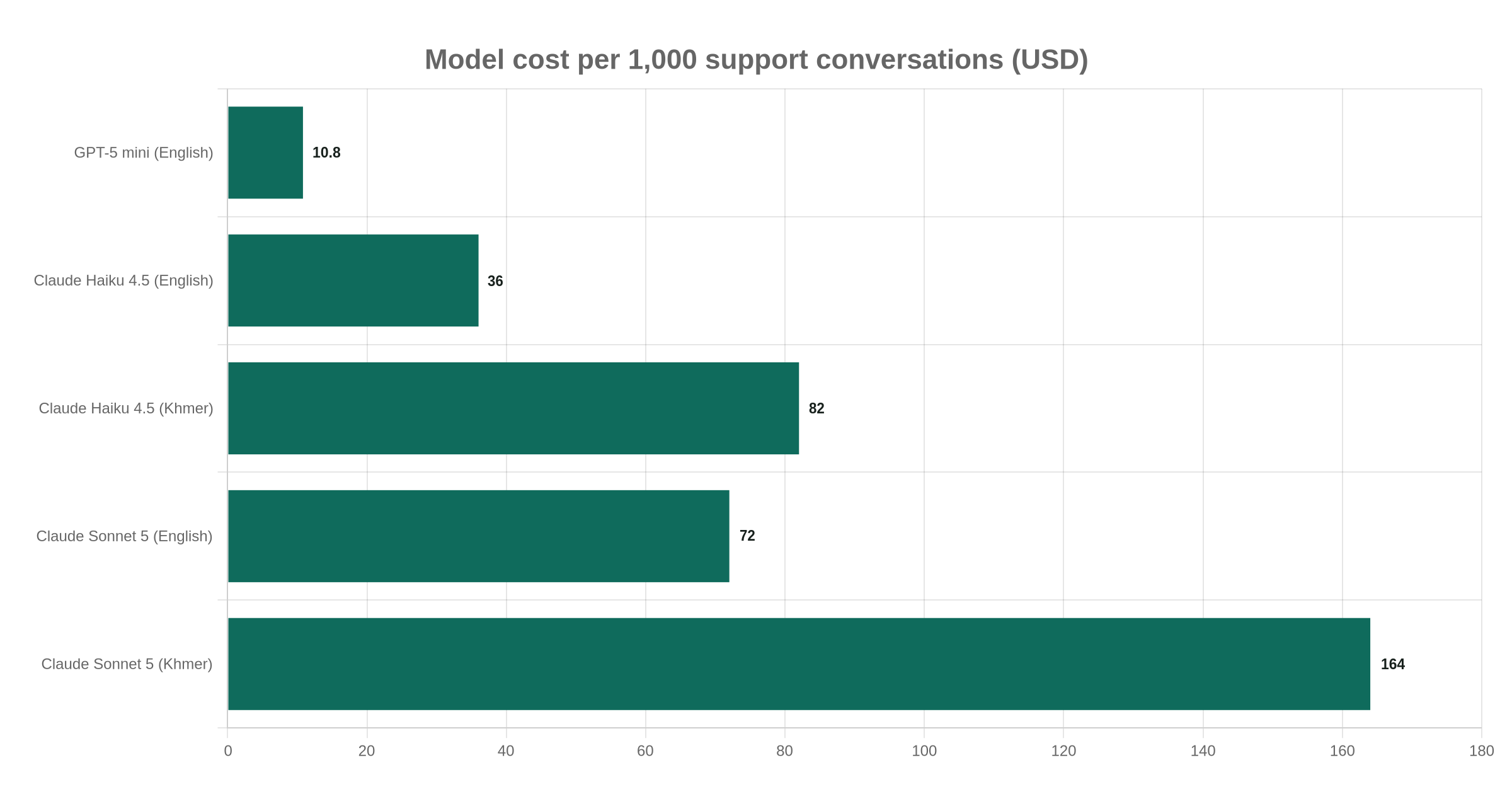
At 1,000 conversations, the gap between models (11 to 72 dollars in English) stays in tens of dollars a month. The Khmer bars are explained below.
The Khmer premium: why language changes the bill
Khmer costs more because major tokenizers split its script into many more pieces. Our measurement, detailed in the parent guide, found that the o200k_base tokenizer used by GPT-4o and GPT-5 needs 3.3 times more tokens for the same text in Khmer than in English. Anthropic does not publish its tokenizer, so we apply the same factor to Claude as a working assumption.
In the worked example, the 1,000 conversational tokens per turn become 3,300 and the 300-token reply becomes 990. The Haiku 4.5 conversation goes from 0.036 to 0.082 dollars (42,400 input and 7,920 output tokens), and Sonnet 5 reaches 0.164 dollars. Doubled, it is still 8 cents: as the parent guide shows, the larger cost of Khmer at this volume is response time and context length, not the invoice.
Our position: choose the model on Khmer test results, not on the price list. One lost patient or client costs more than the monthly gap between two models.
What does the full monthly bill look like for a Phnom Penh business?
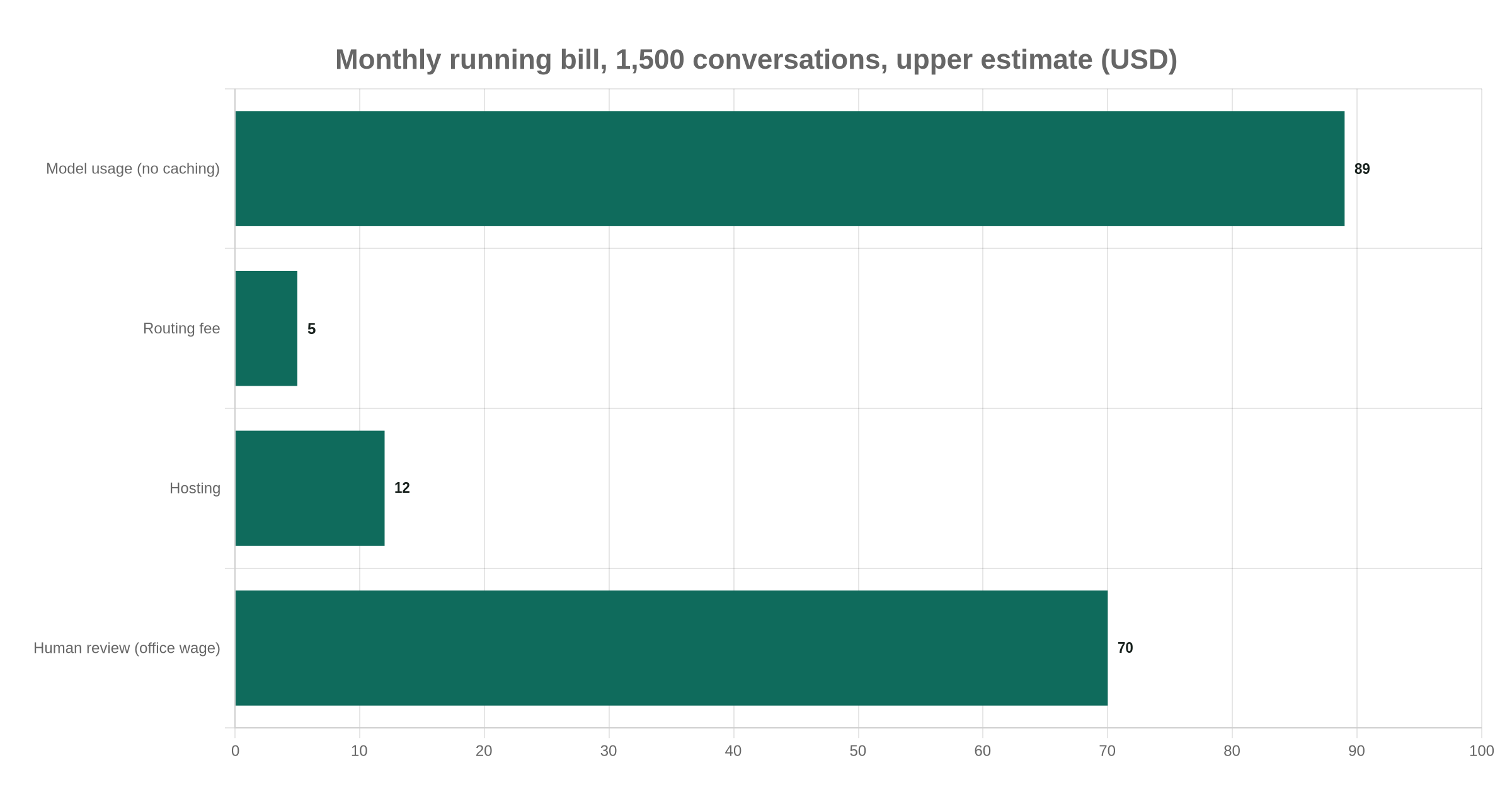
The full monthly running cost of a small business AI agent adds model usage, routing, hosting, the channel and human supervision, before maintenance. Here is the Toul Kork clinic, with 1,500 conversations a month, half in Khmer, on Claude Haiku 4.5.
| Line | Basis (September 2026) | Monthly cost |
|---|---|---|
| Model usage | 750 English at 0.036 dollars, 750 Khmer at 0.082; about 70 with prompt caching | 70 to 89 dollars |
| Routing fee | OpenRouter, 5.5 percent of model spend | 4 to 5 dollars |
| Orchestration and hosting | n8n Community Edition on a 2 GB DigitalOcean droplet | 12 dollars |
| Channel | Telegram Bot API, free by default | 0 |
| Human review | About 20 hours of staff time | 30 to 70 dollars |
| Total | Before maintenance and improvements | About 115 to 175 dollars |
The low end assumes caching and review paid at the national average wage; the high end assumes no caching and an office wage.
The human line runs from the average monthly wage of about 1.2 million riel (roughly 300 dollars) in the National Institute of Statistics' Labour Force Survey 2025 to our assumption of 500 to 700 dollars for office staff, over the 48-hour week set by Cambodia's Labour Law.
The orchestration line hides a budgeting trap. n8n's cloud plans are metered by executions: Starter costs 20 euros a month (billed annually) for 2,500 executions and Pro 50 euros for 10,000. If each of the 8 turns triggers one execution, 1,500 conversations produce 12,000 executions, above the Pro limit. The free, self-hosted Community Edition has no such ceiling.
Which pitfalls sink small business AI agents?
The pitfalls that sink small business AI agents are mostly organisational. Gartner predicted in June 2025 that over 40 percent of agentic AI projects will be cancelled by the end of 2027, citing costs, unclear value and weak risk controls. Small businesses meet the same causes:
- Automating an unmapped process: if two receptionists book patients differently, the agent inherits the confusion. Write one method down first.
- No hand-off rule: complaints, refunds and negotiations must reach a named person, with the history attached.
- Untested Khmer: test on 50 to 100 real past messages, including mixed and romanised Khmer, before launch.
- Personal data without a policy: Cambodia's Law on Personal Data Protection was still not enacted as of February 2026, according to DLA Piper's country guide, after a draft circulated for comment with a consultation workshop in July 2025. Decide now where logs are stored, and for how long.
- Nobody reads the logs: review a sample every week.
Our position: no agent should issue a refund, change a booking or quote a price outside the list without human approval during its first 90 days. Autonomy is earned from the logs.
How we would start, and how TechFlow Agency scopes an AI agent
We would start with the workflow that costs your team the most hours, then choose a channel and a model. Our custom AI agents offer, run from Phnom Penh (ICT, UTC+7) in English and French, begins with a free 1 to 2 hour process-mapping audit, then a costed action plan in 5 days with the lines above filled in for your volumes, deployment in 1 to 4 weeks and monthly reports; our article on going from prototype to production details those weeks.
Orchestration and logs stay on your private cloud or sovereign server, while each request is still processed by the model provider; where full sovereignty matters, a self-hosted open model is the alternative, at the cost of the Khmer quality your test measures. We price our work about 35 percent below European agencies. Still comparing partners? Our guide to AI agency selection in Phnom Penh sets out the criteria; with volumes in hand, request a scoped estimate.
Frequently asked questions
How much does an AI agent cost per month for a small business?
An AI agent handling 1,500 conversations a month, half in Khmer, costs about 115 to 175 dollars to run on September 2026 prices, before maintenance, when it is self-hosted and uses a small model such as Claude Haiku 4.5. Model usage and human review are the two largest lines. Prompt caching cuts the model line by about a fifth.
How long before an AI agent pays for itself?
An AI agent pays for itself when the staff hours it frees are worth more than its monthly bill. In the importer example, 13 hours a month at an office wage of 500 to 700 dollars is worth about 30 to 45 dollars, so invoice processing alone rarely justifies an agent. For the clinic, divide the 115 to 175 dollar bill by your average booking value: if a booking were worth 20 dollars, 6 to 9 extra bookings a month would cover it.
Can an AI agent reply to customers in Khmer?
An AI agent can reply in Khmer, but Khmer is harder for current models and uses about 3.3 times more tokens on OpenAI's o200k_base tokenizer. Test on your own past messages and keep human review in the first weeks.
Is Telegram or Messenger better for a customer-facing AI agent in Cambodia?
Use the channel where your customers already write. Telegram's Bot API lets bots message users at no cost by default; Messenger reaches 8.90 million people in Cambodia according to DataReportal's Digital 2026 report, so many consumer businesses start there.
Have a project in mind?
Book a 30 minute call to see what we can do for you.
Recommended insights
The first 90 days with a marketing agency in Phnom Penh

Most marketing agencies in Cambodia fix the wrong bottleneck

Digital marketing in Cambodia in 2026 is won in the inbox, not the feed

What a digital marketing agency in Cambodia really costs after tax

Why one Phnom Penh digital agency beats three specialists (usually)

What 4 weeks of AI development in Phnom Penh looks like, week by week

The Khmer token tax and what AI development in Cambodia really costs

Before you buy AI in Cambodia, run a 4-criteria consulting audit
What AI agents do for a small business, and what they cost to run

Four things an AI agency in Phnom Penh should hand you

Webflow agency: how we use Webflow on SME projects

Web development Cambodia: Webflow, no-code and custom builds compared



.svg)

.svg)