

A software development company in Cambodia worth hiring delivers four things, not one: a scoped brief, a working system (CRM, ERP, an internal tool, or a platform), the local rules generic software gets wrong, and a team still reachable after launch. Our team works out of Phnom Penh on ICT (UTC+7): a same-timezone call with your developer, not a handoff across a 12-hour gap, is often the difference between a same-day fix and one that waits until tomorrow.
Part of our broader web development in Cambodia coverage, narrowed here to custom software: CRM, ERP, and business platforms, not marketing sites.
What does a software development company in Cambodia actually build?
A software development company in Cambodia builds systems that run a business, not pages that describe one: CRM (Odoo, Twenty CRM, HubSpot, or a bespoke build), ERP modules (accounting, inventory, HR), internal tools (approval workflows, dashboards, booking systems), and customer-facing platforms (marketplaces, SaaS products, member portals). That is a different brief than a website company's, though buyers often mix the two up.
- CRM: a pipeline your sales team updates, wired to email, WhatsApp, or Telegram where leads already are.
- ERP modules: accounting, inventory, or HR reflecting Cambodian tax and payroll rules, not a generic template.
- Internal tools: the approval chains and dashboards a growing team outgrows in spreadsheets.
- Platforms: a marketplace, booking system, or SaaS product with its own paying users.
The market is more fragmented than it looks from one directory. TechBehemoths lists 14 software development companies for the whole of Cambodia (TechBehemoths, 2026), short enough to shortlist three candidates directly.
How much does a software development company in Cambodia charge for CRM or ERP work?
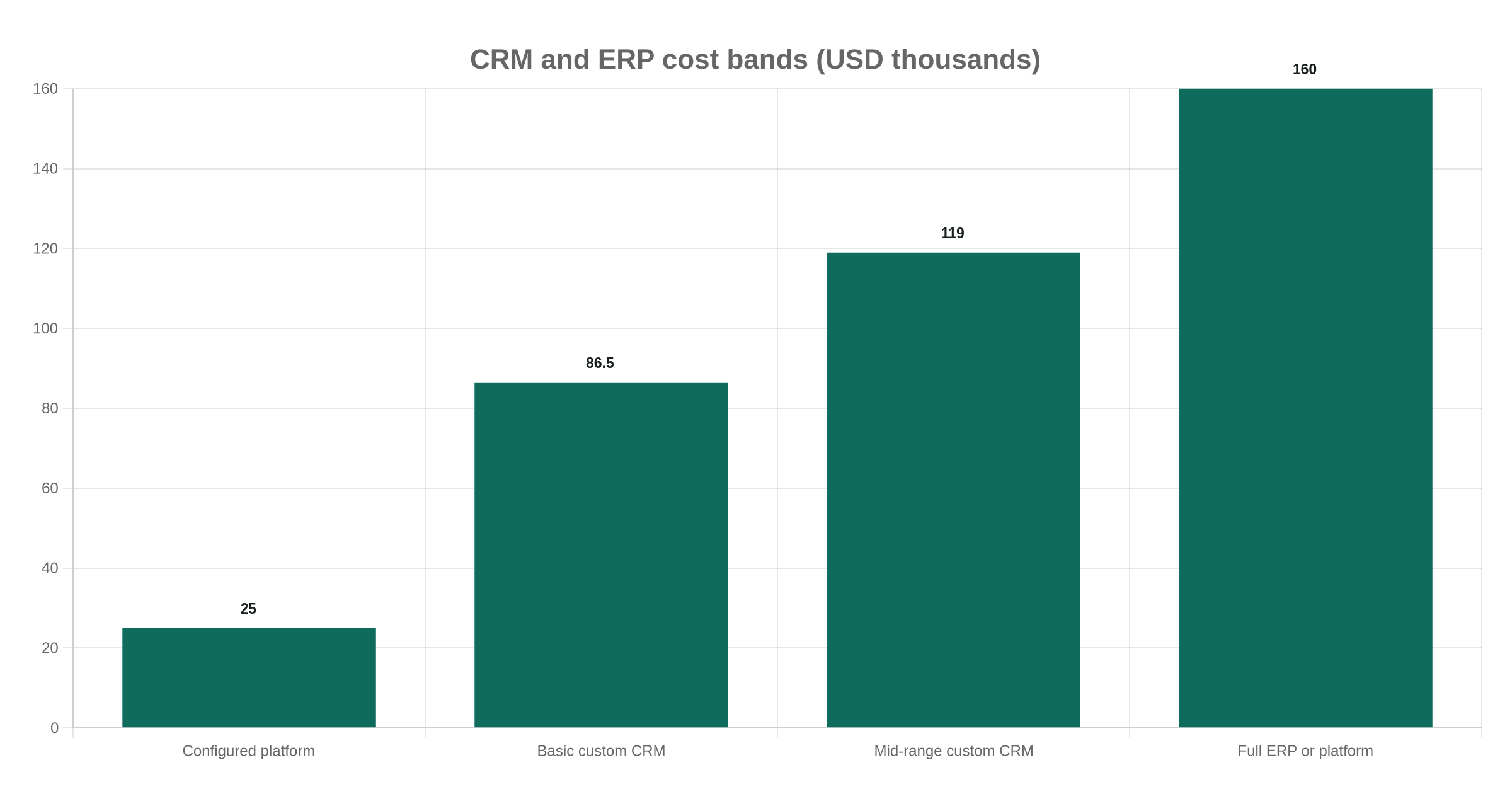
A software development company in Cambodia typically charges below the global bands for a custom CRM or ERP build, because local hourly rates sit at the low end of the region. Cambodia's offshore development rate runs $25 to $49 an hour, the lowest band tracked in Southeast Asia (Qubit Labs, 2026). Purrweb splits a from-scratch custom CRM build into three bands, Simple at $75,000 to $98,000, Medium at $98,000 to $140,000, Advanced at $140,000 to $180,000 and up (Purrweb, 2026), the basis for the table below. Cleveroad's own numbers run lower across the board, $50,000 to $80,000 and up for a small-to-medium build, $100,000 to $150,000 and up for an advanced one (Cleveroad, 2026): a cross-check on the same order of magnitude. Configuring an existing platform instead, Odoo, Twenty CRM, or HubSpot set up rather than coded from zero, runs below even the lowest of those bands: at Cambodia's blended rate near $250 a day, a typical configuration project (60 to 140 developer-days) lands around $15,000 to $35,000, TechFlow's own estimate, since neither guide prices configuration work.
| Build type | What it typically includes | Cost band (Purrweb, 2026) | Typical timeline |
|---|---|---|---|
| Configured platform | Odoo, Twenty CRM, or HubSpot set up and customized, no ground-up code | $15,000 to $35,000 (TechFlow estimate) | 1 to 3 months (Portcities, 2026) |
| Basic custom CRM ("Simple") | Contact management, a pipeline, reporting, built from scratch | $75,000 to $98,000 | 4 to 6 months |
| Mid-range custom CRM or ERP module ("Medium") | Bespoke workflow logic, advanced integrations, marketing automation | $98,000 to $140,000 | 6 to 9 months |
| Full ERP or platform build ("Advanced") | Multiple modules, custom architecture, integrations | $140,000 to $180,000 and up | 9-plus months |
We think most Cambodian SMEs asking for a CRM need a configured Odoo or Twenty CRM, not a system built from zero; a developer who pitches a ground-up build before ruling out configuration first is pricing for their own invoice, not your budget. That same discipline matters before you even shortlist a vendor: our take on buying a CRM in Cambodia argues the habit of logging every lead matters more than the platform, and a system nobody logs into wastes its budget regardless of who built it. Configuration also lands faster: Portcities' own no-customization quick-start Odoo package runs 1 to 3 months (Portcities, 2026), still shorter than any custom build in the table above.
In developer-days, a 15-employee Phnom Penh trading company configuring Odoo for accounting, inventory and NSSF-ready payroll needs about 100 developer-days, a four-person team for five weeks: at $280 a day that is roughly $28,000, inside the band above and well under Cleveroad's $50,000 floor for a from-scratch build.
Why the published Cambodia developer salaries don't add up
Two public salary trackers, pulled the same week, disagree on the same role and city by an order of magnitude, too far apart to trust for a budget. Worldsalaries.com lists a Cambodia-wide software developer average near 38 million riel a year (Worldsalaries, 2026). Glassdoor's Phnom Penh-specific page reports figures for the same title that do not scale to that yearly number, with an unexplained jump in the underlying pay period. Neither site publishes its sample size or its method for Cambodia.
That mismatch is not a rounding error: it signals that public salary aggregators do not have enough Cambodia-specific data to be reliable. We would not anchor a Cambodia software budget on a public salary calculator; ask any shortlisted company for a role-by-role cost breakdown instead, and treat a refusal to itemize as a red flag. A company that can itemize developer-days and blended rate has done the estimating work; one that quotes a lump sum has not.
What local rules does software built for Cambodia actually need to handle?
Software built for Cambodia needs to handle dual-currency accounting (Khmer riel and US dollar side by side), NSSF payroll contributions, Cambodia's withholding tax brackets, and e-invoicing rules, which a generic ERP template skips. Implementers report that earlier ERP projects in Cambodia failed because the team building them did not understand these local practices going in (Innolabs, 2026).
Payments add a second layer. Bakong, the National Bank of Cambodia's payment rail behind KHQR, processed roughly 1 billion transactions worth $135.8 billion in the first half of 2026 alone (National Bank of Cambodia, via Xinhua, 2026), and riel transaction volume through Bakong grew 317.3 percent over the last five years (Khmer Times, 2026). KHQR is now routine from street stalls to corporate invoices. A CRM or ERP that cannot reconcile a KHQR payment against an invoice is incomplete for this market.
Cambodia's SMEs make up 58 percent of GDP, and bringing more of them onto electronic business services is a stated national priority (Cambodianess, 2026). A software company that has already built for the National Social Security Fund and withholding tax rules once does not have to relearn them on your project.
In-house, freelance, or an IT solution company in Cambodia
The right pick, in-house hire, freelancer, or an IT solution company in Cambodia, tracks how much ongoing change your system needs, not how big the first project looks. A single internal tool with a fixed scope suits a freelancer: fast and cheaper at that size. A CRM or ERP that keeps changing as your business grows suits a company: the work spreads across a team, so no single departure leaves it unsupported. A brief that's really a Webflow front end around the CRM or ERP belongs with our Webflow agency coverage instead.
Before we price any of it, we check one thing first: whether a "custom CRM" request is actually a configuration job wearing a custom-build price tag. We map the workflow against Odoo's or Twenty CRM's data model before writing a line of code, since forcing a platform to drop a default field costs more than most clients expect.
An in-house hire makes sense once your software needs are constant enough to keep one or two developers busy full time, which for most SMEs in Cambodia is later than they think. The same thinness behind TechBehemoths' 14-company Cambodia list (TechBehemoths, 2026) also thins the pool of experienced developers: lose the one person who understands your system and wait on a replacement, while a company spreads that risk across a team.
What happens on your first call with a software team in Cambodia?
On a first call with a software team in Cambodia, expect to be asked what the system replaces (a spreadsheet, a paper process, another tool that no longer fits), who uses it daily, and what it needs to connect to: your accounting, your payment rails, your existing CRM. Bring those answers and you save a full round of scoping.
A typical first-call brief takes one of two shapes: a 10-person logistics company replacing a day-old spreadsheet with a CRM the sales team updates itself, or a retailer whose POS and accounting never synced, so every sale gets re-typed by hand at closing. On the call we ask what actually breaks today, then place the project as a configured platform, a two-system integration, or a larger custom build. Most first calls run 30 to 45 minutes and end with a rough cost band, not a final quote.
Our custom software development work in Phnom Penh follows a six-step process: scoping and audit, technical recommendations, design and prototype, sprint-based development, testing and go-live, and post-launch follow-up, the same process behind our web development company and web design work. See the our project work from that process, and book a call to walk through your own brief.
Prefer to chat? Message our founder directly on Telegram (@maxgrolier), or book a call with the team.
Frequently asked questions
Is a software development company in Cambodia cheaper than one in Europe or the US?
Generally yes. Cambodia's $25 to $49 an hour offshore rate sits below most European and North American agency rates, and below several regional peers (Qubit Labs, 2026).
Do I need a custom-built CRM, or can I configure an existing one?
Most SMEs can configure Odoo, Twenty CRM, or HubSpot faster and cheaper than a ground-up build. A custom build only pays off when your workflow genuinely does not fit any existing platform's data model.
How long does a CRM or ERP project take in Cambodia?
A no-customization Odoo quick-start package goes live in 1 to 3 months (Portcities, 2026). A full ERP with several modules typically runs 9 months or more, depending on how many systems it integrates with (Purrweb, 2026).
Does the software need to support both riel and US dollars?
Yes, for almost any Cambodian business. Riel and US dollar amounts run side by side in daily commerce, and an accounting or ERP module that only tracks one currency will need rework later.
What happens if the software does not integrate with KHQR payments?
You lose automatic reconciliation on a payment rail your customers already use daily: Bakong processed roughly 1 billion transactions worth $135.8 billion in H1 2026 alone (National Bank of Cambodia, via Xinhua, 2026). Staff end up matching payments to invoices by hand instead.
Should a small business hire an in-house developer instead of a company?
Only once software work is constant enough to occupy one or two developers full time. Most SMEs reach that point later than expected, and a company relationship covers the gap without the hiring risk.
What does TechFlow Agency deliver differently from a directory listing?
A scoped brief, a working system tested against Cambodia's currency, tax, and payment rules, and a team still reachable after go-live, the same standard we hold our web and branding projects to.