
Here is the question hiding behind "what is Ollama": should a business in Cambodia run its own AI model, on hardware it controls, instead of paying Claude, GPT or another provider by the token? Ollama is the tool that makes that choice practical. It is not, by itself, a reason to make it.
Below: what Ollama actually is, what hardware a self-hosted or private LLM needs, what it costs once Phnom Penh electricity and GPU rental are counted against a cloud API, what Cambodia's draft privacy law does and does not require, and a clear verdict on who should bother.
What is Ollama, and how does self-hosting an LLM actually work?
Ollama is an open-source platform that downloads, runs and serves large language models on a computer or server you control, instead of sending every prompt to a provider's cloud. It exposes a command-line tool, a desktop app and a local REST API (default port 11434) any internal application can call the same way it would call an external AI provider. That local API is usually the point: most businesses reaching for Ollama are not after a chat window, they are wiring a model into an AI agent pipeline that needs something to call on demand.
The project was started in 2023 by Jeff Morgan and Michael Chiang, who had earlier built Docker Desktop: Ollama does for an open-weight model what Docker did for a container, one command instead of a manual build (Yahoo Finance, July 2026; Wikipedia). In July 2026 Ollama closed a 65 million dollar Series B, bringing its total funding to 88 million dollars behind more than 8.9 million monthly developers (Yahoo Finance, July 2026). It ships model families built by other labs, Llama, Gemma, Mistral, Qwen and DeepSeek among them, which a team pulls and runs locally rather than renting through an API.
Self-hosting means the model and its weights sit on a machine your business owns or rents, not a provider's shared cloud: nothing about a prompt leaves that machine unless you decide to send it somewhere.
What hardware does a self-hosted or private LLM need to run well?
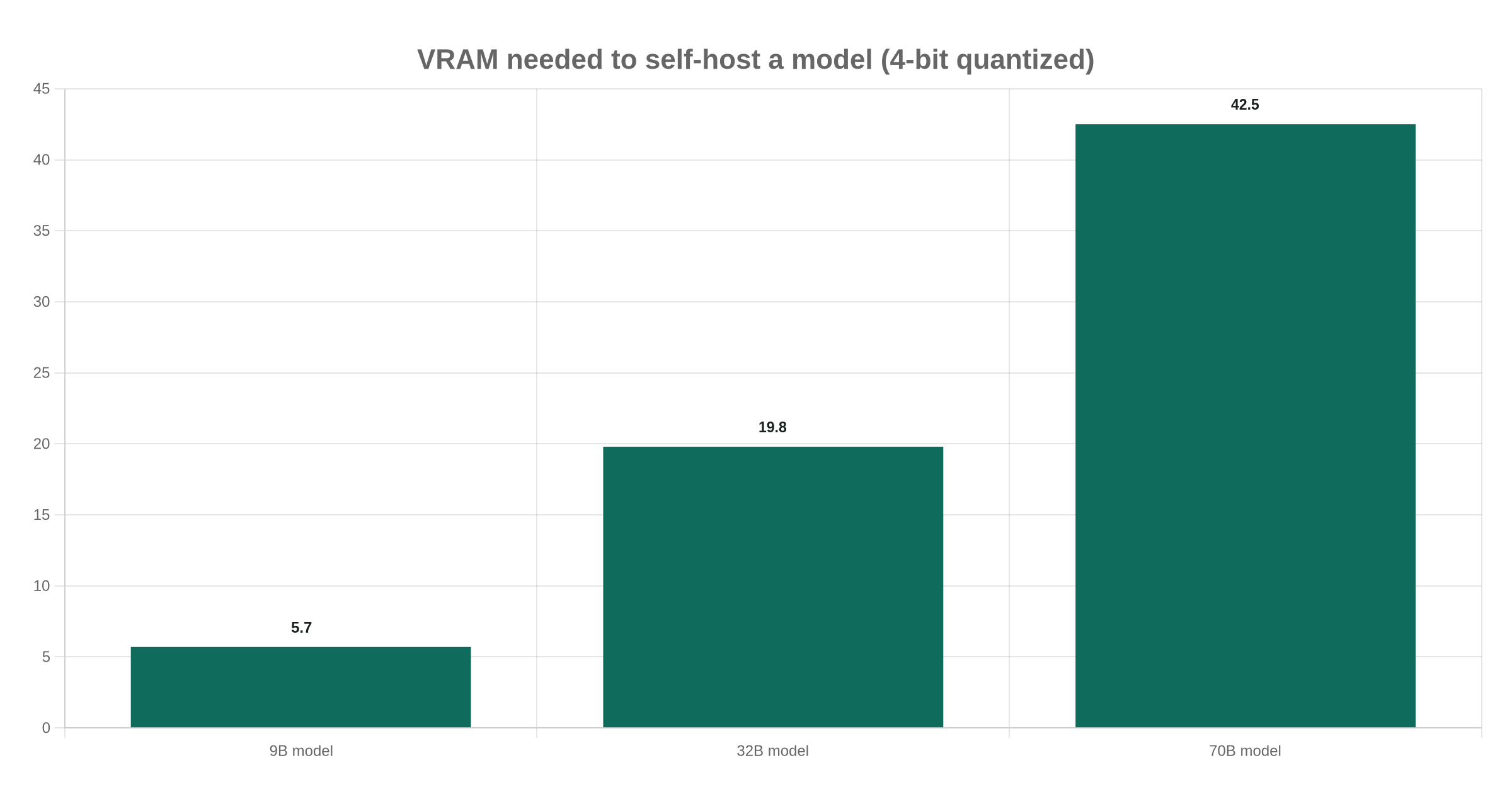
A self-hosted model needs enough GPU memory (VRAM) to hold its weights, and that number scales directly with model size. At 4-bit quantization, the practical default for local deployment, a 9B model needs about 5.7 GB of VRAM, a 32B model needs about 19.8 GB, and a 70B model needs about 42.5 GB (computingforgeeks.com, 2026). Quantization trades a small amount of precision for a large memory saving: the same 70B model needs 141 GB at full precision, so without it, self-hosting a large model is out of reach for anyone but a data center.
A single consumer GPU with 24 GB of VRAM, the RTX 4090 class, comfortably runs a 9B or quantized 32B model and is the realistic ceiling for an owned workstation. A business wanting 70B-class quality must either rent a data center GPU or accept a smaller, quantized model with a lower reasoning ceiling than a frontier model like Claude or GPT. Downloading those weights needs real bandwidth too: a 70B model runs into tens of gigabytes, and Cambodia's fastest fixed broadband averaged only 72.8 Mbps over the year to June 2026 (speedgeo.net, 2026), so a first pull is a multi-hour job on most connections, not a background download.
Cambodia does have commercial data centers, Daun Penh Data Center and ByteDC among them in Phnom Penh, both Tier III-class facilities renting general colocation and rack space, not GPU compute. Neither advertises a dedicated GPU-cloud rental service as of October 2026, so a business renting a GPU rather than buying a workstation is renting from an international cloud, the kind surveyed in the cost comparison below, not a Cambodia-based one.
The real cost comparison: self-hosted Ollama versus a cloud API in Cambodia
| Dimension | Self-hosted (Ollama) | Cloud API (OpenRouter, Claude, GPT) |
|---|---|---|
| Upfront cost | None for the software; 800 to 2,500 USD for a 24 GB GPU workstation, or GPU rental | None, pay per token used |
| Running cost | GPU rental or depreciation, plus electricity, charged whether or not anyone is asking the model anything | Scales down to near zero at low usage |
| Data control | Prompts and documents never leave the machine you run | Every prompt is processed on the provider's infrastructure |
| Model ceiling | Capped by the open-weight models that fit your VRAM | Access to frontier models with no local hardware limit |
| Maintenance | Your team patches, monitors uptime, handles GPU failures | Provider handles uptime, scaling and patching |
| Best for | Confidential documents, steady workload, a data-residency constraint | Variable workload, need for the strongest reasoning, no in-house ops team |
The upfront line is where most comparisons stop, and it is the wrong place to stop. Picture a 24 GB GPU rented for a normal 10-hour business day, 22 working days a month, 220 hours. A September 2026 survey of 28 GPU cloud providers put the RTX 4090's cheapest marketplace listing at 0.14 USD an hour on Vast.ai (dev.to/fastgpu, September 2026); on a branded on-demand provider the same card runs closer to 0.89 USD an hour on RunPod's Secure Cloud (runpod.io, 2026). Either way, the GPU bill alone runs 31 to 196 USD a month before anyone asks the model a question. Electricity barely moves that: a GPU under load draws 300 to 450 watts, so 220 hours at 400 watts is 88 kWh, which at Cambodia's business tariff of 0.115 USD per kWh (globalpetrolprices.com, March 2026) adds about 10 USD. The real cost center is the GPU rental or the hardware purchase, not the power bill, a fixed cost that does not shrink if usage is light that month, unlike an AI agent's real cost on a per-token plan, which falls to near zero when nobody is using it.
Gartner's August 2026 forecast adds a second wrinkle: inference cost per agentic workflow is projected to climb more than fivefold through 2028, narrowing the cost gap over time rather than widening it (Gartner, August 2026). OpenRouter, for comparison, bills per token at each model's posted rate plus a platform fee of 5.5 to 8 percent depending on the plan (openrouter.ai, 2026), a structure that rewards light, unpredictable usage far better than a fixed GPU bill does.
Does self-hosting actually solve Cambodia's data privacy problem?
Self-hosting solves a narrower privacy problem than most pitches suggest. Cambodia's draft Law on Personal Data Protection, published by the Ministry of Post and Telecommunications in July 2025, does not require personal data to stay inside the country. What it requires is a lawful basis for any transfer out of Cambodia: the ministry's permission, documented safeguards, consent, or another listed condition, with administrative penalties up to 600 million riel (about 150,000 USD) or 10 percent of annual turnover for a company, plus separate criminal penalties for individuals, once a 2-year sunrise period runs out after enactment (dgcbriefings, 2026).
That means a business sending client documents to a cloud API outside Cambodia is not automatically breaking the draft law, provided it has a real lawful basis for the transfer and a privacy policy that says so. What self-hosting actually buys is certainty and simplicity: a prompt that never leaves a server inside the country has no cross-border transfer question to answer in the first place, which is worth something to a compliance-conscious client. It is a cleaner story, not a legal requirement that forces the choice.
That residency benefit does not attach to every self-hosting setup. The cost model above priced a GPU rented from the same international clouds surveyed in that September 2026 report, almost all based outside Cambodia, and no Cambodia-based provider currently rents GPUs that way. Running Ollama on a rented foreign GPU is still a cross-border transfer in substance, even once the API call itself disappears. The in-country guarantee only holds for the other setup already on the table: an owned 24 GB GPU workstation sitting in Phnom Penh. If data residency, not just cost, is the actual goal, the workstation delivers it; the rental does not.
Where self-hosting wins, and where a frontier model still wins
Picture a 15-person accounting practice running monthly KHQR and ABA PayWay reconciliation queries against a year of transaction records: repetitive, predictable volume, and financial records it would rather keep off a third party's servers. That is close to the ideal self-hosting case: steady usage, sensitive data, modest reasoning demands a well-chosen open model handles fine, paired with retrieval-augmented generation over the firm's own records rather than the model's general knowledge.
Hypothetical case, labelled as such: we have not run this exact engagement. A 20-person law firm in Phnom Penh drafts contracts and runs due diligence for finance and real estate clients. Client confidentiality is a professional obligation, not a preference, so the firm self-hosts a quantized model on a single 24 GB GPU workstation for first-draft document review and internal search. For harder work, complex multi-jurisdiction contract analysis, it still sends a narrower, anonymized query to a frontier model through OpenRouter: no open model it can run locally matches that reasoning depth yet.
A third profile sits between the two. Picture an NGO in Phnom Penh managing donor records and beneficiary data across a dozen funding agreements, several with their own data-handling clauses. Twenty staff, light but recurring AI use: drafting donor updates, summarizing field reports, searching three years of program documents for a clause a new grant application needs to match. A self-hosted model on a shared office workstation with 24 GB of VRAM covers that recurring work inside the NGO's own four walls, which matters when a donor's clause asks where records were processed, not just how they were secured. For harder work, a complex budget narrative or compliance report, the NGO still reaches for a frontier model.
That split, not an all-or-nothing choice, is how the decision plays out in practice. A frontier cloud model still wins on raw reasoning, on tool use inside a larger agent harness, and on zero maintenance. Self-hosting wins when the workload is steady enough to justify the fixed GPU cost, the task fits inside what a 9B to 70B open model can do, and keeping the prompt on your own hardware is worth more than an API's convenience.
So, should your business run Ollama in-house, or not?
For most Cambodian SMEs, the honest verdict is no, not yet, and not for cost reasons. The break-even between a rented GPU running Ollama and a cloud API only arrives at a steady, high query volume most businesses here will not reach in year one, and a frontier model will out-reason an open model on anything genuinely hard. Self-hosting earns its cost when the real driver is data control: a law firm, a healthcare provider, a bank bound by its own risk guidelines, or any business whose clients would ask "where does our data go" and expect a precise answer.
TechFlow deploys exactly that kind of setup when it is the right call, orchestrating with n8n and routing between Claude, GPT, Mistral and Llama, including sovereign AI deployments on private cloud or self-hosted infrastructure, starting with a free 1 to 2 hour process-mapping audit that tells you which side of this decision your business sits on. If data control, not budget, is what is keeping you up at night, a scoped estimate is the next step, not another GPU benchmark.
Prefer to chat? Message our founder directly on Telegram (@maxgrolier), or book a call with the team.