
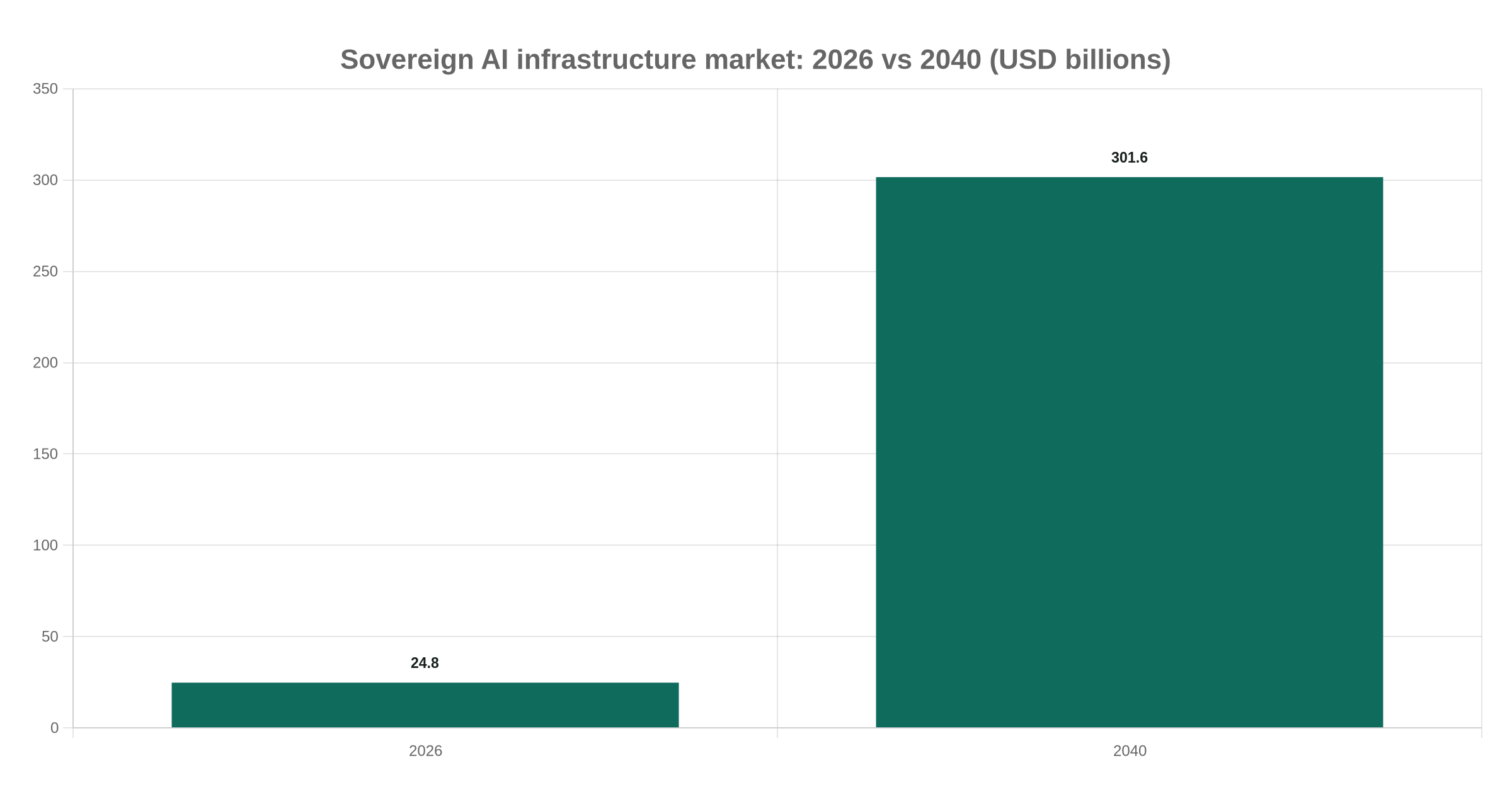
The global market for sovereign AI infrastructure is forecast to grow from 24.8 billion USD in 2026 to 301.6 billion USD by 2040, a nineteen and a half percent compound annual growth rate (Research and Markets, August 2026). A Cambodian SME doesn't participate in that market directly, but it decides which country's data centers get the next wave of GPUs, and which get none, exactly the question behind private LLM hosting once you move past the laptop demo.
Private LLM hosting means running a language model on infrastructure your business controls rather than calling a provider's API. The harder question it raises for a business in Phnom Penh is not whether to self-host. It is where the hardware that makes self-hosting possible actually sits, who operates it, and whose law reaches it. Below: the real menu of options, what Cambodia's own sovereign cloud can and cannot yet do, what the region's bigger players are building, what it costs, and a straight answer on where to host.
What counts as private LLM hosting, beyond running Ollama on a laptop?
Private LLM hosting means a model's weights and every prompt sent to it stay inside infrastructure your business controls, legally and physically, instead of passing through a third-party API. That definition covers far more ground than the open-source tool most people picture first. A developer running a quantized model through Ollama on a desktop is doing private LLM hosting at the smallest possible scale. Our guide to AI development costs in Cambodia covers that single-workstation case in detail, including the Khmer-language token penalty that changes the math for a Cambodia-facing assistant.
The term stretches well past that desktop case once a business needs the model to serve real traffic, stay up overnight, and survive one GPU failing. At that point "private LLM hosting" becomes a procurement decision with at least five distinct shapes: an owned workstation, a colocated rack in a data center, a rented GPU server from an international cloud, a managed private deployment inside a hyperscaler's enterprise cloud, or capacity bought from a regional sovereign cloud. Vendor comparisons in this space, AmasaTech's survey of Azure OpenAI Service, Amazon Bedrock and Google Cloud Vertex AI among them (amasatech.ai, July 2026), frame managed and self-hosted options as a spectrum, not two separate markets: "private" increasingly describes where the data stays, not who owns the rack.
That spectrum matters because the two ends solve different problems. A business already running its CRM and email on Microsoft 365 or Google Workspace gets a faster, better-supported path to a private model through Azure OpenAI Service or Vertex AI's private endpoints than it would building a GPU rack from nothing. A business whose whole reason for going private is to keep prompts off any third party's infrastructure, a law firm, a bank, a healthcare provider, gets little from a hyperscaler's private tenancy: the data still touches someone else's servers, just inside a more tightly fenced part of them. Neither end is wrong. The mistake is picking one without first naming which problem, cost, control, or raw capability, actually drove the decision to go private in the first place.
What are the real options for private LLM hosting in 2026?
The real options for private LLM hosting split along one axis that most generic guides skip entirely: physical location relative to your business, not just technical architecture. A Cambodian company weighing this decision is really choosing between five locations, each with a different cost, latency and compliance profile.
| Hosting model | Where the GPU sits | Who controls it | Typical fit |
|---|---|---|---|
| Owned workstation | Your own office | Fully you | Light, steady workload; no internet dependency for inference |
| Colocated rack | A local Tier III data center (ByteDC, Daun Penh) | You own the hardware, the facility hosts it | Data residency matters more than raw GPU power |
| Rented international GPU cloud | Outside Cambodia, usually North America or Europe | A foreign cloud provider, you rent capacity | Need frontier-adjacent hardware fast, residency is not the deciding factor |
| Managed hyperscaler private deployment | A hyperscaler's regional data center (often Singapore) | The hyperscaler, inside your private tenancy | Already on Azure, AWS or Google Cloud; want enterprise controls without running servers |
| Regional sovereign cloud | A Southeast Asian national cloud (Malaysia, Indonesia) | A national or telco-backed operator | Want data to stay in the region, not necessarily in Cambodia itself |
We would state the real constraint plainly rather than hedge it: in-country GPU colocation, bringing your own hardware into a Phnom Penh Tier III facility, already exists today. In-country GPU rental, paying by the hour for capacity physically based in Cambodia, does not. That distinction, not a blanket question of "in Cambodia or not", is what should drive the choice among the five rows above, and it is also why we would treat ByteDC's sovereign cloud as a sound home for everything except the GPU layer today, watching Malaysia's and Indonesia's clusters as the realistic regional alternative to a US hyperscaler rather than a reason to wait for Cambodia to build its own GB200-class cluster first.
Picture a mid-sized microfinance institution in Phnom Penh evaluating all five for a loan-document review assistant. An owned workstation is cheapest but caps out around a 32B model and dies the moment the office internet or power does. A colocated rack at ByteDC keeps the data in-country with professional uptime, at the cost of shipping and maintaining its own hardware. A rented GPU abroad is the fastest path to frontier-adjacent power, but every prompt now crosses a border. The criteria that actually separate these options are the same ones we walk through in our AI consulting audit: workload steadiness, data sensitivity, and whether a provider can prove where the data actually goes, not just where it says it goes.
A second, very different profile shows why the table is not a ranking. Spiky, not steady, is the whole story for a 30-room boutique hotel group in Siem Reap wanting a booking assistant that reads guest emails in English, French and a little Khmer: busy during booking peaks, quiet the rest of the month, with nobody on staff able to maintain a GPU server even if the budget stretched to one. Its data is guest names and dates, not legal or financial records, so the residency pressure behind the microfinance case above doesn't apply. For that profile, a managed hyperscaler deployment or a straightforward cloud API beats every option in the table: a colocated rack, or even a 299 euro managed rental, would sit idle most days with no compliance question to justify the bill. The table tells you what each option is good at, not which one your business needs until you have named the workload.
Does Cambodia have a sovereign cloud that can host a private LLM?
Cambodia has had a sovereign cloud platform since December 2025, and by October 2026 it is commercially signing partnerships, but it is still not confirmed as a GPU-hosting one. ByteDC, which opened Cambodia's first Tier III certified data center in Phnom Penh in May 2023 as a Cambodia-Singapore joint investment (w.media, May 2023), soft-launched ByteDC Cloud at the Digital Government Forum on 5 December 2025, built on Huawei Cloud Stack and aimed at "government ministries, regulators, banks, and enterprises that need trusted in-country infrastructure" (cambodianess.com, December 2025). The platform has moved well past that soft launch since: ByteDC signed an MoU with Mobile C&C on 26 August 2026 to host the digital lender's loan-processing platform in-country, meeting the National Bank of Cambodia's requirement that financial institutions keep a primary data center in Cambodia, and an MoU with SKAI Technology on 30 July 2026 specifically to host SKAI's AI platform, internal tools and client solutions on ByteDC's Phnom Penh infrastructure (bytedc.com, July and August 2026).
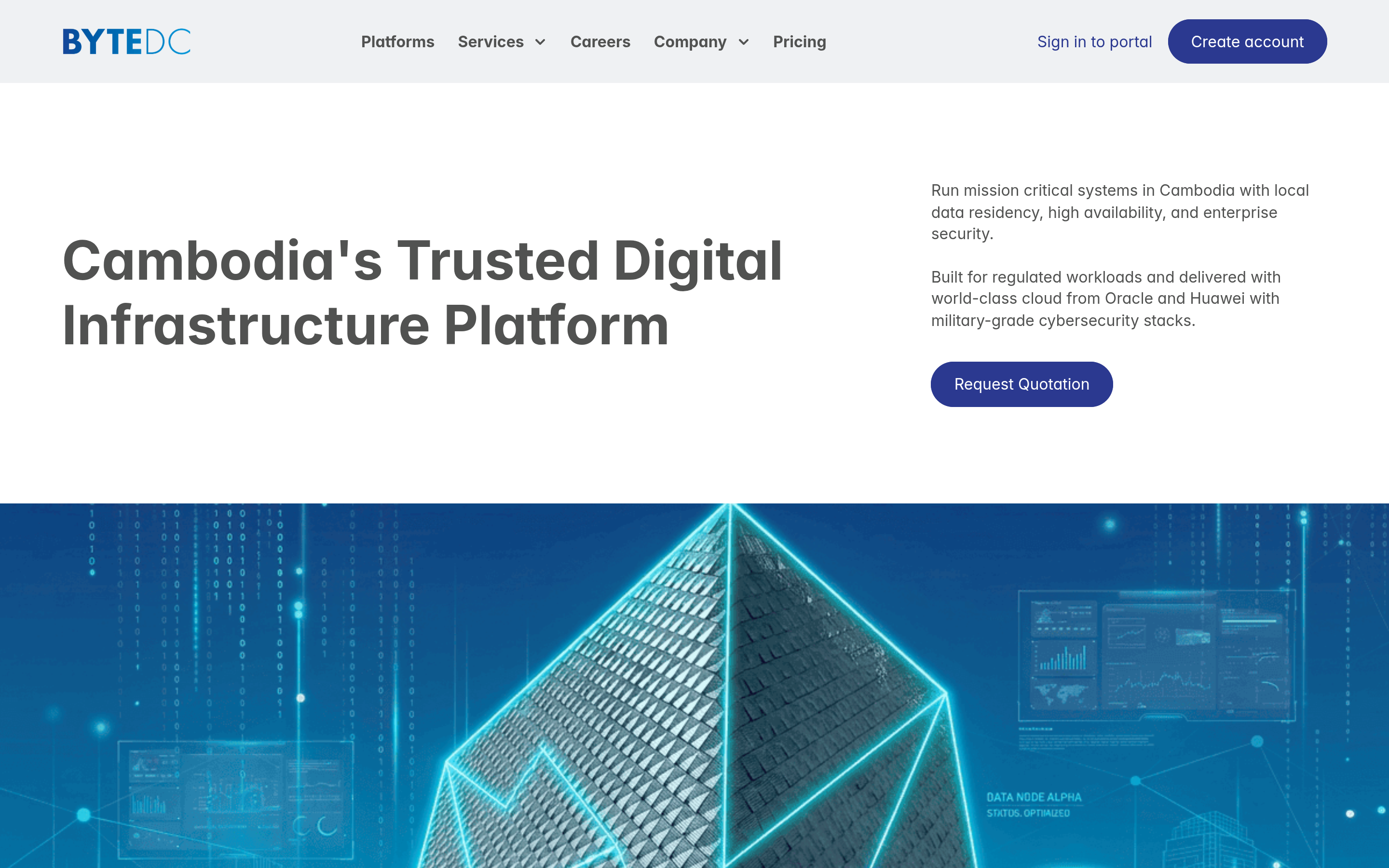
Neither partnership names a GPU model, a VRAM tier or an hourly rate, which matters: a sovereign cloud platform signing AI-hosting deals is not automatically a GPU cloud. Daun Penh Data Center, Cambodia's other established Tier III-class facility, advertises colocation, VPS and web hosting, not a GPU rental service either (Daun Penh Data Center's public site, 2026). In practice, a Cambodian business can colocate its own GPU hardware inside a Tier III Phnom Penh facility, solving residency outright, but still cannot rent GPU capacity by the hour from an in-country provider. That gap is exactly why the next two options exist.
There is a second reason to read "AI hosting" carefully rather than assume the GPU gap has closed. A sovereign cloud built on Huawei Cloud Stack, signing partnerships with a fintech lender and an AI platform within a year of its soft launch, is a deliberate choice of technology partner aimed at government ministries and regulated institutions that want a stack outside the US cloud ecosystem, not necessarily one optimized for the Nvidia-centric GPU tooling most open-weight models and inference frameworks are built around. GPU-as-a-service could still arrive on the platform, the SKAI deal is the closest public signal yet that it might, but a Cambodian business should keep asking the specific question, which GPU model, what VRAM, what hourly rate, rather than take a partnership announcement as confirmation that the gap is already closed.
Why Malaysia and Indonesia are racing ahead on sovereign AI
Malaysia and Indonesia are racing ahead on sovereign AI because both have decided the compute has to live somewhere in the region, and neither waited for a national champion to build it from scratch. Malaysia switched on YTL AI Cloud's 600MW Nvidia GB200 NVL72 cluster in Kulai, Johor on 31 October 2025, a 10 billion ringgit (2.38 billion USD) investment that instantly made it the largest sovereign AI cluster in Southeast Asia, backed by a further 5.9 billion ringgit in Malaysia's 2026 national AI budget (pendakwah.tech, 2025 to 2026).
Indonesia is running the same play through its telecom incumbent rather than a utility group. Indosat, NVIDIA and Universitas Gadjah Mada launched the UGM Indosat NVIDIA AI Technology Center in Yogyakarta, built on Indosat's GPU Merdeka, a sovereign GPU-as-a-service platform the company positions as an alternative to routing Indonesian AI workloads through a US hyperscaler (ultrathink.ai, August 2026).
Neither cluster changes the legal picture for a Cambodian business the way an in-country option would: renting GPU capacity in Johor or Yogyakarta is still a cross-border transfer in substance, whatever marketing language calls it "regional" or "sovereign". What it does change is the practical one. A GPU in Kuala Lumpur or Jakarta sits inside the same region, on faster and more direct network paths, than a GPU in Virginia or Frankfurt, and increasingly under data protection frameworks built with Southeast Asian compliance questions in mind rather than European or American ones. For a business that cannot wait for Cambodia to build its own cluster, and most will not need to, a regional sovereign cloud is a materially different proposition than a generic international GPU rental.
Singapore shows a third, distinct model, worth naming so the three countries don't blur together. It launched ASPIRE 2B, a national research supercomputer at Nanyang Technological University on 8 June 2026: 1,500 Nvidia H200 GPUs delivering 115 petaFLOPS, a 270 million Singapore dollar investment (mothership.sg, June 2026). Unlike YTL AI Cloud or GPU Merdeka, ASPIRE 2B serves public-sector and university research, healthcare models, climate forecasting, not a private business by the hour. "Sovereign AI" covers at least two government motives: Malaysia and Indonesia build commercial, rentable capacity; Singapore builds national research capacity a Cambodian SME will likely never touch directly. Knowing which kind a headline describes saves a wasted sales call.
What does private LLM hosting actually cost in 2026?
Private LLM hosting costs a fixed monthly fee regardless of how much the model actually gets used, the opposite of how a cloud AI API bills. HOSTKEY, a managed LLM hosting provider, publishes a pricing ladder that illustrates the range well, each tier pre-installed with open models like Llama, Gemma and DeepSeek (hostkey.com, 2026), shown in the table and chart below.
| HOSTKEY tier | GPU | Monthly price | Realistic model ceiling |
|---|---|---|---|
| Starter | 1x RTX 4090 | 299 EUR | 9B to 32B (quantized) |
| Advanced | 2x RTX 4090 | 599 EUR | 32B, higher throughput |
| Professional | 1x Tesla A100 | 1,299 EUR | 32B to 70B (quantized) |
| Enterprise | 2x Tesla H100 | 2,499 EUR | 70B class |
| Ultimate | 4x Tesla H100 | 4,999 EUR | Largest open models, multi-user |
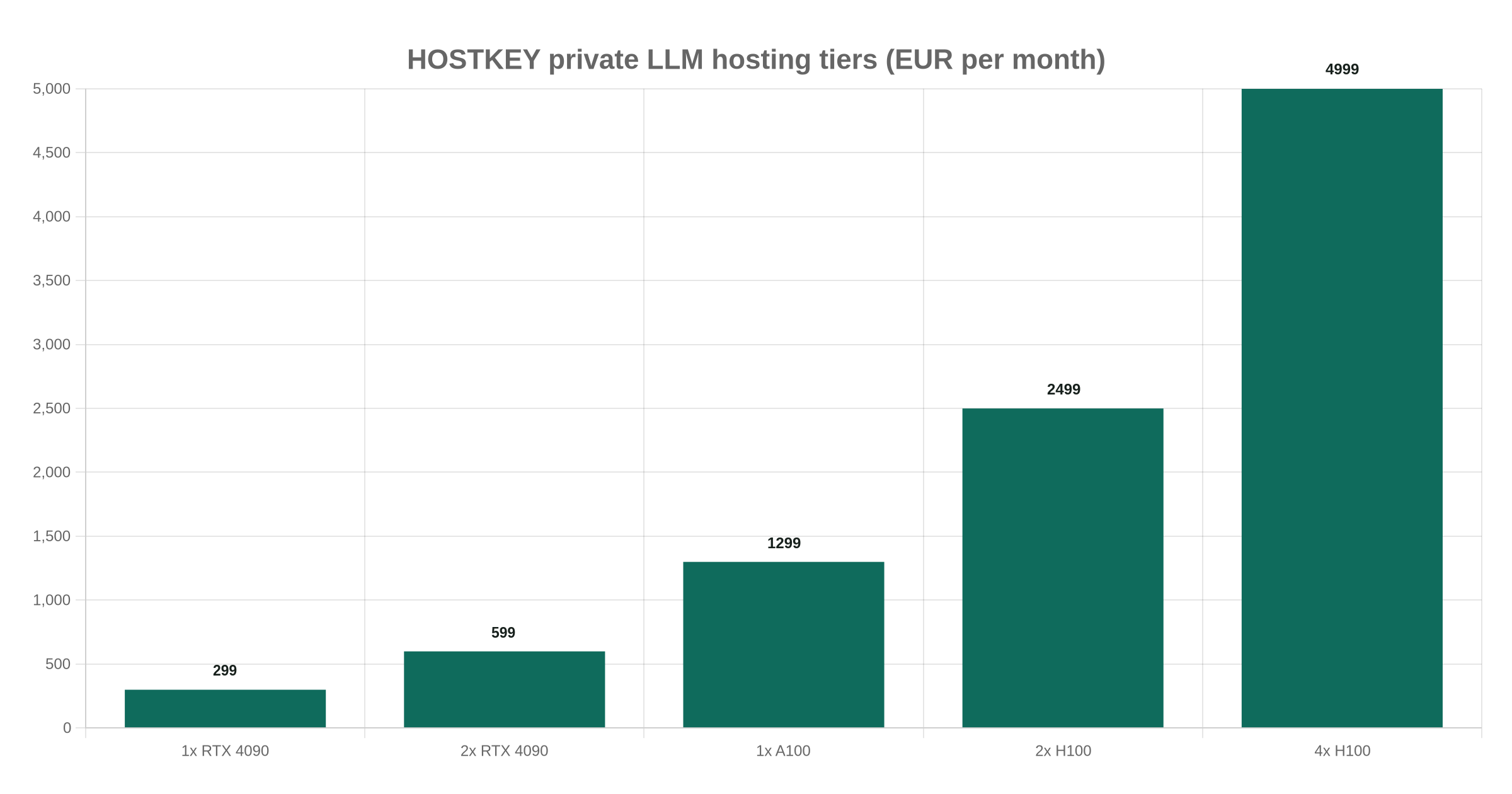
That fixed bill is the number a Cambodian SME needs to hold against its own usage pattern before comparing it to a per-token API, which is what we walk through sector by sector in what AI agents cost. Take the 299 euro RTX 4090 plan: it costs 299 euros flat whether it answers ten queries that month or ten thousand, which matters most for a law firm in Phnom Penh running contract review queries only during business hours, roughly 180 hours a month. A cloud API bill would track actual usage instead and likely land lower in a quiet month.
Run the actual numbers and the crossover point becomes concrete rather than abstract. At HOSTKEY's Starter tier, 299 euros a month works out to roughly 10 euros a day, every day, whether the server is busy or idle. A cloud API charging by the token only reaches that same 10 euros a day once the firm's daily volume of prompts and replies is high enough to burn through it, typically several hundred thousand tokens on a mid-tier model, a volume a 15 to 20 person practice doing contract review would need genuinely heavy daily use to reach in its first year. Below that volume, the private rental is the more expensive option every single month, not just on the slow months; it only becomes the cheaper one once usage is both high and predictable enough to fill the capacity you are already paying for.
Colocation's bill looks different because the facility fee and the GPU purchase are two separate lines, not one. Neither ByteDC nor Daun Penh publishes a colocation rate; both quote on request. MekongNet, another Phnom Penh colocation provider, does publish one: a single rack unit at 150 USD a month, a half rack at 1,500 USD, a full rack at 2,500 USD (mekongnet.com.kh, 2026), which gives a real order of magnitude even though MekongNet's own page makes no Tier III claim the way ByteDC's and Daun Penh's facilities do. A multi-GPU server running a 70B-class model draws more power than a standard rack unit's allocation covers, which pushes the realistic monthly facility cost toward the half-rack tier rather than the entry one. Set that against HOSTKEY's 2,499 euro Enterprise tier for the same model class, and colocation's running cost looks lower, before counting what the GPU hardware itself costs to buy outright. That purchase price, not the rack fee, is what actually decides whether colocation beats renting over a year or two.
Does hosting privately solve Cambodia's data compliance question?
Hosting privately solves a narrower compliance question than most pitches imply. Cambodia's draft Law on Personal Data Protection does not require personal data to stay physically inside the country; it requires a lawful basis for any transfer out of it; consent, a documented safeguard, or Ministry of Post and Telecommunications approval, with penalties up to 600 million riel (about 150,000 USD) or 10 percent of annual turnover once a two-year sunrise period runs out after enactment (dgcbriefings, 2026). A business renting a GPU in Johor, Yogyakarta, or a US data center is not automatically breaking that draft law, provided it documents the transfer basis.
What changes the calculation is connectivity, not just law. Cambodia's international bandwidth currently relies heavily on transit through Thailand and Vietnam; a direct Sihanoukville to Hong Kong submarine cable is meant to reduce that dependency, and China Unicom and Cambodia's Ministry of Posts and Telecommunications reached the cable's landing and installation milestone in Hong Kong on 28 July 2026, with no commercial ready-for-service date announced yet (submarinenetworks.com, July 2026). Until that route goes live, every request to a GPU outside the country, whether in Virginia or in Johor, crosses at least one neighboring country's network first. A colocated rack at a Phnom Penh Tier III facility sidesteps that question entirely: no transfer basis to document, no neighboring transit path to route through, because the data never leaves the building. That is the one guarantee none of the rented options, regional or otherwise, currently match.
A business serving clients outside Cambodia has a second compliance layer to weigh, separate from the draft Cambodian law. A Cambodian agency or SaaS company with French or European customers, a common profile for Cambodia-based businesses serving the France market, inherits whatever data protection commitments it made to those clients, GDPR-adjacent or otherwise, on top of Cambodia's own draft rules. In that case the hosting location question has to satisfy two jurisdictions at once, and a provider who can document exactly where the data sits, in Phnom Penh, in Singapore, or in Frankfurt, becomes worth more than a marginally cheaper option that cannot answer the question precisely. "Trust us" is not a data residency policy; a signed data processing addendum naming the facility is.
Here is where you should actually host a private LLM
The honest answer for most Cambodian businesses in October 2026 depends on the deciding factor, not on waiting for a single winner to emerge. If data residency is the deciding factor, a colocated GPU rack inside a Tier III Phnom Penh facility is the only option that removes the cross-border question outright, even though it means owning and maintaining the hardware yourself. If raw capability and speed to deploy matter more than residency, a managed rental from HOSTKEY or a similar provider, or a regional sovereign cloud in Malaysia or Indonesia, gets a business running within days rather than the weeks a colocation build takes. Our position hasn't changed: ByteDC is the right home for everything except the GPU layer, and Malaysia's or Indonesia's clusters are the realistic regional alternative to a US hyperscaler, not a reason to wait for Cambodia to build its own cluster. Keep watching ByteDC's partnerships rather than a release date: it is already signing in-country hosting deals, including one specifically for AI workloads, but none of them has yet named a GPU model, a VRAM tier or an hourly rate. The day one does, the five-option table above shrinks to four, with the in-country rental finally on it.
Our own delivery timelines, the same ones any AI agency in Phnom Penh should hand you up front, reflect how much of this decision is upfront scoping rather than a quick toggle: we run a free one to two hour process-mapping audit, turn it into a costed action plan within five days, and deploy autonomous agents in one to four weeks, with sovereign AI deployments on private cloud or self-hosted infrastructure typically taking four to eight weeks once the hosting model is settled. That scoping step, not the hosting bill, is usually where a Cambodian business gets the decision above wrong, choosing a hosting model before it has actually measured its own workload.
The order of questions matters more than the hosting menu itself. Before we quote a hosting model, we ask for the workload's shape before its content: how many requests a day, how predictable that daily pattern is, and whether a two-second delay during a traffic spike would actually cost the business anything. A client who leads with "we need this to be private" before naming a real request volume is skipping that scoping step without realizing it, the same mistake behind the law firm's break-even math above: a 299 euro monthly commitment that never clears its own break-even point is not more private, it is just a bill nobody is using. The pitfall we check first is rarely technical. It is who on staff answers the pager at 11pm if a GPU driver crashes, because a colocated rack with nobody on call turns a residency win into a Monday-morning outage. That is also why we keep the agent layer and the hosting layer as separate decisions: our own stack routes model calls through OpenRouter, so swapping the hosting model, self-hosted today, a hyperscaler's API next year, never touches the integrations built on top of it.
Bring us the workload, not the hosting question, and a 30-minute call is enough to tell you which of the five options actually fits.
Prefer to chat? Message our founder directly on Telegram (@maxgrolier), or book a call with the team.