
On 28 October 2026, ABA Bank's AI assistant Navi won the Technology Innovation of the Year, Financial Services award at the Asian Innovation Excellence Awards 2026, recognised specifically for transforming customer service, and the figure attached to the win was a 98 percent successful query-answering rate (B2B Cambodia, 28 October 2026). That is the kind of number a press release gets built around, and every outlet that picked up the story repeated it the same way: as proof the ABA Bank AI customer service tool works.
We think the number is the least interesting part of the story. What matters more is what it took ABA to get there, what a 98 percent answer rate actually proves and does not prove, how Navi compares with what Wing Bank and ACLEDA are building, and what any Cambodian business weighing AI customer service of its own should actually take from this award.
What did ABA Bank's AI customer service tool actually win?
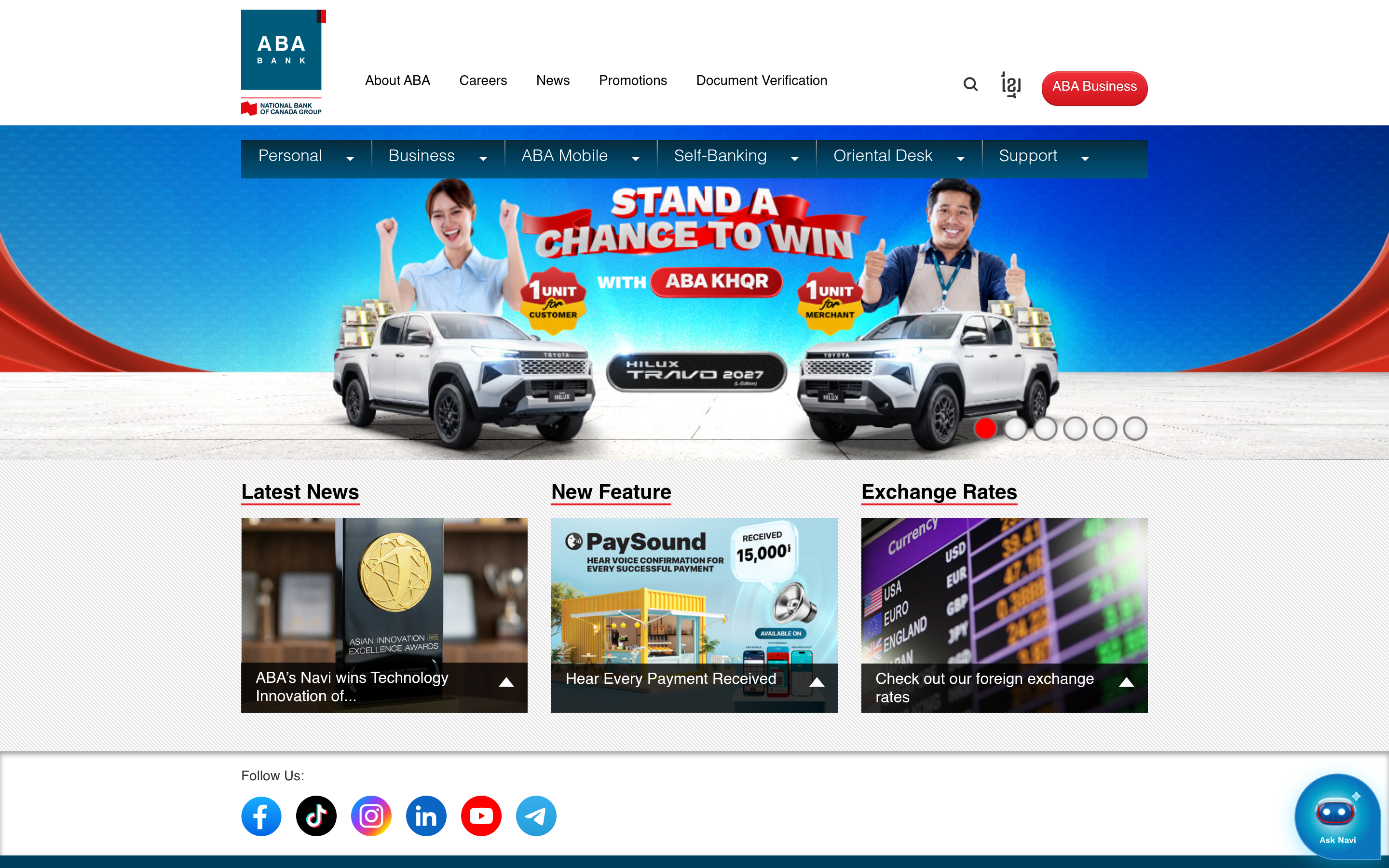
ABA Bank's Navi won the Technology Innovation of the Year, Financial Services award at the Asian Innovation Excellence Awards 2026, with the win announced on 28 October 2026 (B2B Cambodia, 28 October 2026). The award recognises Navi specifically, the AI-powered virtual banking assistant ABA built into its own digital ecosystem rather than a broader claim about the bank's technology generally.
Navi itself is not new. ABA launched it on 10 March 2025 as Cambodia's first AI-powered virtual banking assistant, built to answer questions about payments, cards, transfers and loans around the clock (Cambodia Investment Review, 10 March 2025; Kiripost, 2025). Bekzod Ruzmetov, ABA's Chief Digital Research, Data and AI Officer, framed the award around the bank's underlying approach rather than the trophy itself: "Our approach to innovation starts with our customers. Every solution we develop is driven by a simple goal," he said, pointing at ease and accessibility as the actual target, not the award (Ruzmetov, quoted in B2B Cambodia, 28 October 2026).
That title matters as much as the quote. A bank that has created and staffed a Chief Digital Research, Data and AI Officer role has already made a structural commitment that most companies, in Cambodia or anywhere else, have not. This is one data point in the broader wave of AI development in Cambodia moving from announcements to production systems that we track across this blog, and a regional award for a specifically Cambodian-built, Khmer-language tool is a genuinely new kind of entry in that story.
Navi's win also lands against a market that has grown fast enough to make a serious AI investment worth making. Cambodia now counts more than 10 million mobile banking users, over 60 percent of the adult population, alongside 27.6 million Bakong accounts and 3 million KHQR-accepting merchants (Cambodia Investment Review, June 2026, citing National Bank of Cambodia data). A bank serving a market that size has a genuine volume problem to solve with customer service, which is the context this award has to be read inside.
How a customer service request reaches Navi inside ABA Mobile
A customer service request inside ABA Mobile reaches Navi the moment someone taps its button in the app, or opens the assistant through ababank.com, before any human agent is involved (B2B Cambodia, 28 October 2026). ABA built Navi specifically for ABA Mobile and trained it on the bank's own products, services and app functionality, so it answers from a knowledge base the bank controls rather than a generic model bolted on top of a chat window.
Navi runs 24 hours a day, 7 days a week, and supports Khmer, English and Chinese, with the award coverage also naming Korean and Japanese among the languages it can handle (Kiripost, 2025; B2B Cambodia, 28 October 2026). The Khmer support is not just text. ABA built locally developed voice-recognition technology into Navi specifically so customers can speak a question in Khmer and get an answer back in the same language, which is a harder engineering problem than text matching and one most regional chatbot vendors have not solved for Khmer at all.
ABA also describes Navi as continuously learning from the bank's own, ever-growing knowledge base rather than shipping once and staying static, with the model processing thousands of stored questions and answers to improve its coverage over time (Kiripost, 2025). That detail is easy to skip past, but it is the part that actually costs money month after month: someone at ABA has to keep reviewing what Navi gets wrong, feed the corrections back in, and re-test the Khmer voice model as new phrasing and slang show up in real conversations. An assistant that only works well on launch day and never improves is a demo, not a product, and the ongoing review cycle is the quiet, unglamorous work behind a headline award.
Picture a customer who cannot remember whether their last transfer went through. Under a traditional phone queue, that question waits behind every other caller until a human agent has time. Inside Navi, the same question gets triaged immediately: a straightforward status check gets answered from the transaction log in seconds, while anything that smells like a dispute, a wrong amount or a blocked card gets flagged for a human to pick up with the conversation history already attached. That triage step, not the chat window on top of it, is the actual product ABA built.
Does a 98 percent answer rate mean customer service is solved?
A 98 percent answer rate measures how often Navi returns a response that matches the question asked, not how often that response actually solves the customer's problem, and that distinction is the part every outlet that covered the award skipped. "Successful query-answering" is a generous way to describe a metric: it is closer to a resolution rate a vendor chooses to report than an independently audited customer satisfaction score, and ABA has not published a separate figure for how many of those answered queries closed the customer's issue without a follow-up contact.
The gap matters more at ABA's scale than it would for a small Cambodian business. ABA counts more than 4 million customers and 3.8 million ABA Mobile app users (Cambodia Investment Review, April 2026). If even a fifth of those app users asks Navi a single question in an average month, that is roughly 760,000 monthly queries, and a 2 percent miss rate on that volume works out to more than 15,000 customers a month getting an answer that did not match what they asked, each one needing a human anyway, on top of whatever volume Navi correctly routes to a person by design.
We are not arguing the 98 percent figure is false. We are arguing it is the easiest number to publish, not the hardest one to earn, and a business evaluating any AI customer service claim, ABA's or a vendor's, should ask what the number actually measures before treating it as proof the hard part is finished.
Three numbers would tell a fuller story, and none of them appeared in the award coverage: a containment rate (the share of conversations that never reach a human at all), a repeat-contact rate (how often the same customer comes back within a day or two because the first answer did not stick), and an actual customer satisfaction score collected after the interaction, not inferred from whether Navi matched the question. A tool can answer rate at 98 percent and still have a weak containment rate if customers keep escalating out of habit, or a weak repeat-contact rate if the answer was technically correct but incomplete. Any Cambodian business shopping for an AI customer service vendor should ask for these three numbers specifically, because a vendor that cannot produce them is reporting the metric that flatters the product, not the one that proves it.
How does Navi compare with what Wing and ACLEDA are building?
Navi is not Cambodia's only bank-built AI customer service experiment. Wing Bank has spent two and a half years training its own Khmer-language model to power an app-based chatbot that answers customer queries around the clock and learns from customer behaviour over time (GSMA, Mobile for Development, 2025). ACLEDA took a narrower route, folding AI-driven features into ACLEDA Mobile 7.0 to make the app more usable across a wider range of ages and technical comfort levels (Cambodia Investment Review, 31 July 2024), closer to an accessibility layer than a standalone assistant.
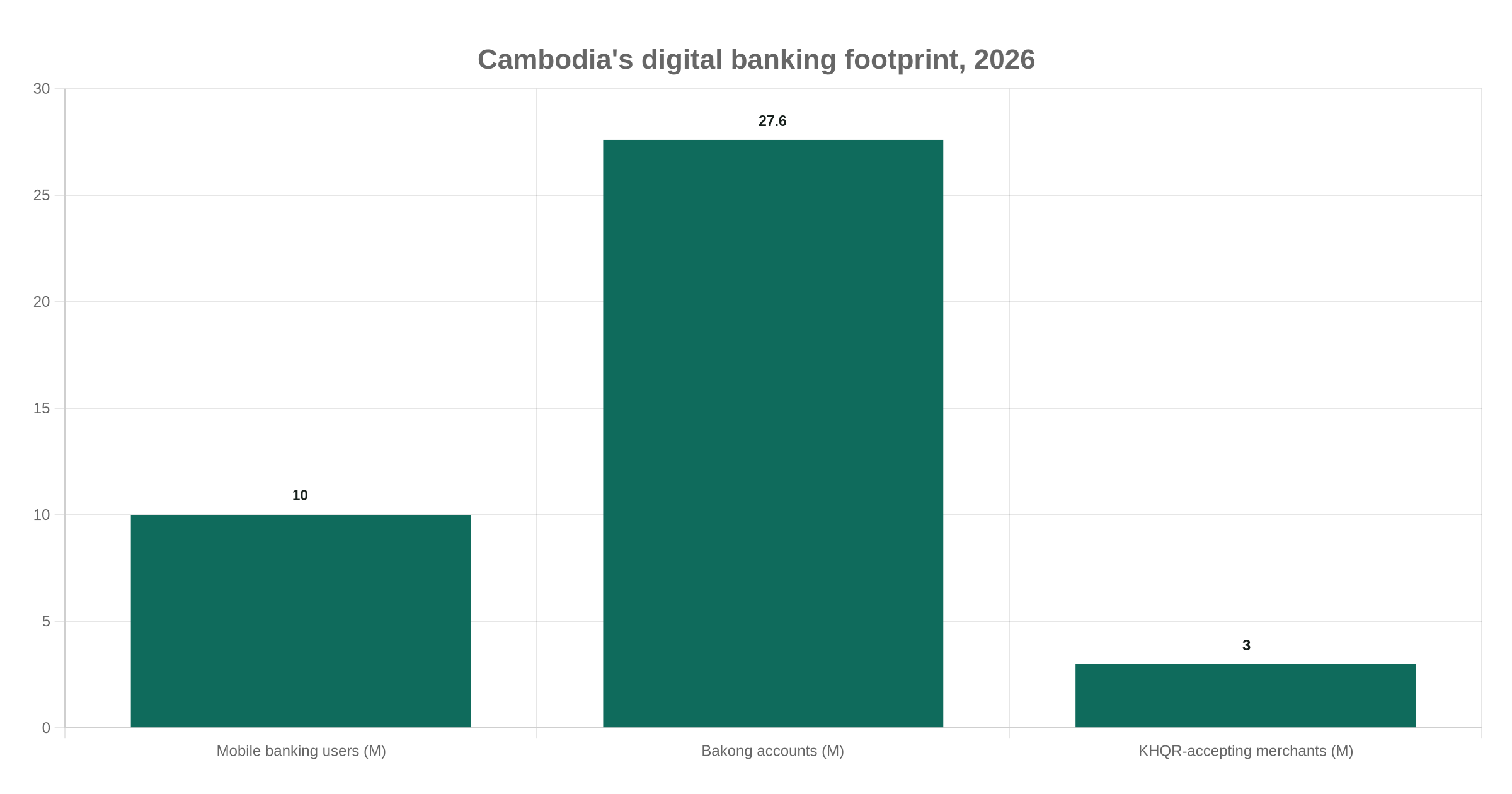
Every one of these three banks is also serving slices of the same national footprint shown above, more than 10 million mobile banking users and 27.6 million Bakong accounts, which is exactly why none of the three can afford to get customer service wrong at scale.
Set side by side, the three approaches say something about where each bank is placing its bet. Wing is investing in the hardest problem, a Khmer-native language model trained from scratch, which is slow and expensive but builds a capability competitors cannot simply copy. ACLEDA is spending less and aiming at usability rather than a branded assistant. ABA is the only one of the three that named the product, gave it a face in ABA Mobile, created an executive role to own it, and put it in front of an international awards panel.
We think that last point is the real story behind this award, more than the 98 percent figure. ABA chose to build Navi in-house, train it on its own data and put a named executive behind it, rather than buying a ready-made platform from a regional vendor, the route foodpanda took for its own AI customer service in Cambodia deployment with the Singapore-based firm Toku. Both are legitimate strategies. The build-your-own route is the one almost no Cambodian SME can afford to copy, which is exactly where this piece is heading next. Before any business spends on either path, running a structured consulting audit on the actual problem first is the step that decides which approach, if either, is worth the money.
Why can't an SME just build a smaller Navi?
An SME cannot just build a smaller Navi, because scaling down a bank-grade build does not make it cheap, it just makes it slow and unfinished. ABA did not build Navi over a weekend. The bank shipped it in March 2025, has iterated on it since, staffed a Chief Digital Research, Data and AI Officer to own the programme, and trained the underlying model on its own multi-year knowledge base of customer interactions across several languages. That is a multi-year, multi-department investment, and it is simply not the kind of project a Cambodian SME should try to replicate at a smaller scale.
A small Cambodian lending company with a couple of thousand active borrowers fields the same handful of questions on repeat: what is my loan balance, when is my next payment due, what documents do I need to apply, why did a payment fail to clear. That is a scoped, bounded problem. It does not need a Navi-style assistant trained to handle the entire breadth of a bank's product catalogue in six languages. It needs a narrow tool trained on five or six question types and wired into the one channel customers already use, usually Telegram or Facebook Messenger in Cambodia's case.
Work the arithmetic through. Say that lender's two staff spend forty minutes of every hour answering the same five questions by phone or Telegram, across a nine-hour working day. That is roughly six hours a day of genuinely repetitive work, out of eighteen combined staff hours, which a narrowly scoped agent trained on exactly those five answers could absorb almost entirely, freeing both staff members to spend their day on the loan applications and collections calls that actually need a person's judgment. Navi was never built to solve that problem cheaply, because ABA was not solving it at that scale. A scoped agent, by contrast, is built for exactly that scale and nothing larger.
What a Cambodian SME's own AI customer service would cost to build
A Cambodian SME's AI customer service does not need Navi's budget or its multi-year timeline to be useful, because the problem it has to solve is far narrower than a national bank's. Our own AI agent work starts with a free one to two hour process-mapping audit, specifically to find out whether a business even has the repeat-question volume that would justify building anything at all, before any build decision gets made.
Once that audit says yes, a narrowly scoped AI skill, answering a handful of fixed questions from a defined knowledge base, can go live in 24 to 48 hours. A fuller autonomous agent, one that can look up a real loan balance or booking status rather than reciting a fixed answer, typically takes 1 to 4 weeks to deploy properly, wired into whatever system holds that data and monitored with monthly reports afterward (see our AI agents page for how we scope and price that work). Neither timeline requires a Chief AI Officer or a model trained from scratch in Khmer: both reuse existing large language models, prompted and grounded in the business's own data instead of retrained on it.
The honest comparison is not "can an SME build a mini-Navi." It is "does an SME have enough repeat-question volume to justify any AI investment at all," and that number, not ambition, decides the budget. A business fielding fifteen questions a day does not need the same tool as one fielding fifteen hundred, and the right first step for either one looks like an audit, not a purchase. We have written in more detail about what AI agents for small business actually do and cost once that audit is done, for businesses that want the fuller picture before booking one.
What should a Cambodian business do next, and where should AI stop deciding?
A human still has to approve the outcome wherever Navi's own description touches money moving or a decision getting made, not just where a question gets answered. Navi's public description covers payments, bank cards, transfers and loans (B2B Cambodia, 28 October 2026), and every one of those categories includes at least one action, a transfer confirmation, a card block, a loan decision, that should sit behind a human check regardless of how good the assistant's answer rate is.
This is the same line we would draw for any AI customer service deployment, bank-built or vendor-bought: let AI answer "what is my balance" or "when is my next payment due" without hesitation, because getting those wrong just means a quick correction. Never let AI alone approve a refund, release a disputed transfer, or make a loan decision, because getting those wrong costs real money and, in a market this size, a customer's trust spreads fast through word of mouth and Telegram groups once it is lost.
For a Cambodian business built around KHQR or ABA PayWay transactions, the same split applies at a smaller scale. AI can tell a customer where their payment is. It should not be the one deciding, alone, whether that customer gets a refund.
Our verdict: ABA's award is a legitimate signal that Cambodia's banking sector has moved past pilot projects into AI products good enough to win regional recognition, not a template any other Cambodian business should try to copy at its own scale. The 98 percent figure is marketing-grade, not proof the underlying problem is solved, and the real investment behind Navi, a named executive, a multi-year build, a model trained on a national bank's own knowledge base, is out of reach for all but a handful of Cambodian companies.
The next step for most businesses reading this is not to build a Navi. It is to count how many of the same five or six questions your team answers every week, and only then decide whether a narrow AI agent, a better-organised Telegram inbox, or nothing at all is the right size for that volume. If you want that counted properly, book a call and we will run the audit before recommending anything.
Prefer to chat? Message our founder directly on Telegram (@maxgrolier), or book a call with the team.
Frequently asked questions
Does Navi replace ABA Bank's human customer service team?
No. Navi answers routine questions about payments, cards, transfers and loans directly, but anything involving a dispute, an unusual request or a transaction that needs manual review still reaches a human agent at ABA, with the conversation history carried over so the customer does not have to repeat themselves.
Can Navi complete a transaction, or does it only answer questions?
Based on what ABA and the award coverage describe, Navi is built to answer questions and guide customers through ABA Mobile's features, not to execute transactions on its own. Actions like transfers or card blocks still happen through the app's normal flow, with Navi helping the customer find and understand them.
Is Navi available to people who are not yet ABA customers?
Navi is reachable through ababank.com as well as inside ABA Mobile, so general questions about ABA's products are accessible before someone becomes a customer. Account-specific answers, like a balance or a transaction status, require being logged into ABA Mobile as an existing customer.
Does Navi's Khmer support include voice, or only text?
Both. ABA built locally developed voice-recognition technology into Navi specifically for Khmer, alongside text support in Khmer, English and Chinese, with Korean and Japanese also named in the award coverage.
How much would a Cambodian SME realistically spend on AI customer service like this?
Nowhere near what ABA spent on Navi, because the comparison is the wrong one. A scoped AI skill answering a handful of fixed questions can go live in 24 to 48 hours, and a fuller agent that looks up real data typically takes 1 to 4 weeks, starting from a free 1 to 2 hour audit that checks whether the business has enough repeat-question volume to make either one worth building.
Should other Cambodian banks be expected to follow ABA's lead?
Two already have, in their own way. Wing Bank has spent two and a half years training its own Khmer-language chatbot model, and ACLEDA added AI-driven usability features in ACLEDA Mobile 7.0. We expect more Cambodian financial institutions to follow, but the pace will depend on how much each one is willing to invest in a Khmer-first build rather than a generic regional platform.