
A restaurant website in Phnom Penh needs four things a Facebook page and a GrabFood listing cannot give you on their own: a menu you can edit the same day a dish sells out, a direct ordering or reservation flow you own, a Google listing that puts you on the map for someone searching nearby, and a KHQR payment button that keeps an order out of an aggregator's commission. None of that replaces GrabFood, foodpanda, or your Facebook page. It sits next to them and keeps a share of every repeat order for the restaurant instead of the platform.
That distinction matters more this year than it did two years ago. International arrivals to Cambodia fell 47.9% to 1.75 million in the first half of 2026, down from 3.36 million a year earlier, according to the Ministry of Tourism as reported by Khmer Times. Margins in Phnom Penh's dining scene are tighter, and a restaurant that hands 25 to 35% of every delivery order to an aggregator, on top of a soft tourist season, is funding someone else's growth with its own.
Most Phnom Penh Restaurants Run Their Business From Facebook and Three Apps
Most restaurants in Phnom Penh operate their entire online presence from a Facebook Page, a GrabFood listing, and a foodpanda listing, with no website in between. That is not an accident. Facebook alone reaches 14.0 million user identities in Cambodia, 77.9% of the population, and setting up a Page costs nothing (DataReportal, "Digital 2026: Cambodia," October 2025 data). Against that free, instant reach, a website can look like an unnecessary project.
The gap shows up the moment a diner wants to do something a Facebook Page and an app listing are not built for: book a table for eight people next Saturday, check which dishes are vegetarian before deciding where to go, or order the same meal again without re-typing an address into a delivery app. Cambodia's online population has grown past the point where "we're on Facebook" counts as a digital strategy on its own. DataReportal counted 12.0 million internet users in the country in October 2025, 67.3% of the population, up 5.4% in a single year, and 21.7 million mobile connections, 121% of the population, most of them on 3G, 4G or 5G. A restaurant's audience is online, on a phone, and increasingly comparing it to competitors who already built past the Facebook Page.
A Facebook Page and an app listing also do nothing for the search a Facebook algorithm cannot control. Someone typing "khmer restaurant near Russian Market" or "best bbq Phnom Penh" into Google is not shown a restaurant's Facebook Page by default; they are shown whatever Google's local pack and organic index surface, and neither GrabFood nor foodpanda hand a restaurant the structured page needed to compete for that specific search. A website is the one asset a restaurant fully controls across every one of those channels at once.
We work from Phnom Penh, on Cambodia time (ICT, UTC+7), and most of the restaurant projects a Phnom Penh digital agency like ours sees share the same starting point: a kitchen that has figured out the food and has not yet figured out the website. That is the gap this piece is about closing. For the broader case on why a digital agency rather than a freelancer or a template handles that gap better, see our digital agency Phnom Penh overview.
What Does a Restaurant Website Need That a Facebook Page Cannot Give?
A restaurant website earns its cost by doing five specific jobs a Facebook Page and a delivery-app listing cannot: hosting a menu the kitchen controls, taking an order or a reservation directly, accepting KHQR or card payment, ranking on Google for someone searching nearby, and collecting reviews the restaurant actually owns.
The menu has to be content, not a PDF. A menu photographed once and uploaded as an image cannot be searched, cannot be updated from a phone between services, and does not show a sold-out dish until a customer has already ordered it. Built as a proper content type in the site, a kitchen manager edits it directly: swap the daily special, mark a dish sold out, adjust a price when an ingredient cost spikes.
Direct ordering and reservations need their own flow, separate from a Messenger inbox. Malis, a well-known Khmer restaurant on Norodom Boulevard, runs its own "Book your table" reservation system directly on malis.thalias.com.kh rather than routing every booking through a phone call or a Facebook message. That is the model worth copying: the restaurant, not a third party, owns the booking record, the contact details, and the relationship with the person making it.
KHQR acceptance has stopped being optional. The National Bank of Cambodia's Bakong system processed 1.33 billion transactions in 2025, according to Cambodia Investment Review, and KHQR is now accepted at approximately 4.5 million merchant locations nationwide, per the National Bank of Cambodia's first-half 2026 biannual report as covered by Xinhua in July 2026. A diner who already has a banking app open to scan a QR code at the table expects the same option when ordering ahead online.
A Google Business Profile and basic local SEO put the restaurant on the map, literally, for anyone searching "restaurant near me" or a specific cuisine in Phnom Penh. Most of that local-pack visibility comes from a complete, verified listing: correct category, accurate hours, real photos, a habit of replying to reviews. A website gives Google a page to point that listing to.
Reviews collected on the restaurant's own channels survive a platform policy change or an algorithm update. Reviews left only inside GrabFood or Facebook stay inside that platform's walls. A website with its own review or testimonial section is proof the restaurant controls and can show to anyone, on any channel.
None of these five jobs needs to launch at once. A restaurant opening its first website reasonably starts with the menu and the Google Business Profile connection, since those two alone already close most of the gap with a template-only competitor, and adds reservations or KHQR ordering once the core site is live and the kitchen is comfortable updating it.
The same five-part logic applies across hospitality more broadly. We cover the booking-engine side of it in our piece on hotel website design in Cambodia, where the direct-booking-versus-OTA math runs almost identically to direct ordering versus a delivery app.
Is "We're on GrabFood" Really Enough for a Phnom Penh Restaurant?
The myth is that a GrabFood and foodpanda listing already functions as a restaurant's website. The reality is that an aggregator listing is a storefront inside someone else's mall: the restaurant does not own the layout, the customer data, or the relationship once the order closes.
Myth: Google already finds us through our Facebook Page. Reality: Facebook Pages rank inconsistently in Google search results and carry none of the structured data (menu items, opening hours, a bookable table) that helps a page show up for a specific, high-intent local search. A website built with that structured data in mind competes for those searches directly.
Myth: delivery apps are our reservation system too. Reality: GrabFood and foodpanda handle delivery orders, not table bookings, and most Phnom Penh restaurants still run reservations through a phone call or a stream of Messenger and Telegram direct messages. Picture a 60-seat Khmer barbecue restaurant in Tuol Kork during the Pchum Ben rush: three staff members juggling phone calls, Messenger pings and walk-ins, with no shared view of which tables are actually free. A booking form on a website that writes straight into one shared calendar replaces that guesswork with a single source of truth, even if staff still confirm the trickiest bookings by phone.
Myth: once a customer finds us on an app, we keep them. Reality: the app keeps the relationship. GrabFood and foodpanda control the customer's order history, their saved address, and whether a competitor's promotion appears above the restaurant's listing on the next visit. Grab's December 2024 acquisition of Nham24's food and grocery delivery operations in Cambodia, confirmed by Grab's own press release and reported locally by the Phnom Penh Post, consolidated two of the country's biggest aggregators into one company with even more control over that layer. A restaurant's own website and its own customer list are the one channel immune to that kind of consolidation.
What Does a Delivery App Actually Keep From Every Order?
A delivery app typically keeps 25 to 35% of every order's value as commission, a share a direct website order through KHQR does not pay at all.
Cambodia-specific commission rates are not published by GrabFood or foodpanda, but Southeast Asia's regional benchmark, compiled from Klikit's 2026 platform fee guides, puts GrabFood's standard commission at roughly 25 to 35% of order value, depending on market and partnership tier, and foodpanda's at roughly 25 to 32%, often with a further 2 to 5% on top if the restaurant opts into in-app promotion. Treat that as a regional range to sanity-check a contract against, not a quoted Cambodian rate.
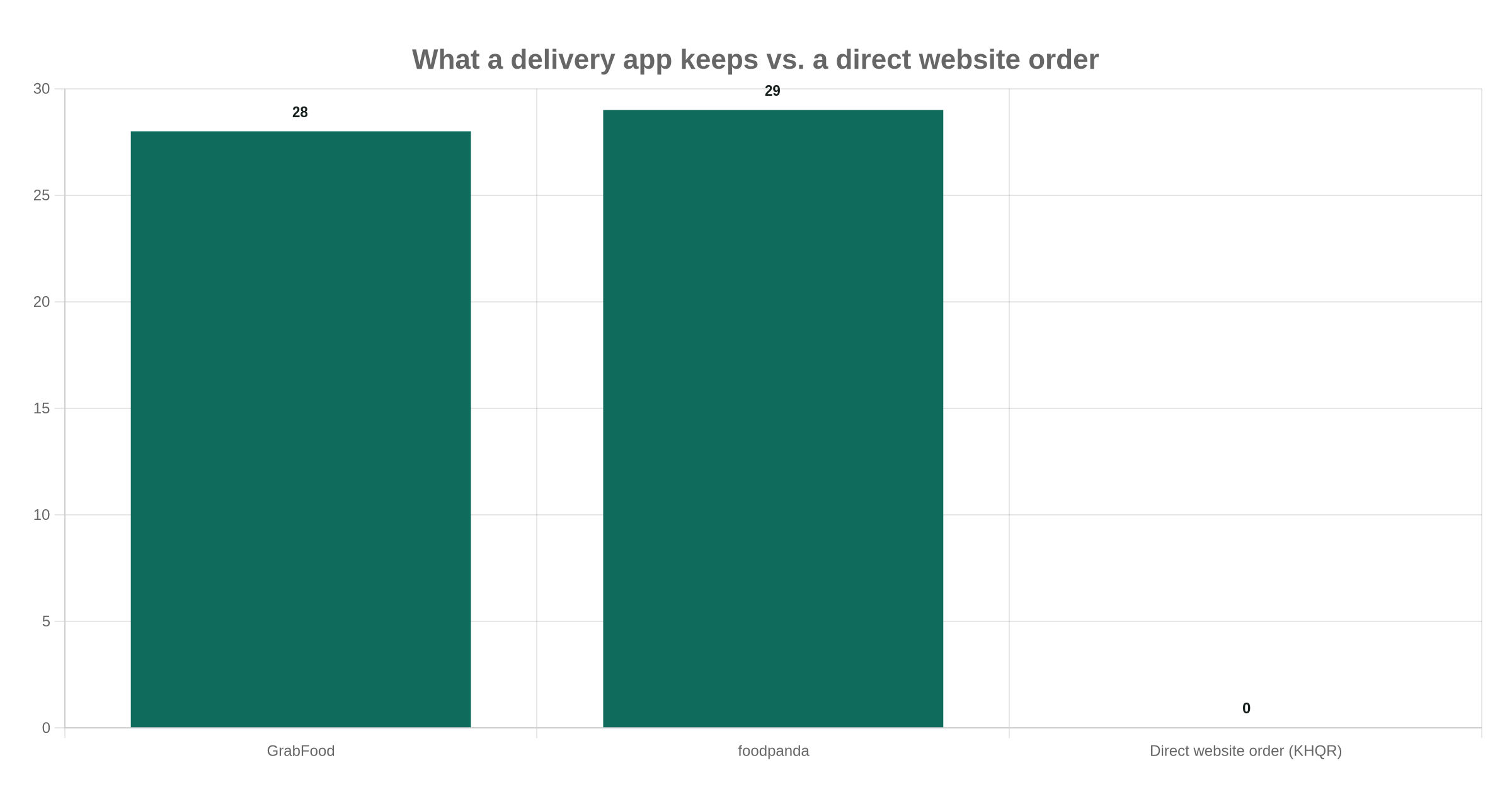
Run the math on a mid-size Phnom Penh restaurant doing 400 delivery orders a month at an average ticket of $8. At a 28% commission, the aggregator keeps roughly $896 of the $3,200 in monthly order value, every month, for as long as the order keeps coming through the app. Move even a quarter of that volume, the regulars who already know what they want, to a direct website order paid through KHQR, and the restaurant keeps the full ticket value on those orders instead, minus whatever small payment-processing cost applies, well below a 28% aggregator cut either way.
The pitfall we check first before recommending that shift is payment friction, not appetite. A regular who already has the GrabFood app open will not open a browser, find a menu PDF, then hunt for a bank transfer instruction just to save the restaurant a commission; the KHQR button has to sit on the menu page itself, one tap from the dish, or the order reverts to the app out of pure convenience. The order we build in reflects that: menu first, KHQR second, loyalty or saved-order history last, because a payment button added before the menu exists does nothing for conversion.
Extend that same 400-order month across a year and the gap compounds: $10,752 a year kept by the aggregator at a 28% commission on $38,400 of annual order value, before counting the promotional fee many restaurants also pay to stay visible in the app's search results. Moving even a modest share of that repeat volume to a direct, commission-free channel is not a marginal optimization; across a full year it is close to the cost of the website project itself, recovered once and then kept every year after.
We would not try to pull a restaurant off GrabFood and foodpanda entirely. New customers still discover a kitchen through those apps, and that discovery function is worth the commission on a first order. What we would do, and what most Phnom Penh restaurants currently do not, is build the direct channel for the customer who already knows the name of the dish and does not need an app to decide. A website with a saved order history, a reservation flow, and a KHQR button converts that repeat customer without paying a delivery app's cut on a relationship the restaurant already earned. A well-scoped AI ordering assistant on top of that website, answering a Telegram or Messenger question with the live menu instead of a staff member re-typing it each time, extends the same logic further without adding headcount. Our AI for hotels piece covers the same automation pattern applied to guest messaging.
How Do We Build a Restaurant Website, and What Does It Cost to Run?
Building a restaurant website runs through the same six-step process we use on every web project: scoping and audit, technical recommendations, design and prototype, sprint-based development, testing and go-live, and post-launch follow-up, with a showcase-style restaurant site typically landing in the 3 to 6 week range once scope is confirmed.
For a restaurant, the scoping step decides more than most. We map the menu structure (categories, dietary tags, daily specials), the ordering model (delivery through aggregators, pickup, dine-in reservations, or all three), and the payment rails (KHQR through Bakong, a card gateway such as ABA PayWay, or both) before any design work starts. Skipping that step is how a restaurant ends up with a beautiful site that still cannot take a KHQR payment six months after launch.
The design and prototype step matters more for a restaurant than for most business types, because the menu is the product. Food photography, legible typography for a menu read on a phone in low restaurant lighting, and a layout that survives a last-minute dish swap all get decided here, in Figma, before a line of code exists. We build the custom website design around the menu's real structure, not a generic template's.
Development and CMS setup is where the menu becomes editable content rather than a fixed page. On the web development side, that means wiring the menu, the reservation or ordering form, and the KHQR payment flow into a content system the restaurant's own staff can update without calling the agency every time a dish changes.
The trade-off we pick at this stage is a content-managed menu over a generic e-commerce cart plugin, even though the plugin ships faster. A cart plugin is built for SKUs that do not change hourly; a restaurant menu does, and a kitchen manager editing a dish description or marking a dish sold out needs that change live in seconds, not queued behind a developer release. The cost of that choice is a slightly longer build in the development step above. The payoff is a menu the kitchen actually keeps current, which is the real difference between a website that reflects the restaurant and one that quietly goes stale within a month of launch.
Testing and go-live is where the payment flow gets checked against real money, not a sandbox: a test KHQR transaction, a test reservation that actually reaches the right inbox or calendar, a menu edit made live and confirmed on a phone before launch day. The pitfall we check for here is a KHQR flow that passes in the sandbox but times out under a real bank app's response delay; a diner who watches a QR scan fail once rarely tries a second time on the same site, so that check happens before launch day, not after the first complaint. Post-launch follow-up then covers the weeks after go-live, when the kitchen is still learning to use the menu editor and small fixes (a mistranslated dish name, a reservation time slot that needs adjusting) surface fastest.
TechFlow positions its project pricing at roughly 35% below European agency rates for comparable scope, in line with the cost-advantage positioning we carry across every service line; a specific quote still depends on the mix of menu complexity, payment integrations and reservation logic a given restaurant needs, scoped during the first step above rather than guessed in advance.
What to Check Before You Hire, and What to Do This Week
Before hiring anyone to build a restaurant website in Phnom Penh, check three things: that the team has shipped a live site with working online payment, not just a portfolio of static designs; that menu updates are promised in hours, not a support ticket queue; and that the team understands KHQR and Bakong integration specifically, not payment processing in general.
Proof matters more than a pitch here. Browse real builds on our projects page before deciding who scopes a restaurant site, and ask any agency, including us, to show a live example rather than a mockup. We are a Phnom Penh-based team that ships bilingual English and French projects and understands the local payment and messaging habits (KHQR, Telegram, Facebook Messenger) a Phnom Penh diner actually uses, not a generic template adapted after the fact.
A short checklist to act on this week, before any project starts:
- Claim and fully complete the restaurant's Google Business Profile: category, hours, photos, and a habit of replying to reviews.
- Pull the restaurant's actual commission rate from its GrabFood and foodpanda contracts and compare it against the regional benchmark above.
- Decide which payment rails the website needs on day one: KHQR through Bakong, ABA PayWay, or both.
- List every menu change made in the last three months, as a test of how often the new site will need to be editable.
- Book a 30-minute call with our team to scope the specific features a restaurant, not a generic business, actually needs: get in touch and we will walk through the menu, ordering and payment setup before any design work starts.
Prefer to chat? Message our founder directly on Telegram (@maxgrolier), or book a call with the team.
Frequently asked questions
Do I still need a website if my restaurant is already on GrabFood and foodpanda?
Yes, for the customers who already know they want your food. GrabFood and foodpanda are discovery channels that bring in new diners, but they keep 25 to 35% of every order as commission and control the customer relationship afterward. A website lets a repeat customer order, book, or pay directly, at a lower cost per order and with the restaurant, not the app, owning the data.
How much does a restaurant website cost in Phnom Penh?
It depends on scope: a menu-and-reservations site costs less than one with full KHQR ordering, a loyalty system, and bilingual content. TechFlow positions its pricing at roughly 35% below comparable European agency rates, with the specific figure scoped during the first step of the process rather than quoted blind.
Can customers pay directly on the website with KHQR?
Yes. KHQR, built on the National Bank of Cambodia's Bakong system, is accepted at approximately 4.5 million merchant locations across the country according to the National Bank of Cambodia's first-half 2026 report, and it can be wired directly into a restaurant's ordering flow during development so a customer pays the same way they would at the table.
How long does it take to launch a restaurant website in Phnom Penh?
A showcase-style restaurant site typically takes 3 to 6 weeks from the start of the project, following TechFlow's standard six-step process: scoping and audit, technical recommendations, design and prototype, sprint-based development, testing and go-live, and post-launch follow-up.
Should the menu be in Khmer, English, or both?
Most Phnom Penh restaurants serving a mixed local and international customer base benefit from a bilingual menu, Khmer and English side by side, especially once online ordering is involved and a customer needs to recognize a dish name without guessing. The right mix depends on the restaurant's actual customer base, which is worth confirming during scoping rather than assuming.
What happens to the website when a dish sells out or the seasonal menu changes?
If the menu is built as editable content rather than a static image or PDF, restaurant staff update it directly, the same afternoon, without involving the agency. That editability is one of the first things to check before hiring anyone to build the site, since a menu that takes days to update defeats much of the website's purpose.