

Only 37 percent of companies answer a sales lead within an hour, 23 percent never answer at all, and the average response time across 2,241 US companies was 42 hours, according to Oldroyd, McElheran and Elkington's study in the Harvard Business Review (2011). That number is more than a decade old and it still describes how most Cambodian real estate developers run their presale pipeline today: a buyer messages a sales gallery's Telegram account at 11pm Phnom Penh time, and the next reply arrives whenever someone picks up the next morning, if anyone does at all. AI for real estate exists to close that specific gap. It is not here to replace the sales team that still has to walk a buyer through a tower's floor plans and payment schedule.
This article is written for the developer side of Cambodia's property market, not the individual agent most "AI for real estate" guides online are actually written for. We work through what AI automates at each stage of a developer's sales pipeline, what it costs in a market this size, and where a pipeline sitting on top of 63,334 completed condo units (Knight Frank Cambodia, 2025) is still losing buyers to a slow reply.
What Counts as AI for Real Estate When You're a Developer, Not an Agent?
AI for real estate, for a Cambodian developer, breaks into four jobs that have little to do with an individual agent's listing photos: qualifying and routing inbound buyer leads, keeping one CRM record per unit instead of three spreadsheets and a notebook, drafting the sales report a project director reads every week, and answering the repetitive questions (price per square meter, strata title rules, payment schedule) that currently eat a sales team's day one message at a time. It is the same pattern we see across our wider Phnom Penh digital agency work: the buyer-facing tool is rarely the real bottleneck, the back-office data pipeline behind it is.
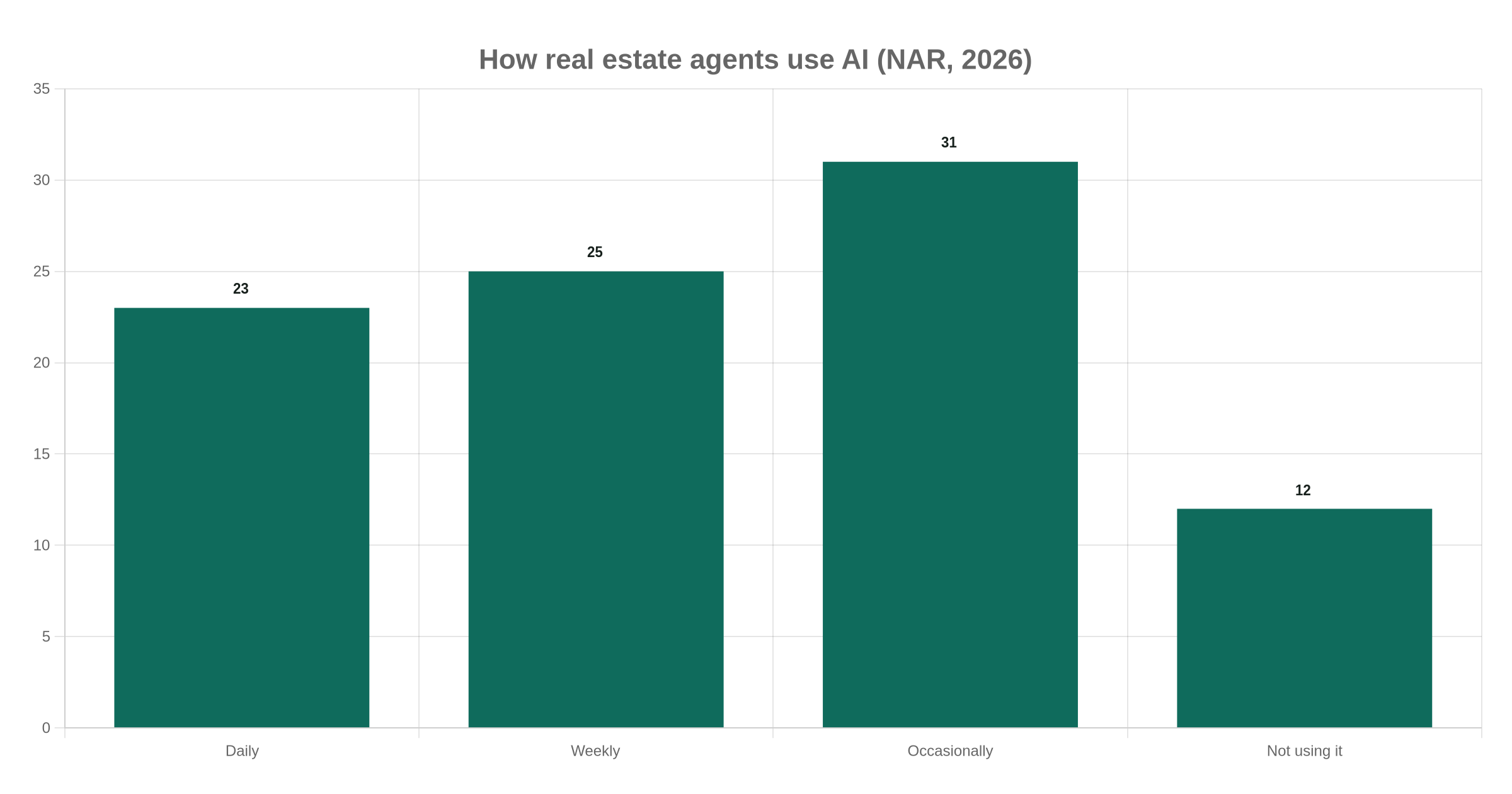
Globally, real estate professionals already lean on AI more than most buyers assume. In the National Association of Realtors' 2026 Technology Report, 48 percent of agents use AI daily (23 percent) or weekly (25 percent), and only 12 percent say they are not using it and have no plan to, down sharply from 32 percent a year earlier. The three jobs agents hand to AI most often are writing listing descriptions (75 percent), social media posts (56 percent), and follow-up emails or messages (52 percent), the same survey found.
The wider "real estate AI tools" category that most global guides cover end to end goes further than chatbots: automated valuation models estimate a unit's fair price from comparable sales, virtual staging software furnishes an empty show unit's photos digitally instead of paying for physical staging, and AI floor-plan generators turn a hand-drawn sketch into a measured, labelled plan a sales team can hand a buyer the same day. All of that is real and useful, and almost none of it is what a Cambodian developer's sales office needs solved first. A valuation model or a staged photo only helps once a buyer's message has actually reached a human, or an AI system, able to act on it, which is precisely the step that breaks down first in most presale offices here.
Cambodia's Condo Pipeline Is Bigger Than the Leads Chasing It
Phnom Penh had 63,334 completed condominium units by the end of 2025, up 9.6 percent from a year earlier (Knight Frank Cambodia, H2 2025 report). That supply is not evenly absorbed: IPS Cambodia put average project vacancy at around 15 percent across 2025. Pricing spreads just as wide: new affordable launches sit around 676 USD per square meter (Knight Frank Cambodia, H2 2025), Bamboo Routes' own market comparison puts typical resale listings at 1,500 to 2,000-plus USD, and CBRE put high-end stock above 2,800 USD per square meter, a roughly 5 percent year-on-year increase (CBRE, late 2025).
A foreign buyer adds one more filter most global AI scripts never account for: under Cambodia's 2010 Foreign Ownership Law, foreigners can hold up to 70 percent of the units in a strata-titled building, and only units above the ground floor. A developer qualifying a lead needs to know, inside the first exchange, whether a foreign buyer's unit choice still falls inside that 70 percent cap on that specific tower. Real estate agency and property-agent services in Cambodia also require a license from the Real Estate Business and Pawnshop Regulator under the Non-Bank Financial Services Authority, with fines from roughly 125 to 125,000 USD for operating unlicensed (DFDL, notification dated 17 June 2025). None of the generic "AI for real estate" guides currently ranking for this term write for a market with a 676-to-2,800-USD-per-square-meter spread, a 70 percent ownership cap, and a licensed-agent requirement baked into every qualified lead. That is the gap AI for real estate actually fills here: not a smarter chatbot script in the abstract, but one that already knows Cambodia's own ownership math before it routes a lead to a human.
What Does AI Lead Qualification Cost for a Phnom Penh Developer?
AI lead qualification for a Phnom Penh developer costs a few cents per conversation at the model layer, and the real expense is the one to two weeks of integration work to wire Telegram, Facebook Messenger, WhatsApp and a website form into one system, not the AI itself. Running the model on something like Claude Haiku 4.5 costs roughly 0.036 USD per English-language conversation and 0.082 USD per Khmer conversation, since Khmer script costs more tokens per sentence than English (figures we use consistently across our AI development in Cambodia coverage). The routing layer that watches each channel and hands the message to the model, commonly n8n, costs nothing to self-host or 20 euros a month on n8n's paid Cloud plan (n8n, 2026 pricing page).
Take a mid-size Phnom Penh developer handling around 600 inbound inquiries a month across Telegram, Messenger, WhatsApp and a web form, roughly 70 percent in English, 20 percent in Khmer, and 10 percent in Mandarin or Vietnamese (priced close to the English rate). That works out to about 15 USD for the English conversations, 10 USD for the Khmer ones, and 2 USD for the rest, call it 27 to 28 USD a month in pure model cost. Against a single 60,000 USD unit sale that an unanswered overnight message could cost, that is not a budget decision. It is a rounding error next to the integration work of getting every channel talking to one system in the first place. None of it matters if the web form itself drops the lead: a real estate website that cannot pass a qualified lead to this pipeline is the same dead end as a Telegram message nobody answers.
The one to two weeks of integration work breaks down into a short, concrete sequence: a scoping call to list every channel a buyer currently uses (usually Telegram, Messenger, WhatsApp and a contact form, sometimes a phone hotline too), two to four days wiring those channels into a single routing layer with automatic translation, and one or two more days testing the qualification logic against real buyer messages, including the foreign-ownership check described above, before it goes live. None of that timeline assumes a developer already has a CRM or a PMS-style system in place. It only assumes someone can name which channels a buyer actually uses today.
The scoping call comes first for a reason that is easy to skip past: a sales team often believes it uses four channels when a buyer-side audit of real inbound messages turns up a fifth, usually a phone hotline nobody logs anywhere, or a WhatsApp number printed on an old billboard that a junior sales rep still checks once a day. Wiring the channels a team thinks it has, rather than the ones buyers actually use, is the single most common reason an otherwise well-built pipeline still misses leads after go-live. The fix costs nothing beyond asking the sales gallery staff to list, for one week, every number and account a buyer messaged them on, before the routing layer is built around an assumption instead of a count.
AI Chatbot or a Human-Staffed Sales Desk for After-Hours Leads?
An AI chatbot and a human-staffed sales desk solve the same after-hours problem differently, and for a Cambodian developer the honest answer is that most presale offices need the chatbot first and the desk second, not one instead of the other. A human desk staffed around the clock gives a buyer a real person and real judgment on a complex negotiation, but staffing three shifts across Khmer, English, Mandarin and Vietnamese is a cost few single-project developers carry. An AI chatbot never sleeps, replies in whichever language the buyer opens with, and costs cents per conversation, but it cannot close a negotiation on financing terms or waive a reservation deadline.
That matters more here than a raw lead count suggests. Cambodia had 12.0 million internet users by October 2025, a 67.3 percent penetration rate (DataReportal, Digital 2026 Cambodia), and a growing share of a presale tower's inbound messages now arrive through exactly the online channels, Telegram, Messenger, WhatsApp, a web form, that a chatbot can watch at 3am and a sales desk cannot afford to staff at 3am.
Picture a 150-unit presale tower in BKK1 or Chroy Changvar taking inquiries through Telegram, Facebook Messenger, phone, and a walk-in sales gallery, with no shared calendar between channels. A buyer in Seoul messages the gallery's Telegram at 11pm Phnom Penh time asking about a two-bedroom unit's price per square meter and whether it still falls inside the building's foreign-ownership quota. If nobody replies until the following afternoon, that buyer has plenty of company: a 2014 WAV Group and Weichert study of 384 US brokerages found agents never responded at all to 48 percent of buyer inquiries, averaging 917 minutes to reply on the ones that did get an answer, and that buyer has likely already messaged two other towers with the same question by the time a human gets back to them. Route that same message through an AI qualification layer and the buyer gets an answer, in Korean or English, within seconds: unit availability, price, and whether the ownership cap still has room, with the human sales team looped in only once the buyer is ready to schedule a viewing or ask something the bot cannot resolve.
The right split, in our view, puts AI on the first reply and the ownership-cap check, and keeps a human on everything that involves negotiating terms, discounts, or anything the buyer pushes back on. That division costs a fraction of round-the-clock staffing and still gets every lead a same-minute reply.
How Does a Lead Actually Get From Telegram Into Your CRM?
A lead gets from Telegram into a CRM through an automation layer sitting between the messaging channel and the database, not through a staff member retyping a conversation by hand. A tool like n8n watches each connected channel (Telegram, Messenger, WhatsApp, a website form), passes new messages to an AI model that extracts structured fields (budget, unit size preference, buyer nationality, timeline, which tower or unit they asked about), and writes that record into a CRM such as HubSpot or Twenty CRM, the tools named in our own stack for client work. A hot lead, one that mentions a viewing date or a specific unit number, gets flagged and pushed to a human sales rep's own Telegram or Slack immediately, rather than sitting in a dashboard nobody checks until the next morning.
This is also where the foreign-ownership math from earlier becomes operational rather than theoretical. If the qualification step already knows a tower's current foreign-ownership percentage, a buyer who would push that figure past 70 percent gets flagged before a sales rep spends an afternoon on a unit that legally cannot be sold to them. That single check, built once into the intake automation, removes a mistake that costs a sales team real time on nearly every foreign-buyer inquiry.
The same pipeline also solves a problem specific to multi-unit developments: duplicate interest. Two sales reps fielding the same popular floor plan on different channels, one on Telegram and one by phone, routinely end up promising the same unit to two different buyers before either checks the master list. A CRM record created the moment a lead is qualified, rather than whenever a human gets around to logging it, closes that window. The unit's status updates once, and every channel sees the same answer.
The order this gets built in matters more than it looks. Phone number normalization has to happen before the first CRM record is written, not after, because Telegram and WhatsApp store the same number in two different formats more often than not: one with a leading country code, one without. A dedup rule that matches on the raw string catches almost nothing. We would rather build the matching logic to over-merge, flagging two genuinely different buyers for a human to split apart, than under-merge and let a sales rep call the same lead twice while a different buyer's message sits unanswered. That single ordering choice, fixed once in the automation rather than left to whoever happens to notice a duplicate, is the kind of detail that decides whether a CRM migration actually holds up once real buyer traffic hits it.
Can AI Write Your Weekly Sales Report for a Development?
AI can write a usable first draft of a weekly sales report once the underlying lead and unit data already lives in one CRM, but it cannot write a good report from three disconnected spreadsheets any more than a human analyst could. Picture a sales director at a mid-size Phnom Penh developer spending roughly three hours every Friday pulling numbers from a Telegram lead log, a separate Messenger tracker, and a paper sign-in sheet from the sales gallery into one slide deck for the Monday management meeting, a realistic, hypothetical routine built from how presale offices typically operate, not a specific client's figures. With a CRM already holding clean, structured records from the intake pipeline described above, an AI agent can pull the same numbers, draft the narrative, and flag the week's notable movements (which unit types sold, which price band stalled, how many foreign-buyer leads hit the ownership cap) in minutes rather than hours. McKinsey's State of AI in 2026 survey found that 20.5 percent of generative AI users already save four or more hours a week on tasks like this, and a weekly report built from data that already exists sits squarely in that category.
The sequencing matters more than the tool. A report only summarizes data that already exists in usable form, and an AI report generator pointed at three disconnected trackers will either fail outright or quietly summarize bad data with total confidence. Fix intake first, and the report becomes the easy part.
Where Most AI for Real Estate Advice Gets Cambodia Wrong
Most AI for real estate advice circulating in 2026 is written for a solo agent in a mature market with an MLS, a CRM already in place, and one listing at a time to manage, and almost none of it transfers cleanly to a Cambodian developer selling 50 to 300 units out of a single presale tower. We see the same mis-sequencing one sector over in AI for hotels: a team reaches for a guest-facing chatbot before fixing the reservation data behind it, same mistake, different vertical.
We think most Cambodian developers chasing AI for real estate start by shopping for a chatbot when the actual leak is upstream: leads already arriving on Telegram, Messenger, and a sales gallery sign-in sheet that never make it into one system. A faster chatbot bolted onto that mess answers questions faster, then still drops the same lead on the floor, because nothing downstream of the chat window changed.
We would not recommend a developer with one active project build an AI sales-report generator before fixing lead intake, because a report only summarizes data that already exists in usable form, and a presale office running three disconnected trackers has nothing clean yet for the report to summarize.
If you run sales for a Cambodian development, do this in order this week:
- List every channel a buyer can currently reach you on (Telegram, Messenger, WhatsApp, phone, walk-in) and name who checks each one after 6pm.
- Pick one CRM record format and migrate whatever spreadsheet or notebook your team uses into it, before any AI touches the data.
- Confirm with your RPR-licensed counsel or agent where each tower's foreign-ownership percentage currently sits, so an intake script can check the 70 percent cap on day one instead of guessing.
- Start AI on lead qualification and routing, not on pricing or reporting, since both of those need the clean data intake produces first.
Our own AI agents work starts with a free one to two hour process-mapping audit built for exactly this kind of intake problem. Take a look at our project work or book a call to talk through your pipeline directly.
Prefer to chat? Message our founder directly on Telegram (@maxgrolier), or book a call with the team.
Frequently asked questions
Does a Cambodian real estate developer need a CRM before using AI?
Yes, in practice. AI lead qualification can run without one, but the value compounds once qualified leads land in a single CRM record instead of a spreadsheet, since that same record is what later powers accurate sales reporting and buyer follow-up.
Can AI chatbots reply to property buyers in Khmer, Chinese and Vietnamese?
Yes. Modern language models translate and reply across Khmer, Mandarin, Vietnamese and English within the same conversation, which matters directly in Cambodia since foreign buyers and overseas Khmer are a meaningful share of condo demand.
How much does AI lead qualification cost per month for a mid-size developer?
Model cost alone runs around 27 to 28 USD a month for roughly 600 mixed-language inquiries, using a model like Claude Haiku 4.5 at 0.036 USD per English conversation and 0.082 USD per Khmer conversation. The larger cost is the one to two weeks of integration work to connect every channel to one system.
Is a free tool like ChatGPT enough to qualify real estate leads?
Not on its own. A general chatbot can answer a question typed directly into it, but it has no connection to Telegram, Messenger or a CRM, so nothing it handles gets recorded or routed. Lead qualification needs that connective layer, commonly built with a tool like n8n, wired to a model and a CRM.
How long does it take to set up an AI lead-to-CRM pipeline?
For the usual channel mix (Telegram, Messenger, WhatsApp, a web form), a realistic build runs one to two weeks: a scoping call to map every current lead channel, two to four days wiring each channel into a routing layer, and one or two days testing against real buyer messages before go-live. That range only stretches toward three or four weeks when the build adds something the basic sequence does not cover, such as a second PMS integration or a custom CRM with non-standard fields.