

.svg)

What 4 weeks of AI development in Phnom Penh looks like, week by week
AI development in Phnom Penh, as TechFlow Agency runs it, takes one business workflow from a free process-mapping audit to an autonomous agent live in your own tools within 1 to 4 weeks, after a costed action plan delivered in 5 days. Here is that build, week by week, with the hosting choices the Cambodian rules of 2026 impose.
Our team works from Phnom Penh, in the ICT time zone (UTC+7), and delivers in English and French. The odds explain the method: Gartner predicted in July 2024 that at least 30% of generative AI projects would be abandoned after proof of concept by the end of 2025, and MIT NANDA's "The GenAI Divide" (2025), based on interviews, surveys and about 300 public deployments, found that roughly 95% of enterprise generative AI pilots delivered no measurable P&L impact.
What happens before week 1 of AI development in Phnom Penh?
Before week 1, AI development in Phnom Penh starts with two short steps: a free process-mapping audit of 1 to 2 hours, then a costed action plan delivered in 5 days. The audit ranks the workflows that consume hours (quote requests on Messenger, invoices retyped into Odoo, unqualified leads) by volume and risk, using the criteria explained in our guide to choosing an AI consulting audit.
The plan fixes one workflow, one success metric, the systems to touch, the hosting tier and a cost per agent. We decide hosting here, in week 0, never after the prototype: moving an agent from a public model API to a server in Cambodia after week 2 means rewriting connectors, credentials and logs.
Take a hypothetical BKK1 property developer receiving 400 buyer inquiries a month on Messenger, Telegram and its website: one metric (inquiries qualified and routed within 5 minutes), three systems (Messenger, CRM, calendar), one hosting tier (private cloud, no banking data). Messenger earns its place: the DataReportal Digital 2026 Cambodia report puts its advertising reach at 8.90 million people in October 2025, out of 12.0 million internet users (67.3% of the population).
| Week | What we deliver | What the client provides | Decision gate |
|---|---|---|---|
| 0 | Audit, then costed plan in 5 days | One workflow, access to its tools | Scope, metric and hosting signed |
| 1 | Prototype answering 200 to 500 real messages | Anonymised past conversations | Written go or no-go |
| 2 | Connectors, guardrails, logs | CRM and inbox access, handoff contacts | Permissions validated |
| 3 | Test report: accuracy, speed, cost | Scoring of a sample of answers | Metric reached or scope cut |
| 4 | Shadow mode, then one channel live | A person who sends drafted answers | Autonomy switched on |
Week 1: why must the prototype run on real messages?
A week-1 prototype must run on real, anonymised messages from the client's own channels, because a demo built on invented English prompts hides the two variables that decide the project: language and edge cases. We collect 200 to 500 past conversations, strip names and phone numbers, and replay them through the agent before Friday.
Language is the hidden variable in Cambodia. In our September 2026 measurement, the same text needed 3.3 to 15.6 times more tokens in Khmer than in English depending on the model family, a gap detailed in our analysis of AI development costs in Cambodia. Claude's tokenizer is not public, so we measure the ratio on the client's own messages in week 1 instead of assuming it.
Edge cases are the second variable: an agent promising "we will send the brochure tomorrow" breaks Meta's rule that standard Messenger replies go out within 24 hours of the customer's last message, so follow-ups are designed in week 1.
Our position is firm: we would rather stop a use case on day 5 than discover in week 4 that the Khmer answers are wrong or the running cost is three times the budget. Week 1 ends with answers on real messages, measured tokens per conversation, and a written go or no-go.
Weeks 2 and 3: integration and testing, where most projects stall
Weeks 2 and 3 connect the prototype to the systems where work happens, then test it until its failures are predictable. We orchestrate those connections with n8n, route model calls through OpenRouter, and choose between Claude, GPT, Mistral and Llama per task, so a low-cost model sorts incoming messages and a stronger one drafts the answers customers read.
Week 2 covers connectors and guardrails:
- Scoped access: the agent reads the CRM record and writes a qualified lead, but never deletes or edits prices.
- Human handoff: negotiation, complaints and payment go to a named person on Telegram. The agent never generates or confirms a KHQR or ABA PayWay payment: a wrong amount is a liability no model should carry.
- Full logs: every prompt, answer and tool call is stored, so an error is traced in minutes.
Week 3 tests against the plan's metric: we replay the archive, add hard cases (Khmer text with English product names, a transcribed voice note, a request at 11 p.m. ICT) and measure accuracy, response time and cost per conversation. Connectivity is rarely the constraint: DataReportal reports a median mobile download speed of 53.58 Mbps in Cambodia, up 86.7% in the twelve months to August 2025. The real constraint is data quality in the client's tools.
Where should an AI agent built in Phnom Penh be hosted?
An AI agent built in Phnom Penh should be hosted according to the data it touches: private cloud for most SMEs, infrastructure in Cambodia for banks and financial institutions, sovereign servers only where a regulator or risk policy requires them.
The National Bank of Cambodia's Technology and Cyber Risk Management Guidelines, published in January 2026, require licensed banks and financial institutions to keep at least one primary data center in Cambodia (clause 3.13.1), to use a data center abroad only as a secondary site approved by the NBC (3.13.5), and to obtain prior NBC approval before customer personal data is hosted outside Cambodia (9.0.3). The personal data protection law is still a draft, validated in a Ministry of Post and Telecommunications workshop on 5 August 2026.
| Data the agent touches | Rule in force, September 2026 | Our default hosting |
|---|---|---|
| Marketing content, internal documents | No sector rule | Private cloud, models via OpenRouter |
| Customer contacts, bookings, leads | E-Commerce Law 2019 security duty; PDP law in draft | Private cloud, portable design |
| Customer data of a bank or MFI | NBC guidelines 2026: primary data center in Cambodia, prior approval to host abroad | Servers in Cambodia, open-weight models (Mistral, Llama) |
Consider a hypothetical Phnom Penh microfinance institution sorting loan inquiries on Telegram. Sending an applicant's name and income to a model API abroad would need prior NBC approval (9.0.3), so we would run an open-weight model on servers in Cambodia, within its primary data center (3.13.1), with the periodic bias review of section 6.4.4 built into the monthly report. That project leaves the 4-week route for the 4 to 8 week sovereign infrastructure track.
Our second position: most Phnom Penh SMEs should not pay for sovereign infrastructure in anticipation of the data law. We build every agent to be portable instead, so a later move to servers in Cambodia is a migration, not a rebuild.
What does an AI agent cost to run each month?
An AI agent of this kind costs tens of dollars a month to run, not thousands, when the model matches the task; the build is quoted after the 5-day plan. Here is a worked calculation for a hypothetical Phnom Penh electronics retailer handling 3,000 customer conversations a month, about 4 messages each:
- Model: Anthropic's pricing page (September 2026) lists Claude Haiku 4.5 at $1 per million input tokens and $5 per million output tokens, and estimates about $37 for 10,000 support conversations of roughly 3,700 tokens. At that size, 3,000 English conversations cost about $11.10. Resent history is billed at 0.1 times the input price with prompt caching.
- Router: OpenRouter adds no model markup but 5.5% on card credit purchases.
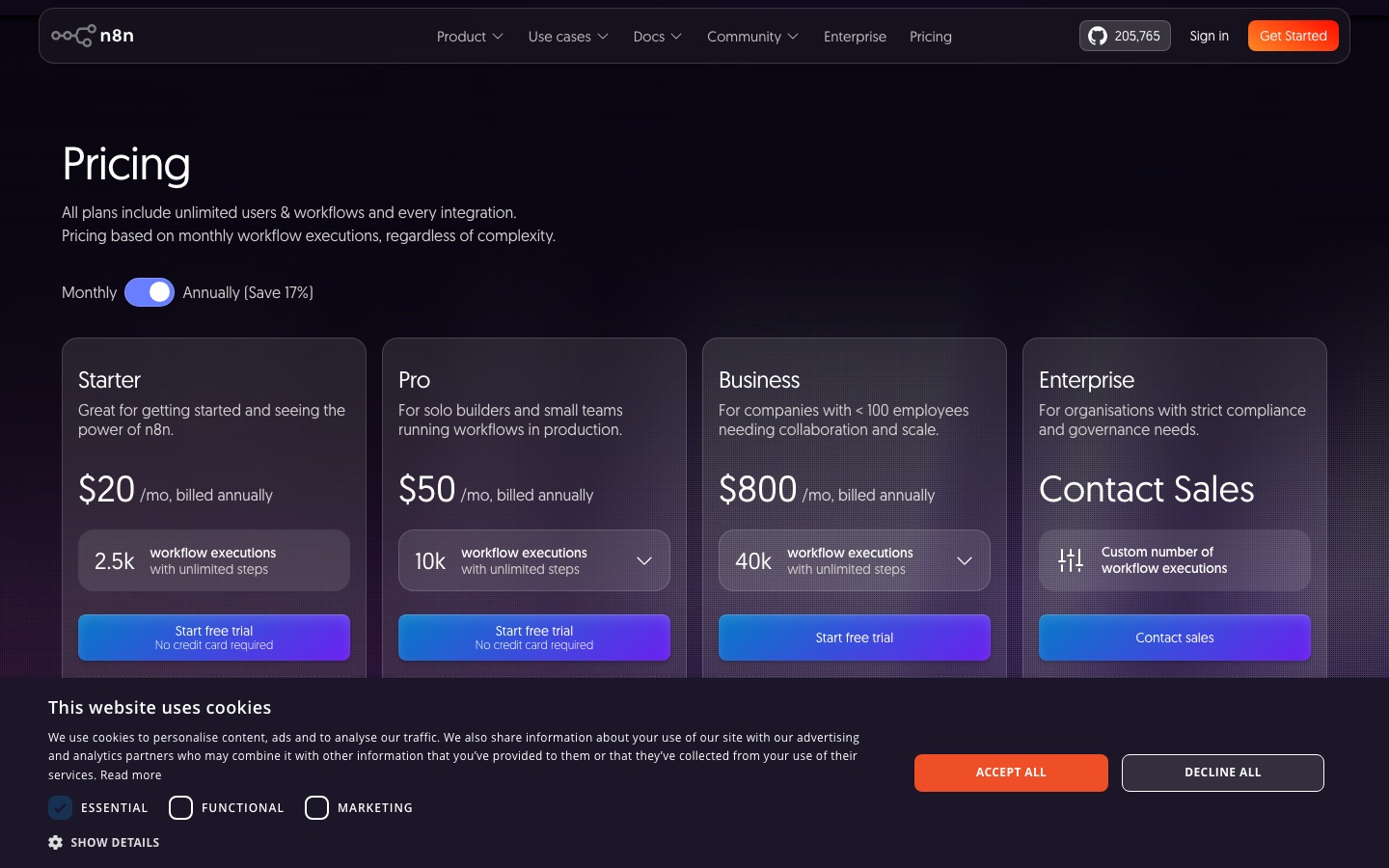
- Orchestration: n8n bills per workflow execution. A message-triggered agent runs once per message, so 12,000 executions a month, above the 10,000 of the $50 Pro plan. We self-host the free Community Edition on a $12-a-month 2 GB DigitalOcean droplet, or batch messages per conversation to stay on Pro.
- Khmer: if the client's messages run at 3.3 times the English tokens, the lowest ratio we measured, the model line becomes about $36.63.
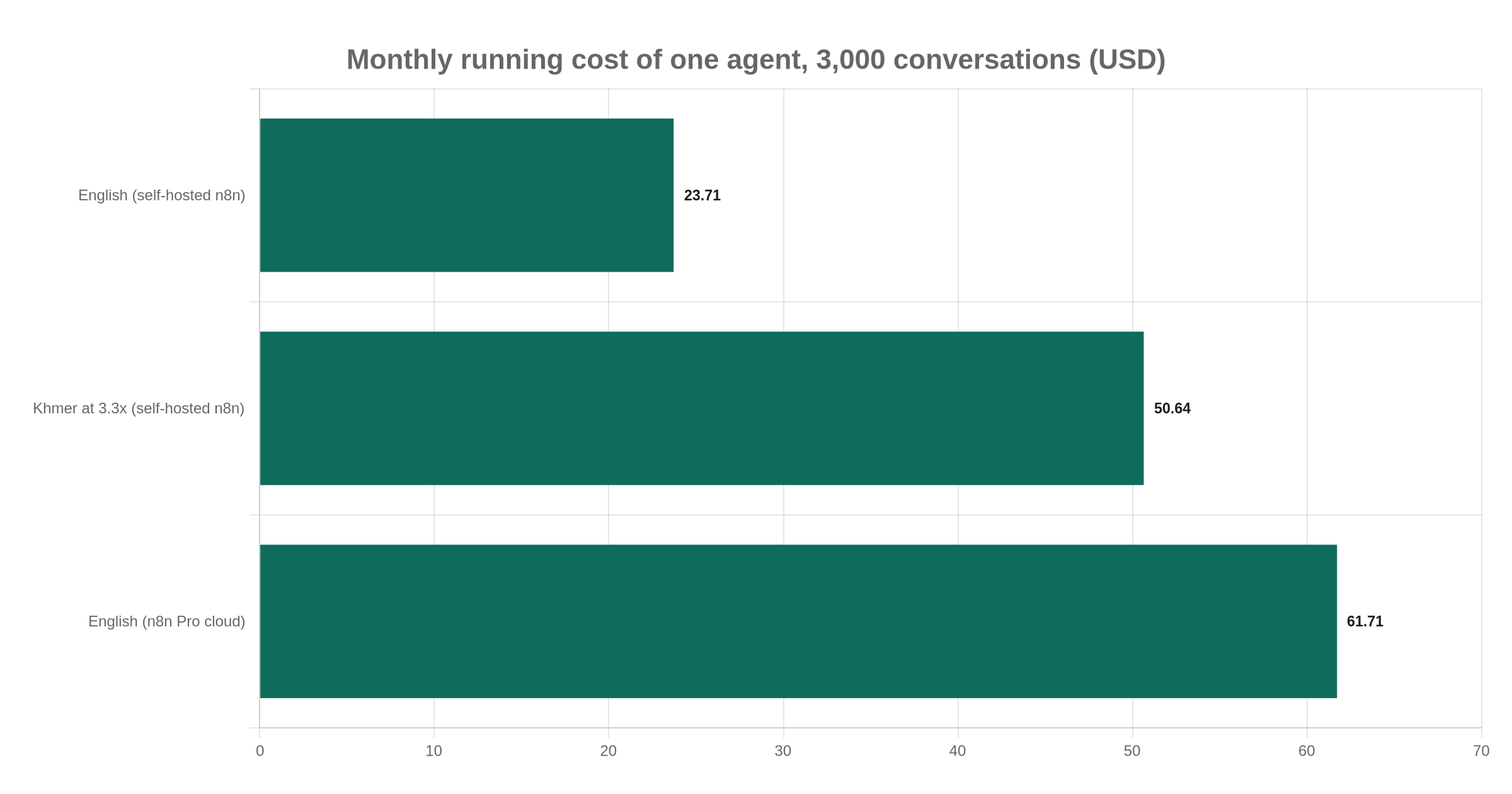
Total: about $24 a month in English and $51 in Khmer self-hosted, or $62 in English on n8n Pro. The build fee and the week-1 go or no-go matter more, and our guide to AI agents for small business compares the use cases worth that fee.
Week 4: how does go-live work, and what follows?
Go-live in week 4 is staged, and afterwards the agent stops being a project and becomes an operation with continuous improvement and a monthly report. For the first days the agent runs in shadow mode, drafting every answer that a person on the client's team sends, which exposes the last wrong tone or outdated price. Then autonomy is switched on for one channel, usually the one with the most repetitive volume, while the human handoff stays in place.
Monitoring tracks four numbers, each tied to the plan:
- Accuracy on a weekly sample, scored by the client.
- Handoff rate to a person.
- Cost per conversation, compared with the week-1 measurement.
- Response time at peak hours in ICT.
Models also change: Anthropic's own pricing page lists several models already retired, so the monthly report includes a model review. For banks and microfinance institutions, the NBC guidelines of 2026 turn this into an obligation under section 6.4.
Book a 30-minute call with our Phnom Penh team
The first step is a 30-minute call with our founder, Maximilien Grolier, followed by the free process-mapping audit. Bring one workflow that costs your team hours every week, and we will tell you whether it fits the 4-week route, a 24 to 48 hour skill, or 4 to 8 weeks of sovereign infrastructure, the three formats of our AI agents offer. Our AI agents line is new and has no published case study yet; our past projects cover branding, UX/UI and Webflow work for clients such as Mandil Avocats and Concorde, and our positioning is to deliver 35% below European agency prices. Book a call from Phnom Penh or abroad.
Frequently asked questions
What happens if the week-1 prototype fails?
A failed week-1 prototype ends with a written no-go and a reason, such as accuracy below the plan's metric or a cost per conversation above budget. We then narrow the scope, switch models, or stop before integration costs are spent.
Do we need servers in Cambodia for an AI agent?
Most SMEs do not need servers in Cambodia; a private cloud is enough outside regulated data. Banks and financial institutions are different: the NBC guidelines of January 2026 require a primary data center in Cambodia and prior approval before customer personal data is hosted abroad.
What does an AI agent cost to run each month?
In our worked example of 3,000 conversations a month, running costs come to about $24 in English and $51 in Khmer with self-hosted n8n, or $62 in English on n8n's Pro plan.
What should we prepare before the first call?
Prepare one workflow, its monthly volume, its channels and the tools it touches, such as your CRM or Odoo. Past conversations help.
Have a project in mind?
Book a 30 minute call to see what we can do for you.
Recommended insights
The first 90 days with a marketing agency in Phnom Penh

Most marketing agencies in Cambodia fix the wrong bottleneck

Digital marketing in Cambodia in 2026 is won in the inbox, not the feed

What a digital marketing agency in Cambodia really costs after tax
Why one Phnom Penh digital agency beats three specialists (usually)
What 4 weeks of AI development in Phnom Penh looks like, week by week
The Khmer token tax and what AI development in Cambodia really costs

Before you buy AI in Cambodia, run a 4-criteria consulting audit

What AI agents do for a small business, and what they cost to run
Four things an AI agency in Phnom Penh should hand you

Webflow agency: how we use Webflow on SME projects

Web development Cambodia: Webflow, no-code and custom builds compared



.svg)

.svg)