
An AI chatbot on Telegram is, for most Cambodian businesses, the faster and cheaper first deployment: Telegram's Bot API is free to message on, carries no reply-window rules, and reaches a market where Telegram has led Facebook Messenger since at least 2022 (IPS Cambodia, 2022). Messenger still matters where a business already runs Facebook ads, but it comes with compliance rules a Telegram bot never has to think about.
We build both. This guide compares them as a deployment decision, not a popularity contest: what each platform lets an AI bot do, what it costs to run, where each one still wins, and the rules that catch a new bot off guard.
What's the Difference Between a Telegram AI Bot and a Messenger AI Chatbot?
A Telegram AI bot is a standalone account registered through BotFather that can message any user who starts a conversation with it, with no time limit; a Messenger AI chatbot is a Facebook Page feature that can only message freely inside a 24-hour window that resets each time the user replies. That single rule shapes almost everything else about building on each platform.
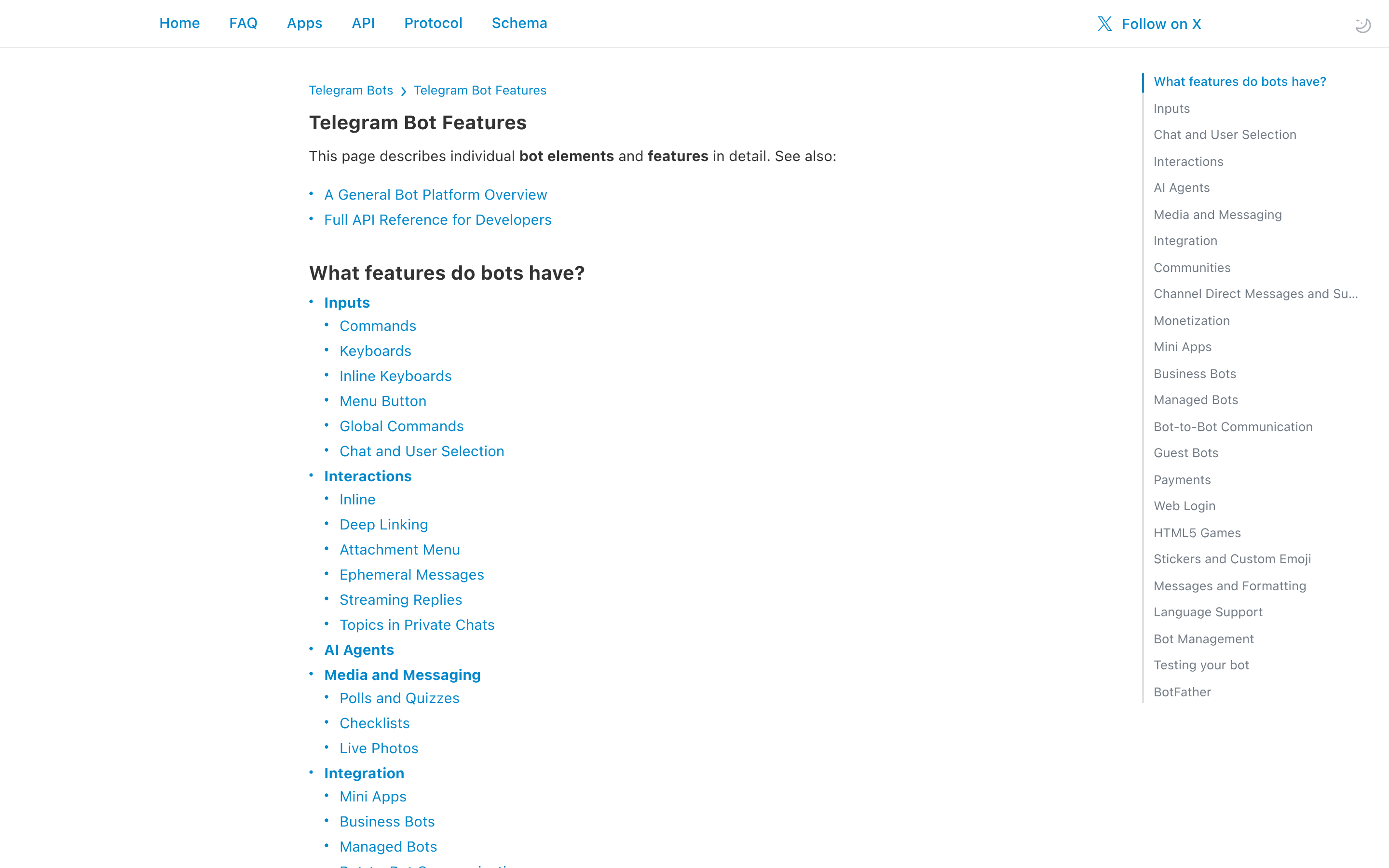
Telegram's Bot API, documented publicly at core.telegram.org, lets a registered bot send messages, buttons, files and payments to any user who has opened a chat with it, with no expiry. Telegram's own May 2026 update added Guest AI Bots (tagged with @username inside any chat, seeing only the message they were tagged in) and bot-to-bot messaging for chained automations, both aimed at the kind of AI-agent workflows a business would wire up.
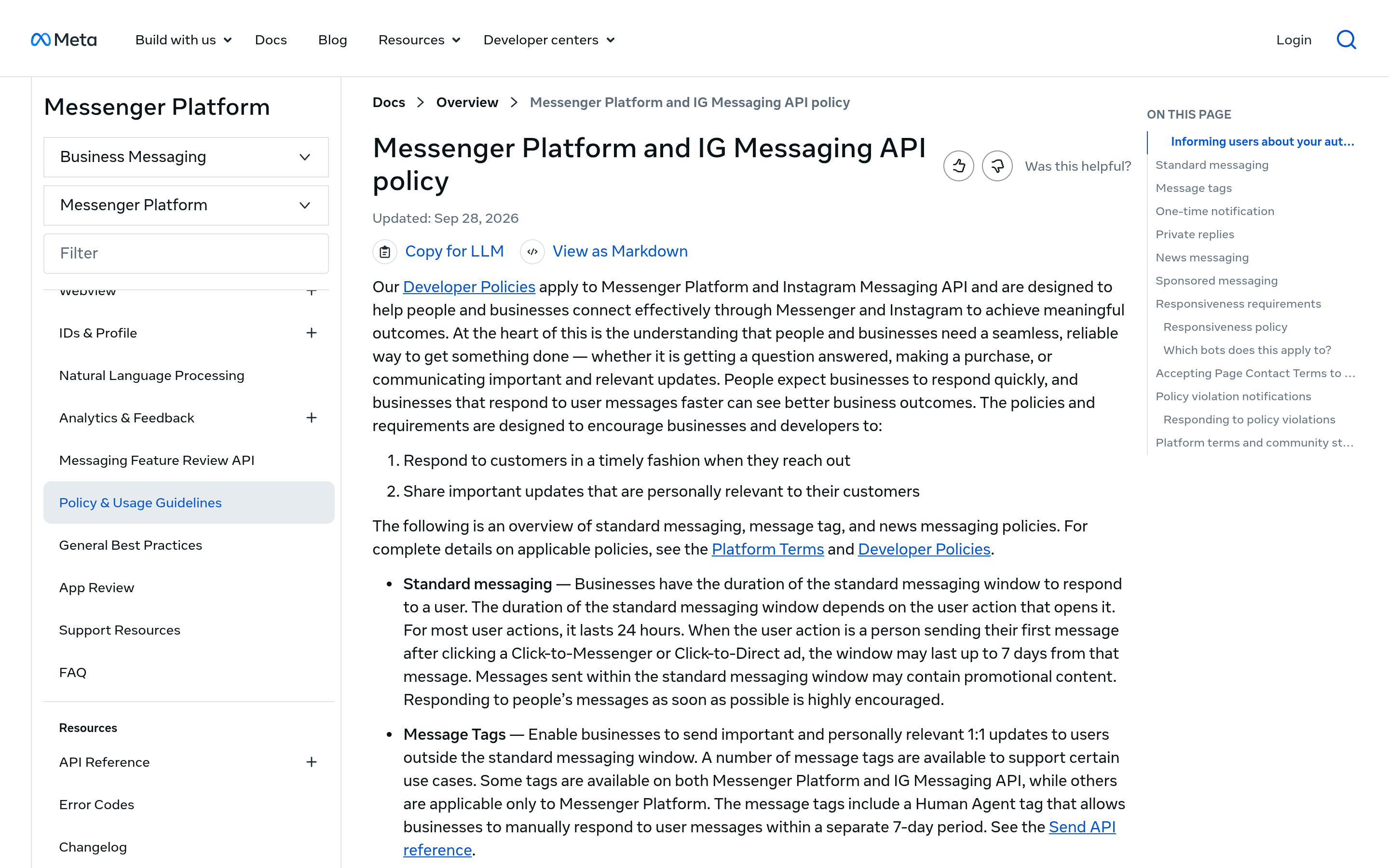
Messenger's Send API, by contrast, sits inside Meta's Messenger Platform policy: a business can message a user freely only within 24 hours of that user's last message, story reply, or Ice Breaker click. Outside that window, only a human agent may reply, using the Human Agent tag, for up to 7 days.
| Telegram Bot API | Messenger Platform | |
|---|---|---|
| Who can message first | Anyone who starts a chat with the bot, no expiry | Only within 24h of the user's last message (or 7 days, human only) |
| Verification to launch | None; register with BotFather in minutes | Meta Business verification, up to 14 business days |
| Native AI features | Guest AI bots, bot-to-bot chats, streaming replies (Telegram, May 2026) | No native AI layer; the business supplies its own model |
| Rate limit | 30 messages/second globally, 1/second per chat (core.telegram.org/bots/faq) | Governed by messaging-window and tag rules, not a raw rate cap |
| Messaging fee | None | None (Send API); WhatsApp's API, not Messenger's, now charges per message from Oct 2026 |
Why Does Telegram Already Lead Messenger for Business Messaging in Cambodia?
Telegram already leads Messenger as Cambodia's primary business-messaging app because it won that position years before AI chatbots existed, not because of anything specific to AI. A 2022 survey by IPS Cambodia found Telegram in first place and Facebook Messenger in second among instant messaging apps, with 73.9 percent of the country's roughly 17 million residents actively using instant messaging; the same report described Telegram, not Messenger, as "one of the main applications used to communicate with businesses, officials and more."
That lead widened in a way no global chatbot guide accounts for. In June 2023, Prime Minister Hun Sen moved his own communications to Telegram after a Meta Oversight Board recommendation to suspend his Facebook and Instagram accounts, according to CamboJA News, which cited Telegram's usefulness in countries where Facebook is restricted. His Facebook page was listed as having 14 million followers at the time, according to ABC News. Whatever one makes of the politics, the practical effect is that Telegram carries an institutional weight here most global chatbot guides never account for, part of the broader shift we track in our AI development in Cambodia guide.
Meta's own Digital 2026 Cambodia data, compiled by DataReportal, puts Messenger's advertising reach at 8.90 million people against Facebook's 14.0 million: still substantial, but a measure of ad reach, not messaging-app preference.
Our position: for a Cambodian business with no existing Facebook Page audience, Telegram should be the default channel for a new AI chatbot, not a secondary one. It carries no messaging-window rules to engineer around, and the available market data says more of the conversation already happens there.
How Do You Actually Build an AI Chatbot on Telegram?
Building an AI chatbot on Telegram means registering a bot with BotFather, connecting its webhook to an orchestration tool, and wiring that tool to a language model. The whole chain can run without a Meta review step at any point.
- Register the bot. Message @BotFather inside Telegram, choose a name and username, and receive an API token in under a minute. No business verification, no app review.
- Connect the webhook. Point the bot's webhook at an orchestration workflow, commonly built in n8n, which receives each incoming message and decides what to do with it.
- Wire in the model. The workflow calls a language model, typically through a router such as OpenRouter so the business is not locked to one provider, then returns the reply through the Bot API.
- Add the business logic. Look up the customer in a CRM, check a calendar, or read from a product list, the same tool calls an AI agent would use on any other channel; our guide to AI agents for small business walks through that layer.
- Test on real messages, including Khmer and mixed Khmer-English, before launch. Our measurement found Khmer text runs at roughly 3.3 times the token count of English, which changes reply latency more than it changes the bill.
A guesthouse in Siem Reap could have this chain live within a day: BotFather registration in the morning, an n8n workflow reading its booking calendar by the afternoon, tested on real guest questions before it reaches the guesthouse's Telegram link.
What Does It Cost to Run a Telegram or Messenger AI Chatbot in Cambodia?
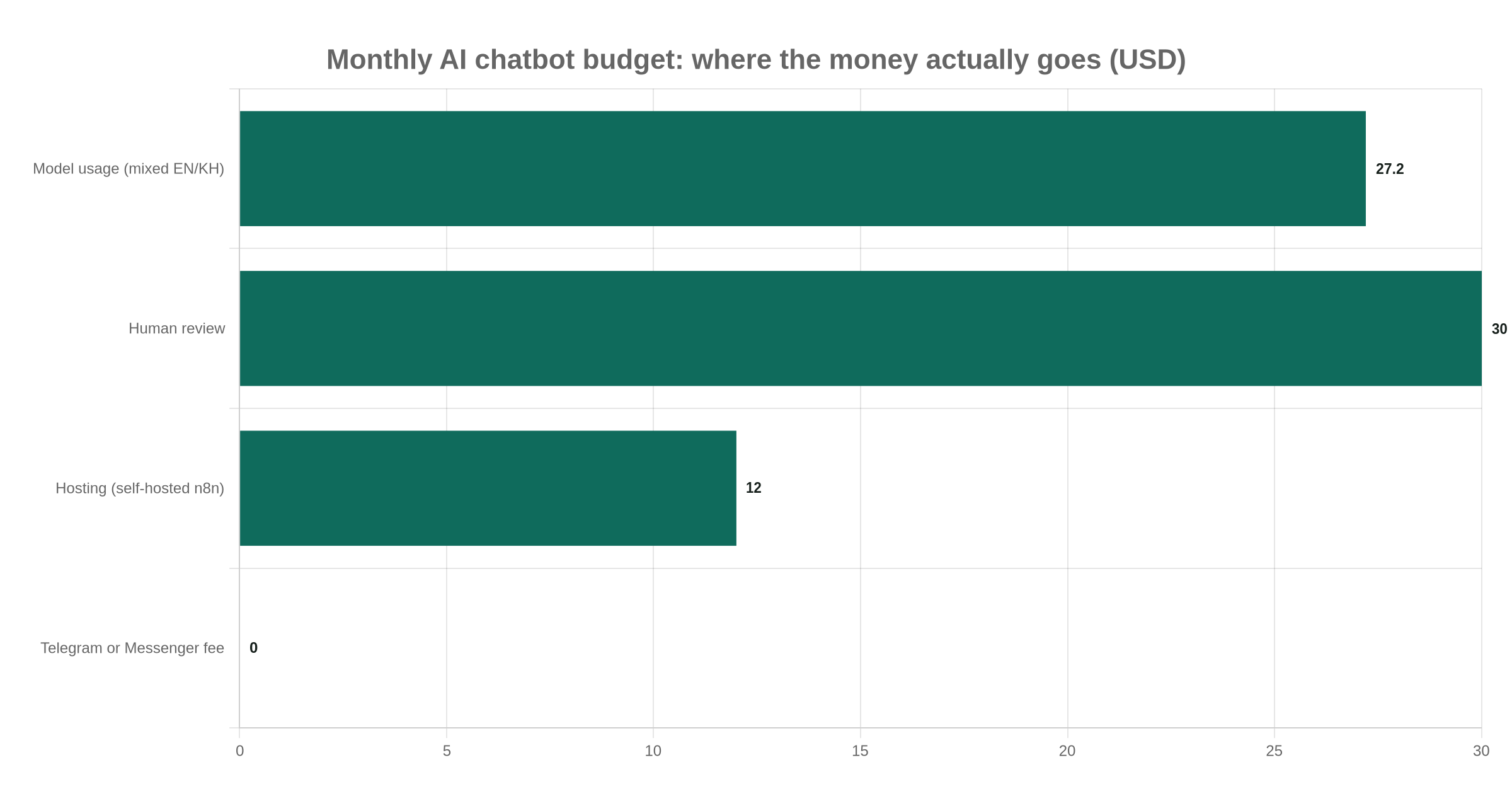
Running an AI chatbot costs roughly the same whether it lives on Telegram or Messenger, because neither platform charges to send a message; the bill comes from the model, the hosting, and the person who checks the bot's work.
Worked example: a small retailer handling 500 conversations a month, 60 percent in English and 40 percent in Khmer, on Claude Haiku 4.5 at September 2026 list prices (0.036 USD per English conversation, 0.082 USD per Khmer conversation, as priced in our AI agent pricing guide):
| Line | Basis | Monthly cost |
|---|---|---|
| Model usage | 300 English at 0.036, 200 Khmer at 0.082 | About 27 USD |
| Hosting and orchestration | Self-hosted n8n on a small cloud instance | About 12 USD |
| Human review | A few hours a week checking transcripts | About 30 USD |
| Telegram or Messenger messaging fee | Both platforms' bot APIs are free to send on | 0 USD |
| Total | Before setup and maintenance | About 69 USD |
One line often gets confused here: from 1 October 2026, Meta began charging per delivered service message, but only on the WhatsApp Business Platform, with 1,000 free messages a month before the meter starts. It has nothing to do with Messenger. A Cambodian business quoted a per-message chatbot fee should ask exactly which Meta platform that fee applies to.
Our position: a chatbot builder priced by messaging fees is solving a problem Cambodia does not have. Budget for the model and the person who reviews its answers instead.
Where Does Facebook Messenger Still Win?
Facebook Messenger still wins wherever a business already advertises on Facebook, because Messenger sits one tap away from the ad that started the conversation. A Phnom Penh boutique running Facebook catalogue ads captures a warm lead the moment someone clicks "Send Message," inside the same app the ad appeared in; sending that person to Telegram instead adds a step most will not take.
Messenger also keeps the conversation attached to a Facebook Page a business may already use for reviews, hours, and a product catalogue, something a Telegram bot has no equivalent of. For a business whose whole funnel already runs through Facebook, that outweighs Telegram's lighter rules.
A realistic split: an e-commerce seller running Facebook ads keeps its chatbot on Messenger and accepts the 24-hour window as a cost of doing business there, while still registering a Telegram bot as a second, no-cost channel for customers who message the shop directly.
The Messenger Rules That Trip Up New Bots
New Messenger bots most often fail on the 24-hour window and the tags meant to work around it, not on anything AI-specific. Three rules cause most of the trouble:
- The 24-hour window resets on every user reply, but a bot that tries to send a follow-up message the next day, without a fresh user message, will silently fail to deliver it.
- The Human Agent tag is for humans only. Meta's policy explicitly bans using it to extend an automated bot's reach past 24 hours; only a person typing a reply may use it, for support purposes, for up to 7 days.
- Message Tags, the feature many bots used to send updates outside the window, were deprecated by Meta on 9 February 2026 across the Messenger Platform, according to Meta's developer documentation and Manychat's 2026 product update notes. Bots still relying on the old tags need a rebuilt notification flow.
None of these three rules exist on Telegram, which is the practical argument for starting there rather than a theoretical one.
How We Would Choose, and What TechFlow Builds
We would start on Telegram by default, move to Messenger only where a business already has a live Facebook ad funnel worth protecting, and plan for both once the first channel is proven. Our custom AI agents offer is exactly this: a free 1 to 2 hour process-mapping audit, a costed action plan in 5 days, deployment in 1 to 4 weeks, run from Phnom Penh in English and French. Where the workflow itself is unclear, our AI consulting audit in Cambodia ranks the candidate workflows by hours saved first. Still weighing which agency to brief? Our guide to AI agency in Phnom Penh sets out the questions to ask.
With your monthly conversation volume in hand, request a scoped quote and we will price the model, hosting and review time against your real numbers.
Prefer to chat? Message our founder directly on Telegram (@maxgrolier), or book a call with the team.
Frequently asked questions
Is an AI chatbot on Telegram free to run?
The Telegram Bot API itself is free to message on, with no per-message fee and no business verification required. The running cost comes from the language model, the hosting that connects the bot to that model, and the staff time spent reviewing its replies, typically 40 to 90 US dollars a month for a small business handling a few hundred conversations.
Does an AI chatbot on Messenger cost more than one on Telegram?
No. Messenger's Send API carries no per-message fee either. The confusion usually comes from WhatsApp: Meta began charging per delivered service message on the WhatsApp Business Platform from 1 October 2026, a change that does not apply to Messenger.
Do I need Meta business verification to launch a Messenger AI chatbot in Cambodia?
Yes, launching on Messenger requires a verified Meta Business account, which can take up to 14 business days and needs documents such as a business registration certificate matching the details on file exactly. Telegram requires no equivalent verification step.
Can an AI chatbot on Telegram or Messenger reply in Khmer?
Yes, on either platform, but Khmer costs more to process: our measurement found Khmer text uses about 3.3 times more tokens than English on common tokenizers. Test the bot on real Khmer and mixed-language messages before launch, on whichever platform you choose.
Why does Telegram have no 24-hour messaging window like Messenger?
Telegram bots operate as ordinary Telegram accounts with no built-in reply-window restriction, so a bot can message anyone who has started a chat with it at any time, subject only to a 30-message-per-second rate limit. Messenger's window exists as a Meta anti-spam policy specific to the Messenger Platform, not a technical limitation either platform shares.
Should a new Cambodian business start with Telegram or Messenger?
Start with Telegram unless the business already runs Facebook ads that feed a Messenger conversation. Telegram launches faster, carries no verification step, and reaches a market where Telegram has led Messenger in usage since at least 2022, reinforced by high-profile moves such as the Prime Minister's own shift to the platform in 2023.