

Most businesses in Cambodia treat a .com.kh domain the way they treat a nicer logo: a credibility upgrade they will get to eventually. That is the wrong frame. Since 1 January 2023, a registered Cambodian company has been expected to give the Ministry of Commerce an email address on a .com.kh domain every time it files its Annual Declaration of Commercial Enterprise, under Joint Notification 0837 issued jointly by the Ministry of Commerce and the Ministry of Posts and Telecommunications (MPTC) on 1 April 2022, according to DFDL and ASEAN Briefing.
A .com.kh domain is a compliance item with a paper trail, not a nice-to-have. This guide covers what the rule actually requires, what registration costs through the official channel versus an international reseller, the step-by-step process, and the specific cases where a .com remains the better call even for a Cambodian company.
Is a .com.kh domain legally required for Cambodian companies?
Yes, for most companies registered in Cambodia, giving the Ministry of Commerce a .com.kh email address is a standing requirement, not an optional upgrade. Joint Notification 0837 set the rule in April 2022 and gave registered businesses until 1 January 2023 to comply, after which every Annual Declaration of Commercial Enterprise (ADCE) has to carry an electronic address on that national domain, according to DFDL and VDB-Loi.
The rule did not stop there. On 18 February 2025, the Ministry of Information issued a second, narrower notification, No. 047, aimed specifically at online media and audiovisual businesses: new ones must launch on a .kh domain from day one, existing ones had until the end of 2025 to migrate, and businesses operating mainly through a website permit tied to social media had a tighter deadline of 31 March 2025, according to Andersen in Cambodia. A trading company and a news outlet are now covered by two different rules issued three years apart, and both point at the same domain.
Here is the part the registrar pages that currently rank for this keyword leave out: very few companies have actually complied. As of 30 November 2022, there were 3,255 registered .kh domains in total, across every category, according to the registry statistics cited on Wikipedia. The Ministry of Commerce registered 9,530 new companies between January and November 2024 alone, itself a 17 percent drop from the 11,506 registered over the same months in 2023, per data compiled by KnowYourCustomer. Even allowing for renewals and domains added since 2022, the total .kh footprint is a fraction of the active company register.
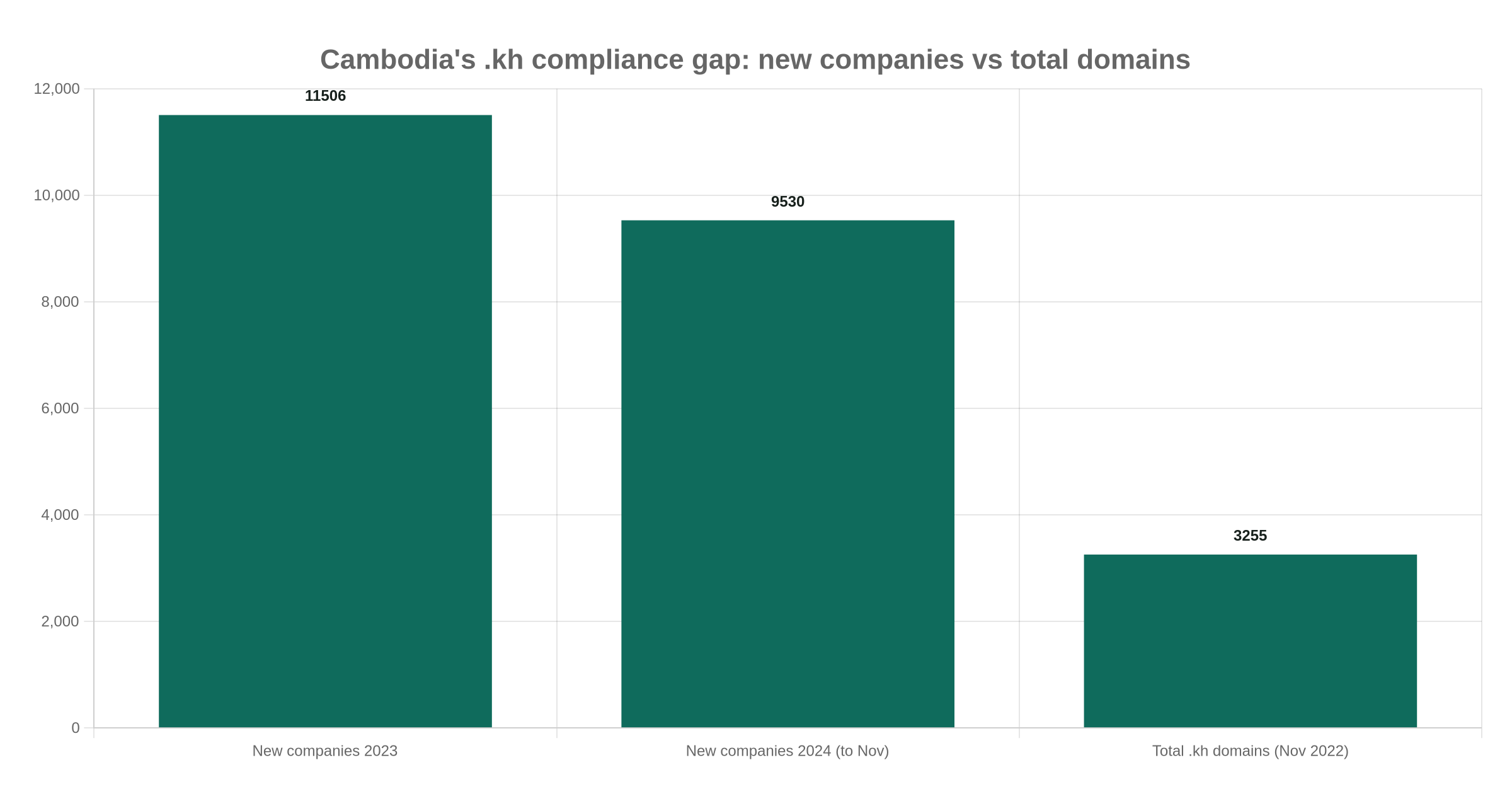
For a business weighing whether to bother, that gap cuts two ways. It confirms enforcement has been loose so far. It also means a company that does comply stands out against a crowded field of competitors who have not, which matters more in regulator-facing moments like license renewals than it does in a Google search.
Take a newly incorporated Phnom Penh trading company as a concrete case. It registers with the Ministry of Commerce in March, which means its first Annual Declaration of Commercial Enterprise falls roughly a year later, within 90 days of its incorporation anniversary, per Acclime's compliance guidance. If nobody has registered a .com.kh address by then, the ADCE filing still goes in, but the domain field is blank, and the company has started the clock on a gap a future audit or license renewal can flag. Registering early costs the same 100 USD it would cost later. Registering late costs the same money plus the risk of filing an incomplete declaration at the one moment a regulator is actually looking.
What .com.kh actually is, and how it differs from .kh
.com.kh is one of seven second-level categories under Cambodia's national top-level domain, .kh, reserved for commercial and corporate entities. A company applying for .com.kh or .net.kh must show that the domain name matches its own registered company or trademark name, per Intername's .com.kh registration guidance. The other six categories split the same .kh namespace by entity type: .gov.kh for government bodies, .edu.kh for schools and universities, .net.kh for internet service providers, .org.kh for NGOs and associations, .mil.kh for the military, and .per.kh for individuals registering under their own name rather than a company.
The .kh top-level domain itself is older than most people assume. It was registered with IANA on 20 February 1996, administered first by the Ministry of Posts and Telecommunications, then handed to the Telecommunication Regulator of Cambodia (TRC) in September 2012, which still runs it today alongside the Ministry of Posts and Telecommunications on the registration side, according to Wikipedia's registry history. That three-decade gap between when the domain existed and when using it became close to mandatory is exactly why most Cambodian businesses still think of .com.kh as new.
Picking the wrong category is a common early mistake. A design studio registered as a private company needs .com.kh, not .per.kh, even if the site is built around the founder's personal brand; a local NGO needs .org.kh, not .com.kh, even if it sells merchandise to fund its programs. Getting the category wrong does not just delay the application, it can mean re-submitting documents that match a different registrant type, since the supporting paperwork for .org.kh (association or NGO registration) is not interchangeable with the certificate of incorporation a .com.kh application needs. This is the kind of detail we check first when we scope a build on top of our own web development process, because the domain category has to be settled before a single page gets designed.
The category question also answers the "kh domain" search on its own, separate from the .com.kh branch of it. A Cambodian citizen registering a personal consulting practice under their own name, not a company, uses plain .per.kh rather than any commercial category. An international NGO with a registered local office uses .org.kh, and keeps that distinct from any global .org it already runs, since the two are unrelated registrations with unrelated renewal clocks. Treating "kh domain" and "com.kh domain" as interchangeable is the single most common mix-up in the forum threads and registrar FAQ pages that currently rank for either term.
How do you register a .com.kh domain name?
You register a .com.kh domain by applying through the National Domain Registration Service at domain.gov.kh, submitting your company's incorporation documents, and paying the registration fee, a process the Ministry of Posts and Telecommunications moved online via an automation system it announced on 31 January 2023. Before that date, the same application went through a largely manual, paper-based process at the TRC office in Phnom Penh.
The document list is short but each item has to be a certified copy, not a scan of the original: a certificate of incorporation certified by a public notary, a certified copy of the applicant's passport or national ID, and, if relevant, a certified copy of the company's Cambodian trademark registration, according to VDB-Loi. Processing typically takes one to two months from a complete submission, the same source notes, which is longer than registering almost any other domain extension and worth planning around if a launch date is already fixed.
On fees, three independent sources agree closely: about 406,000 riel (roughly 100 USD) for the initial registration, and about 121,000 riel (roughly 30 USD) a year after that, reported consistently by ASEAN Briefing, VDB-Loi, and an independent account of the process published by Travel Begins at 40. Unpaid renewals are not forgiven quietly either: a domain goes into temporary suspension first, and is deleted after 60 days without payment, per ASEAN Briefing, which means a missed invoice can cost a company its email addresses and its site in two months flat.
Two details catch most first-time applicants off guard. The application has to come from someone who can produce the company's own certified documents, not a foreign contractor acting without a local point of contact, since the local-presence requirement applies to the registrant, not just the domain itself. And the registration covers the name only, not DNS hosting: once the application clears, the registrant still has to point the domain at nameservers and configure mail records, work that sits with whoever hosts the site, not with the TRC.
Once the domain itself is sorted, where it actually points still needs deciding, and that is a separate question from who issues the name. We walk clients through local web hosting options at the same time we handle the domain paperwork, because a .com.kh registered to a server with poor Phnom Penh connectivity defeats half the point of going local in the first place.
Why do official fees and registrar prices differ so much?
Official fees and registrar prices differ because most of what shows up when you search ".com.kh domain" is not the Cambodian government's own channel, it is an international registrar reselling the same extension at a markup, and in at least one case that reseller cannot actually complete the registration for you anymore. Gandi.net, a well-known international registrar, lists .kh domains at 190 EUR for a first-year registration and 370 EUR for renewal, roughly six to twelve times the official rate, and states plainly on its own TLD page that "the registry does not longer accept registration and transfer requests from registrars," meaning registrants now have to apply directly with the Cambodian registry regardless of what a reseller's price page implies. Domgate lists a flatter 200 EUR per year for both registration and renewal, still several times the government rate, and confirms the same local-presence requirement from the registrant's side.
| Channel | First-year cost | Ongoing annual cost | Source |
|---|---|---|---|
| Official registry via domain.gov.kh (TRC / MPTC) | about 100 USD | about 30 USD | ASEAN Briefing, VDB-Loi, 2022 |
| Gandi.net (international registrar) | 190 EUR | 370 EUR | Gandi.net, 2026 |
| Domgate.com (international registrar) | 200 EUR | 200 EUR | Domgate.com, 2026 |
Run the five-year math on the official channel and the gap is stark: 100 USD to register plus four years of 30 USD renewals comes to 220 USD total. A single year through Gandi, just the renewal line, already exceeds that five-year figure. Stretch the same comparison to ten years and the official channel comes to 370 USD (100 USD plus nine renewals at 30 USD), against 3,520 EUR through Gandi over the same decade at current list pricing (190 EUR to register plus nine renewals at 370 EUR), close to ten times the cost for an identical domain string pointed at the same site. A company registering three related domains for separate brands, which we see with Cambodian groups running a hotel, a restaurant, and an events arm under one holding structure, multiplies that gap three times over, since each .com.kh is its own application with its own renewal clock.
We think a Cambodian-registered company that still has not filed a .com.kh address with the Ministry of Commerce is carrying a compliance gap, not just a missed SEO opportunity. We would close it before the next Annual Declaration of Commercial Enterprise is due, not after, registering directly rather than paying a reseller markup for a request the registry may not even process.
We think a reseller is worth paying only for genuine hand-holding on the document side: certifying copies, translating a trademark certificate, chasing a stalled TRC application. That is a real service. Six times the government's price for simply listing a domain it may not even be able to register is not.
Why does the markup hold at all, if the official price is public? Mostly because .com.kh does not behave like a generic gTLD from a registrar's back end. There is no automated API handoff the way there is for .com or .io, the local-presence and matching-name rules mean every application needs manual review, and as Gandi's own page now states, the registry has stopped accepting registrar-submitted requests entirely for at least one major reseller. A registrar that cannot actually place the order is still happy to take a listing fee for a domain it can only point a customer toward, not deliver.
When a .com is the smarter choice than .com.kh
A .com is the smarter choice when the business is not yet eligible to register .com.kh, or when its audience is mostly outside Cambodia and the national-identity signal would not reach the people who matter. Eligibility is the harder filter: only a company already registered in Cambodia, a government agency, an organisation, or a Cambodian citizen can register under .com.kh, .net.kh or .org.kh, per Wikipedia's registry overview, and the domain name generally has to match the registered company or trademark name, per Intername's registration guidance. A foreign startup still mid-incorporation cannot register .com.kh at all until that paperwork clears, which can take weeks on its own before the one-to-two-month domain application even starts.
We see two eligibility traps often enough to call them out by name. The first is the holding-company structure: a Singapore- or Hong Kong-incorporated parent that owns 100 percent of a Cambodian subsidiary and treats the two as interchangeable on every other form. For .com.kh, they are not interchangeable. Eligibility attaches to the Cambodian-registered entity, so the subsidiary has to be the applicant, with its own certificate of incorporation and its own name on the domain, not the parent's name or the group's international brand if the two differ. A group that markets everywhere under the parent's brand but incorporated the Cambodian arm under a different legal name ends up with a .com.kh that does not match the logo on its own homepage, which is a worse outcome than simply using .com until the names are reconciled.
The second trap is timing: a foreign founder who assumes the application can start the week incorporation documents are filed, when in practice the Ministry of Commerce certificate needs to be certified by a notary before the TRC will even log the domain request, adding days most launch plans do not budget for.
Audience is the softer filter, but it still matters. A Phnom Penh boutique hotel booked mostly through international travel platforms gets little from a .com.kh in its URL; the guests searching for it are not parsing Cambodian ccTLDs, they are clicking a link from Booking.com or a travel blog. A Cambodia-based SaaS tool selling to regional buyers across Southeast Asia faces the same logic: .com.kh reads as hyper-local exactly when the product is trying not to. A professional services firm incorporated in Cambodia but billing mostly overseas clients in USD sits in between: it is eligible and arguably obligated to register .com.kh for compliance, but it would be a mistake to lead marketing with the local extension when the buyer reading the proposal is in Singapore or Paris.
We do not think most clients should drop their existing .com once they register a .com.kh. We would run both, pointing the .com at the same site, because the compliance obligation is about having a registered national address on file with the Ministry of Commerce, not about abandoning the domain international customers already know. Once both domains exist, the build decision moves to the platform itself: a heavier no-code stack changes how easily that dual-domain setup gets maintained, which is part of why we weigh no-code development against a simpler Webflow build before locking in either domain's final destination.
What happens if you ignore the .com.kh requirement?
Nothing happens immediately, which is exactly why so many companies still have not registered, but the requirement does not go away either: it resurfaces at the next Annual Declaration of Commercial Enterprise, now filed through the CamDX system at registrationservices.gov.kh rather than a company's old Ministry of Commerce account, according to Acclime's 2025 to 2026 compliance guide. A company that has never registered a .com.kh address has nothing to list where the ADCE form expects one. What we see across the region's slower-moving regulatory requirements is a familiar pattern: loose enforcement for years, then a sudden tightening tied to a specific filing cycle or audit push. The February 2025 Ministry of Information notification, three years after the original 2022 rule, is itself evidence that Cambodia keeps circling back to this requirement rather than letting it lapse quietly.
The pitfall we check first, before anything else on a new build, is whether the client's registered company name on file with the Ministry of Commerce actually matches the brand name they want on the domain and the site. The two drift apart more often than clients expect: a company incorporated under one name years ago now trades under a shortened or rebranded version, and that mismatch is exactly what trips up a .com.kh application later, not the paperwork volume itself. Catching it at the domain stage, before a site is designed around a name the registry will reject, costs an afternoon of checking a certificate. Catching it after costs a redesign.
The deletion clock is the part worth taking seriously even under loose enforcement. A domain suspended for non-payment and deleted after 60 days is not quietly reinstated: the registrant goes back through the full application, certified documents and all, and loses whatever email continuity and inbound links pointed at the old address in the meantime. For a company whose invoices, contracts, and Ministry of Commerce correspondence all reference a .com.kh email address, a lapsed renewal is closer to an outage than a late fee.
The trade-off we weigh against that risk, every time, is who actually owns the renewal reminder. A domain registered by an outside contractor during a rushed launch, with the contractor's own email on file as the administrative contact, is the single most common reason a 30 USD renewal gets missed: the invoice goes to an inbox nobody at the company checks anymore. We would rather register a .com.kh slightly slower, with the client's own Ministry of Commerce-registered email as the contact on file from day one, than register it fast and inherit a renewal nobody owns.
If we were in a Cambodian business owner's place today, we would do three things, in this order. First, check whether the company is already past its own incorporation anniversary and due for an ADCE filing, since that is the moment a missing .com.kh address becomes visible to a regulator rather than just a theoretical gap. Second, register directly through domain.gov.kh rather than an international reseller, budgeting the one-to-two-month processing time into any website launch plan rather than discovering it the week before a deadline. Third, keep the existing .com running alongside the new .com.kh instead of migrating everything at once, so customers who already have the old address bookmarked are not the ones who pay for a compliance fix.
None of this has to be a solo project. Domain paperwork, local hosting, and the development project needed to actually use the new address are three separate problems that tend to arrive at once, and our team can also pick this up mid-way through a planned website redesign if that is already on the calendar, so the compliance fix and the site refresh happen once instead of twice.
Prefer to chat? Message our founder directly on Telegram (@maxgrolier), or book a call with the team.