
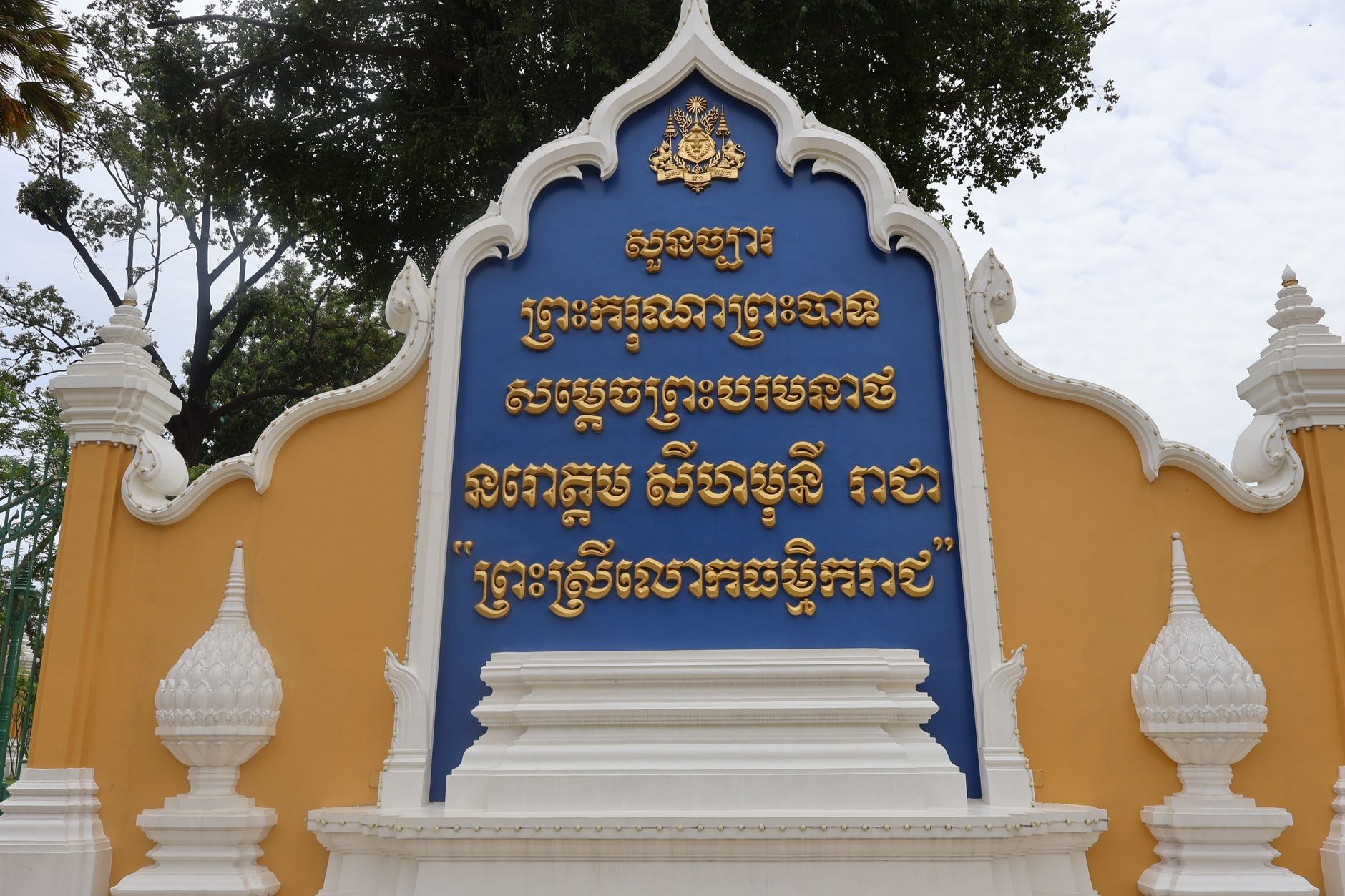
AI in Khmer reads fluently today and still gets things wrong that a native speaker catches on the first line: a formal pronoun swapped for a casual one, a date written the Western way inside an otherwise Khmer sentence, a clause that trails off because the model ran out of confidence rather than words. ChatGPT, Claude and Gemini all produce Khmer on request, and none of the three companies behind them publish a number that says how good it actually is.
That gap matters for any Cambodian business that puts AI in front of a Khmer-speaking customer: a chatbot on Telegram, a translated product page, a staff memo drafted in five minutes instead of twenty. We build AI agents for businesses in Phnom Penh, and we read the vendor documentation closely before recommending one model over another for a Khmer-facing job. Here is what that documentation actually says, what it leaves out, and what we would do about the gap in the meantime.
How Well Does AI Actually Handle Khmer?
AI handles Khmer well enough to draft a readable paragraph and not well enough to publish unedited, and that holds across ChatGPT, Claude and Gemini alike. All three produce grammatically plausible Khmer sentences on a simple prompt: a product description, a short reply to a customer, a one-paragraph summary. The trouble shows up past the first sentence, in exactly the places a general-purpose model has the least data to learn from.
Khmer carries a formal and informal register, marked through particles and pronoun choice rather than through separate verb conjugations the way French or Spanish mark it. The pronoun a speaker uses for "I" or "you" changes with who is being addressed: a monk, an elder, a close friend and a stranger each get a different word, and the closing particle on a sentence shifts the same way. A model trained mostly on English and a handful of high-resource languages tends to flatten that distinction, defaulting to one register regardless of context, which reads as mildly rude or oddly stiff to a native speaker depending on which way it leans. We have seen this most often in customer-facing drafts: a chatbot reply that is grammatically correct but uses the pronoun a teenager would use with a friend, aimed at a 60-year-old customer asking about an invoice.
Numbers, dates and currency are another recurring slip: Khmer has its own digit glyphs and date conventions, and all three chatbots routinely fall back to Western numerals mid-sentence, which looks inconsistent rather than wrong but still signals a machine draft to anyone reading closely. A fourth, quieter problem is length. Ask any of the three models for a short Khmer answer and it will sometimes pad the reply with an English-language aside or switch mid-paragraph into English entirely once the topic gets technical, a behaviour none of the three vendors document but that shows up reliably once a prompt pushes past a few sentences.
None of this is unique to one vendor. It is a direct consequence of how little annotated Khmer text exists to train on, a point OTM Research Cambodia has made in its own technical writing on Khmer as a low-resource language: large-scale digital corpora and high-quality annotated datasets for tasks like translation or part-of-speech tagging remain scarce compared to languages with decades of digitised text behind them (OTM Research Cambodia, 2026). That same scarcity shows up again once a Khmer sentence has to be encoded into tokens rather than just read: it measurably costs more to process than the equivalent English sentence, a gap we quantified in our Khmer token tax analysis and that compounds every issue described below.
No AI Vendor Publishes a Khmer Benchmark, and That Silence Is the Real Finding
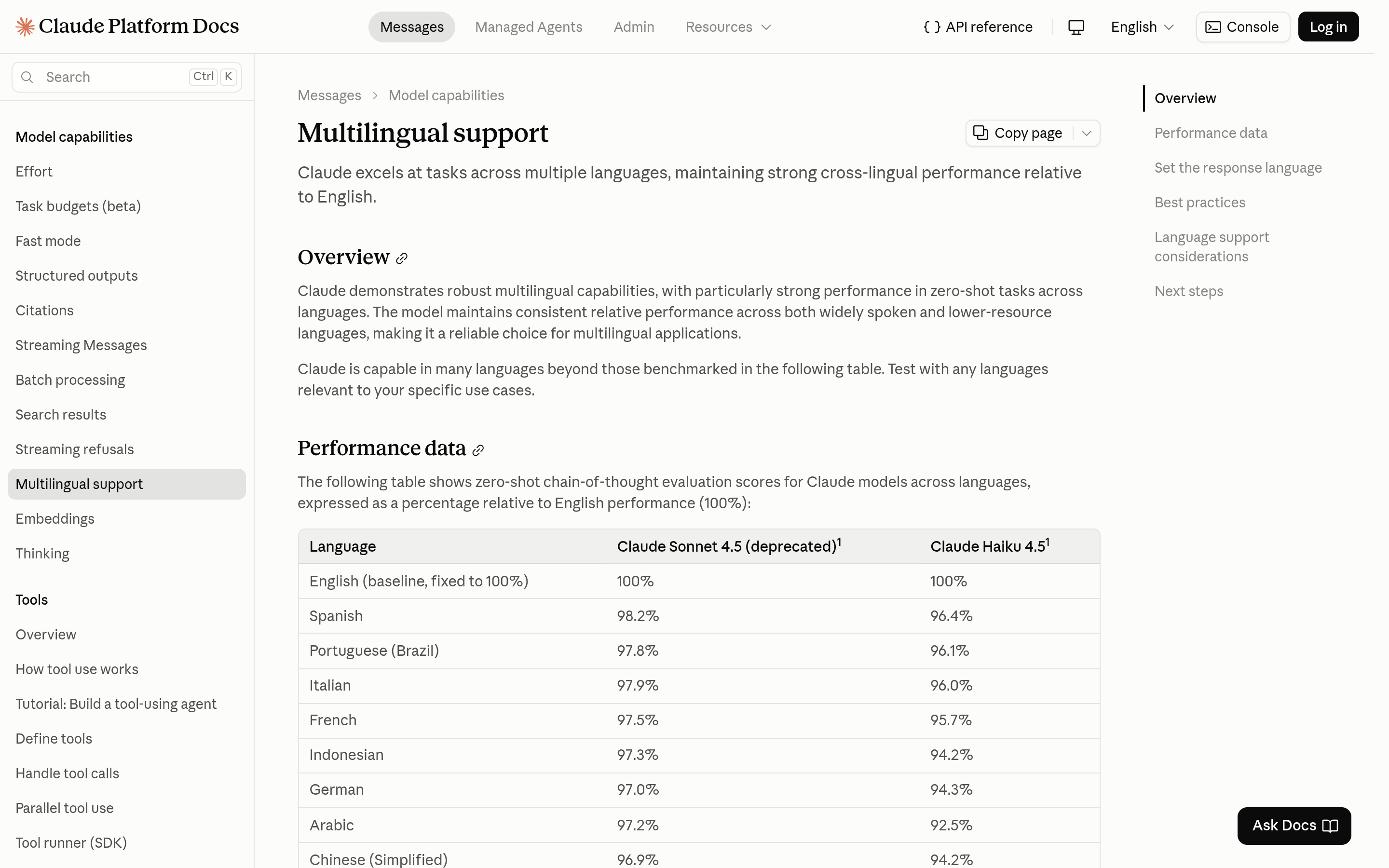
No AI vendor currently publishes a Khmer-specific quality score, and once you line up what each one does publish, the gap is consistent rather than accidental. Anthropic's own multilingual support documentation lists zero-shot benchmark results for Claude across 14 languages, from Spanish and Portuguese down to Swahili and Yoruba as the lowest-resource examples shown. Khmer is not one of the 14 (Anthropic, Claude Platform Docs, Multilingual support, 2026).
OpenAI's help centre lists 59 interface languages that ChatGPT's menus and settings can display beyond English. Khmer does not appear on that list either, though OpenAI is explicit that interface language and model capability are separate things, so the omission is not proof the model refuses Khmer, only that nobody at OpenAI has committed to supporting it as a first-class language (OpenAI Help Center, 2026). Google markets Gemini as available in more than 70 languages across its apps, a round number repeated in its own support pages without ever naming which 70 (Google, Gemini Apps Help, 2026).
The closest thing to an independent, cross-vendor quality index we could find is Alconost's 2026 AQI benchmark: 5,632 engine-language-content evaluations across 85 language pairs, scoring Gemini at 77.7, Claude at 75.6 and GPT at 73.1 overall. Khmer is not among the 85 pairs tested, and Alconost's own published breakdown shows even nearby Southeast Asian pairs like Thai and Indonesian were scored on small samples of five to seven evaluations each, a reminder that "evaluated" and "well evaluated" are not the same claim even for the languages that do appear (Alconost, Best LLM for Translation 2026). Put the three together and the pattern is not that Khmer scores badly. It is that nobody with the data to measure it has published a number either way, which is a different and in some ways more useful thing for a buyer to know: a missing score is not the same claim as a bad one, but it means every quality claim a vendor makes about Khmer, in a sales call or a product page, is unverifiable against anything the vendor itself has shown its work on.
Why Is Khmer So Hard for AI Models in the First Place?
Khmer is hard for AI models because the script itself resists the tooling built for English, well before any question of vocabulary or grammar comes up. Khmer is an abugida: consonants carry an inherent vowel, subscript consonants stack vertically under the main letter to form clusters, and traditional Khmer text runs with no spaces between words, relying on context to mark boundaries a human reader learns to see and a tokenizer has to guess at.
That stacking behaviour breaks more than it should. SIL International's research into Khmer Unicode rendering found that Chrome and Firefox showed spoof-vulnerable rendering in 87 percent of the implementations it tested, against 46 percent for Edge and 52 percent for Safari: sub-consonants and vowels failing to stack correctly, detaching into isolated, misaligned glyphs instead of forming a single visual cluster (SIL International, Spoof-Vulnerable Rendering in Khmer Unicode Implementations). The problem has not gone away with newer AI tooling either. As of 2026, Google's own AI developer forum carries an open request to integrate a proper Khmer complex-script layout engine, HarfBuzz, into one of its generative backends, filed by a developer hitting exactly this stacking failure in production (Google AI Developer Forum, 2026). If the company building Gemini still has an open ticket for Khmer text layout, it is a fair bet every smaller product built on top of these models inherits the same bug.
The absence of word boundaries compounds the problem for a tokenizer specifically. English text gives a model a free signal, the space character, to decide where one unit of meaning ends and the next begins. Khmer text historically gives it none: a tokenizer has to learn where to cut a string of consonants and vowels with no delimiter to lean on, which is part of why the same sentence costs so many more tokens to encode in Khmer than in English, a cost we measure in the next section. Segmentation tools exist for Khmer, but they are trained on the same thin body of annotated text as everything else in this article, so the error compounds rather than cancels out.
The Khmer Token Tax Makes AI More Expensive Before It Is Even Wrong
Khmer costs more to run through an AI model than English does, before any quality problem even enters the picture, because Khmer text needs roughly 3.3 times as many tokens to encode the same content, a figure we measured by running the Universal Declaration of Human Rights in both languages through a standard tokenizer in our Khmer token tax analysis referenced above. Every model bills by the token, so that multiplier applies whichever of the three vendors a business picks.
Here is what that looks like at a realistic volume. Using Claude Haiku 4.5's published pricing (1.00 US dollars per million input tokens, 5.00 US dollars per million output tokens), a short customer-service conversation of 6,000 input tokens and 6,000 output tokens costs 0.006 plus 0.030, about 0.036 US dollars to run in English. Scale both the input and output token counts by the same 3.3 times multiplier, to roughly 19,800 tokens each, and the Khmer version costs 0.0198 plus 0.099, about 0.119 US dollars: the ratio holds at 3.3 times because scaling every token count by a constant scales the bill by that same constant, whatever the input and output price split. A Phnom Penh business running 500 such conversations a day, entirely in Khmer, spends roughly 0.119 times 500 times 30, about 1,785 US dollars a month. The same volume in English would run closer to 540 US dollars a month. That 1,245 dollar monthly gap buys nothing extra: it is the price of the script, not the price of better service.
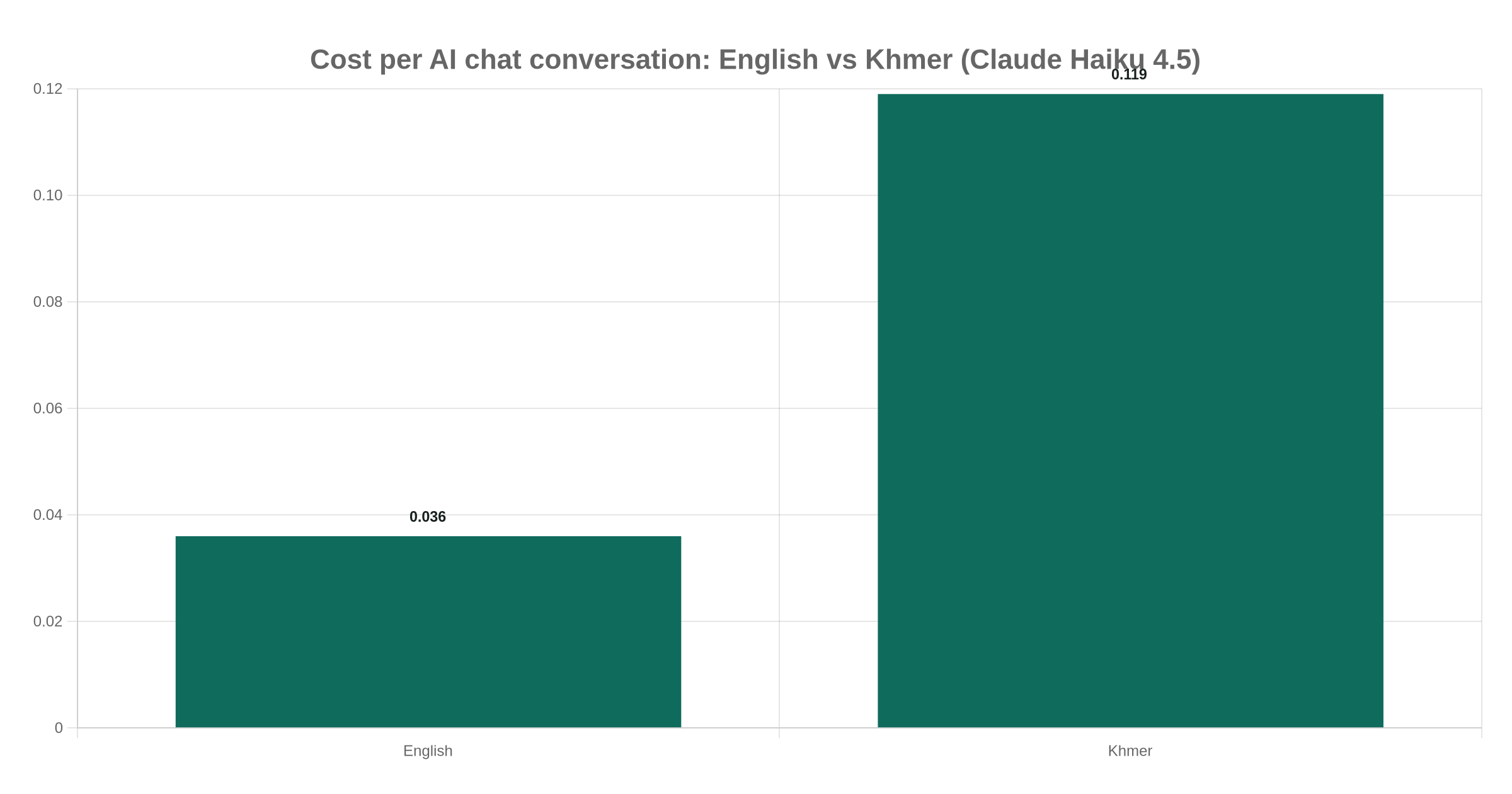
A business scoping an AI budget in Khmer should plan for roughly 3.3 times the per-conversation cost of an English-only deployment, not as a rounding error but as a line item.
Is Google Translate Still Better Than a Chatbot for Khmer?
Google Translate is not automatically better than a chatbot for Khmer, because the two tools are built differently and fail differently. Google Translate's classic engine is a dedicated neural machine translation model, tuned narrowly on sentence pairs, which tends to be literal: it translates what is there and rarely invents content, but it also struggles with context that spans more than one sentence. Google's own announcement confirms that its newer Gemini-powered translation upgrade, built on a general chat model rather than the classic engine, rolled out for English paired with fewer than 20 languages at launch, not a universal upgrade across every language Translate supports (Google, The Keyword blog, 2026).
A general chatbot like ChatGPT or Claude works the opposite way: it reasons about the whole passage before answering, which often produces smoother, more natural-sounding Khmer for a paragraph of context, at the cost of occasionally paraphrasing something the source never said. For a short, literal string, a dedicated translation engine is usually the safer choice. For a longer passage where tone and context matter more than word-for-word accuracy, a general model tends to read better, provided someone checks it before it goes out.
Khmer to English translation tools that blend several models into one answer exist too: one consensus engine we reviewed runs a query through 22 different AI models at once and picks whichever translation the majority agree on, claiming 85 percent professional accuracy across a 10,000-segment test (machinetranslation.com, 2026). That approach is a reasonable hedge against any single model's blind spots, but it still does not publish a Khmer-specific score for any one of the 22 models individually, which is the same documentation gap this article keeps finding, not an exception to it.
What a Side-by-Side Comparison of the Three Vendors Actually Shows
Lined up against each other, the three vendors differ less in what they can do with Khmer and more in what they are willing to say about it.
| Model | What the vendor documents | Khmer in its own benchmark | Our read |
|---|---|---|---|
| ChatGPT (OpenAI) | 59 interface languages listed; model language ability undocumented separately | Not listed | Usable for drafting; treat as untested by the vendor, not as unsupported |
| Claude (Anthropic) | 14-language zero-shot benchmark table, Spanish to Yoruba | Not included | Strongest published resource-efficiency story of the three, but it stops short of Khmer |
| Gemini (Google) | "70+ languages" claim, no itemised list; Advanced translate mode limited to select languages | Not named | Broadest marketing claim, least specific documentation |
None of the three is the clear winner for Khmer, because none of the three has shown its work. The practical difference between them, for a Cambodian business, comes down to cost (the token tax applies to all three) and to how the output is reviewed afterward, not to a vendor claim worth taking at face value.
Where Does a Local Effort Like SEA-LION Fit In?
A local effort like SEA-LION fits in as the closest thing to a Khmer-first alternative, though it is still being built rather than finished. SEA-LION, AI Singapore's open-source family of models, is designed from the ground up for 11 Southeast Asian languages, Khmer among them, specifically to serve languages the mainstream vendors under-support (AI Singapore, SEA-LION paper, 2025). Even inside that project, Khmer has not fully caught up: the SEA-HELM benchmark used to score SEA-LION's own progress currently covers only Indonesian, Tamil, Thai and Vietnamese, leaving Khmer out for lack of a proper benchmark to test it against, the same documentation gap that shows up everywhere else in this article (AI Singapore, SEA-LION paper, 2025).
Cambodia has a direct stake in closing that gap. In January 2025, AI Forum Cambodia and AI Singapore signed a memorandum of understanding in Phnom Penh to build a Khmer-language version of SEA-LION, training Cambodian researchers and engineers on the underlying model as part of the work (The Better Cambodia, 2025). Cambodia's own draft National AI Strategy for 2025 to 2030 names Khmer-language data collection as one of its stated priorities, which signals the government sees this as infrastructure, not a side project (OpenDevelopmentCambodia, draft NAIS v5).
The logic behind SEA-LION is worth spelling out, because it explains why a regional model can eventually do something a general one structurally cannot. SEA-LION is pretrained and instruction-tuned specifically on Southeast Asian languages and scripts rather than retrofitted onto a mostly English and Chinese base, using roughly 200 billion tokens of English, code and Southeast Asian language data plus 16.8 million instruction and answer pairs in the region's languages for its tuning stage (AI Singapore, SEA-LION paper, 2025). That is a materially different starting point for a script like Khmer than a general model that sees Khmer as a small fraction of a much larger, mostly unrelated training set. It does not make SEA-LION better today. It makes the eventual ceiling higher, once the Khmer-specific training and the benchmark to measure it both catch up with the rest of the project.
We would tell a Cambodian business not to wait on it. A model that is still training is not a model you can deploy, and a January 2025 MOU does not come with a public release date. The sensible move today is pairing whichever of the three mainstream models fits the budget with a human review step, not holding a project until a Khmer-native model reaches general availability.
What Happens When a Cambodian Business Actually Deploys This?
What happens depends on where in the business the Khmer output lands, and three situations come up often enough to be worth naming individually. A boutique hotel using an AI chatbot on Telegram to answer Khmer-language guest messages is the lowest-risk case: short, transactional replies about availability and price rarely trip the register problem, but a model that answers a loyal returning guest with the same overly formal tone it uses for a first-time stranger reads as cold, which is the opposite of what hospitality wants.
An HR or admin team drafting a staff memo in Khmer with a general chatbot sits in the middle, the kind of task we cover in our AI agents for small business guide. A memo is longer, more formal, and more visible than a chat reply, so a pronoun or particle slip is more likely to appear and more likely to be noticed by every employee who reads it. We would always route this kind of document through a native Khmer speaker before it goes out, treating the AI draft as a time-saver on structure and first-pass wording, not as a finished document.
A customer support team routing both English and Khmer tickets through the same AI agent is the case where the token tax becomes a budget line rather than an abstraction, following directly from the worked example above. A support desk fielding a majority-Khmer ticket volume should expect its AI spend to run roughly 3.3 times higher than an English-only equivalent at the same ticket count, the same token tax multiplier, and should size the model tier and the review workflow accordingly rather than discovering the gap on the first invoice.
Cambodia's own numbers make this a mainstream problem rather than a niche one. The country counted about 17.9 million people and 12.0 million internet users, 67.3 percent of the population, as of the most recent Digital 2026 Cambodia report (DataReportal, 2026), and Ethnologue puts the number of Khmer speakers at roughly 19 million first-language speakers and about 21 million total. Any AI deployment aimed at the general Cambodian public, not just an English-speaking, internationally-facing segment, is a Khmer deployment by default, which means the register, cost and rendering issues above are not an edge case to plan around later. They are the default case to plan for from the first scoping call.
What Would We Do in the Reader's Place?
We would take three moves, in this order. First, treat any AI-drafted Khmer text as a first draft, never a final one: route it through a native Khmer speaker before it reaches a customer, especially for anything longer than a one-line chat reply, since that is where register and particle mistakes do the most damage. Second, budget for the token tax before committing to a Khmer-heavy deployment, not after: a support or chatbot workload that is mostly Khmer should be priced at roughly 3.3 times an English-only equivalent, a number worth checking against your own volume the way we laid it out above, and worth revisiting with a proper AI consulting audit before a single workflow goes live. Third, do not wait for a Khmer-specific model to arrive before starting. Pair a general model with a human review step now, and revisit the choice once SEA-LION's Khmer version or a similar effort actually ships a public benchmark, not before.
None of ChatGPT, Claude or Gemini is disqualified by any of this. All three are usable for Khmer today, provided the business using them knows where the weak points sit and budgets for the review step that catches them. We help Cambodian businesses scope exactly this kind of deployment through our AI agents work, from the first process audit through to a system running in production, and our recent project work shows the range of builds we actually ship. If Khmer-facing AI is on your roadmap for next year, a scoped estimate is a faster way to size the real cost than testing all three vendors from scratch on your own.
Prefer to chat? Message our founder directly on Telegram (@maxgrolier), or book a call with the team.