A client of ours removed a lead filter once. Meetings booked went up 61%. A year later, a third of the memberships that filter would have blocked were gone, and the setup had already been shut down. That is the real tension behind "lead volume vs lead quality": more leads and more meetings are easy to buy, and they do not automatically buy more revenue.
This article is about that trade-off and what we did about it, on a real account we still run. The short version: volume answers a different question than quality does, and treating them as the same number is how a growth channel quietly turns into a churn machine.
Key points
- A "no filter" lead setup bought 61% more meetings for an investment club client of ours and cost a third of its memberships inside a year; the filter was reinstated and the experiment was logged as a mistake, not repeated.
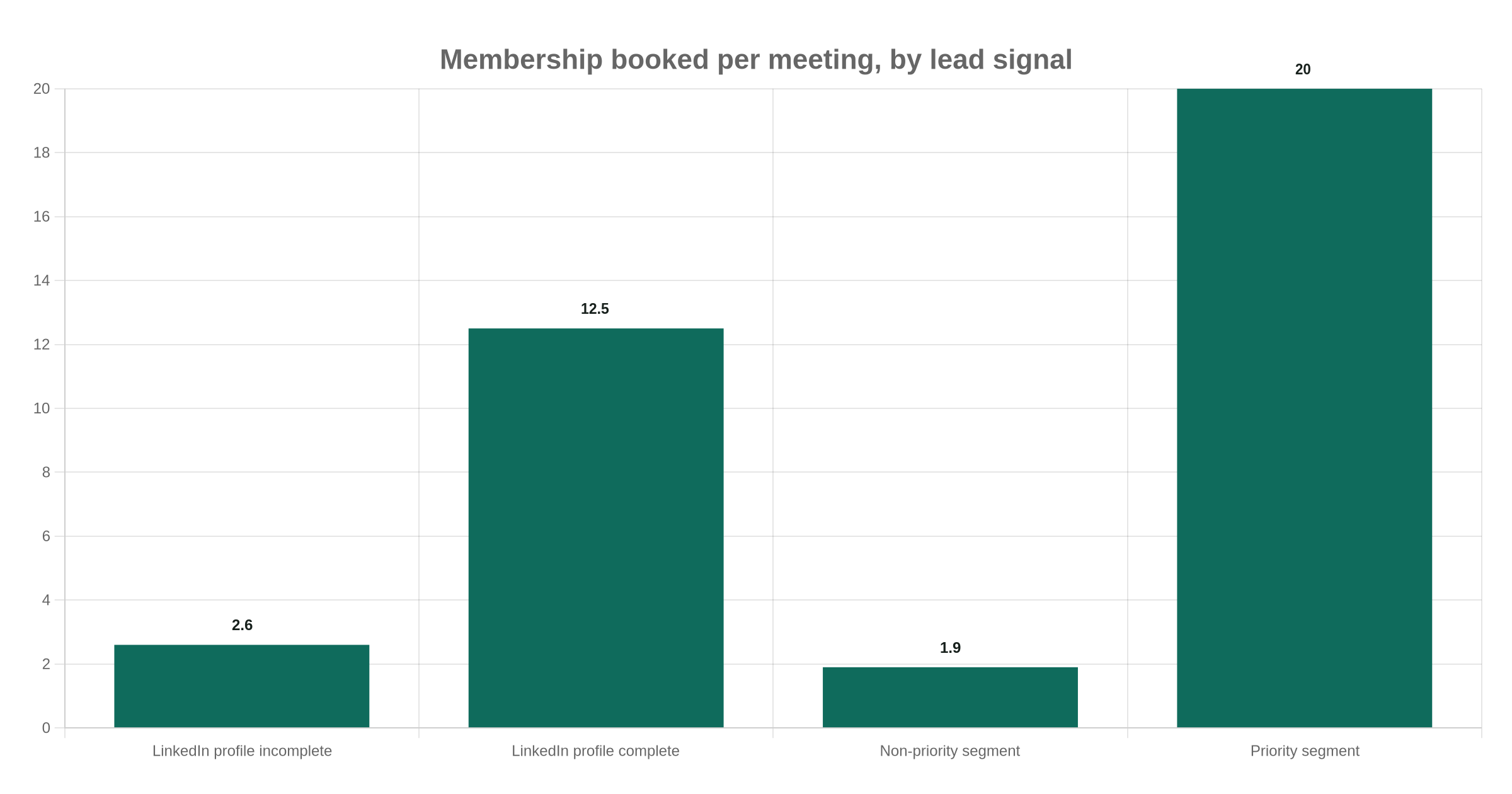
- The signals that actually predicted a sale were behavioural, not self-declared: a completed LinkedIn profile lifted membership per meeting from 2.6% to 12.5%, and a priority segment converted at more than 20% against 1.9% elsewhere, a tenfold gap. The lead's own stated motivation score predicted nothing.
- Fixing lead quality is not only a top-of-funnel fix. On the same account, a member who attends one event renews at 34.5% against 10.1% for a member who does not, a 3.4x difference that starts well before volume vs quality ever becomes a funnel debate.
A "no filter" lead setup removes the gate, not just the friction
A "no filter" lead setup is a funnel with no qualification gate between the ad click and the booked meeting: no scoring, no screening question, no waiting list, nothing that stops a low-fit lead from reaching a human. It is the fastest way to grow a meetings-booked number, because every form of friction you remove (a question, a wait, a scoring rule) removes a reason for a lead to drop off before booking.
That is also its entire appeal and its entire risk. Volume goes up because the funnel got easier to enter, not because the people entering it got more likely to buy. For a business where acquisition is paid and expensive, Meta Ads and Google Ads feeding a daily waiting list in our case, every extra meeting that was never going to convert still costs the same media spend and the same sales hour as a meeting that was.
We run marketing, sales and operations for this kind of account ourselves, as part of our work as a marketing agency in Cambodia and beyond: a membership business is a clean test case for volume vs quality, because every extra member who churns shows up on a renewal line a year later, not buried in a blended conversion rate.
The same arithmetic applies to a Cambodian SME running Meta or Google Ads on a much smaller budget. According to DataReportal's Digital 2026 Cambodia report (October 2025 figures), 14.0 million social media user identities were active in the country, 77.9% of the population, with Facebook alone reaching the same 14.0 million and TikTok reaching 11.3 million adults, 97.5% of the adult population. Almost every paid lead in this market comes through one of two or three platforms, which means a filter that lets the wrong clicks through is not a rounding error: it is most of your acquisition budget, spent on the same handful of channels everyone else is also bidding on.
In practice, most of those leads never fill in a form at all. They message a business page on Messenger or move the conversation to Telegram, and whoever answers first becomes the de facto qualification gate. The same verified-signal-versus-self-declared-signal argument the Kretz Club case makes still applies there: a lead who volunteers a company name or a product link in that chat is a different prospect from one who only writes "price please", and a business that answers every inbound message the same way is running the exact no-filter setup this article is about, just without a form attached to it.
What happened when Kretz Club turned its filter off?
Case: Kretz Club
The first investment club dedicated to prestige real estate, launched in October 2024 by Martin and Valentin Kretz and Alexandre Bruneau. Members join on an annual membership, selected through an interview, for access to a deal flow of property operations alongside the Kretz family, a network of entrepreneurs and investors, and a programme of events. TechFlow Agency, based in Phnom Penh, took over the club's marketing, sales and operations infrastructure in 2025, and three of us have worked on it full time for close to two years since.
Acquisition is paid and high-volume: Meta Ads and Google Ads feed a waiting list, qualified through a Typeform, every day. Every lead and every missed meeting is expensive, and the sales cycle is short and human, a single selection meeting with a closer, decided on a video call. Communication has to be flawless, because the people on the other end of that call are business leaders and investors.
At one point the qualification gate on that waiting list was switched off. No filter, no screening question doing its job before the lead reached a closer's calendar. Meetings booked rose 61%. The case does not say for how long the experiment ran or exactly how many leads and members it touched, and we will not estimate either number here. What is on the record is the outcome: a third of the memberships that setup let through were gone within a year, and the no-filter setup was stopped. It was not refined, not A/B tested for longer: stopped.
That is the part a "more leads" dashboard never shows on its own. A meeting booked and a membership signed are two different events, and the gap between them is exactly where lead quality lives or dies.
Why does more meetings rarely mean more lead quality?
More meetings rarely means more lead quality, because the two numbers measure different stages of the funnel and a filter sits between them on purpose. A booked meeting only proves someone was willing to click through a form. A membership, a signed contract, a paid invoice, proves they were worth reaching in the first place; nothing upstream of that guarantees it.
The scale of the gap is not unique to one investment club. In the 2026 B2B Pipeline Trust Report, LeadSpot surveyed more than 500 B2B demand-generation, sales and marketing-operations leaders and found marketing-ops teams reporting an average invalid or unusable lead rate of 22%, against a vendor-stated rate most teams expect to be under 5%. Four times the expected waste, on leads that already passed whatever filter was in place before they were even "qualified".
Remove the filter entirely, as happened here, and that waste does not shrink, it moves downstream and gets more expensive. A lead that never should have booked a meeting now costs a closer's hour instead of a marketing dollar, and if it slips through to a signed membership, it costs a churned account a year later. We would rather see that waste show up early, as a lower meetings number, than late, as a renewal that does not happen.
The one honest exception is a business that is still looking for product-market fit and needs raw volume to learn from, fast, before any filter is worth building. Kretz Club was past that point: the club was entering its third year and had already doubled revenue every year since launch, which is exactly when a filter starts paying for itself instead of slowing you down.
Picture a simplified, illustrative version of the same choice. A team spending $3,000 a month on ads gets 100 leads with a filter, half as many as the 200 it would get without one, but the filtered leads convert to a sale at 10% against 3% for the unfiltered batch. Ten sales against six, from the same budget, before any cost from the no-shows and the extra closer hours the unfiltered batch also burns. The numbers here are a worked example, not a Kretz Club figure, but the direction is the same one the case shows: a bigger top-of-funnel number is worth less than it looks once you follow it to a close.
The no-show numbers proved a booked meeting is not a commitment
The no-show numbers proved that a booked meeting is not the same thing as a real, two-sided commitment, and the gap between the two tracks the same quality problem the membership losses showed from a different angle. On the Kretz Club account, meetings set through an in-house conversation before the booking carried a 12.3% no-show rate. Meetings set by direct inbound, a lead booking straight off an ad with no human touch in between, carried a 35.3% no-show rate, almost three times higher.
That gap is wider than anything we found in outside benchmarks, which is itself the point. A 2026 report by Focus Digital, aggregating booking-channel data across B2B sales teams, put self-scheduled instant bookings at an 8% no-show rate against 35% to 45% for cold, SDR-booked meetings depending on the channel: 36% for a cold email sequence, 39% for a cold call. A separate study by Growth Cab, tracking 1,380 cold-call-booked B2B meetings between September 2024 and September 2026, measured a 14.6% no-show rate overall, and found meetings booked within two days of the call showing up 85.4% of the time against 58.5% for meetings booked more than 30 days out.
Put the three together and a pattern holds across all of them: the less human contact and the less verification happens before the meeting, the more likely the lead is to simply not show up. Kretz Club's own in-house number, 12.3%, sits close to the better end of those outside ranges precisely because a person has already spoken to the lead before the booking exists. Its "no filter" direct-inbound number, 35.3%, sits at the expensive end, in the same territory as a cold-call-booked meeting with zero prior contact, which is effectively what a filter-free form submission is.
This is the comparison most "lead quality" articles skip: they treat the no-show rate as a scheduling nuisance, not as a quality signal with the same root cause as a lost membership. We treat it as the earliest, cheapest warning that a lead was never going to be a good one, available days before a closer's calendar confirms it the hard way.
What predicts an actual sale, not just a booked meeting?
What predicts an actual sale is a behavioural signal you can verify, not a self-declared answer on a form, and the Kretz Club data makes the gap between the two unusually clear. The waiting-list Typeform went through five versions, each tightening the qualification rules and the scoring model that splits leads into a high or low potential segment inside Brevo.
Across hundreds of meetings booked from leads who filled in the fifth version of that form, one field stood out: a completed LinkedIn profile lifted membership per meeting from 2.6% to 12.5%, roughly a fivefold gap, just from having a real, filled-in professional profile attached to the lead. A separate priority segment, built on verifiable criteria rather than a self-report, converted at above 20% per meeting against 1.9% elsewhere, a tenfold difference.
Against that, the lead's own self-declared motivation score, a field where the lead rates their own interest, predicted nothing. Zero correlation with whether the meeting turned into a membership. That is the uncomfortable finding for anyone building a qualification form: the question that feels the most direct, "how motivated are you", is the one least worth asking, and a fact you can check, a LinkedIn profile, a verifiable criterion, carries the signal instead.
We would build every new qualification gate around that order of priority from the start: verifiable facts first, declared intent last, if at all. A form that only asks people to rate their own interest is not a filter, it is a courtesy question.
We rebuilt the filter in stages, not as a straight reset
We rebuilt the filter in stages rather than switching it back on exactly as it was, because the goal was to keep as much of the volume gain as the quality data would allow, not to return to the slower, pre-experiment baseline. In order:
- Kept the scoring model, tightened the inputs. The high/low potential split in Brevo stayed, but the self-declared motivation field was downgraded to context, not a gate, since it predicted nothing.
- Weighted the verifiable signals. A completed LinkedIn profile and the verifiable priority-segment criteria became the leading factors, in line with the fivefold and tenfold gaps the data showed.
- Added a blocking exception for high-wealth leads. A lead in that bracket skips the slower path entirely and reaches a closer directly, because the cost of a missed high-value lead outweighs the cost of one extra manual check.
- Set priority follow-up for leads who do not book. Instead of leaving a qualified lead to drop off silently, a follow-up sequence re-engages anyone the scoring model rated highly but who stalled before booking.
- Allocated closer slots by segment, so the sales team's limited calendar time goes first to the leads the data says are worth a closer's hour, not to whoever filled in the form first.
The result is a funnel that still moves fast for the leads worth moving fast, Meta Ads and Google Ads keep feeding the waiting list every day, but no longer treats every click as equally worth a closer's time. The automation behind these five steps runs on n8n, the tool that replaced the club's old Zapier set-up across more than 170 connected workflows, inside the same kind of sales funnel system we build for other clients.
What are the lead qualification mistakes that cause this in the first place?
The lead qualification mistakes that cause a "no filter" problem almost always start before the filter is ever removed, in how it was built. Four show up repeatedly, on this account and elsewhere.
The first is scoring on self-declared fields alone. A motivation score, a self-reported budget, a "how soon are you looking to buy" dropdown: all easy to add to a form, all weakly correlated with an actual sale, as the 2.6%-to-12.5% LinkedIn gap and the flat motivation-score result both show from opposite directions.
The second is treating a booked meeting as the success metric instead of a leading indicator. A dashboard that stops at "meetings booked" cannot tell the difference between a lead worth 12.5% membership odds and one worth 1.9%, because both booked the same meeting.
The third is removing a filter under pressure for volume without first confirming what that filter was actually blocking. The 61% jump in meetings looked like a win for exactly as long as nobody checked the membership line a year later.
The fourth is building the scoring model once and never feeding sales outcomes back into it. The five Typeform versions at Kretz Club only got better because each round was checked against hundreds of real meetings and their real outcomes, not against guesses about what should matter.
A fifth, closely related mistake is treating every call the same way once it happens. On this account, phone lines are connected to a call-recording and transcription tool with Claude plugged in, so every closing call is summarised and scored out of 10 against a fixed grid rather than left to a closer's memory. The same analysis, run across hundreds of calls, turned up three closing arguments with a measured impact on outcomes, worth +24%, +13% and +10% respectively. A business that never reviews its own sales calls at that level of detail has no way to tell whether a weak close or a weak lead caused a lost deal, which makes it almost impossible to fix the right half of the funnel.
A HubSpot or Brevo CRM will happily store a self-declared motivation field right next to a verified LinkedIn URL and treat them as equally valid inputs to a score. The tool does not make the distinction for you; someone has to decide which fields earn weight and which ones do not, a decision an in-house marketing team or an outside partner both have to own deliberately, not by default.
Fixing the filter also protects renewal, not just the funnel
Fixing the filter also protects renewal, because the two sit on the same quality chain even though they look like separate metrics on separate dashboards. A membership business lives or dies on renewal, not on first-year signups, and the Kretz Club numbers make that chain visible end to end.
A member who attends at least one club event renews at 34.5%, against 10.1% for a member who does not, a 3.4 times difference. That gap has nothing to do with the filter directly, but everything to do with who the filter let in: a member who was never a strong fit in the first place is also the member least likely to show up to an event, least likely to engage with the deal flow, and least likely to renew.
So the chain runs from the qualification gate at the top, through the no-show rate, to event attendance, to renewal, and a filter that lets through the wrong people damages every link, not just the first one. The club's revenue has doubled every year since launch, through its third year running in 2026, which is the kind of trajectory that a one-time, 61%-bigger meetings number cannot explain on its own. It takes members who stay.
This is also why we treat "lead quality" as a sales-and-retention question, not a marketing-only one. A sales funnel that only optimises for leads in the door, without a feedback loop back from renewal data, will keep polishing the wrong end of the chain.
What would we do in your place before touching the ad budget?
If you are weighing lead volume against lead quality on your own funnel, we would make three moves before changing anything on the ad side.
First, define the real success event before you touch the filter, and work backward from it. Not "meetings booked", a membership renewed, a contract signed, a second order placed, whatever event actually pays the bills a year out. Every scoring decision should trace back to that event, the way the Typeform's fifth version traced back to real membership outcomes instead of a motivation score nobody checked.
Second, score on what you can verify, and demote what you cannot. A completed professional profile, a company registration, a prior purchase: check these before you trust a self-declared field. The fivefold and tenfold gaps in this case did not come from a cleverer algorithm, they came from weighting a verifiable fact over a stated opinion.
Third, protect your sales team's time on purpose, not by accident. Route the leads your data says are worth it to the closer slots that matter, and put the rest on automated or lower-touch follow-up instead of the same calendar. A filter that drives volume to the wrong queue is not a filter at all; it just redistributes the waste.
None of this requires removing a filter to find out if it was doing its job. It requires checking, with real outcomes, whether it was doing the right one.
Prefer to chat? Message our founder directly on Telegram (@maxgrolier), or book a call with the team.
Keep reading
- marketing agency guide: how we structure marketing and sales operations for clients beyond this one case.
- sales funnel in Cambodia: the 90-day system a filter like this one feeds into.
- in-house or agency: who should own a qualification decision like this one internally.
Need this built? We design and run lead scoring, CRM automation and sales qualification systems as part of our sales funnel work for clients in Cambodia and beyond.