

Cambodia's microfinance institutions did not get a digital upgrade in 2026 so much as a payments upgrade. Borrowers can now repay a loan with a KHQR scan, apply through a mobile app, and get a disbursement over Bakong rail, often inside the same day. None of that touches the step right behind it: a loan officer still pulling paper or PDF documents into a credit memo by hand, the same way the sector did ten years ago.
That gap matters more than it looks, because the sector's own numbers show where the pressure sits. We think most Cambodian MFIs digitizing today are solving the visible half of the problem and leaving the expensive half alone.
Cambodia's Microfinance Sector Digitized the Front Door, Not the Back Office
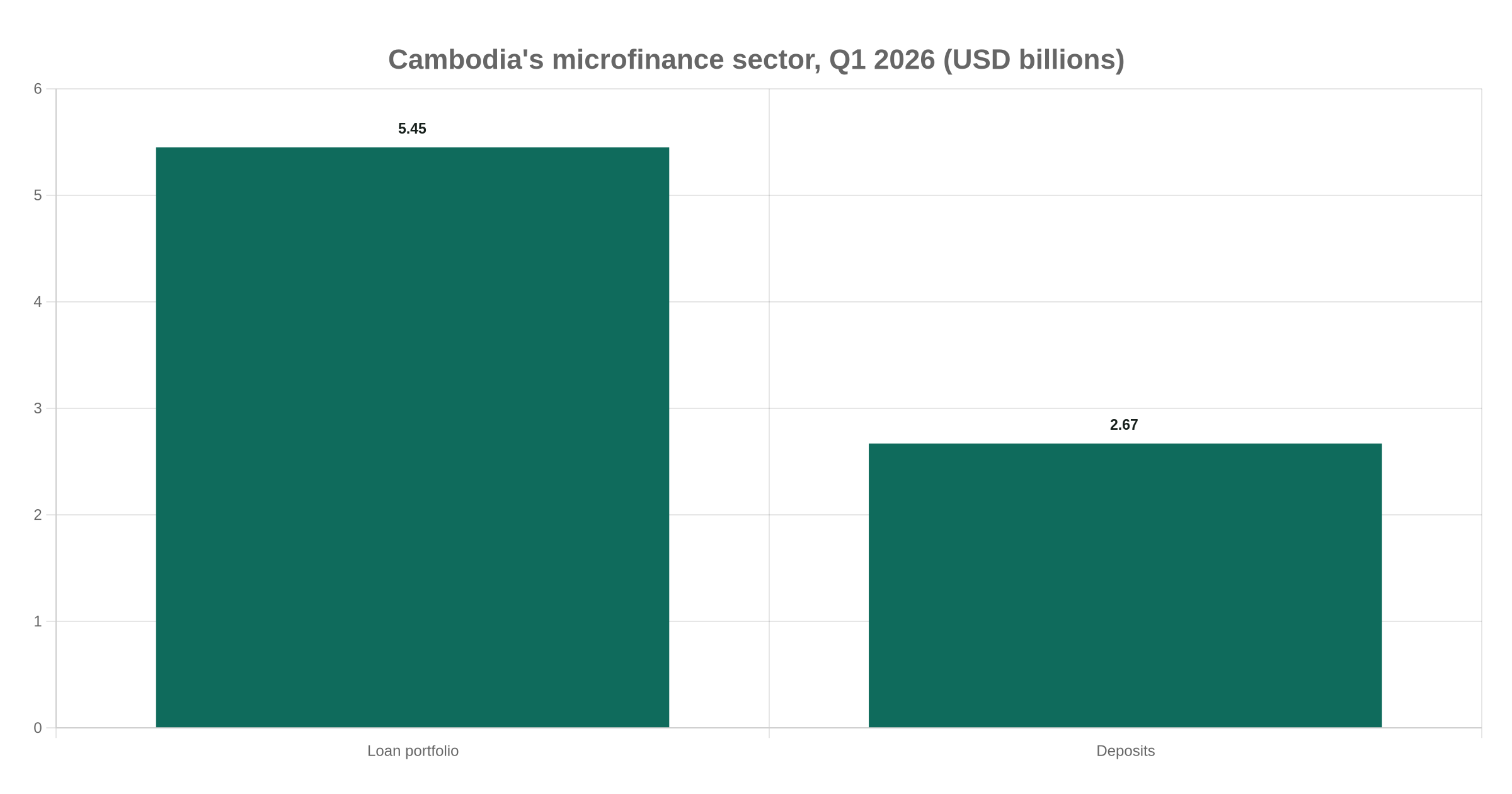
Cambodia's microfinance sector carried an outstanding credit portfolio of 5.45 billion US dollars across 1.11 million active borrowers as of 31 March 2026, alongside 2.67 billion US dollars in deposits from 1.75 million individual depositors, according to the Cambodia Microfinance Association (CMA, Q1 2026). That portfolio is run from 785 branches by 19,387 staff, a ratio of roughly 25 staff per branch, and the CMA's own figures put portfolio at risk over 30 days (PAR30+) at 11.20 percent, with a 5.70 percent loan restructuring rate and a 1.1 percent write-off rate in the same quarter.
Those risk numbers are the real story, and they sit in the part of the business that no mobile app touches. Bakong and KHQR make repayment faster. They do nothing to the step where a loan officer decides whether a borrower qualifies, how large a restructuring should be, or which of 1.11 million active accounts needs a call before it slips into write-off.
The sector is also mid-consolidation, which raises the stakes on getting the back office right before scale makes the gap worse. AMK officially became a commercial bank on 16 March 2026 after two decades as a deposit-taking microfinance institution, a transition large enough that the CMA flagged it as distorting the sector's Q1 aggregate data (AMK Bank Plc, March 2026; CMA, Q1 2026). PRASAC took the same path earlier: majority-owned by South Korea's Kookmin Bank since 2020, it merged into KB PRASAC Bank in 2023 and now runs 187 branches with 5.66 billion US dollars in consolidated assets, Cambodia's fourth-largest bank by assets behind ABA, ACLEDA and Canadia (KB PRASAC Bank Plc, bank profile, 2026; SuperBankRatings, Cambodia SuperPower Banking Index 2026). The National Bank of Cambodia's own Annual Supervision Report 2025 counts 4 deposit-taking and 87 non-deposit-taking microfinance institutions still licensed behind that consolidation wave.
We have made a version of this same argument for a different audience: the brief looks a lot like what we wrote about NGO website design in Cambodia, where the public-facing layer is rarely where the real operational bottleneck lives. It is the same lens our work as a digital agency Phnom Penh clients hire us for applies to a finance brief as readily as it does to a hotel or a law firm one.
What Counts as 'Digital' for a Cambodian Microfinance Institution in 2026?
For most Cambodian MFIs in 2026, going digital means three things in roughly this order of adoption: KHQR or Bakong-based repayment, a borrower-facing mobile app, and electronic KYC document capture at onboarding. AMK's own mobile banking app added QR-scan loan repayment as a core feature (AMK Mobile, App Store listing), and CAMMA Microfinance now lets borrowers apply for a loan and manage repayments through its wallet or KHQR, from a phone, without visiting a branch (CAMMA Microfinance Limited, 2026). Roughly 70 to 90 fintech firms now operate in Cambodia, including Wing, TrueMoney, Pi Pay and Clik, and Bakong itself connects banks, MFIs and payment providers into one interoperable rail linked to regional QR networks in Thailand, Vietnam and Malaysia (The Fintech Times, 2026). With internet penetration past 67 percent of a population of roughly 17.9 million (DataReportal, Digital 2026: Cambodia, data October 2025), the reach for a mobile-first product is real.
One piece of the credit process is already centralized and digital, just not integrated into most MFIs' own workflow. Credit Bureau Cambodia (CBC) puts its member base at 198 institutions as of 2026, spanning commercial banks, specialized banks, deposit-taking and non-deposit-taking microfinance institutions, leasing companies and rural credit institutions, all required to check and report under the National Bank of Cambodia's Prakas on Credit Reporting, issued in June 2020 (Credit Bureau Cambodia, company profile, 2026). CBC's own profile does not publish a per-category count alongside that total, so we are reporting the figure it gives, not reconstructing one. A CBC pull tells a loan officer whether an applicant already carries debt elsewhere, which matters directly for the sector's 11.20 percent PAR30+ ratio. In practice, that pull still means opening a separate system, reading the report, and re-typing the relevant lines into the MFI's own loan file, a second manual step bolted onto the first.
What that list does not include is almost everything that happens before a loan is approved or after a payment is missed. The table below maps a typical Cambodian MFI loan cycle against what is actually digitized today.
| Loan-cycle step | Typically digitized by 2026 | Still largely manual |
|---|---|---|
| Lead intake and first contact | Telegram, Facebook Messenger, branch walk-in | Qualifying the lead against lending criteria |
| Application and KYC | A mobile app form; photo capture of ID documents | Verifying documents, cross-checking against other debts |
| Credit assessment | None, in most non-deposit-taking MFIs | Drafting the credit memo, routing it for approval |
| Disbursement | Bakong transfer, KHQR, mobile wallet | None, this step is largely solved |
| Repayment | KHQR scan, in-app payment, mobile wallet | None, this step is largely solved |
| Collections and PAR follow-up | None, beyond automated SMS reminders | Calling, visiting, restructuring decisions |
| Regulatory reporting to the NBC and CMA | None, in most smaller MFIs | Compiling figures manually for submission |
Three of the seven steps are close to solved. Four are not, and three of those four, credit assessment, collections and regulatory reporting, are exactly where PAR30+ and write-off numbers get made or avoided.
Where Does the Manual Work Still Sit in a Cambodian MFI's Loan Cycle?
The manual work in a Cambodian MFI's loan cycle sits almost entirely in the two steps a borrower never sees: underwriting and collections follow-up, plus a third a regulator sees but a borrower never does, compliance reporting. None of the sector's public data breaks out staff time by task, because MFIs do not benchmark it that way. But the operational shape is visible in the numbers CMA already publishes: a 5.70 percent restructuring rate and an 11.20 percent PAR30+ ratio across 1.11 million accounts is not a volume a loan officer tracks from memory or a spreadsheet without something slipping.
A credit memo for a small working-capital loan in Cambodia typically pulls together an ID, a business or land document, a repayment history check and a few photos of the business itself, then gets written up by hand and routed for sign-off. None of that changes whether the loan originated through a branch visit or a mobile app, because the app only handles intake. The underwriting step sits downstream of it, untouched.
Collections follow-up has the same shape. A loan officer managing a book of delinquent accounts works from a list, decides who to call first, and makes a judgment call on restructuring versus escalation, largely without a system flagging which accounts crossed a risk threshold overnight. At the sector's current 11.20 percent PAR30+ ratio, that is roughly 122,000 of the 1.11 million active accounts needing some form of attention at any given point, a volume no manual list scales to cleanly.
This is the part of the picture the current public commentary on Cambodia's microfinance digitization, almost all of it framed around payments, mobile apps or Bakong adoption, does not price. The repayment experience has been solved. The risk-management workload that actually produces a PAR30+ number has not, and it is the more expensive gap to leave open.
Regulatory reporting carries the same shape again. A non-deposit-taking MFI reports portfolio, risk and CBC-related figures to the National Bank of Cambodia and to CMA on a recurring schedule, and for most of the 87 non-deposit-taking institutions the NBC counts in its 2025 supervision report, that means someone compiling numbers out of a core system into a spreadsheet, then formatting that spreadsheet into whatever template the regulator expects. None of the three gaps, underwriting, collections and reporting, show up in a demo of a borrower-facing app, because none of them involve the borrower at all.
A 40-Branch MFI Loses More to Paperwork Than to Interest Rate Competition
A worked example, not a reported figure. At the sector's average staffing ratio of roughly 25 staff per branch (CMA, Q1 2026), a 40-branch MFI runs close to 1,000 staff, with perhaps 400 of them in loan-officer or credit roles once management, tellers and support functions are excluded. If each of those 400 spends even 90 minutes a day on credit memo drafting and PAR follow-up paperwork rather than borrower contact, a conservative estimate given the sector's restructuring and write-off volumes, that is 600 staff-hours lost to manual process every single working day across the branch network. Split by task, our estimate puts roughly 50 of those 90 minutes on credit memo drafting (pulling together an ID, a land or business document, a repayment history check and sign-off routing) and roughly 40 on PAR follow-up paperwork (updating a delinquent account's file after a call or visit, ahead of any restructuring decision). Both halves are an estimate, not a reported split, but credit memo drafting is the larger of the two once a loan is anything more than a simple top-up, which is most of a Cambodian MFI's working-capital book.
At a loaded cost of roughly 3 US dollars an hour for a Cambodian loan officer, itself a conservative figure once salary, benefits and overhead are counted, 600 hours a day works out to roughly 1,800 US dollars a day, or close to 450,000 US dollars a year, spent on work a document-intake and credit-memo-drafting workflow can largely absorb. That number will not survive a rate war with a competing MFI two percentage points cheaper on interest. It is also not a number any Cambodian MFI's current KHQR integration or mobile app touches.
We saw the same mismatch writing about a different sector: in AI for hotels in Cambodia, the business case for automation sat in messaging and booking follow-up, not in the guest-facing website. The channel a customer sees is rarely the channel losing the money.
The same hypothetical branch network makes the collections side of the case too. Scale the sector's 1.11 million active accounts down to a 40-branch share of its 785 branches and that institution carries close to 56,600 accounts; apply the sector's 11.20 percent PAR30+ ratio and roughly 6,300 of those sit at risk at any given time. If even a quarter of that, close to 1,600 accounts, get a same-day automated flag instead of surfacing on a loan officer's list days or weeks late, the restructuring decision happens while a workout is still realistic rather than after an account has drifted toward write-off. We are not aware of a published Cambodian figure for how much earlier flagging moves a restructuring rate, so we are not putting a number on it here. The direction of the effect, an earlier signal shifting an account from write-off toward restructuring, follows from how the two outcomes are defined rather than from a case we can cite.
Why Is the National Bank of Cambodia Pushing Non-Bank Digitization Through 2030?
The National Bank of Cambodia is pushing non-bank digitization through 2030 because the sector it regulates has outgrown the manual reporting and risk-monitoring tools most of its licensees still use. Cambodia's non-bank financial sector, which includes microfinance institutions and rural credit operators, grew its total assets from more than 3 billion US dollars in 2021 to over 9 billion US dollars in 2025 (Phnom Penh Post, 2026), tripling in four years without a matching upgrade to how that sector reports and monitors risk.
The Non-Bank Financial Services Authority convened a workshop in Phnom Penh on 19 May 2026, chaired by Mey Vann, Secretary of State of the Ministry of Economy and Finance and Secretary General of the FSA, to refine the Draft Strategic Plan of Digital Transformation in the Non-Bank Financial Sector 2026 to 2030 (Khmer Times, May 2026; Phnom Penh Post, 2026). The areas flagged as needing the most work were data quality and governance, risk monitoring and assessment capacity, consumer protection, and the sector's ability to respond to fast-moving financial technology, not payment rails, which the sector has already largely solved through Bakong.

That framing matters for an MFI deciding what to build next. A plan built around data quality and risk monitoring is a plan that will eventually ask licensees for cleaner, faster, more structured reporting, not a prettier mobile app. An MFI that automates its credit memo and PAR-tracking workflow now is building toward what the regulator is already signalling it wants by 2030. An MFI that spends the same budget on a second payment feature is not.
What Should a Cambodian MFI Automate First With AI Agents?
A Cambodian MFI should automate document intake, credit memo drafting and PAR30 monitoring first, in that order, before spending on anything borrower-facing. Those three steps carry the highest staff-hour cost per the worked example above, and they are the steps closest to what Cambodia's regulator is already asking the sector to get better at: cleaner data, faster risk visibility, and structured reporting.
We think most Cambodian MFIs digitizing today are optimizing the wrong end of the loan cycle. A KHQR repayment button is easy to justify to a board and easy to demo to a regulator. A back-office automation project is harder to picture and slower to show off, which is exactly why it gets skipped, and exactly why it is where the restructuring and write-off numbers actually move.
The order we run a process-mapping audit in is not arbitrary. We map collections before underwriting, even though credit memo drafting takes more staff time than PAR follow-up in the worked example above (an estimated 50 of the 90 minutes a day, against 40), because a delay in catching a troubled account compounds daily while a slow credit memo only costs once, at approval. When a client wants both automated at once, the trade-off we pick is to sequence them anyway and ship the collections flag first: a lender that watches its PAR30 list improve inside a month tends to fund the underwriting build itself, while a lender that waits three months for both at the same time often loses the budget before either ships. The pitfall we check first, before writing a single workflow step, is whether the institution's core system actually exposes account-level risk data through an export or an API, rather than only a dashboard a person has to read. Without that export, an automated PAR flag has nothing to read from, no matter how well the workflow around it is designed.
Our second opinion follows from the first: an MFI preparing for the NBC's 2026 to 2030 plan should budget for a process-mapping audit before it buys any new core banking or lending software, because the audit is what reveals which manual step is the real bottleneck, not the vendor's brochure. That is also the sequence our own AI agents work runs for clients across the finance sector, among others: a free process-mapping audit of 1 to 2 hours, a costed action plan inside 5 days, deployment over 1 to 4 weeks using orchestration tools like n8n and OpenRouter wired into the business's own systems, then monthly reports once it is live. We position that build cost at roughly 35 percent below what a European agency would charge for the same scope, a standing positioning claim rather than a measured result, since the AI agents line is new and carries no published case studies yet.
For a deeper look at what that kind of build actually costs in Cambodia and who ends up doing the work, we cover it in full in our breakdown of AI development in the market.
The open question nobody can answer yet is whether the NBC's 2030 roadmap will set a specific data or reporting standard for MFIs to automate toward, or leave each institution to pick its own tools and timeline. Until that standard exists, our recommendation stands regardless of how it resolves: map the back-office process before buying anything, start with the three steps that already cost the most staff hours, and treat the borrower-facing app as the part of the project that was never the hard part. If that is where your institution is stuck, book a call with our AI agents team and we will scope the audit first.
Prefer to chat? Message our founder directly on Telegram (@maxgrolier), or book a call with the team.
Frequently asked questions
Does KHQR or Bakong count as "going digital" for a Cambodian microfinance institution?
Partly. KHQR and Bakong digitize disbursement and repayment, which is real progress and reaches a large share of borrowers already. They do nothing for credit assessment, collections follow-up or regulatory reporting, the three steps where most of a Cambodian MFI's operational cost and risk actually sits.
Is AI-assisted credit scoring already used by Cambodian microfinance institutions?
Not widely, and not as a sector standard. Most Cambodian MFIs still assess creditworthiness through a manually drafted credit memo rather than an automated scoring model. Alternative-data credit scoring is discussed in regional fintech commentary, but we found no evidence of it in routine use across Cambodia's licensed MFIs as of this writing.
How much does back-office automation cost for a small or mid-sized Cambodian MFI?
It depends on scope, but the entry point does not have to be expensive. A process-mapping audit, the step that identifies which workflow to automate first, typically runs 1 to 2 hours and can be free. Deployment of the automation itself usually runs 1 to 4 weeks once the audit defines the scope, well below the cost of replacing a core banking system.
What happens to loan officers' jobs when document intake and credit memos are automated?
Automation in this context removes the paperwork step, not the judgment step. A loan officer still makes the lending and restructuring decision; the automation assembles the credit memo and flags at-risk accounts faster so that decision happens with better information and more of the officer's time spent with borrowers instead of documents.
How does the NBC's 2026 to 2030 digital transformation plan affect non-deposit-taking MFIs specifically?
The draft plan covers the whole non-bank financial sector, which includes the 87 non-deposit-taking MFIs the National Bank of Cambodia counted in its 2025 supervision report, not just the three remaining deposit-taking institutions. Its priority areas, data quality, risk monitoring and consumer protection, apply regardless of deposit-taking status, so a non-deposit-taking MFI should expect the same eventual pressure toward structured reporting.
Does checking Credit Bureau Cambodia count as automation, or is it already solved?
Checking CBC is already digital at the data layer: all 198 member institutions report into and query the same system under the National Bank of Cambodia's Prakas on Credit Reporting. What is not solved is the workflow around it. Most loan officers still read a CBC report on one screen and re-enter the relevant figures into the MFI's own loan file by hand, which is the kind of step a workflow automation removes without touching the credit bureau system itself.