

.svg)

Cambodia's Startups Need Fewer Incubators, More First Customers

Cambodia's startup ecosystem in 2026 is a small, government-anchored network built around two organizations: Techo Startup Center and Khmer Enterprise, both coordinated under the Ministry of Economy and Finance. StartupBlink ranks the country 105th globally and 7th in Southeast Asia, with the ecosystem growing 51.3 percent over the past year (StartupBlink, 2026), off a small base of roughly 50 tracked companies.
That growth is real, and so is the gap it hides. Cambodia's National Strategy on Startup Development 2026-2030 targets just 30 million USD in total startup investment by 2030 (Cambodia Investment Review, August 2026), spread across 100 funded companies. We think most first-time founders read "national startup strategy" and assume venture-scale money is coming. It is not, not yet. This article covers what actually exists in 2026, what each program actually pays, and why we would tell a founder to treat incubation as proof of concept, not as a funding round.
What does Cambodia's startup ecosystem actually look like in 2026?
Cambodia's startup ecosystem is a government-led network of roughly 50 tracked companies, coordinated by Techo Startup Center and Khmer Enterprise, ranked 105th out of the countries StartupBlink tracks worldwide and 7th in Southeast Asia (StartupBlink, 2026). Phnom Penh itself ranks 536th globally but sits first among Cambodian cities, which tells you most of what counts as "the ecosystem" is concentrated in the capital.
The August 2026 launch of the National Strategy on Startup Development 2026-2030, presided over by Deputy Prime Minister Aun Pornmoniroth at the Sokha Phnom Penh Hotel, set four targets for the next five years: move the country's Startup Ecosystem Performance Index from "Emerging" to "Expanding," get 300 startups into incubation programs, get 100 startups to secure investment, and reach 30 million USD in total startup investment (Cambodianess, August 2026). None of those numbers describe a Silicon Valley-style boom. They describe a market still building its basic plumbing, which is exactly why distribution matters as much as funding here.
StartupBlink's September 2026 ranking names CamboTicket (regional bus and transport ticketing), ATEC Biodigesters (clean energy for rural households) and AI Farm Robotics Factory (AI and robotics software) among Cambodia's most visible startups (StartupBlink, 2026). What the three have in common is not a large check. It is a working product with actual users, sold well before any accelerator got involved, which is usually where digital marketing in Cambodia does more for early traction than a pitch deck does.
How does the Techo Startup Center fund Cambodia's newest startups?
The Techo Startup Center, founded in 2019 under the Ministry of Economy and Finance, funds Cambodia's newest startups through small, competitive cohorts rather than open-ended grants. Its Digital Platform Accelerator's third cohort, in 2024, selected five startups, Golden Spiral, Mainichi Digital, Polymer Invoice, Scholarar and Zippy Express, out of 70 applicants, and split 30,000 USD between them, an average of about 6,000 USD each (Khmer Times, 2024). The program kept running after that: a fourth cohort, sponsored by Wing Bank, closed in mid-2025 with 61 applicants competing for five slots (Cambodia Investment Review, July 2025), the same low acceptance rate as the cohort before it.
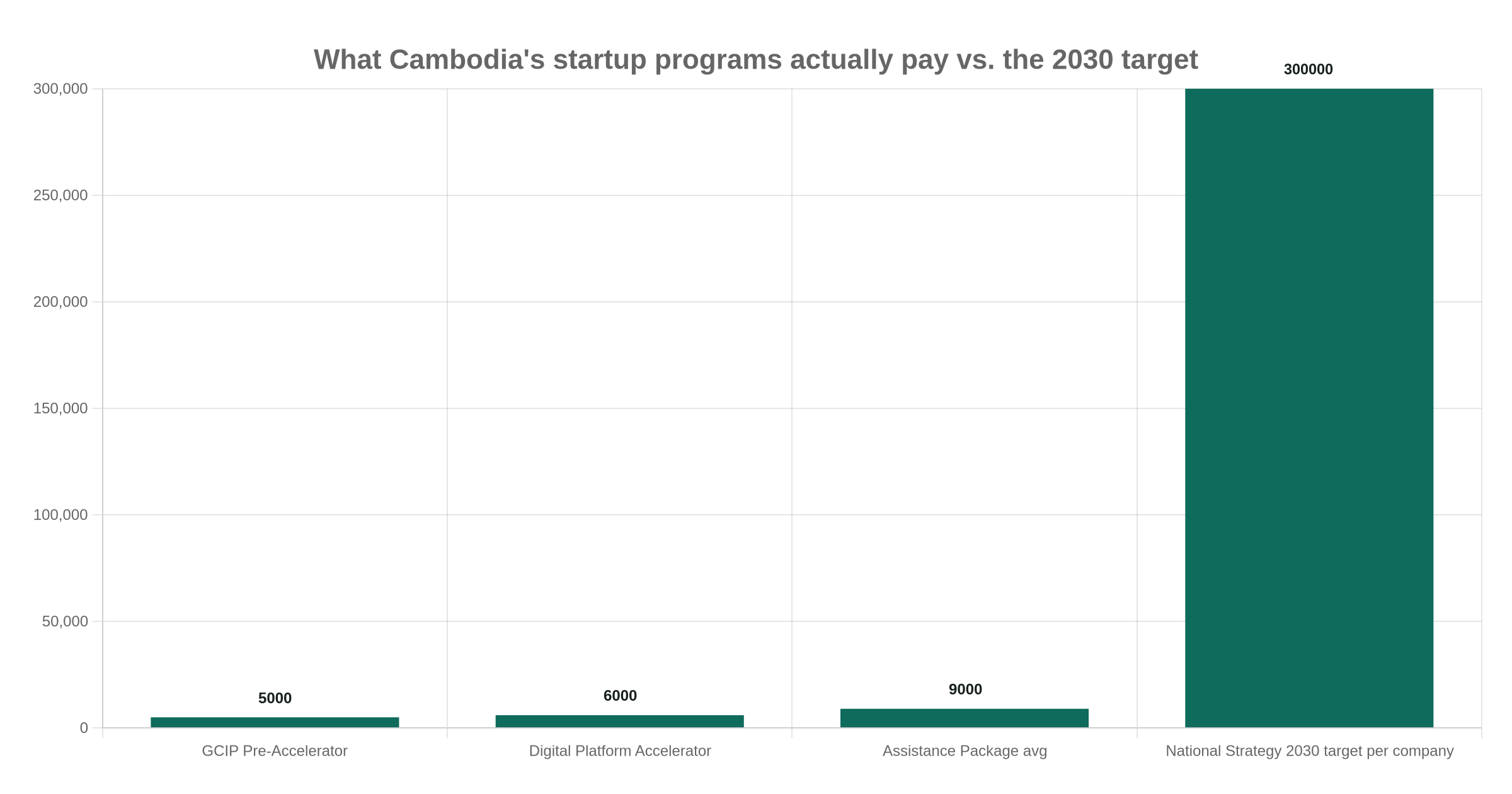
Techo Startup Center also runs the GCIP Cambodia Pre-Accelerator, aimed at university students and the public with an environmentally focused business idea, which pays up to 5,000 USD to the winner, and a related Accelerator Program for cleantech startups and SMEs built around training and mentorship rather than cash. Beyond money, the center's main asset is free or subsidized workspace in Phnom Penh, which matters more than it sounds: co-working space is one of the few real costs a pre-revenue founder can cut immediately.
The center's public face is the Startup Cambodia portal (startupcambodia.gov.kh), which lists open programs, mentors and events in one place. It is worth bookmarking before applying anywhere else, since most of the programs below feed into it.
Government grants every Cambodia startup should know about in 2026
| Program | Runs it | Typical payout | Best fit |
|---|---|---|---|
| GCIP Cambodia Pre-Accelerator | Techo Startup Center | Up to 5,000 USD | Students and idea-stage founders, cleantech angle |
| Digital Platform Accelerator | Techo Startup Center | About 6,000 USD per startup (2024 cohort: 30,000 USD split five ways) | Digital products past the idea stage |
| Assistance Package | Khmer Enterprise | 5,000 to 20,000 USD, roughly 9,000 USD on average | Registered SMEs and startups needing working capital |
| Cambodia Startup Accelerator | Khmer Enterprise and Seedstars | Mentorship and investor access, no fixed grant | Startups ready to talk to investors |
| Plug and Play Cambodia | Plug and Play Tech Center, incorporated locally in 2025 | Corporate pilots and investor matchmaking | Startups seeking a paying pilot partner |
Khmer Enterprise, the Royal Government's trust fund for entrepreneurship, is the largest single source of direct grants. Its Assistance Package has run five rounds over two years, handing out 815,000 USD to 90 grantees, an average of roughly 9,000 USD each (Cambodia Investment Review, 2022), with individual grants capped between 5,000 and 20,000 USD and a maximum one-year term. That range has held steady across the more recent rounds reported by Khmer Times.
None of these figures should surprise anyone who has priced a real build. A 9,000 USD grant covers a few weeks of a small Phnom Penh team's time, not a finished product. Programs like the Cambodia Startup Accelerator and Plug and Play Cambodia matter less for the cash and more for who they introduce a founder to next.
Where is the venture capital coming from, and who is actually getting it?
Venture capital in Cambodia comes mostly through a small number of regional funds and corporate-backed showcases, not local seed-stage VC firms writing first checks. Tracxn counts 16 venture capital funds active in the market, led by BOD Tech Ventures with 24 investments across the region (Tracxn, accessed September 2026), but most of that activity sits above the size of a typical Cambodian pre-seed round.
The clearest recent example is the Cambodia Entrepreneur Showcase, hosted in March 2026 at the Shangri-La Hotel Phnom Penh by Khmer Enterprise, 2080 Ventures and Seedstars. Nineteen entrepreneurs took part, and five were named Selected Startups of 2026: OneDash, PharmKulen, WeMoney Mobile, CheckinMe and FHF Capital PLC (Cambodia Investment Review, March 2026). OneDash was reported to be closing an investment from 2080 Ventures out of that event, which is the kind of deal that actually moves a Cambodian startup from grant money to investor money.
That path exists, but it runs through a handful of curated events a year, not through open applications. A founder aiming for it should assume the audition happens well before the showcase, in the form of a product investors can actually try.
Grants will not cover your MVP: the gap Cambodia's startups miss
Run the National Strategy's own numbers and the ambition becomes clear: 30 million USD in total investment split across 100 funded startups by 2030 averages out to 300,000 USD per company, spread over roughly five years. That is a reasonable seed-stage outcome for a company that has already shipped something. It is not a budget for building that something in the first place.
A grant or an incubator seat is a stamp of validation, not funding. None of the programs above cover the cost of building a working product, so a founder should budget for that separately from day one. Take a hypothetical, labeled as such: a Phnom Penh founder wins a 15,000 USD Khmer Enterprise grant for a KHQR-linked ordering app. At a typical Phnom Penh agency day rate for a small team, that budget covers a few weeks of build time, well short of a first paying version with payment integration and testing.
We would rather see a first-time Cambodian founder spend the first month proving the idea with a working prototype than polishing a pitch deck for a 30,000 USD pool split five ways. Grant applications are worth pursuing in parallel, never instead of the product. Teams that need to move fast on the build side without hiring a full engineering team usually look at web development in Cambodia options built for exactly this stage, and founders building around chat, data entry or support workflows increasingly reach for AI development in Cambodia to cut the headcount a first version would otherwise need.
What should a first-time Cambodia startup founder actually do first?
A first-time Cambodia startup founder should build a working version of the idea before applying anywhere, since every program above, from Techo Startup Center's cohorts to the Cambodia Entrepreneur Showcase, selects on evidence of traction over paperwork. Seventy applicants competed for five Digital Platform Accelerator slots in its 2024 cohort, and 61 competed for five slots in the 2025 cohort that followed: the deciding factor was rarely the application itself.
In practice, that means three things in order: get a working prototype in front of real users, apply to Khmer Enterprise or Techo Startup Center programs as a parallel track rather than a first step, and line up the digital marketing and dev capacity to act fast once a grant or investor conversation goes well. A Phnom Penh digital agency that has already built products under similar cost and timeline pressure tends to save a founder the two or three months usually lost to a first, wrong technical hire.
That is the gap TechFlow Agency works in with Cambodian and international founders: branding, product and development handled as one project instead of three separate hires. If a working prototype or a scoped MVP budget is the current blocker, book a call with the team, or look through our project work first to see how similar builds were scoped and priced.
Prefer to chat? Message our founder directly on Telegram (@maxgrolier), or book a call with the team.
Frequently asked questions
What is Techo Startup Center, and how is it different from Khmer Enterprise?
Techo Startup Center, founded in 2019 under the Ministry of Economy and Finance, runs incubation cohorts, mentorship and subsidized workspace for early-stage founders. Khmer Enterprise is the Royal Government's entrepreneurship trust fund, and it focuses on direct cash grants, typically 5,000 to 20,000 USD, to registered SMEs and startups. The two frequently co-run programs, such as the Cambodia Startup Accelerator with Seedstars.
How much money can a Cambodian startup realistically get from a government program?
Expect somewhere between 5,000 and 20,000 USD per program, not a full seed round. Techo Startup Center's Digital Platform Accelerator has averaged about 6,000 USD per startup across its recent cohorts, while Khmer Enterprise's Assistance Package has averaged roughly 9,000 USD per grantee across its five rounds to date.
Can a foreign-founded startup join Cambodia's national programs?
Programs like Plug and Play Cambodia and the Cambodia Startup Accelerator are built to connect outside expertise and capital with the local market, so foreign-founded teams can generally take part. Most disbursement processes still expect a registered Cambodian entity, so confirm the specific eligibility rules on each program's page before applying.
What happens after a startup finishes an incubation or accelerator program in Cambodia?
Graduates typically stay inside the same network: Techo Startup Center and Khmer Enterprise alumni get priority access to later events such as the Cambodia Entrepreneur Showcase, where Seedstars and 2080 Ventures scout for investment-ready teams. The March 2026 showcase moved at least one participant, OneDash, into an active investor conversation this way.
Is venture capital available in Cambodia, or is it mostly grants?
It is still mostly grants and corporate-backed programs at the earliest stage. Tracxn tracks 16 venture capital funds with activity touching Cambodia, but most write larger, later-stage checks across the region rather than local pre-seed rounds, which is why government grants remain the more realistic first source of outside money.
How does the National Strategy on Startup Development 2026-2030 change things for a new founder?
It sets the government's first formal five-year targets: 300 startups into incubation, 100 into funding, and 30 million USD in total investment by 2030. For a founder today, the practical change is more coordinated programming between ministries, incubators and investors, not a sudden jump in available capital.
Have a project in mind?
Book a 30 minute call to see what we can do for you.
Recommended insights

TikTok Marketing in Cambodia Needs a Funnel, Not Just Views
Cambodia's Startups Need Fewer Incubators, More First Customers
A Real Estate Website in Cambodia Should Win on Speed, Not Listings
The first 90 days with a marketing agency in Phnom Penh

Most marketing agencies in Cambodia fix the wrong bottleneck

Digital marketing in Cambodia in 2026 is won in the inbox, not the feed

What a digital marketing agency in Cambodia really costs after tax

Why one Phnom Penh digital agency beats three specialists (usually)

What 4 weeks of AI development in Phnom Penh looks like, week by week

The Khmer token tax and what AI development in Cambodia really costs

Before you buy AI in Cambodia, run a 4-criteria consulting audit

What AI agents do for a small business, and what they cost to run
Four things an AI agency in Phnom Penh should hand you

Webflow agency: how we use Webflow on SME projects

Web development Cambodia: Webflow, no-code and custom builds compared


.svg)

.svg)