

Search "IT company Cambodia" and Google returns a freelancer's Facebook post, a Phnom Penh software vendor, an international outsourcing brand, and a boutique creative agency, side by side, as if they sold the same thing. They do not. The business that calls itself an IT company in Cambodia today can mean five different operating models, and most buyers never ask which one they are looking at before they sign a contract.
That gap is not academic. The first month of a project is easy to lose to the wrong vendor type, not the wrong vendor: a software house built to run ERP implementations is a poor fit for a six-week marketing site, and a freelancer who is excellent at a three-page landing page should never be quoting a multi-year platform build. Picking well starts with knowing what you are actually buying.
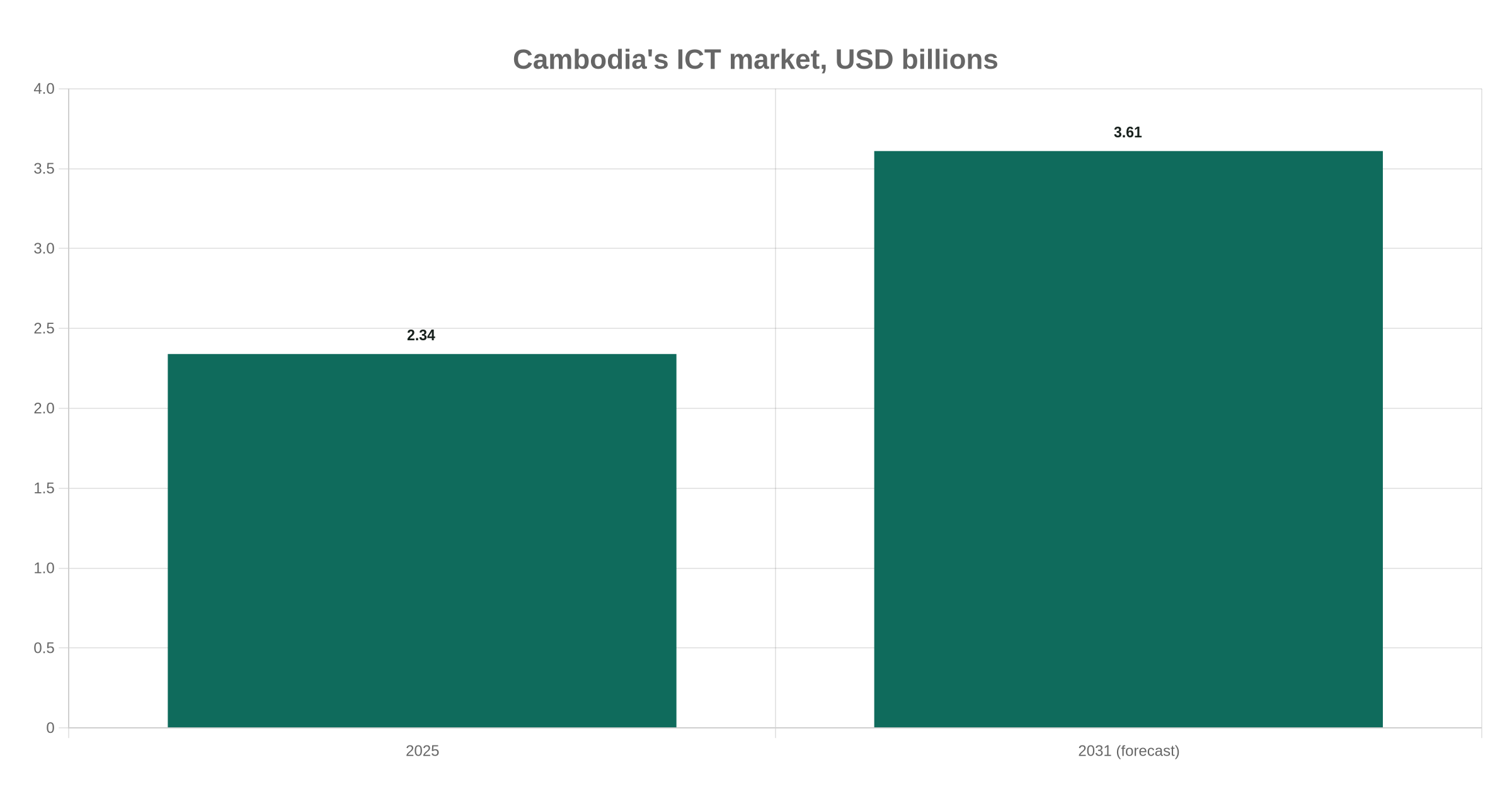
Cambodia's IT Market Is Growing Faster Than Its Talent Pool
Cambodia's ICT market is forecast to grow from 2.34 billion US dollars in 2025 to 3.61 billion by 2031, a compound annual growth rate of 7.55 percent, and IT services already make up the largest slice of that spend at 35.48 percent of 2025 revenue (Mordor Intelligence, Cambodia ICT Market report, 2026). That is a market expanding faster than the country is producing senior engineers, a dynamic that shows up across digital marketing in Cambodia too, and it shows directly in who you can actually hire.
A junior developer in Cambodia typically earns between 400 and 800 US dollars a month; someone with several years of experience or a specialised skill moves into the 1,000 to 2,000 US dollar range (WorldSalaries, Average Software Developer Salary in Cambodia, 2026). On hourly billing, Cambodia-based developers run 25 to 49 US dollars an hour on international projects (Qubit Labs, Offshore Software Development Rates by Country, 2026), against 20 to 40 US dollars in Vietnam and 18 to 35 US dollars in the Philippines (Aalpha, Offshore Software Development Hourly Rates, 2026). By those two sources, Cambodia is not reliably the cheapest option in the region; its band sits above both neighbours at the low end and above Vietnam at the high end too.
We think this is the single most under-discussed fact in how buyers price an IT company in Cambodia: "Cambodia is cheap" is an assumption, not a verified comparison, and a quote that looks 30 percent cheaper than a regional competitor is more often explained by a junior-heavy staffing mix than by a genuine country discount. That is not automatically a bad deal. It is a different deal, and it only works if the project scope matches what junior-heavy teams do well: well-specified, well-managed builds, not ambiguous, fast-changing ones.
What Does "IT Company" Actually Mean in Cambodia?
In Cambodia, "IT company" covers five genuinely different businesses, and the label does nothing to tell you which one you are dealing with.
Independent freelancers work alone or in loose two- or three-person teams, often found through Telegram channels or Facebook groups rather than a company website; the "IT Professionals of Cambodia" and "IT Job Cambodia" Facebook groups alone count well over 10,000 and 8,900 members between them, most of it informal, unregistered capacity (Facebook group listings, observed live, 2026). Boutique creative and web agencies, the category our own digital agency model fits as a Phnom Penh digital agency, pair branding and UX/UI with development and usually run four to twelve week projects. Software houses build and sell their own product, the way CLOSO (Cambodia) Co., Ltd does from Phnom Penh with its own ERP, POS, accounting and HRM software rather than custom one-off builds (CLOSO Cambodia, company profile, 2026). System integrators sell infrastructure and enterprise software deployment at a different scale again: First Cambodia, founded in 2002, now runs 190+ staff across four offices in Phnom Penh, Siem Reap, Laos and Myanmar, ISO 9001:2015 certified, serving banks, MFIs and telcos (First Cambodia, company profile, 2026). International outsourcing and consulting branches round out the list, local offices of firms like Noventiq or YCP Group that sell staff-augmentation or strategy work into the Cambodian market from a regional or global base.
None of the top search results for "IT company Cambodia" actually sorts the market this way. What ranks is a mix of listing directories and single-company profile pages, so a buyer is left comparing a freelancer's Facebook post against a 190-person system integrator's homepage with no sense that the two solve different problems.
How Many IT Companies Actually Operate in Cambodia?
Nobody publishes a clean count of IT companies operating in Cambodia, and that absence is itself useful information about how young and informal the sector still is. Directories give fragments, not a census: TechBehemoths lists Cambodia-based providers split into narrow categories, from custom software development to specific platform work, with no claim to be exhaustive and no cross-check against business registration (TechBehemoths, Cambodia company directory, 2026).
What the fragments agree on is direction, not scale. The ICT sector is adding headcount faster than universities graduate computer science students, pulling freelancers and informal two-person shops in to fill the gap. That informality cuts both ways for a buyer: more price competition at the low end, but also a real chance that a "company" a Google search surfaces is one person with a laptop and a Facebook page, not a registered business with continuity past one project.
Geography adds another layer most buyers miss. Phnom Penh holds almost all of the registered agencies, software houses and system integrators, while Siem Reap and the provinces mostly see freelancers and small teams serving tourism and hospitality clients directly. A company that lists a Phnom Penh address but staffs a project entirely with remote contractors spread across provinces is not lying to you, but it is a materially different setup from a team that works out of one office, and it is worth asking which one you are actually getting before you assume "Phnom Penh based" means "in one room together."
A Freelancer and a Software House Solve Different Problems
Put a freelancer and a software house next to each other on the same brief and the mismatch becomes obvious fast.
A freelancer is the right call for a small, well-defined job: a landing page, a content fix, a one-off integration script, something you can describe completely in a single paragraph and verify by eye once it is done. Freelancers are cheaper per hour, available faster, and carry almost no overhead, but they also carry almost no bench. If the one person gets sick, takes another contract, or disappears mid-project, which happens often enough in this market to be a real risk rather than a hypothetical one, there is no one else to call.
A software house like CLOSO is built for the opposite brief: a system that has to keep working for years, with support tickets, version upgrades and a roadmap, sold to dozens of clients running the same core product with configuration rather than custom code. That model is cheaper per feature at scale and comes with institutional memory that survives any one employee leaving. It is also the wrong fit, and usually the more expensive fit, for a one-off marketing site or a single custom build that will never be resold, because you are paying into a product business model for a service you only need once.
The honest question is not which type is better. It is which type matches how often the work will need to be redone, extended or supported after launch.
What Should You Actually Pay for IT Work in Cambodia?
A realistic budget for IT work in Cambodia starts from the hourly bands the market actually bills, not the lowest number in a proposal. Cambodia-based developers typically bill 25 to 49 US dollars an hour on outsourced projects, with the low end staffed by junior talent and the high end by senior or specialised roles (Qubit Labs, 2026). Teams scoping web development in Cambodia specifically should compare quotes against that band before comparing them against each other.
Run the numbers on a concrete example: a scoped six-week MVP, roughly two developers at 30 hours a week each, lands around 360 total billable hours. At a blended 35 US dollar hourly rate, that is approximately 12,600 US dollars in development cost before design, project management or hosting, a figure that moves up quickly if the brief needs senior-heavy staffing for integration-heavy or compliance-sensitive work.
What moves the number more than country choice is seniority mix. A team quoting 20 percent below a competitor is worth a direct question: which roles are junior, and what happens to the effective hourly rate once a senior has to step in to fix something the junior team missed. That single question surfaces more budget risk than comparing headline day rates ever does.
Ongoing cost deserves the same scrutiny as the build itself. Ask for a specific monthly retainer figure and what hours it covers, in writing, before the project starts rather than after launch when leverage has shifted to the vendor. A vendor who quotes the build cheap and leaves the retainer as "to be discussed" is usually shifting margin from the number you negotiate hardest on to the number you check least.
Why Do So Many Cambodia IT Projects Go Over Budget?
Most Cambodia IT projects go over budget for a reason that has nothing to do with country or cost: a quote with no named, dated deliverables list.
A fixed price quoted against a one-line scope such as "build a CRM system" sounds simple precisely because it hides every decision still left open. A fixed price with a real deliverables list, screens named, integrations named, a QA and testing phase on the calendar, is easy to hold a vendor to and easy to catch if underpriced. A fixed price with a vague scope gives the vendor an incentive to interpret every grey area in its own favour, because every unscoped feature becomes a change order.
The pitfall we check first, before we even look at the price line, is whether the scope document names a specific person on the client side who signs off on each milestone. A scope with no named deliverables on the vendor's side is dangerous; a scope with no named approver on the client's side is almost as dangerous, because both gaps leave room for the two sides to remember the agreement differently the moment a deadline slips. Given the choice between a harder price negotiation against a clearly named scope and approver, or a softer price against a vague one, we would take the harder negotiation every time: it is a known, one-time cost, where the vague scope is an unknown, recurring one.
One specific clause goes missing more often than any other in a Cambodia vendor contract: a written cap on revision rounds per deliverable, paired with a clear statement of who owns the source code and credentials once the final invoice is paid. Without that line, "unlimited revisions until you're happy" becomes the vendor's slowest, most expensive deliverable, and a client who never gets the repository keys has no real leverage left once the relationship turns sour.
This is, in our view, a bigger red flag than price itself. An underpriced quote with a clear deliverables list just means a hard renegotiation when the vendor runs out of runway. A vague scope at any price means the client absorbs the ambiguity project after project, and it is the single pattern we would tell a first-time buyer to screen for before signing anything.
Registration and Years in Business Tell You More Than a Portfolio
A polished portfolio website costs a few hundred dollars and can be built in a weekend; business registration and years of continuous operation cannot be faked the same way, which is why they are worth checking first.
Cambodia's Ministry of Commerce runs company registration through its online Single Portal, built on the CamDX platform, which files one application simultaneously with the Ministry of Commerce, the General Department of Taxation and the Ministry of Labour and Vocational Training. The Ministry aims to process a registration within eight to ten working days, though the full process can run two to three weeks depending on how complete the submission is (Acclime, How to Register a Company in Cambodia, 2026).

Asking for a business registration certificate is not bureaucratic box-ticking. A one-year-old studio with a strong portfolio can disappear before a second project starts; a company registered for several years, with a continuous filing history, has already survived the part of the market where most informal shops quietly stop answering messages. We would weight that history higher than portfolio size for any engagement expected to need support after launch, maintenance, an evolving platform, anything with a life past the first invoice.
How Does Cambodia's Digital Policy Push Change Who You Should Hire?
Cambodia's government has committed to a specific, funded direction for the digital economy, and it is already shaping where new supply in the IT market comes from. The Digital Economy and Society Policy Framework 2021-2035, unveiled by the Royal Government of Cambodia in June 2021, sets out 139 policy measures across three pillars: digital citizens, digital government and digital business (Royal Government of Cambodia, Digital Economy and Society Policy Framework 2021-2035).
That policy push has one concrete, practical effect for a buyer: expect more newer, policy-funded and accelerator-backed shops entering the market without a multi-year track record, and treat their pitch differently from an established vendor's pitch. The Techo Startup Center, the government's main vehicle for turning that framework into funded companies, had disbursed roughly 369,000 US dollars in financial assistance to 179 businesses as of mid-2026 (Khmer Times, October 2026), and the national startup count rose to 235 tracked ventures in 2025, per the Startup Cambodia Insight 2025 report jointly published by Techo Startup Center and Startup Cambodia (as reported by Kiripost, Cambodia's Startup Ecosystem Grows to 235 Ventures, 2025). That pipeline is also climbing in StartupBlink's global startup ecosystem ranking over the same period, a trend we have also covered in how Cambodia startup ecosystem founders typically choose a first technical hire (StartupBlink, Cambodia Startup Ecosystem, 2026).
For a shop that young, do not expect the multi-year history a system integrator like First Cambodia can show, and do not score it against that bar. Ask instead for three things a one- or two-year-old, accelerator-backed team can actually prove: a named senior lead with provable prior experience elsewhere, at least one completed project whose client you can call directly, and a funding or accelerator relationship you can verify with the funder rather than take on the strength of the pitch deck. A young team that can produce those three is often a sharper, hungrier option than an established vendor charging for its history; a young team that cannot is simply unproven, whatever the deck claims.
None of this changes what an established IT company looks like today. It does mean the newer end of the market needs a different checklist, not a lower bar.
What Should You Check Before You Sign?
Before signing with any IT company in Cambodia, confirm four things in writing: which of the five operating models you are actually hiring, a freelancer, boutique agency, software house, system integrator, or outsourcing branch; a deliverables list with named screens and integrations rather than a one-line scope; a business registration certificate and how long it has been active; and who, specifically and by name, will be doing the senior-level work.
We run our own projects against a documented six-step process, scoping and audit, technical recommendations, design and prototype, sprint-based development, testing and go-live, post-launch follow-up, with a named deliverable at every step, so a client can ask at any stage which step we are on.
Not every vendor needs that exact process, but every vendor should be able to name theirs with the same specificity. One that cannot describe more than two or three steps between "we start" and "we deliver" has probably not run enough projects to have standardised one.
Our own view: the label on the website matters far less than whether the vendor can answer those four questions without rephrasing the pitch deck.
Before you hire, run this checklist this week:
- Ask which of the five operating models (freelancer, boutique agency, software house, system integrator, outsourcing branch) you are actually talking to.
- Request a deliverables list with named screens, integrations and a QA phase, not a one-line scope.
- Ask for a business registration certificate and how many years the company has been continuously active.
- Ask who, by name, does the senior-level work, and what happens if that person leaves mid-project.
- Price the quote against Cambodia's 25 to 49 US dollar hourly band and ask which end of it your team is staffed from.
See how we structure engagements across our IT services overview, or go straight to the two steps that matter here: our development team in Phnom Penh reviews scopes for exactly this kind of mismatch, and you can request a scoped estimate before you sign anything.
Prefer to chat? Message our founder directly on Telegram (@maxgrolier), or book a call with the team.
Frequently Asked Questions
Is it cheaper to hire an IT company in Cambodia than one abroad?
Not automatically. Cambodia-based developers typically bill 25 to 49 US dollars an hour (Qubit Labs, 2026), against 20 to 40 US dollars in Vietnam and 18 to 35 US dollars in the Philippines (Aalpha, 2026), bands that sit at or below Cambodia's, not above it. Price the seniority mix your quote is staffed from, not the country label, before assuming Cambodia is the cheaper option for your specific project.
Should I hire a freelancer or an agency for a small project?
For a small, fully specified job, a freelancer. For anything that needs support after launch, a bench to fall back on if one person is unavailable, or a multi-month build, an agency or software house carries less risk. Weigh the cost of the work stopping entirely if a solo freelancer becomes unavailable against the premium an agency charges for that redundancy.
How long does it take to find a reliable IT company in Cambodia?
Expect one to three weeks if you do it properly: shortlisting three to five vendors by operating model, requesting a deliverables list and a business registration certificate from each, and comparing like for like. Rushing this step is the most common reason buyers end up signing with whichever vendor replied fastest rather than whichever vendor fit the brief.
What is the difference between a system integrator and a software development company?
A system integrator like First Cambodia deploys and connects infrastructure and enterprise software, often third-party platforms, at a scale built for banks, telcos and large organisations. A software development company builds custom applications or its own product from scratch. The two overlap on large projects but rarely compete for the same brief.
Do I need to work with a company physically based in Phnom Penh?
No, but it changes what you are trading off. A Phnom Penh-based team can meet in person, works in the same time zone, and understands local payment, messaging and regulatory context directly. An offshore or remote vendor can still deliver well if the brief is fully specified, but it is a weaker fit for ambiguous, fast-changing scopes that benefit from being in the room. Browse our project work to see how we scope and run projects from Phnom Penh.